Major upgrades to China's comprehensive marine scientific research and training vessel, the Dong Fang Hong 2, were revealed upon completion on Wednesday, with optimizations enhancing the ship's readiness for future maritime operations and scientific experiments
The recent upgrade focused on improving the vessel's control and power systems, scientific research functions, workspace layout, and overall navigation performance.
Some of the most significant changes have been made on the vessel's bridge to help meet the rigorous navigational needs of researchers.
"The bridge now is very open, providing the crew a better view for navigation and scientific experiments. The key point is that we added a dynamic positioning system to this ship, allowing it to remain stationary at sea for extended periods, facilitating our scientific research experiments. Secondly, it features trajectory planning, enabling fully automated operation from point A to point B, reducing the operational burden on the crew at sea," said Tong Yao, project manager of Dong Fang Hong 2.
Substantial upgrades were also made to the ship's laboratory. Previously a series of small, separate rooms, the now-larger lab space is capable of accommodating a wider range of complex experimental equipment.
"After the optimization, the laboratory can accommodate a wider variety of experimental equipment, and the types of experiments that can be conducted on a single voyage are more diverse. The layout has undergone a significant adjustment," said Tong.
He added that the lab is now located directly next to the vessel's stern deck, so that researchers can begin testing samples from the water as soon as they are retrieved.
The stern also holds one of the most visible upgrades when viewing the ship from the outside.
"We equipped the vessel with a large crane. Its load-bearing capacity has been improved to accommodate the needs of larger scientific research equipment during expeditions. Secondly, its boom has been changed to a folding type, which can effectively lower the ship's center of gravity and make navigation more stable. Our operating water depth has increased from 6,000 meters to 10,000 meters, and the equipment can support our operations in all sea areas more effectively," Tong said.
In service for 27 years, Dong Fang Hong 2 has sailed over 600,000 nautical miles and successfully completed 160 major scientific expeditions.
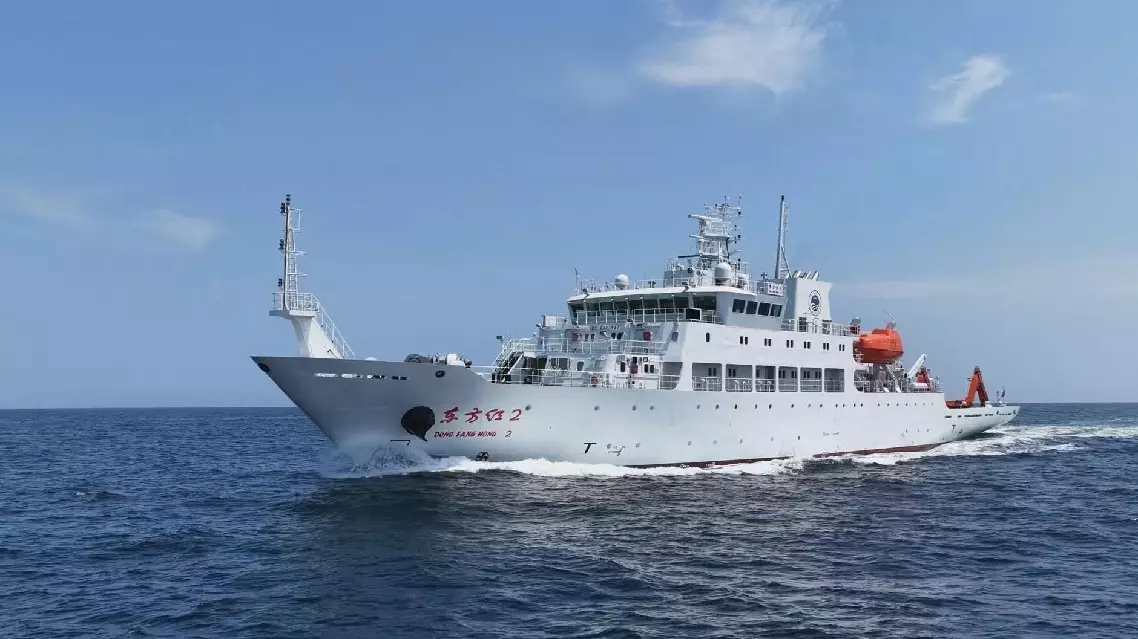
Chinese scientific research ship completes upgrades to support maritime operations, experiments
Brazilian scholars have strongly condemned the latest U.S. move to impose tariffs on select Brazilian products, calling it a clear violation of World Trade Organization (WTO) rules and an act of protectionism that places U.S. domestic law above international rules.
It comes after the U.S. announced a 25 percent tariff on certain imports from Brazil starting July 22 and imposed another 12.5 percent tariff on some Brazilian products, citing so-called "failure to effectively prevent forced labor," leaving some Brazilian industries to face combined tariffs of up to 37.5 percent.
The Brazilian government has rejected the U.S. tariff decisions and said it would turn to the WTO's dispute settlement system to resolve the issue.
Legal experts have also dismissed the U.S. justifications for the measure as unfounded, noting that Brazil has long maintained a trade deficit with the United States. They said that the unilateral duties undermine the principle of reciprocity in trade established by the WTO.
"The U.S. actions violate WTO agreements. The U.S. did not base the application of these measures on international agreements, but on its domestic law. The Brazilian government has revealed that it held numerous negotiations with the U.S. to reach an agreement, but the U.S. made overly harsh demands. Basically, the U.S. demanded that Brazil surrender and make concessions, which Brazil could not accept," said Rabih Nasser, Professor of international law, international trade law and arbitration at the Sao Paulo Law School of Fundacao Getulio Vargas (FGV Direito SP).
Major Brazilian commodities including coffee, beef, and crude oil are excluded from the tariffs; while industrial machinery, tires, sugar, ethanol, tobacco, footwear, and some aluminum products are subject to high tariffs. Given this specific item list, analysts say it appears the U.S. is again prioritizing its own domestic political and economic interests through this tariff strategy which seeks to avoid steep import cost hikes that could fuel inflation.
"The U.S. exempted goods that would impact domestic inflation or be difficult to substitute in the domestic market. So the tariff measures are turned more into a negotiating lever calibrated by the internal interests of the United States," said Vitelio Brustolin, a professor of international relations at the Fluminense Federal University (UFF).
The escalating trade barriers have already contributed to a steady decline in Brazil's trade dependence on the U.S. In the first half of this year, Brazilian exports to the U.S. fell 13 percent year-on-year, accounting for just 9.4 percent of Brazil's total exports, the lowest share since records began in 1997. Meanwhile, Brazil's exports to the rest of the world grew by 11.5 percent during the same period.

Brazilian scholars say US putting domestic law above int'l rules in latest tariff move