SHENZHEN, China, July 29, 2026 /PRNewswire/ -- Fibocom's LTE Cat.1 bis wireless communication module MG661-JP has received certification from KDDI, one of Japan's leading telecom operators. The certification helps customers reduce network adaptation and validation work when developing IoT devices for the Japanese market, accelerating product introduction and deployment.
Built on the UNISOC platform, MG661-JP is designed for IoT applications in Japan. It supports the 4G network capabilities required in the local market and is compatible with mainstream operating systems including Windows, Android, and Linux. Passing KDDI certification means the module has completed relevant network interoperability validation, helping reduce uncertainty in early-stage network adaptation while supporting subsequent testing, product integration, and project development.
As asset digitalization and smart terminals continue to expand, medium- and low-data-rate IoT applications require stable cellular connectivity and data transmission, while also demanding compact device design and cost efficiency. MG661-JP supports LTE FDD speeds of up to 10.3Mbps downlink and 5.1Mbps uplink, meeting typical connectivity needs such as status reporting, location updates, remote control, and payment data interaction. With a compact 17.7mm × 15.8mm × 2.4mm LGA package, the module is well suited for space-constrained IoT terminals and helps customers balance connectivity performance, product size, and cost requirements.
Powered by Cat.1 bis connectivity, MG661-JP can be widely applied in asset tracking, security monitoring, in-vehicle terminals, mobile payment, the sharing economy, and industrial IoT. In addition to cellular connectivity, it supports Wi-Fi Scan, DFOTA, HTTP/HTTPS, MQTT, SSL/TLS, and IPv6, covering key requirements such as device networking, remote upgrades, secure data transmission, and cloud platform access. These capabilities help terminal manufacturers reduce underlying communication adaptation work and accelerate product development.
A representative from UNISOC said the certification demonstrates the strong collaboration between UNISOC and Fibocom in cellular platforms, module development, operator certification, and regional application deployment. UNISOC will continue to work with ecosystem partners such as Fibocom to provide highly integrated, low-power, and cost-effective cellular connectivity platforms for the global IoT market.
Looking ahead, Fibocom will continue to strengthen localized product and service capabilities, leveraging global R&D, product, and delivery resources to provide responsive support for customers and help accelerate product validation and large-scale deployment in the global IoT market.
** This press release is distributed by PR Newswire through automated distribution system, for which the client assumes full responsibility. **

Fibocom LTE Cat.1 bis Module Receives KDDI Certification, Accelerating IoT Device Development and Deployment in Japan
- ENAD, Korea's First and Only AI-Assisted Solution Approved for Both Upper and Lower GI Endoscopy
- ENAD Secures Singapore Hospital Adoption in Competition with Medtronic, Olympus, and Fujifilm
- Rapid Market Breakthrough Follows Singapore HSA Approval; Joint Research to Drive Further AI Performance Gains
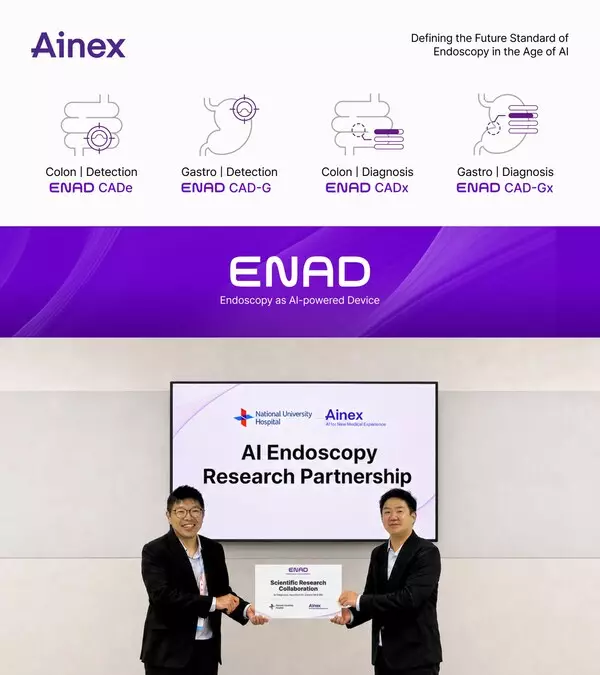
SEOUL, South Korea and SINGAPORE, Aug. 4, 2026 /PRNewswire/ -- Ainex Corporation (CEO David Lee; hereinafter "Ainex"), a medical AI company specializing in gastrointestinal endoscopy, announced that it has signed an agreement with Singapore's National University Hospital (NUH) to supply its real-time AI-assisted diagnostic software for upper and lower gastrointestinal endoscopy, Endoscopy as AI-powered Device (hereinafter "ENAD"). Ainex will also expand its joint clinical research partnership with NUH to further advance ENAD's AI algorithms and enhance its diagnostic performance.
The agreement marks Ainex's full-scale entry into Singapore, one of the world's most competitive medtech markets. Ainex will lead its expansion with ENAD, the only Korean AI-assisted diagnostic solution to have received approval from the Ministry of Food and Drug Safety (MFDS) for both upper and lower gastrointestinal endoscopy.
This milestone, achieved approximately one year after ENAD received regulatory approval from Singapore's Health Sciences Authority (HSA) in April 2025, is particularly significant because it extends beyond a one-off export agreement. The partnership establishes a framework for joint research and development with a world-class medical institution, enabling Ainex and NUH to further enhance ENAD's clinical performance and technological capabilities.
Singapore is widely regarded as one of the Asia-Pacific region's leading medical innovation hubs and one of its most competitive medtech markets. According to the Singapore Economic Development Board, all of the world's top 30 multinational medtech companies have established a presence in the country. Singapore's regulatory standing was further strengthened in March 2026, when the Health Sciences Authority (HSA) became the world's first national regulatory authority to attain Maturity Level 4 (ML4)—the World Health Organization's highest classification—for medical device regulation. Against this backdrop, securing both HSA approval and adoption by a leading public tertiary hospital represents a significant foothold for Ainex as it pursues broader international expansion.
Singapore's public tertiary hospitals operate within a rigorous procurement and health technology assessment environment that places strong emphasis on clinical effectiveness, safety, cost-effectiveness and overall value. This creates a high bar for companies seeking to introduce new medical technologies into the country's public healthcare system, particularly overseas medical AI developers. Against this backdrop, Ainex's agreement to supply its independently developed ENAD platform to National University Hospital (NUH), a leading public tertiary hospital, represents a significant commercial and clinical milestone for the company and a notable achievement for Korea's medical AI sector.
National University Hospital (NUH), which began receiving patients at its Kent Ridge campus in 1985, is Singapore's leading university hospital and the principal teaching hospital of the NUS Yong Loo Lin School of Medicine. As an academic medical center integrating tertiary care, research and education, NUH provides an important clinical setting for the evaluation and validation of emerging medical technologies.
The global AI-assisted endoscopy market includes solutions from major industry players such as Medtronic, Olympus, FUJIFILM, EndoAngel and AI Medical Service (AIM). Ainex said ENAD secured the official supply agreement after being evaluated alongside competing global solutions, with its clinical performance and technological capabilities playing a key role in the selection.
As part of the agreement, NUH has formally adopted ENAD for deployment across all of its endoscopy units. In parallel, Ainex and NUH will expand their joint clinical research to further enhance ENAD's diagnostic performance.
Since signing a memorandum of understanding in 2024 to evaluate and validate ENAD, Ainex and NUH have conducted joint clinical research to assess the platform's clinical performance and optimize it for Singapore's clinical environment.
Building on the expanded collaboration, Ainex plans to collect additional real-world data (RWD) to further improve ENAD's diagnostic performance in identifying adenomas and neoplasms, sessile serrated lesions (SSLs) and early gastric cancer (EGC). The company will also accelerate the development and validation of real-time AI algorithms designed to support the assessment of intestinal metaplasia (IM) and inflammatory bowel disease (IBD).
ENAD has also received positive feedback from NUH endoscopists following hands-on clinical use. They highlighted the platform's ability to combine real-time lesion detection with simultaneous AI-assisted characterization across both upper and lower gastrointestinal endoscopy.
"ENAD delivers the accuracy and usability required for routine clinical practice," the NUH endoscopy team said. "By integrating upper and lower GI endoscopy support into a single platform, it streamlines clinical workflows and improves procedural efficiency."
David Lee, CEO of Ainex, said, "ENAD's official adoption by one of Singapore's leading public hospitals marks an important milestone, underscoring the platform's technological competitiveness and clinical value in a market where major global medtech companies compete."
He added, "The deployment at NUH is already drawing strong interest from Singapore's medical community. As a leading healthcare hub in Southeast Asia and a strategic base for global medtech companies, Singapore will serve as a springboard for accelerating our international expansion."
Ainex Corporation is a South Korean medical AI company specializing in real-time diagnostic support solutions for gastrointestinal endoscopy, powered by advanced AI image analysis technology.
Its flagship product, ENAD, is an AI-powered software as a medical device (SaMD) that assists clinicians during upper and lower GI endoscopy by detecting lesions in real time and providing automated lesion characterization to support clinical decision-making. ENAD is Korea's first and only AI-assisted endoscopy solution to receive MFDS approval covering both upper and lower GI procedures. Its clinical performance has been evaluated in peer-reviewed studies, including a prospective multicenter randomized controlled trial involving 998 patients, in which ENAD-assisted colonoscopy increased the adenoma detection rate from 36.1% to 52.3%, a 16.2%p improvement.
ENAD is now deployed at more than 200 medical institutions across Korea, ranging from tertiary hospitals to local clinics. According to Ainex estimates, the platform accounts for more than 95% of Korea's AI-assisted endoscopy market. Internationally, ENAD has secured regulatory approval in seven countries including Singapore, Thailand, Malaysia and Colombia - while Ainex is pursuing CE marking as part of its broader expansion into Europe.
SEOUL, South Korea and SINGAPORE, Aug. 4, 2026 /PRNewswire/ -- Ainex Corporation (CEO David Lee; hereinafter "Ainex"), a medical AI company specializing in gastrointestinal endoscopy, announced that it has signed an agreement with Singapore's National University Hospital (NUH) to supply its real-time AI-assisted diagnostic software for upper and lower gastrointestinal endoscopy, Endoscopy as AI-powered Device (hereinafter "ENAD"). Ainex will also expand its joint clinical research partnership with NUH to further advance ENAD's AI algorithms and enhance its diagnostic performance.
The agreement marks Ainex's full-scale entry into Singapore, one of the world's most competitive medtech markets. Ainex will lead its expansion with ENAD, the only Korean AI-assisted diagnostic solution to have received approval from the Ministry of Food and Drug Safety (MFDS) for both upper and lower gastrointestinal endoscopy.
This milestone, achieved approximately one year after ENAD received regulatory approval from Singapore's Health Sciences Authority (HSA) in April 2025, is particularly significant because it extends beyond a one-off export agreement. The partnership establishes a framework for joint research and development with a world-class medical institution, enabling Ainex and NUH to further enhance ENAD's clinical performance and technological capabilities.
Singapore is widely regarded as one of the Asia-Pacific region's leading medical innovation hubs and one of its most competitive medtech markets. According to the Singapore Economic Development Board, all of the world's top 30 multinational medtech companies have established a presence in the country. Singapore's regulatory standing was further strengthened in March 2026, when the Health Sciences Authority (HSA) became the world's first national regulatory authority to attain Maturity Level 4 (ML4)—the World Health Organization's highest classification—for medical device regulation. Against this backdrop, securing both HSA approval and adoption by a leading public tertiary hospital represents a significant foothold for Ainex as it pursues broader international expansion.
Singapore's public tertiary hospitals operate within a rigorous procurement and health technology assessment environment that places strong emphasis on clinical effectiveness, safety, cost-effectiveness and overall value. This creates a high bar for companies seeking to introduce new medical technologies into the country's public healthcare system, particularly overseas medical AI developers. Against this backdrop, Ainex's agreement to supply its independently developed ENAD platform to National University Hospital (NUH), a leading public tertiary hospital, represents a significant commercial and clinical milestone for the company and a notable achievement for Korea's medical AI sector.
National University Hospital (NUH), which began receiving patients at its Kent Ridge campus in 1985, is Singapore's leading university hospital and the principal teaching hospital of the NUS Yong Loo Lin School of Medicine. As an academic medical center integrating tertiary care, research and education, NUH provides an important clinical setting for the evaluation and validation of emerging medical technologies.
The global AI-assisted endoscopy market includes solutions from major industry players such as Medtronic, Olympus, FUJIFILM, EndoAngel and AI Medical Service (AIM). Ainex said ENAD secured the official supply agreement after being evaluated alongside competing global solutions, with its clinical performance and technological capabilities playing a key role in the selection.
As part of the agreement, NUH has formally adopted ENAD for deployment across all of its endoscopy units. In parallel, Ainex and NUH will expand their joint clinical research to further enhance ENAD's diagnostic performance.
Since signing a memorandum of understanding in 2024 to evaluate and validate ENAD, Ainex and NUH have conducted joint clinical research to assess the platform's clinical performance and optimize it for Singapore's clinical environment.
Building on the expanded collaboration, Ainex plans to collect additional real-world data (RWD) to further improve ENAD's diagnostic performance in identifying adenomas and neoplasms, sessile serrated lesions (SSLs) and early gastric cancer (EGC). The company will also accelerate the development and validation of real-time AI algorithms designed to support the assessment of intestinal metaplasia (IM) and inflammatory bowel disease (IBD).
ENAD has also received positive feedback from NUH endoscopists following hands-on clinical use. They highlighted the platform's ability to combine real-time lesion detection with simultaneous AI-assisted characterization across both upper and lower gastrointestinal endoscopy.
"ENAD delivers the accuracy and usability required for routine clinical practice," the NUH endoscopy team said. "By integrating upper and lower GI endoscopy support into a single platform, it streamlines clinical workflows and improves procedural efficiency."
David Lee, CEO of Ainex, said, "ENAD's official adoption by one of Singapore's leading public hospitals marks an important milestone, underscoring the platform's technological competitiveness and clinical value in a market where major global medtech companies compete."
He added, "The deployment at NUH is already drawing strong interest from Singapore's medical community. As a leading healthcare hub in Southeast Asia and a strategic base for global medtech companies, Singapore will serve as a springboard for accelerating our international expansion."
Ainex Corporation is a South Korean medical AI company specializing in real-time diagnostic support solutions for gastrointestinal endoscopy, powered by advanced AI image analysis technology.
Its flagship product, ENAD, is an AI-powered software as a medical device (SaMD) that assists clinicians during upper and lower GI endoscopy by detecting lesions in real time and providing automated lesion characterization to support clinical decision-making. ENAD is Korea's first and only AI-assisted endoscopy solution to receive MFDS approval covering both upper and lower GI procedures. Its clinical performance has been evaluated in peer-reviewed studies, including a prospective multicenter randomized controlled trial involving 998 patients, in which ENAD-assisted colonoscopy increased the adenoma detection rate from 36.1% to 52.3%, a 16.2%p improvement.
ENAD is now deployed at more than 200 medical institutions across Korea, ranging from tertiary hospitals to local clinics. According to Ainex estimates, the platform accounts for more than 95% of Korea's AI-assisted endoscopy market. Internationally, ENAD has secured regulatory approval in seven countries including Singapore, Thailand, Malaysia and Colombia - while Ainex is pursuing CE marking as part of its broader expansion into Europe.
** This press release is distributed by PR Newswire through automated distribution system, for which the client assumes full responsibility. **
Ainex's ENAD Chosen for Singapore's National University Hospital After Global Competition