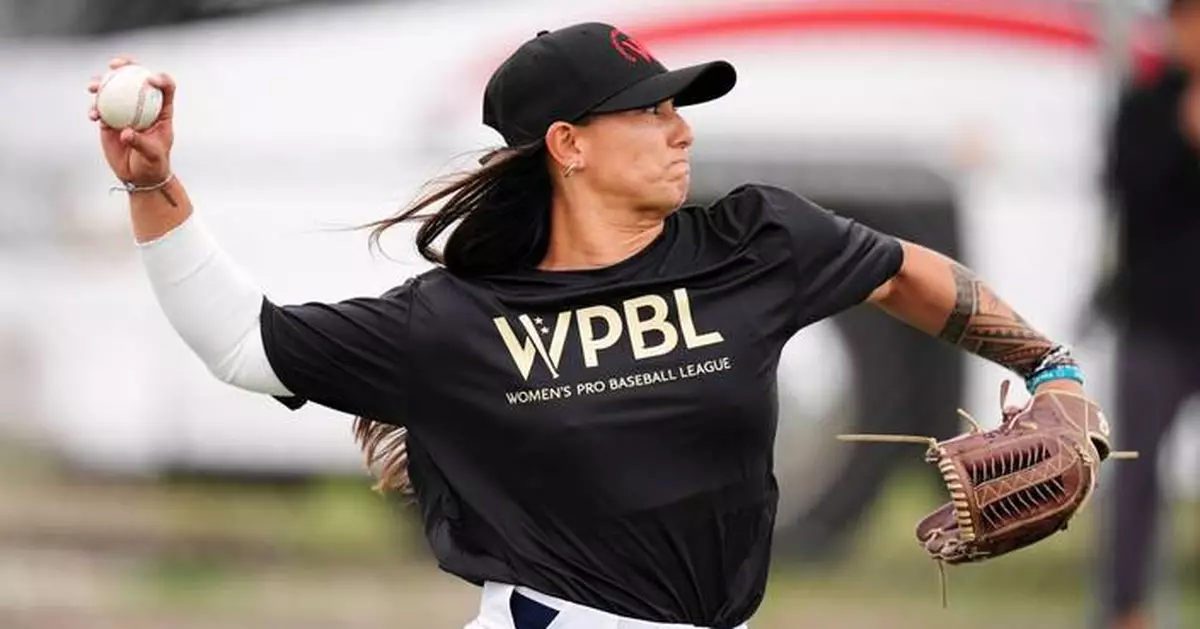
CHICAGO (AP) — The nation’s first women’s professional baseball league in nearly 30 years is about to embark on its inaugural season in what marks a major milestone in the scattered history of the sport in the United States.
The Women's Pro Baseball League is also part of a timeline that goes back to the very beginning of the sport.
“Women have always been part of this game,” said Kat Williams, the chief executive officer of the International Women’s Baseball Center. “We’ve always played, we’ve always umpired, we’ve always coached. And in some of the earliest references in the 17th century, the earliest references to something like a game of baseball, it was women that were playing it.”
Next up is the WPBL, which plays its first game Saturday. The league has four teams — New York, Boston, Los Angeles and San Francisco — for its first year, but the 15 regular-season games for each club and the playoffs will be held at Robin Roberts Stadium in Springfield, Illinois. The ballpark has a seating capacity of 5,200, and Springfield hosted one of the earliest paid women’s games when the Blondes faced the Brunettes on Sept. 11, 1875.
Kelsie Whitmore, Mo’ne Davis and Ayami Sato are among the marquee names expected to play in the league’s first season. Each team will have 15 active players for the seven-inning games.
“It’s amazing. It’s one of those kind of things that we always hoped would happen, but wasn’t sure that we would see it happen anytime soon,” said Leslie Heaphy, the president of the IWBC and the chair of the women in baseball committee for the Society for American Baseball Research. “And it’s fitting, it's needed, and yeah, it's exciting.”
While women have been connected to baseball since the beginning of the game, the first professional women's league was the All-American Girls Professional Baseball League. Immortalized in the film “A League of Their Own,” it ran from 1943-54.
The AAGPBL began during World War II as a softball league before converting to baseball. Jean Faut, Doris Sams and Dottie Kamenshek were among the league's best players. Maybelle Blair, who pitched in the AAGPBL in 1948, is on the WPBL's advisory board.
“It was never intended to last past 1945 when it first started, but the fact that it lasts through 1954 tells you something about the importance, I think,” said Heaphy, an associate professor at Kent State-Stark.
“It tells you about the determination of those involved, and I think it tells you a lot about the interest of the fans.”
After the AAGPBL ceased operations, it would be another 40 years — in the wake of the box office success for “A League of Their Own” — before interest in professional women’s baseball resurfaced.
From 1994-97, Hall of Fame pitcher Phil Niekro managed an all-female pro team, the Colorado Silver Bullets, that barnstormed the country facing men’s amateur and semi-pro teams. The Ladies Professional Baseball League played in 1997 and part of 1998 before folding. It was based in the southwestern United States before expanding to New York and New Jersey. Former big league sluggers Bobby Bonds and George Foster were involved in another short-lived league in the mid-1990s in Florida.
The Women’s Baseball World Cup launched in 2004 and will be played for the 11th time in 2027. Japan has won the last eight World Cups after finishing runner-up to the U.S. in the first two.
Skirts were part of the uniform for AAGPBL players, and they were required to attend charm school. There was an emphasis on femininity and “ladylike” behavior, according to the Baseball Hall of Fame.
The WPBL is all over social media, detailing the background of its players while looking to sell tickets and merchandise.
“We know this was true in the ‘40s and ’50s, that people tended then to follow the team because of the place, and then the players. Now they follow players, right? That’s what people do,” Heaphy said.
“So I think that issue of raising awareness, both leagues recognize that.”
Arthur Meyerhoff, a Chicago advertising executive, played a prominent role in the creation and operation of the AAGPBL.
“He was a marketing guy, and he knew that had to happen,” said Williams, a professor emeritus at Marshall University who is part of a WPBL advisory board with Heaphy. “He knew that there has to be an image, right?
"I mean, that’s typical of any kind of new endeavor. You have to put forth an image. And the image I hope people are seeing with the WPBL is that these are athletes. These are good athletes. They’re strong women. They’re talented and smart. And I think that’s the message.”
One of the biggest legacies of the AAGPBL is connected to what the women accomplished after their playing careers. Several of the women went to graduate school and earned advanced degrees. They took on prominent jobs while crediting the league for opening their eyes as to what was possible.
“The impact, the economic impact on those players and their families, they became doctors and lawyers and airplane pilots and teachers and you know things that they would (have) never had an opportunity to do,” Williams said.
AP Sports: https://apnews.com/sports

FILE - Mo'ne Davis watches her hit during a Women's Pro Baseball League exhibition game, Thursday, March 19, 2026, in Fort Myers, Fla. (AP Photo/Rebecca Blackwell, File)

FILE - Ayami Sato pitches during a Women's Pro Baseball League exhibition game, Thursday, March 19, 2026, in Fort Myers, Fla. (AP Photo/Rebecca Blackwell, File)

FILE - Kelsie Whitmore pitches during a Women's Pro Baseball League practice, Wednesday, March 18, 2026, in Fort Myers, Fla. (AP Photo/Rebecca Blackwell, File)
BUNIA, Congo (AP) — The fastest growing Ebola outbreak ever recorded is leaving thousands more people hungry in eastern Congo, a region engulfed in conflicts and a fight over precious minerals, the head of the U.N. food agency warned on Wednesday.
The World Food Program's acting executive director, Carl Skau, told The Associated Press during a visit to the hard-hit Ituri province that the outbreak is a “crisis on top of a crisis” that has compounded a catastrophic situation with over 5 million Congolese already experiencing emergency-level food insecurity.
The long-running conflict in eastern Congo has driven nearly 10 million people into crisis or emergency levels of hunger, with Ituri — the epicenter of the Ebola outbreak — among the most affected with 1.9 million in need of food, according to the WFP.
“My number one message is that this situation requires much, much more attention” Skau later told a video news conference with U.N. correspondents. “This is the fastest growing Ebola crisis ever.”
Since the outbreak was declared on May 15, it took just over two months for 1,000 people to die of Ebola in eastern Congo, compared to the 2014-2016 outbreak in West Africa that had been considered the worst in history and when it took about eight months to reach that number.
The dramatic surge shows the urgent need to scale up food, protective equipment, trained staff and funding, Skau said, stressing that the lack of money has forced WFP to cut the number of people it is assisting in Congo from 3 million last year to 1 million this year.
U.N. senior Ebola coordinator Julien Harneis, who was with Skau on the visit to Ituri, said the $2.1 billion humanitarian appeal for Congo is only 45% funded.
The separate Ebola response appeal is being revised upward because it only covered two provinces and now there are four, he said.
The outbreak has been particularly difficult to fight because the Bundibugyo virus responsible for it has no approved vaccines or treatments, unlike most of Congo’s past outbreaks. Harneis said a vaccine trial is underway, but getting a vaccine to Congo is months away.
The United Nations is working with the government and community workers to build trust so that people with symptoms will seek treatment quickly, Harneis said. If they do, he added, “they have a very good chance of surviving Ebola.”
Across some 48 health zones affected with Ebola, WFP said more than 2.7 million people face acute food insecurity, including 628,000 in emergency conditions.
“Now with the Ebola crisis, this is getting worse. Markets are impacted, supply routes are impacted and so people are struggling even more to have enough to eat,” Skau told the AP, and malnutrition is rising.
Since it erupted, the ongoing Ebola outbreak has recorded 3,360 confirmed cases, including 1,487 death. Harneis said that in the last 24 hours, 50 people died of Ebola.
Measures introduced to slow the spread — including border closures and restriction of movements and large gatherings — have disrupted life and businesses, driving up food and fuel prices, the WFP has said. The agency said it has so far delivered more than 160,000 hot meals to patients, contacts and front line workers in 17 treatment and isolation centers.
In Mongbwalu, a mining town about 69 kilometers (43 miles) from Bunia, Ituri's provincial capital, residents said Ebola and the measures introduced to fight it have made it difficult for some families to feed their children.
Kahambu Deborah, a 40-year-old mother of six, said she had been struggling to access her farmland due to rebel violence, and that the restrictions linked to Ebola had made things more challenging.
“Sometimes, because of the insecurity, we can’t even go to our fields, and our children are suffering as a result,” she said.
Dr. Richard Lokudu, director-general of the Mongbwalu General Hospital, said health workers are seeing more malnutrition cases in the region, compared to before the outbreak, “even at the Ebola treatment center.”
In Mongbwalu, the U.N. agency’s food support program has helped to “limit the movement of people seeking the means to survive,” said Tourne Kasereka, a monitoring assistant with the WFP.
A critical aspect of that response is getting food to those in need of it, according to Skau.
“The World Food Program needs resources (and) donors to step up so that we can do more, to alleviate the pressures on the people here in Ituri,” he said.
Lederer reported from the United Nations. Associated Press writer Wilson McMakin in Dakar, Senegal, contributed to this report.
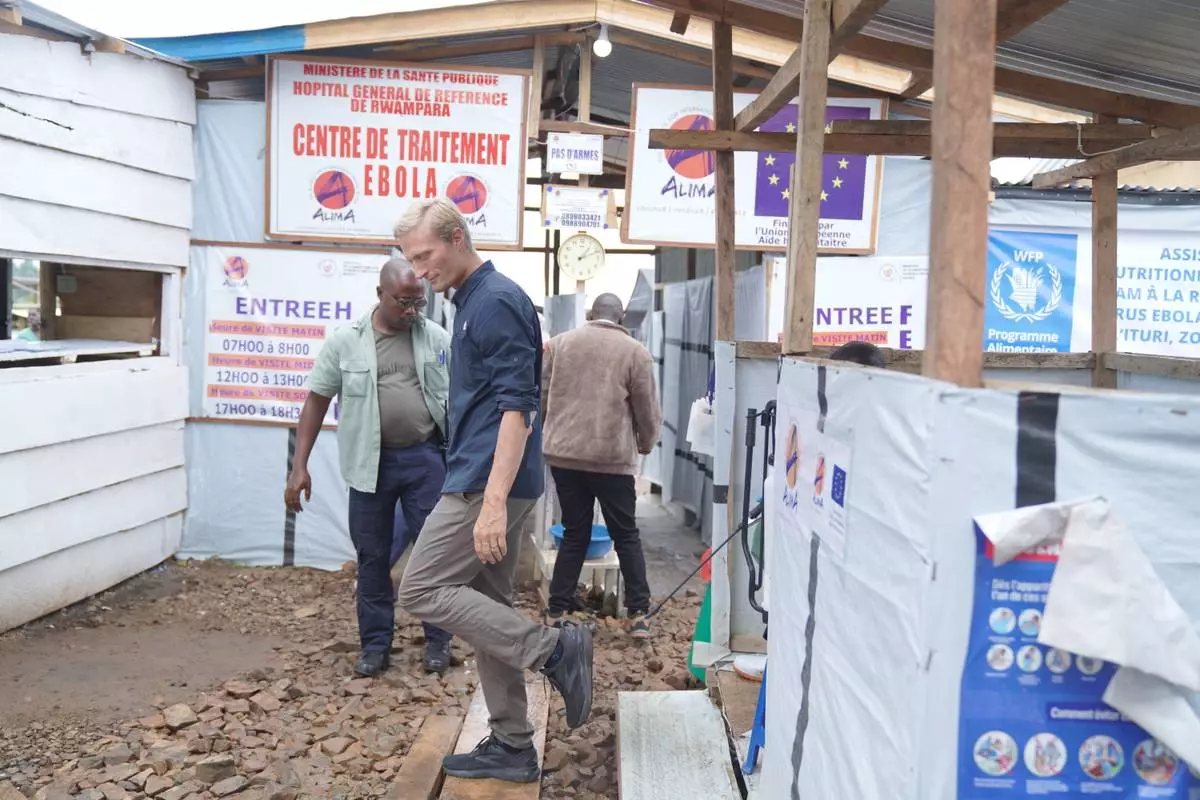
Carl Skau, acting executive director of the World Food Programme, holds up his shoe during a disinfection process at the Rwampara Ebola treatment center in Ituri, eastern Congo, Wednesday, July 29, 2026. (AP Photo/Dieudonne Dirole)
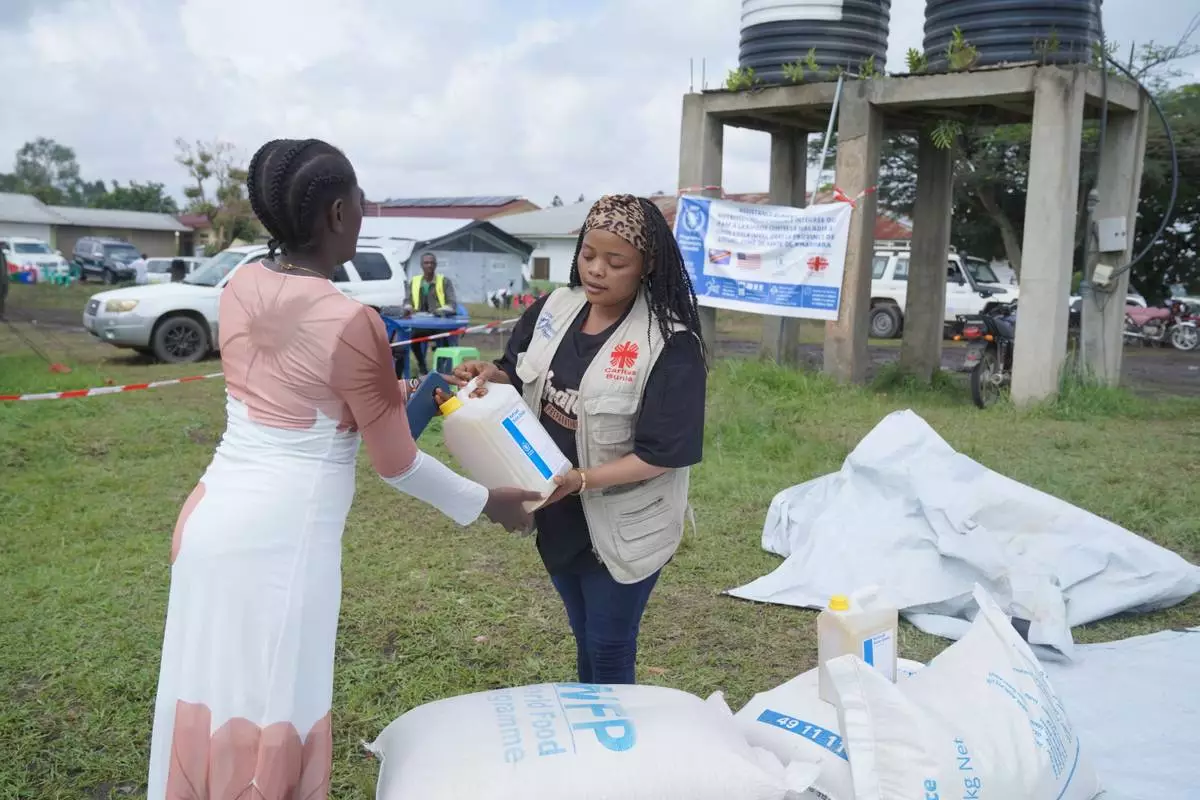
A woman collects a food donation from the World Food Programme at the Rwampara Ebola treatment center in Ituri, eastern Congo, Wednesday, July 29, 2026. (AP Photo/Dieudonne Dirole)
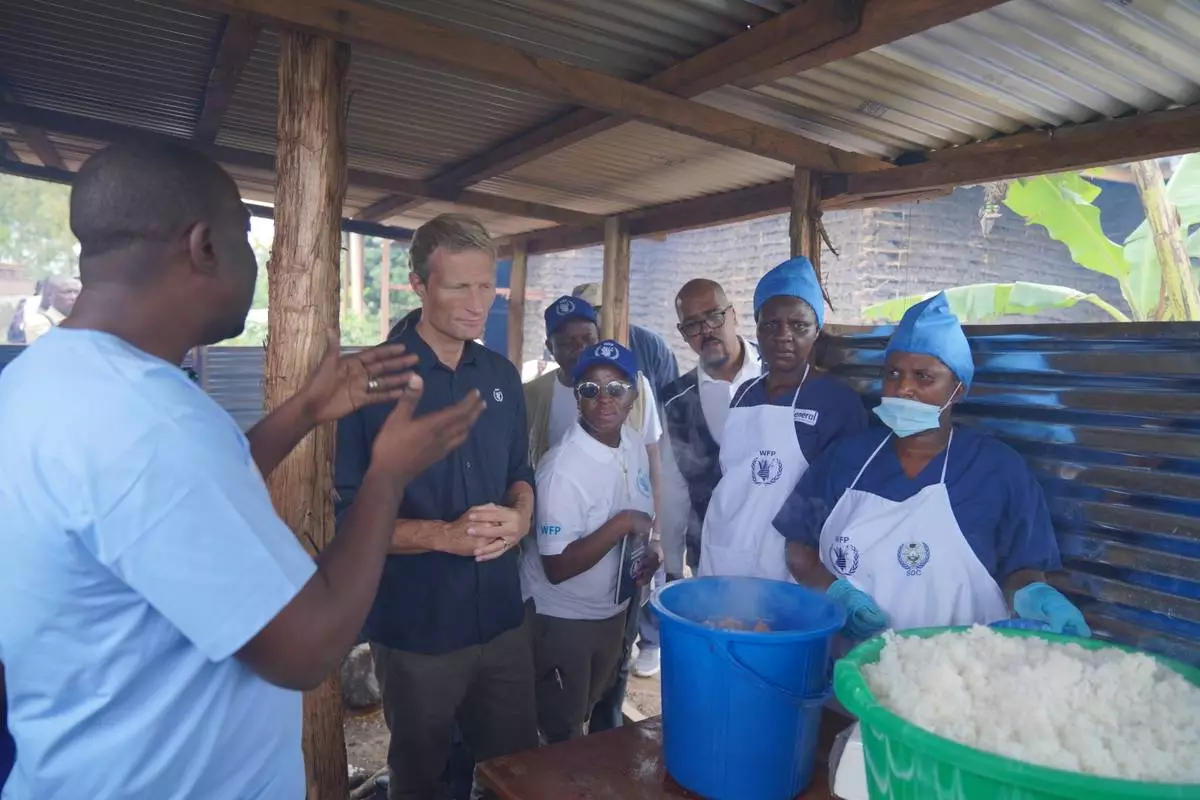
Carl Skau, acting executive director of the World Food Programme (WFP), second from right, meets with frontline workers and WFP staff at the Rwampara Ebola treatment center in Ituri, eastern Congo, Wednesday, July 29, 2026. (AP Photo/Dieudonne Dirole)
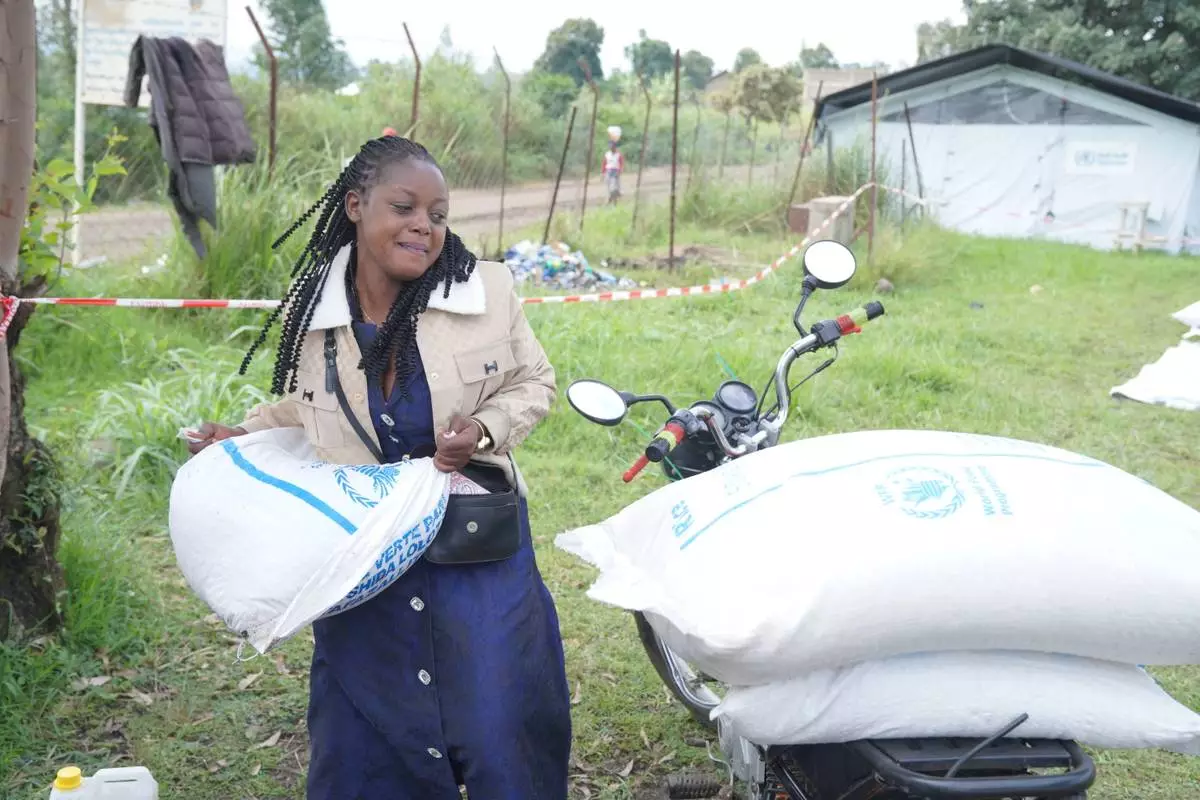
A woman collects a food donation from the World Food Programme at the Rwampara Ebola treatment center in Ituri, eastern Congo, Wednesday, July 29, 2026. (AP Photo/Dieudonne Dirole)
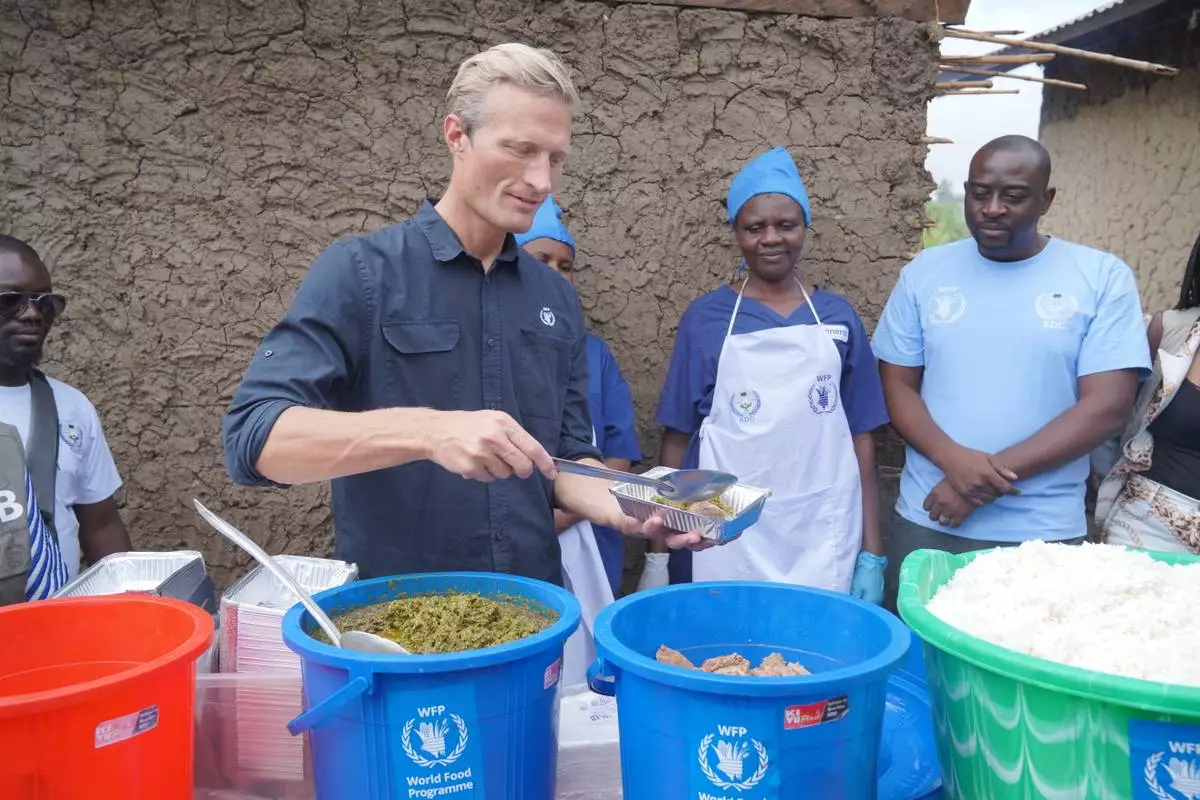
Carl Skau, acting executive director of the World Food Programme, pepares a container of food at the Rwampara Ebola treatment center in Ituri, eastern Congo, Wednesday, July 29, 2026. (AP Photo/Dieudonne Dirole)
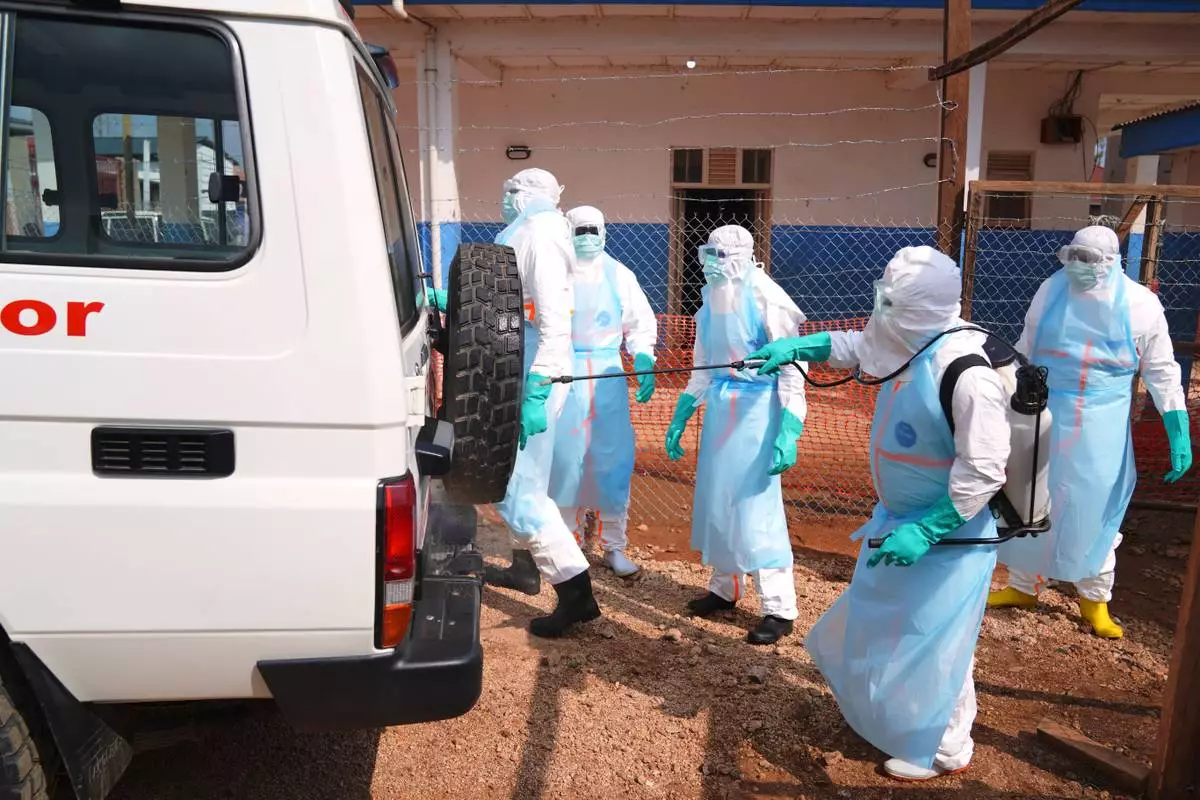
Health workers disinfects an ambulance at Ebola Treatment Center at Bunia General Hospital in Ituri, Congo, Wednesday, July 22, 2026. (AP Photo/Dirole Lotsima Dieudonne)
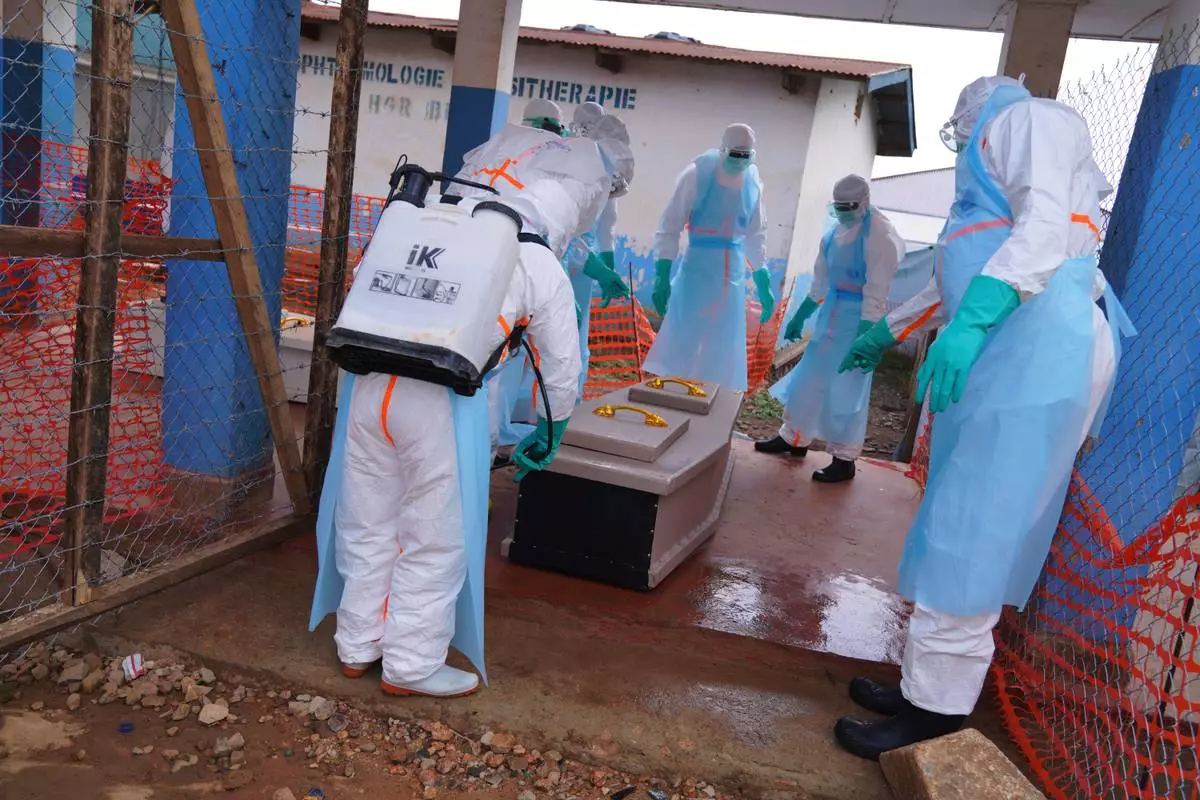
Health workers disinfect a coffin of an Ebola victim at Ebola Treatment Center at Bunia General Hospital in Ituri, Congo, Wednesday, July 22, 2026. (AP Photo/Dirole Lotsima Dieudonne)