ROME (AP) — Italy’s highest court has ruled that children born with Italian citizenship do not automatically lose it when a parent later becomes a citizen of another country, a decision expected to bolster citizenship-by-descent claims by descendants of Italian emigrants worldwide.
The ruling resolves a long-running legal dispute known as the “Minor Issue,” which has affected thousands of ancestry-based citizenship cases involving families who left Italy in the late 19th and early 20th centuries, experts say.
The ruling — dated Sunday but published Wednesday — was made by the Court of Cassation's highest-level panel for resolving conflicting legal interpretations.
At the center of the dispute was whether children automatically lost Italian citizenship when an Italian parent later acquired a foreign nationality while the children were still minors.
Under a restrictive interpretation adopted in a series of court decisions beginning in 2023, many applications by later generations were rejected because authorities considered the line of citizenship transmission to have been interrupted.
In its new ruling, the court said that under Italy’s historical citizenship laws, children who were already Italian citizens by birth under the principle of “iure sanguinis,” or citizenship by bloodline, did not automatically lose their Italian citizenship when a parent became a citizen of another country.
The court clarified that children born in countries that automatically grant citizenship at birth — including the United States — retained their Italian citizenship even if their parents later naturalized there. Because they remained Italian citizens, they could pass that citizenship on to subsequent generations.
Lawyer Marco Mellone, who represented applicants in the case, explained that the ruling reversed a restrictive interpretation that had blocked citizenship claims in recent years, many by U.S. citizens.
“The Supreme Court of Cassation has completely changed its position and gone back, confirming that all these Italian-American families — and, more generally, families in all countries where this situation existed — regain the right to Italian citizenship by descent,” Mellone told The Associated Press.
The decision could have broad implications for descendants of Italian emigrants, particularly in North and South America, where large Italian diaspora communities have ancestral ties to Italy. Mellone estimated that several hundred thousand families may have been affected by the restrictive interpretation adopted in recent years.
Legal experts say the judgment is likely to strengthen the position of applicants whose claims were rejected solely because of the Minor Issue and provide authoritative guidance to judges handling pending cases. The ruling could also influence how Italian administrative authorities and consulates assess future citizenship applications.
Whether the Interior Ministry and Italian consulates formally adjust their practices to reflect the court’s interpretation remains unclear. However, decisions issued by the panel — known as the “Sezioni Unite” or United Sections — carry particular weight because they are intended to resolve conflicting interpretations of the law.
Mellone noted that “there's no one above” the panel, which has only very rarely reversed decisions.
The ruling comes as Italy faces growing demand for citizenship by descent and legal disputes over the scope of ancestry-based citizenship rights.
Separately, a law championed by Foreign Minister Antonio Tajani that restricts citizenship transmission through more distant generations has been referred to the European Union’s Court of Justice, with proceedings expected next year.

FILE - Lawyer Marco Mellone speaks during an interview outside Italy's highest Court of Cassation, in Rome, April 14, 2026, prior to the start of a hearing to argue against the new citizenship law that restricts citizenship by descent. (AP Photo/Gregorio Borgia, File)
BUNIA, Congo (AP) — The fastest growing Ebola outbreak ever recorded is leaving thousands more people hungry in eastern Congo, a region engulfed in conflicts and a fight over precious minerals, the head of the U.N. food agency warned on Wednesday.
The World Food Program's acting executive director, Carl Skau, told The Associated Press during a visit to the hard-hit Ituri province that the outbreak is a “crisis on top of a crisis” that has compounded a catastrophic situation with over 5 million Congolese already experiencing emergency-level food insecurity.
The long-running conflict in eastern Congo has driven nearly 10 million people into crisis or emergency levels of hunger, with Ituri — the epicenter of the Ebola outbreak — among the most affected with 1.9 million in need of food, according to the WFP.
“My number one message is that this situation requires much, much more attention” Skau later told a video news conference with U.N. correspondents. “This is the fastest growing Ebola crisis ever.”
Since the outbreak was declared on May 15, it took just over two months for 1,000 people to die of Ebola in eastern Congo, compared to the 2014-2016 outbreak in West Africa that had been considered the worst in history and when it took about eight months to reach that number.
The dramatic surge shows the urgent need to scale up food, protective equipment, trained staff and funding, Skau said, stressing that the lack of money has forced WFP to cut the number of people it is assisting in Congo from 3 million last year to 1 million this year.
U.N. senior Ebola coordinator Julien Harneis, who was with Skau on the visit to Ituri, said the $2.1 billion humanitarian appeal for Congo is only 45% funded.
The separate Ebola response appeal is being revised upward because it only covered two provinces and now there are four, he said.
The outbreak has been particularly difficult to fight because the Bundibugyo virus responsible for it has no approved vaccines or treatments, unlike most of Congo’s past outbreaks. Harneis said a vaccine trial is underway, but getting a vaccine to Congo is months away.
The United Nations is working with the government and community workers to build trust so that people with symptoms will seek treatment quickly, Harneis said. If they do, he added, “they have a very good chance of surviving Ebola.”
Across some 48 health zones affected with Ebola, WFP said more than 2.7 million people face acute food insecurity, including 628,000 in emergency conditions.
“Now with the Ebola crisis, this is getting worse. Markets are impacted, supply routes are impacted and so people are struggling even more to have enough to eat,” Skau told the AP, and malnutrition is rising.
Since it erupted, the ongoing Ebola outbreak has recorded 3,360 confirmed cases, including 1,487 death. Harneis said that in the last 24 hours, 50 people died of Ebola.
Measures introduced to slow the spread — including border closures and restriction of movements and large gatherings — have disrupted life and businesses, driving up food and fuel prices, the WFP has said. The agency said it has so far delivered more than 160,000 hot meals to patients, contacts and front line workers in 17 treatment and isolation centers.
In Mongbwalu, a mining town about 69 kilometers (43 miles) from Bunia, Ituri's provincial capital, residents said Ebola and the measures introduced to fight it have made it difficult for some families to feed their children.
Kahambu Deborah, a 40-year-old mother of six, said she had been struggling to access her farmland due to rebel violence, and that the restrictions linked to Ebola had made things more challenging.
“Sometimes, because of the insecurity, we can’t even go to our fields, and our children are suffering as a result,” she said.
Dr. Richard Lokudu, director-general of the Mongbwalu General Hospital, said health workers are seeing more malnutrition cases in the region, compared to before the outbreak, “even at the Ebola treatment center.”
In Mongbwalu, the U.N. agency’s food support program has helped to “limit the movement of people seeking the means to survive,” said Tourne Kasereka, a monitoring assistant with the WFP.
A critical aspect of that response is getting food to those in need of it, according to Skau.
“The World Food Program needs resources (and) donors to step up so that we can do more, to alleviate the pressures on the people here in Ituri,” he said.
Lederer reported from the United Nations. Associated Press writer Wilson McMakin in Dakar, Senegal, contributed to this report.
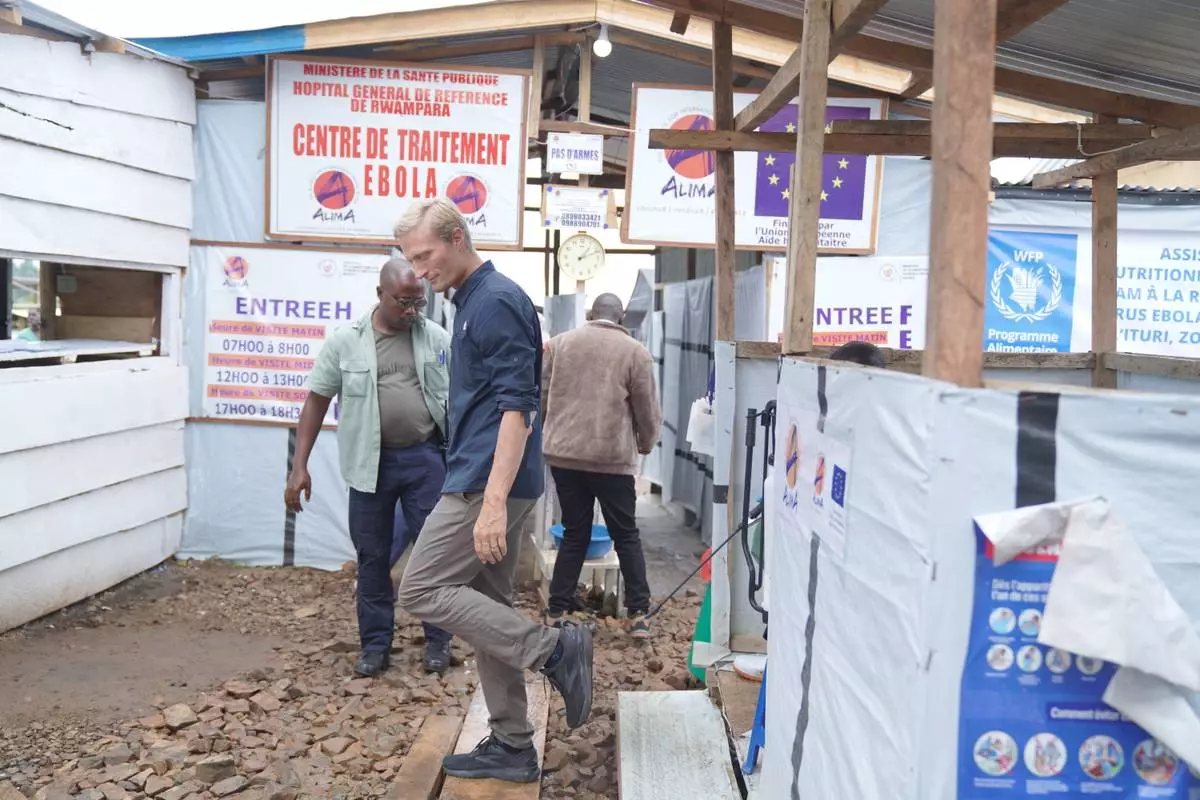
Carl Skau, acting executive director of the World Food Programme, holds up his shoe during a disinfection process at the Rwampara Ebola treatment center in Ituri, eastern Congo, Wednesday, July 29, 2026. (AP Photo/Dieudonne Dirole)
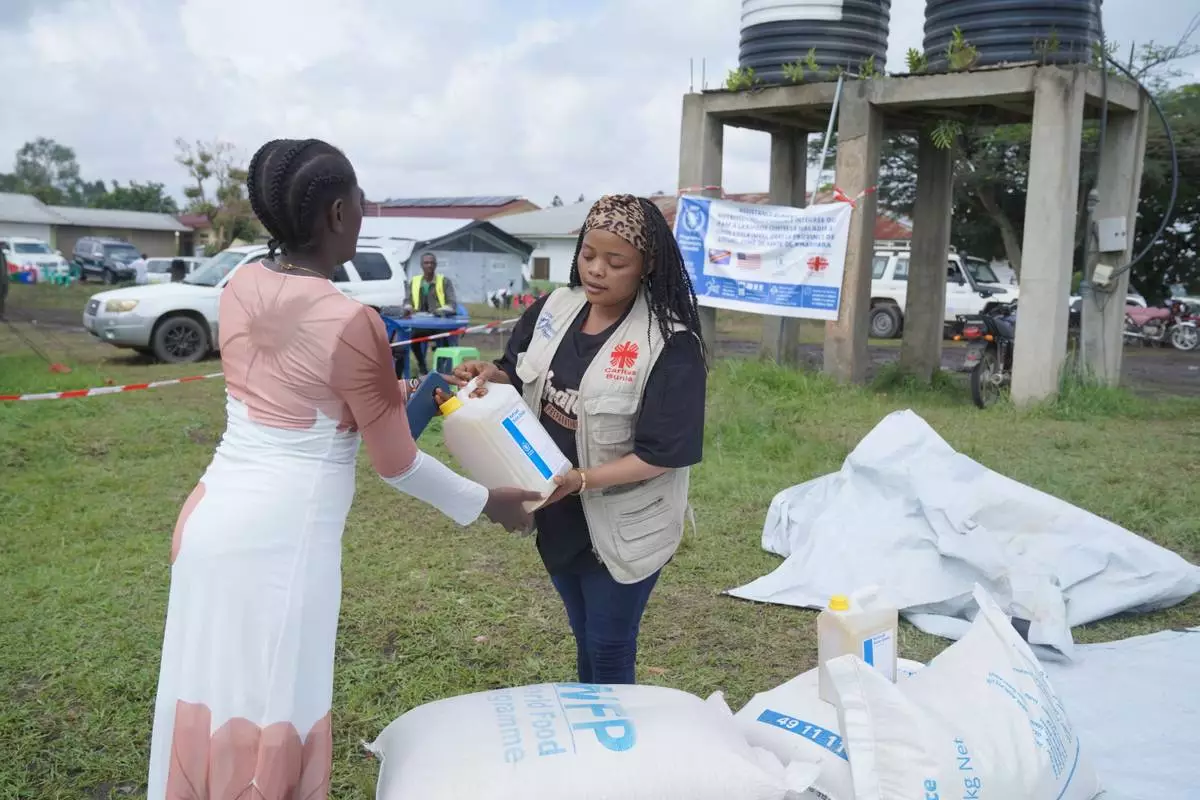
A woman collects a food donation from the World Food Programme at the Rwampara Ebola treatment center in Ituri, eastern Congo, Wednesday, July 29, 2026. (AP Photo/Dieudonne Dirole)

Carl Skau, acting executive director of the World Food Programme (WFP), second from right, meets with frontline workers and WFP staff at the Rwampara Ebola treatment center in Ituri, eastern Congo, Wednesday, July 29, 2026. (AP Photo/Dieudonne Dirole)
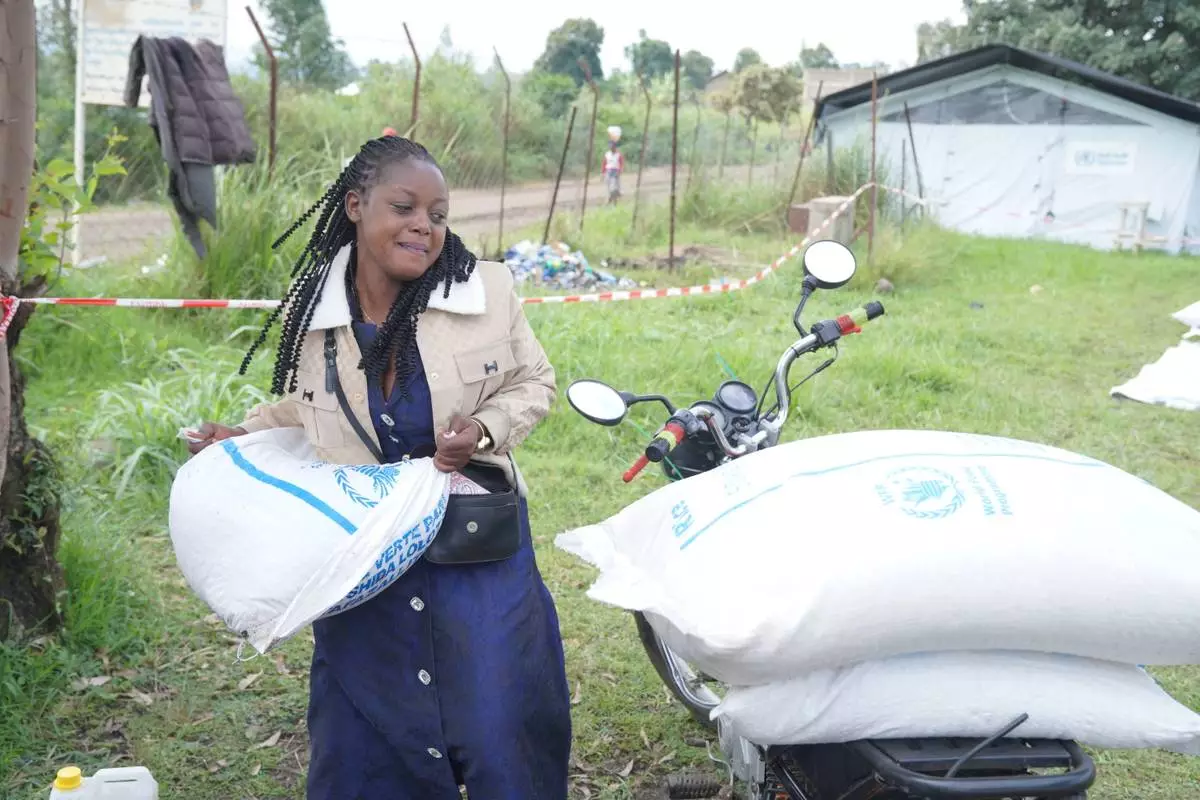
A woman collects a food donation from the World Food Programme at the Rwampara Ebola treatment center in Ituri, eastern Congo, Wednesday, July 29, 2026. (AP Photo/Dieudonne Dirole)
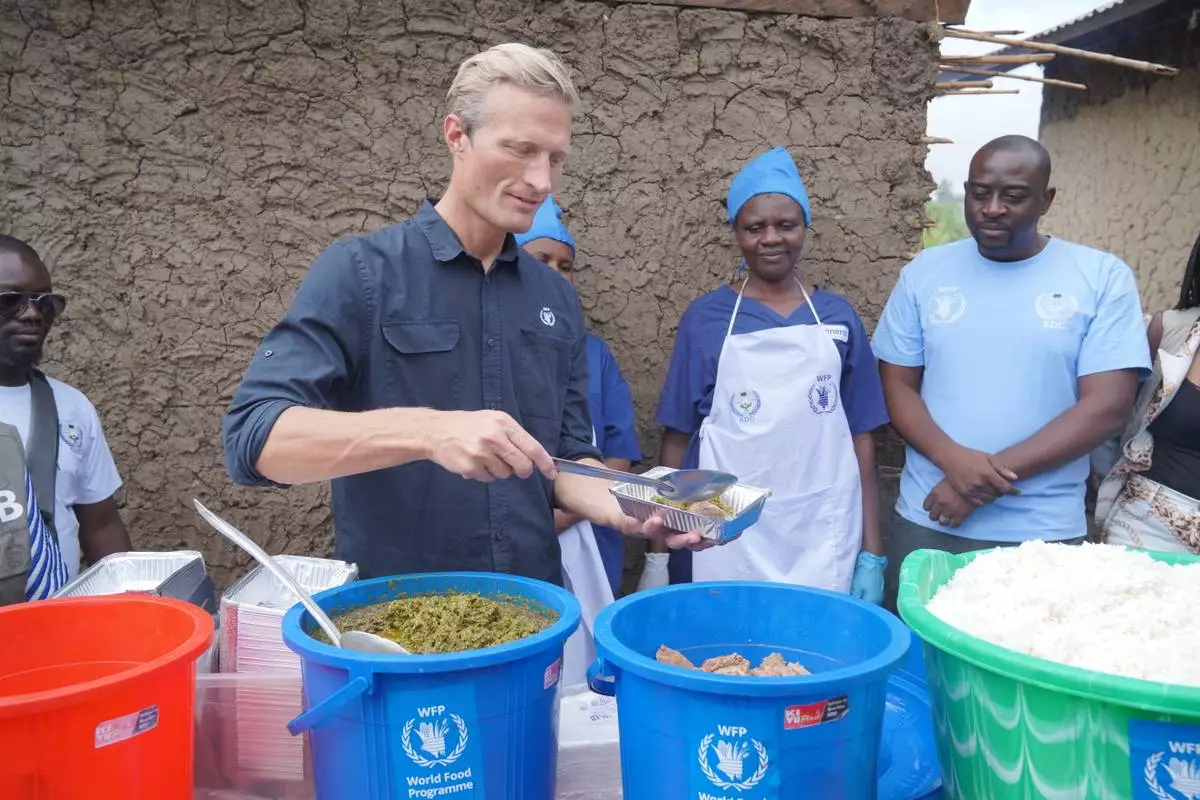
Carl Skau, acting executive director of the World Food Programme, pepares a container of food at the Rwampara Ebola treatment center in Ituri, eastern Congo, Wednesday, July 29, 2026. (AP Photo/Dieudonne Dirole)
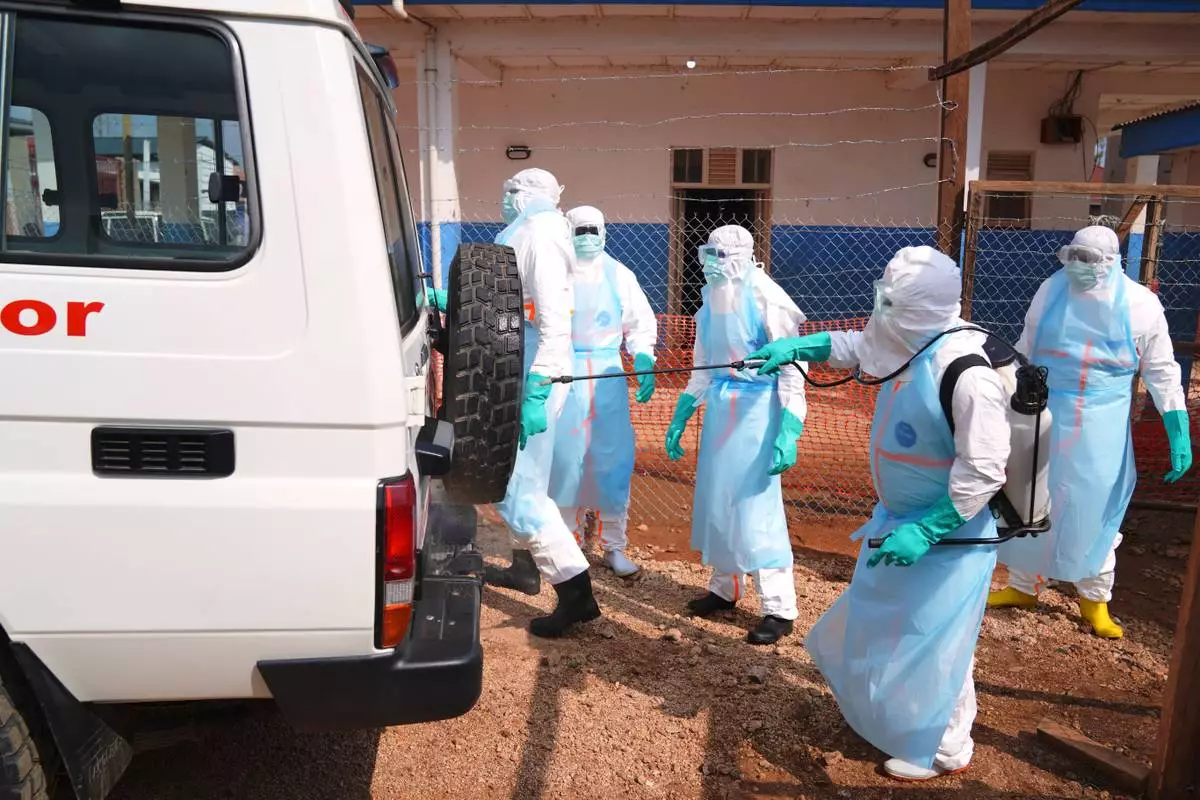
Health workers disinfects an ambulance at Ebola Treatment Center at Bunia General Hospital in Ituri, Congo, Wednesday, July 22, 2026. (AP Photo/Dirole Lotsima Dieudonne)
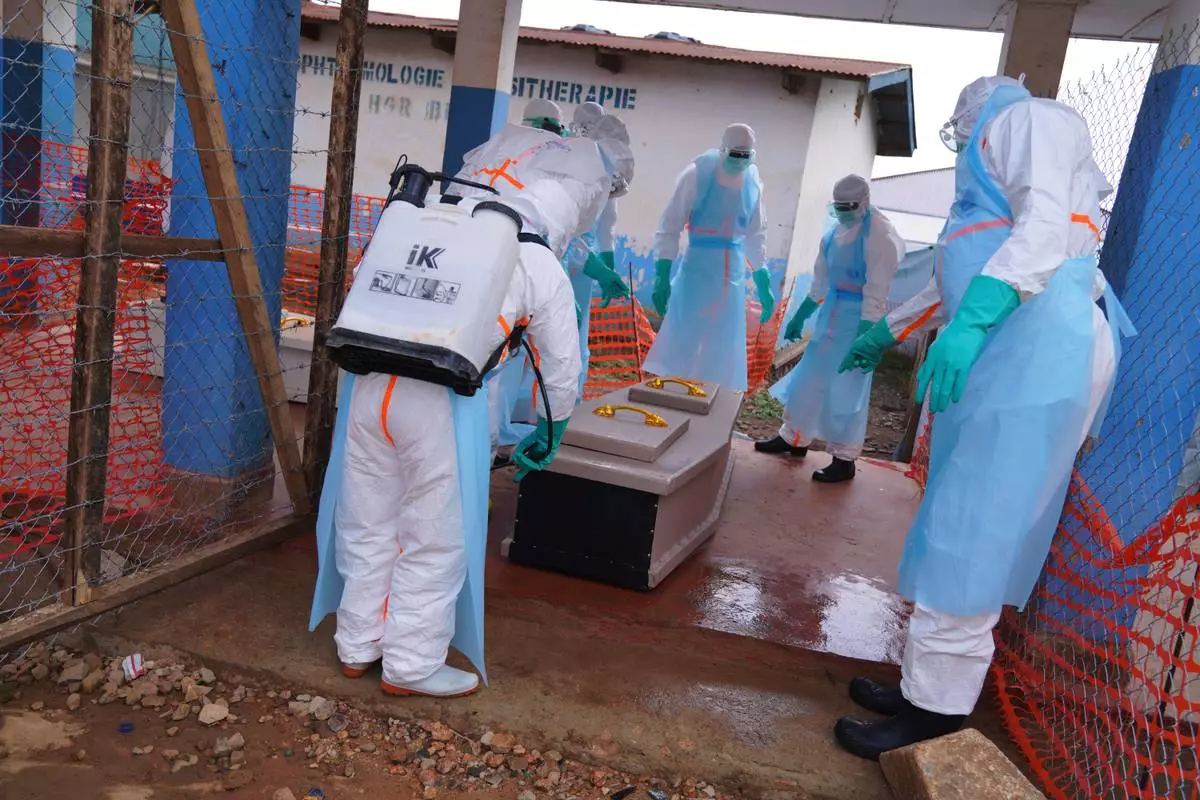
Health workers disinfect a coffin of an Ebola victim at Ebola Treatment Center at Bunia General Hospital in Ituri, Congo, Wednesday, July 22, 2026. (AP Photo/Dirole Lotsima Dieudonne)