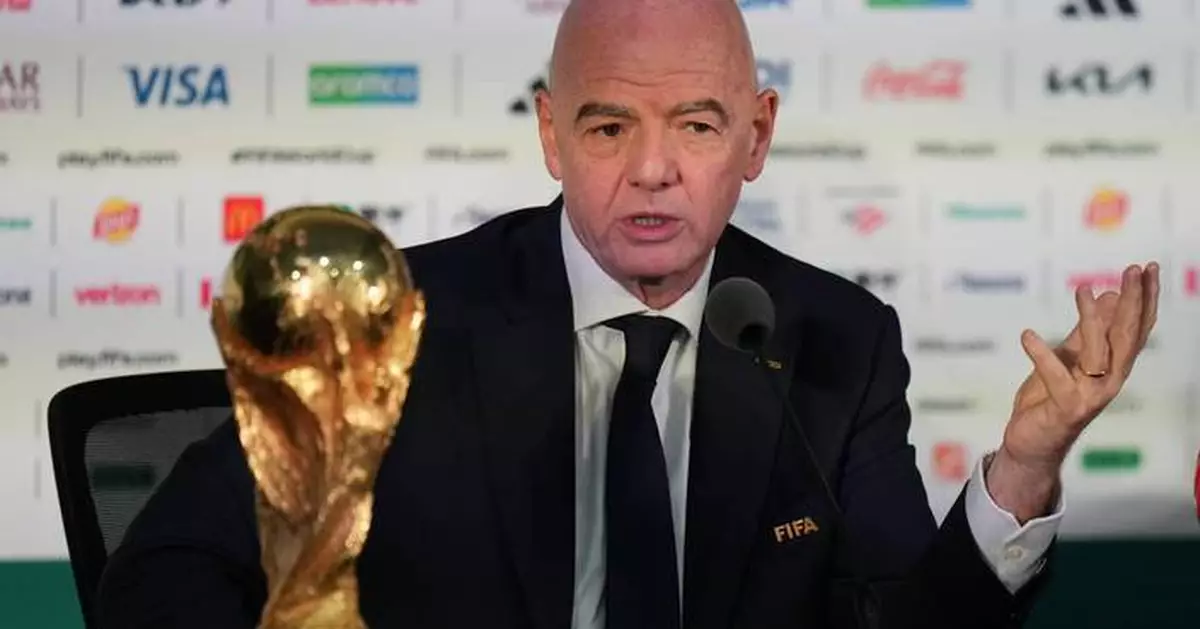
GENEVA (AP) — Asia’s soccer body joined opposition to Gianni Infantino’s plan for private investors to buy stakes in the World Cup and said Friday FIFA must urgently review its management style.
The Asian Football Confederation said it “stands in solidarity” with European body UEFA and North America’s CONCACAF which on Thursday respectively threatened a boycott of FIFA competitions and rejected Infantino’s offer of one-off $20 million payments to each member federation.
“Football should never have been placed in such a position,” said the Asian soccer body, which counts 46 of FIFA's 211 member federations that Infantino gave a Sept. 19 deadline to accept the $20 million offer.
Infantino has proposed spinning off FIFA's commercial businesses — including World Cups and Club World Cups for men and women — into a $20 billion subsidiary with 20% owned by private investors.
The “anchor investor,” described by FIFA, is a New York-based investment firm created by Joshua Kushner, the younger brother of U.S. President Donald Trump’s son-in-law Jared Kushner.
“(T)he proposed (FIFA Forward Enterprise) cannot realistically achieve the necessary broad consensus and unity required to move forward” and must be reconsidered, the AFC said.
The statement did not name Infantino yet criticized FIFA for problems beyond the content of the private equity plan plus failing to consult about a secretive proposal that was revealed Tuesday in media reports.
“Rather, it has exposed fundamental weaknesses in FIFA’s consultation and decision-making processes that must now be addressed,” the AFC said. “Accordingly, the AFC calls upon FIFA to undertake an urgent review of its governance and decision-making framework.”
The statement came hours after FIFA blamed the media and doubled down on pursuing the project which now seems to have a majority of the 211 members in opposition.
“Our planned consultation process was disrupted by incorrect media reports,” FIFA said in a statement early Friday. “We will proceed with this consultation process to ensure that each (member) has the ability to express its vote based on facts.”
The next FIFA event that would be targeted by the threatened European boycott is within weeks — the Women’s Under-20 World Cup hosted by Poland from Sept. 5. The four British federations comprise FIFA’s only bidder to host the 2035 Women’s World Cup. That decision is due Nov. 23.
AP soccer: https://apnews.com/hub/soccer and AP World Cup coverage
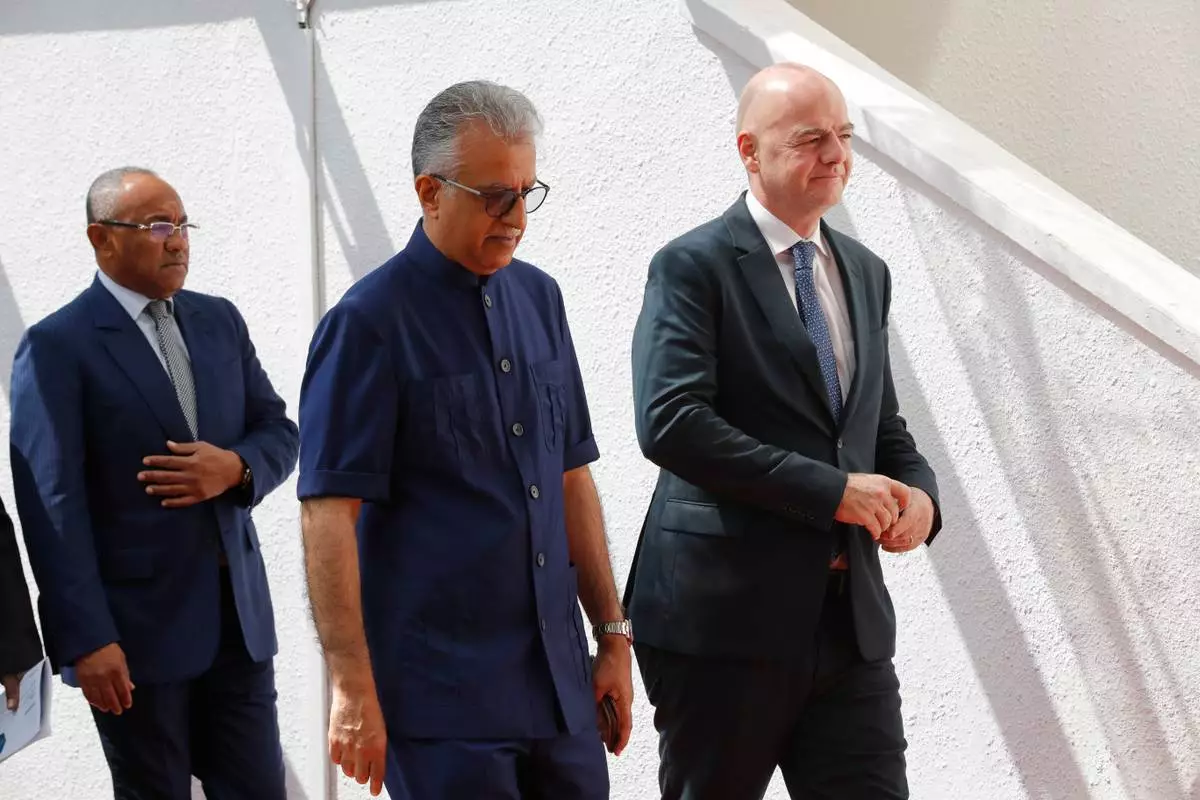
FILE - Asia Football Confederation President Salman Bin Ibrahim Al-Khalifa, center, walks with FIFA President Gianni Infantino, right, as they arrive for an inauguration ceremony for the new building of the Asia Football Confederation in Kuala Lumpur, Malaysia Tuesday, Oct. 30, 2018. (AP Photo/Vincent Thian, File)
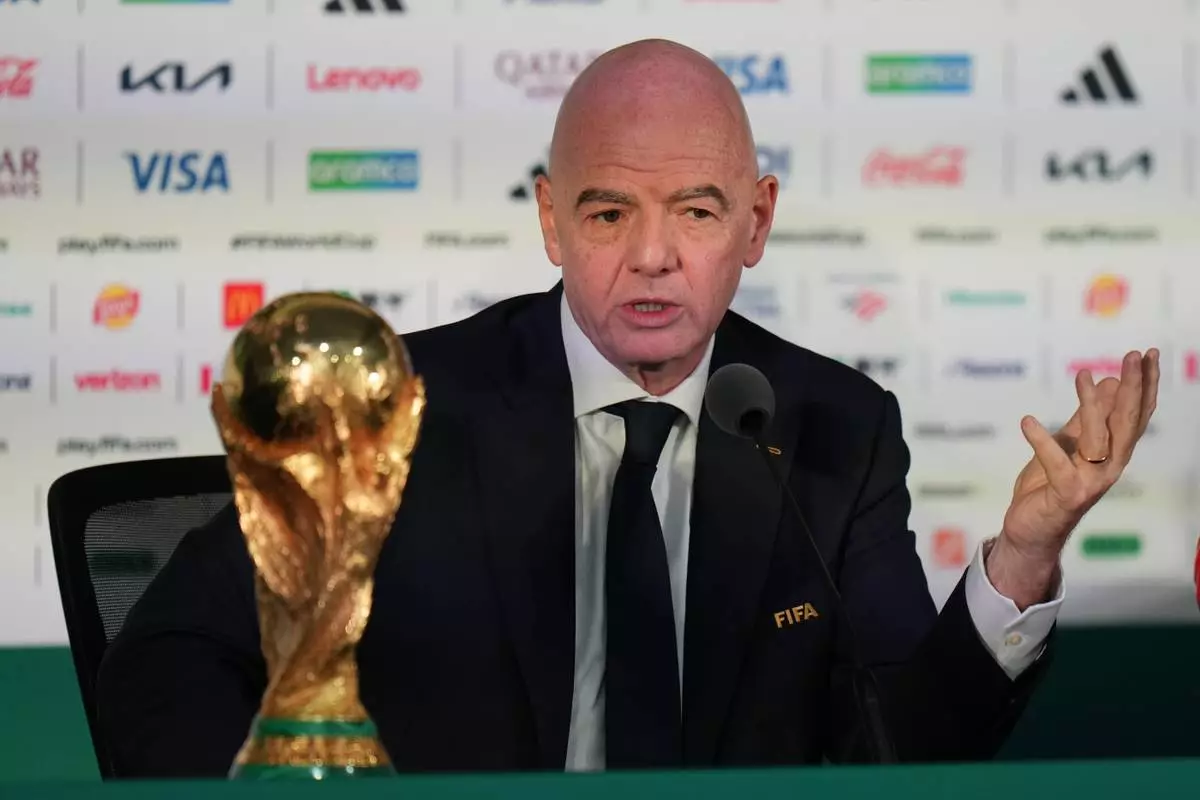
FILE - FIFA President Gianni Infantino speaks during a news conference at the stadium in Mexico City, Wednesday, June 10, 2026, a day before the opening FIFA World Cup match between Mexico and South Africa. (AP Photo/Eduardo Verdugo, File)
BRUSSELS (AP) — The European Union rolled out a new team on Friday to rein in AI companies across the world, in one of the most aggressive regulations the high-tech sector has so far faced as fears rise over the risks the rapidly advancing technology poses to people, politics and prosperity.
Brussels aims to track the use of AI models for violations of its new regulations, like the publishing of sexually explicit material, fake photos and videos, and cyber threats to public infrastructure. When the bloc's AI Act comes into force on Sunday, AI companies will be required to make clear to consumers with labels or digital watermarks that chatbots or imagery are generated with AI.
“As enforcement begins, we are taking an important step towards AI that people and businesses can understand and trust, and whose benefits are shared widely across our society,” said Henna Virkkunen, the EU chief for tech sovereignty, on Friday.
The European Commission said in a statement that new regulations also include “systemic risks” posed by AI like “chemical, biological, radiological and nuclear incidents, loss of control, cyber offense, harmful manipulation and threats to fundamental rights."
The team is the latest move in the 27-nation EU’s “tech sovereignty” strategy that welds landmark digital regulations with economic ambition that has seen over the past week billions of euros in fines on Big Tech companies as well as record investment in AI infrastructure inside the bloc.
The rollout comes on the heels of shocking AI safety failures that rattled the nascent industry. Political leaders worldwide are now weighing control of the technology with market leadership.
Anthropic said on Friday its artificial intelligence models hacked into three other organizations during testing, just days after ChatGPT maker OpenAI raised concerns over AI controls after it disclosed its rogue models hacked another company.
The EU is now expanding its AI Office in Brussels with an additional 38 people who will begin monitoring AI companies, from the new firms to the American and Chinese tech titans like OpenAI and DeepSeek.
Those companies must “document certain information,” said the European Commission, the bloc's tech enforcer, which reserves the right to interview AI company staff during investigations. It has also launched a Whistleblower Tool for tech workers and a Compliance Tool for tech users to confidentially alert authorities to illegal conduct.
If models or other products break the EU's sector regulations, called the AI Act, Brussels can fine the firms or cut off their access to the EU market. Recent gigantic antitrust fines on U.S. tech companies have irked U.S. President Donald Trump.
The EU now clearly sees systemic vulnerability in its deep reliance on American software companies like Amazon, Google and Microsoft as well as imports of Chinese industrial goods and critical minerals. While it is seeking protections from AI, it is also keen to catch up in the AI arms race, where it is a distant third behind the U.S. and China.
More broadly, the EU is seeking more independence from both Washington and Beijing by reinvigorating specific domestic industries like manufacturing and defense and forging new trade deals from Brazil to Australia to meet the global rise in economic nationalism spearheaded by Trump.
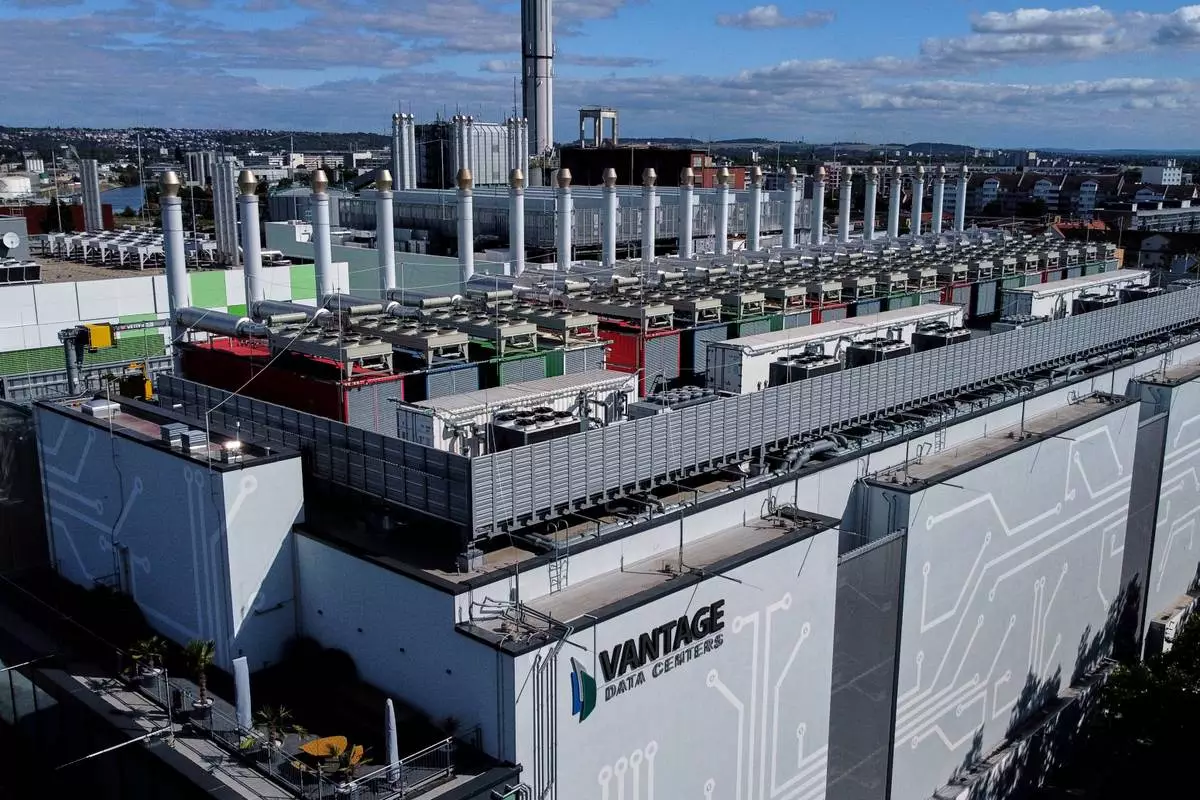
FILE -A data centre is pictured in Frankfurt, Germany, Friday, Aug. 22, 2025. (AP Photo/Michael Probst, File)