MOUNTAIN VIEW, Calif.--(BUSINESS WIRE)--Jul 31, 2026--
H2O.ai, the sovereign enterprise AI platform for predictive, generative and agentic AI, with built-in observability and governance, today announced that H2O AI Super Agent™ is currently ranked #2 on FutureX’s overall leaderboard, following several months among the benchmark’s top-performing AI agents. The ranking reflects H2O.ai’s continued work to build AI systems that can reason across complex information, assess possible outcomes and solve real-world problems.
This press release features multimedia. View the full release here: https://www.businesswire.com/news/home/20260731975613/en/
Static benchmarks get memorized. FutureX cannot be gamed the same way: questions rotate weekly across finance, politics, sports, technology and healthcare, and the ground truth doesn't exist anywhere in a model's training data until after every agent has already committed to an answer. It rewards agents that reason under real uncertainty.
“Anyone can top a benchmark once. Staying among the leaders for months, against every major player, shows H2O AI Super Agent is built for sustained performance, not a lucky result,” said Sri Ambati, founder and CEO of H2O.ai.
Leadership: A Consistent Top Performer
H2O AI Super Agent™ has repeatedly reached the top of the FutureX leaderboard, including multiple #1 rankings during 2026. Its sustained performance reflects continued improvements from H2O.ai’s research team across live evaluations of future prediction, reasoning and tool use.
Earlier FutureX results placed H2O AI Super Agent™ ahead of submissions powered by models from OpenAI, Google, DeepSeek, xAI and other leading AI developers. The leaderboard continues to update as new agents, model versions and weekly results are added.
Built on the Same Architecture Behind H2O's Other Benchmark Wins
The result isn't a one-off. H2O.ai topped GAIA, the grounded-reasoning benchmark, in 2025, and H2O AI Super Agent has separately taken the #1 spot on FutureX outright in three different weeks this year. The common thread is architecture: deep multi-source web research, a reasoning pipeline built for multi-step planning and self-critique, predictive modeling for time-series and seasonality, and the ability to build its own tools mid-task.
"Every other player on this board is running a chat model with search bolted on. We're running predictive AI underneath the reasoning, and that's the difference between guessing and forecasting," said Jon McKinney, Director of Research atH2O.ai. “For regulated enterprises in banking, government and healthcare, that same skill, reasoning accurately about what's likely to happen next, is what a compliance team needs before they'll trust a risk model in production".
About H2O.ai
H2O.ai is on a mission to democratize AI for Good. As the world's leading agentic AI company, H2O.ai converges Generative and Predictive AI to help enterprises and public sector agencies develop purpose-built Agents, SLMs, and solutions on their private data. With a focus on secure, compliant, and infrastructure-flexible Sovereign AI deployments, H2O.ai delivers solutions that align with the highest standards of data privacy and control.
Its open-source technology is trusted by over 20,000 organizations worldwide, including more than half of the Fortune 500. H2O.ai powers AI transformation for companies like AT&T, Commonwealth Bank of Australia, Wells Fargo, Bank of America, Chipotle, Workday, Progressive Insurance, and NIH.
Through its AI for Good program, H2O.ai supports nonprofits, public sector agencies, and global institutions in advancing healthcare, education, disaster response, and environmental sustainability using agentic and predictive AI.
H2O.ai has raised $256 million from investors, including Commonwealth Bank, NVIDIA, Goldman Sachs, Wells Fargo, Capital One, Nexus Ventures, and New York Life.
For more information, visit www.h2o.ai.
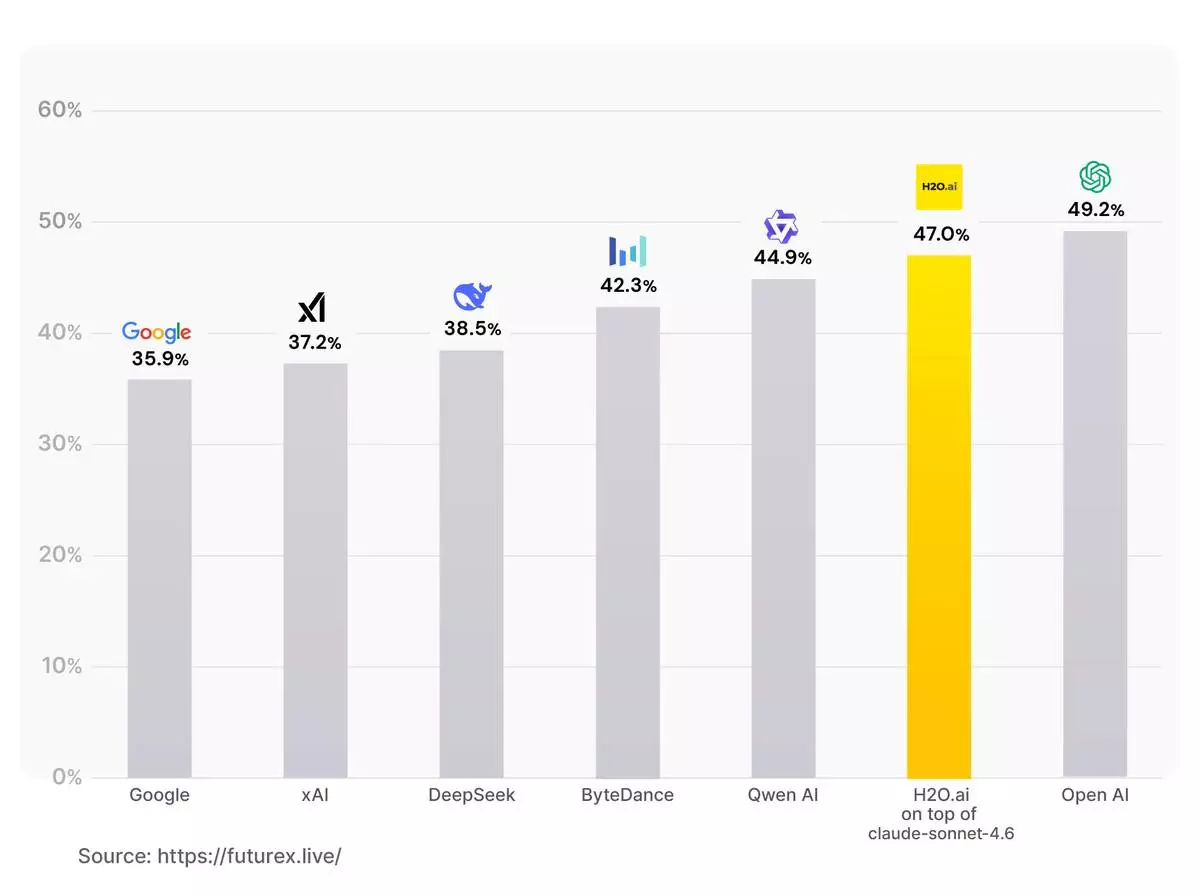
FutureX July Week 3, 2026 chart comparing H2O.ai to industry’s top players
CEUTA, Spain (AP) — Spain on Saturday installed a 500-meter-long (1,600-foot) barrier on the sea border between its North African territory of Ceuta and neighboring Morocco after tens of thousands of migrants breached the frontier earlier in the week.
At least 67 migrants died, including some who drowned and others who were killed in a stampede to cross a breakwater barrier, the Spanish government said Saturday. The sudden arrival of 50,000 to 60,000 migrants in the territory on Thursday and Friday sparked a humanitarian crisis and reignited the immigration debate in Europe and beyond, though most of the migrants soon went back.
Critics of Spain’s socialist government, notably right and far-right politicians, seized upon the dramatic images of crowds storming into Ceuta, which sits on the Strait of Gibraltar at the entrance to the Mediterranean Sea and has been a Spanish possession since 1580. Spain’s migration policy has focused on granting legal status to workers lacking authorization who entered the country before 2026 to boost its economy, in contrast with the anti-migration and pro-deportation policies promoted across much of the EU and in the U.S.
Spanish Prime Minister Pedro Sánchez slammed the reaction of some EU leaders to the events in Ceuta, saying calls for Spain to be suspended from the EU's borderless Schengen zone were “driven by prejudice, fake news, ignorance, or political interest.” Despite the Ceuta crisis, Spain in recent years has had fewer illegal migrants cross into the country than Mediterranean neighbors Italy and Greece.
On Saturday morning, a handful of migrants who swam to Ceuta's urban Tarajal beach were met by soldiers who escorted them across the border.
“We are relentless against those who break the law,” Spanish Interior Minister Fernando Grande-Marlaska told journalists.
Asked how the breach could have happened given the heavy security on both sides of the border and whether Morocco posed a threat to Ceuta, Marlaska defended the government in Rabat.
“The events require an evaluation by Spain and Morocco,” he said. But it was the cooperation with its neighbors that allowed Spain “to revert the situation in 24 hours.”
“Morocco is not a threat to Ceuta, or to the rest of Spain. It is a reliable partner,” Marlaska said.
Other European Union countries called for urgent talks and a coordinated response to the situation in Ceuta.
“We cannot allow uncontrolled mass crossings, the instrumentalization of migration or other hybrid threats to create the perception that illegal entry into the European Union is possible. That a migrant’s illegal entry can turn into legal stay,” a letter to top EU officials, released Saturday by the Danish prime minister’s office, said. “Such a perception would encourage further attempts, undermine confidence in our common migration policy and have repercussions for all Member States.”
Leaders of Italy, Denmark, Austria, Belgium, Bulgaria, Cyprus, Croatia, the Czech Republic, Estonia, Finland, Germany, Greece, Hungary, Latvia, Lithuania, Malta, the Netherlands, Poland, Romania, Slovenia, Slovakia and Sweden signed the letter asking the EU’s current Irish presidency to convene a videoconference of interior ministers.
Sánchez also asked for a videoconference of EU interior ministers to “enable us to establish a common response to situations of this kind and reaffirm that the security of our external borders is a shared responsibility of all Member States, and not only of those on the Union’s front line.”
Italy has threatened to suspend the open-border Schengen agreement with Spain and was reimposing border controls for people arriving from Spain by air and sea. Ceuta is not part of the Schengen area, however, and border checks are carried out when traveling from the exclave to continental Spain or other European countries in the Schengen zone.
“In the current international context, the European Union cannot afford this kind of selfish, polarizing and unlawful reaction,” Sánchez wrote in his letter.
Hundreds of migrants continued to make their way back to Morocco on Saturday. Hungry and angry, some barefoot or shirtless and others nursing visible injuries, they said they were leaving Ceuta after what they described as degrading treatment on the Spanish side of the border.
Migrants walked along a long stretch of wave breakers before slipping into Morocco through a small breach in the border fence. Most of the migrants were Moroccans, while a smaller number were from sub-Saharan Africa.
“I decided to come back on my own,” said Ouail Lamzeiz. “I spent eight days in Ceuta, and I was about to get a bed at the migrant center, but I hadn’t eaten for days. Even the Moroccans there didn’t help,” he added, showing a document supporting his account.
Migrants said they spent their nights sleeping in the forests around Ceuta because they could not find shelter, and that they often fought over food.
Othmane El Merzoug asked passersby for a phone call so he could reach his family and ask them to send money for the journey back to his hometown, about 189 miles (305 kilometers) from the border.
Along Ceuta’s Tarajal beach, sunbathers largely ignored the streams of migrants walking toward the border.
Ceuta resident Mohamed Abdelatif, 21, said the border rush had ruptured the city's peace.
“The reality is, it’s not good,” Abdelatif said, before wading into the water with his girlfriend.
To reach Ceuta, on the northern African coast, migrants often swim from the Moroccan town of Fnideq, covering about 3 miles (5 kilometers) to reach Spanish territory. In response to the influx, Spain deployed its armed forces and additional police in Ceuta. On the Moroccan side, security forces clashed with migrants. Authorities used water cannons, tear gas and warning shots to try to turn back migrants.
On Saturday, the road linking Fnideq to the border crossing bore the scars of the unrest. Burned-out vehicles sat along the roadside, while the acrid smell of smoke still hung in the air. Water cannons remained stationed nearby.
“Life in this city has been disrupted as a result of the border incident,” said Ceuta President Juan Jesús Vivas. “The return of people has begun satisfactorily, but the process must be completed.”
But some who made it to Ceuta say they do not intend to go back. Among them was Mohamed Hatri, a 23-year-old Moroccan.
“They’ve closed everything down so that we can’t buy anything to eat, to force us to return to our country,” he said, adding that he and others were determined to stay “whether we’re hungry or not." —— Oubachir reported from Fnideq, Morocco. Renata Brito in Barcelona, Spain and Elena Becatoros in Athens, Greece contributed to this report.
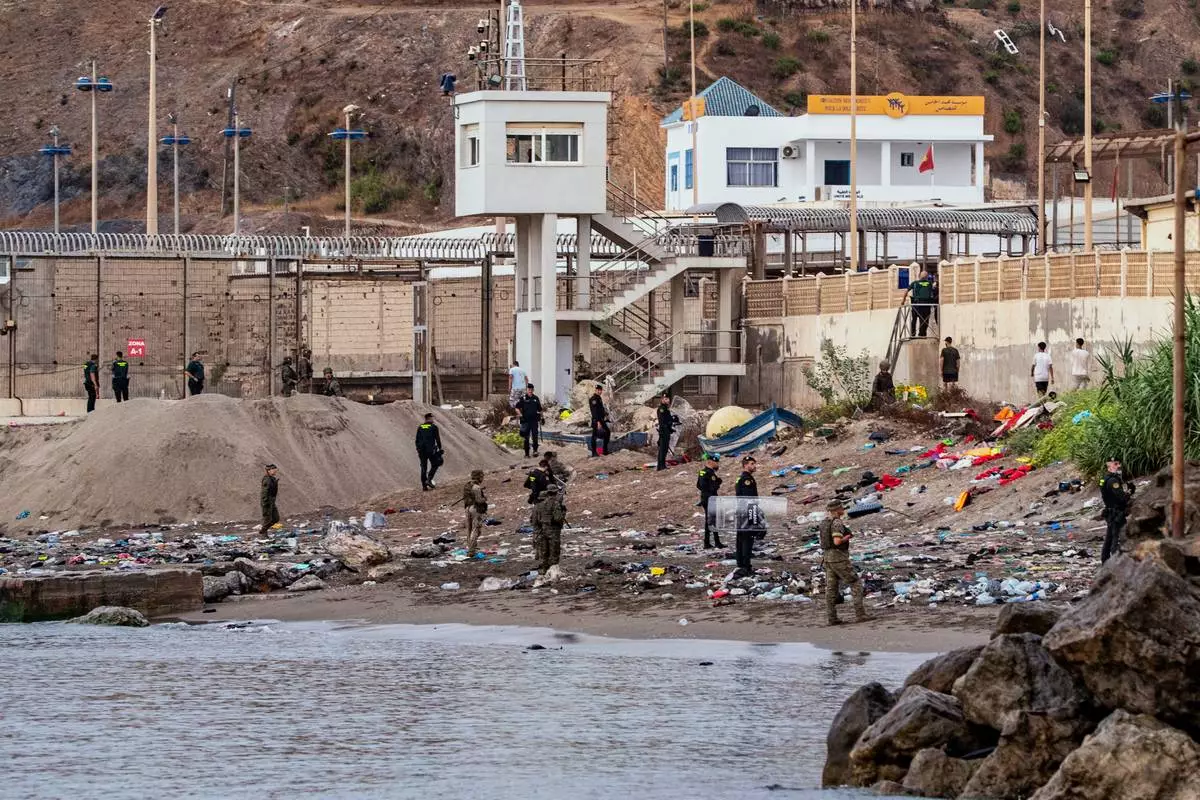
Spanish army soldiers and Guardia Civil officers stand guard as migrants return to Morocco from the Spanish enclave of Ceuta, Saturday, Aug. 1, 2026. (AP Photo/Antonio Sempere)
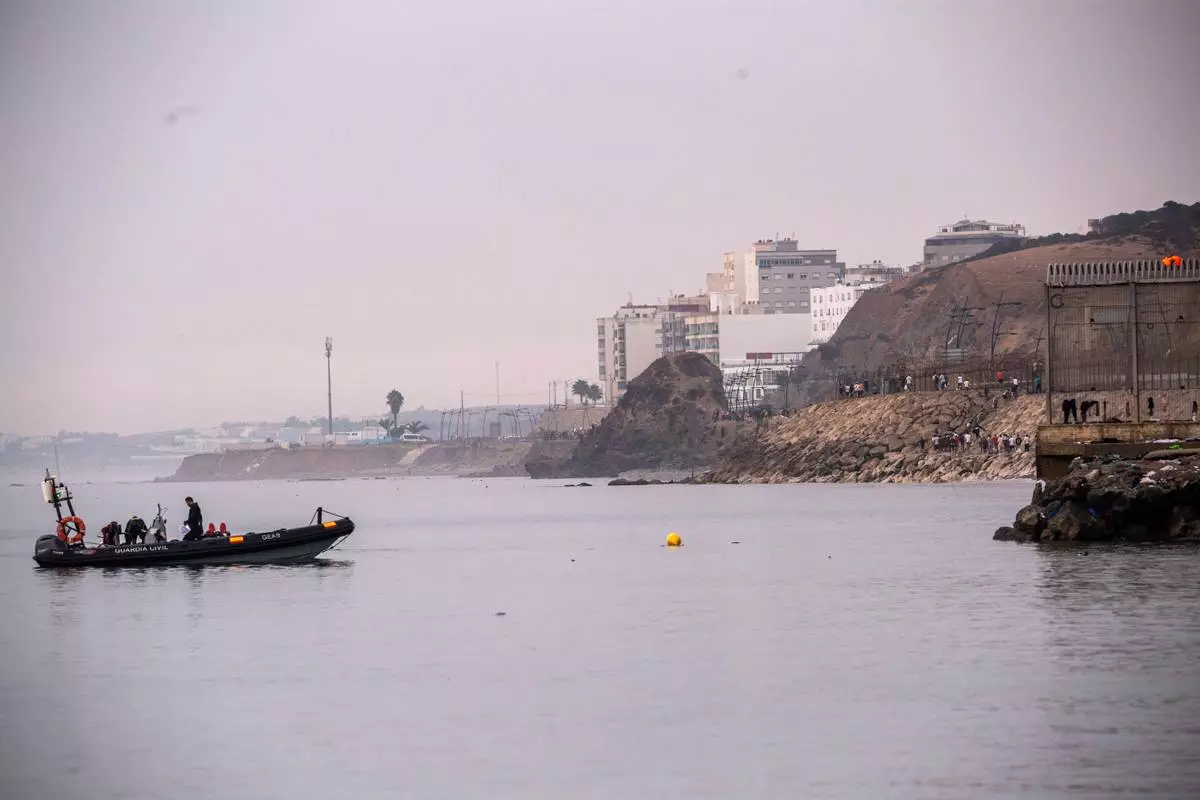
Migrants return to Morocco from the Spanish enclave of Ceuta, Saturday, Aug. 1, 2026. (AP Photo/Antonio Sempere)
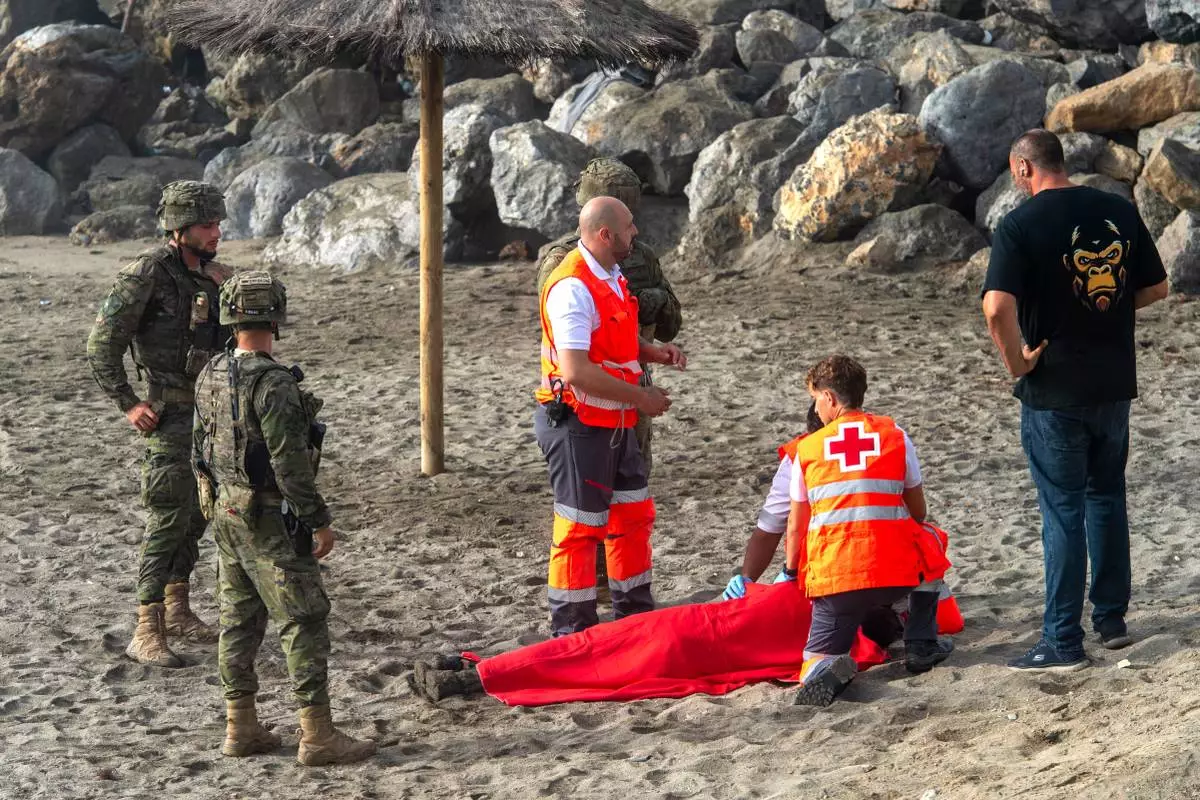
Spanish army soldiers and Red Cross workers assist a migrant who swam from Morocco to the Spanish enclave of Ceuta, Saturday, Aug. 1, 2026. (AP Photo/Antonio Sempere)
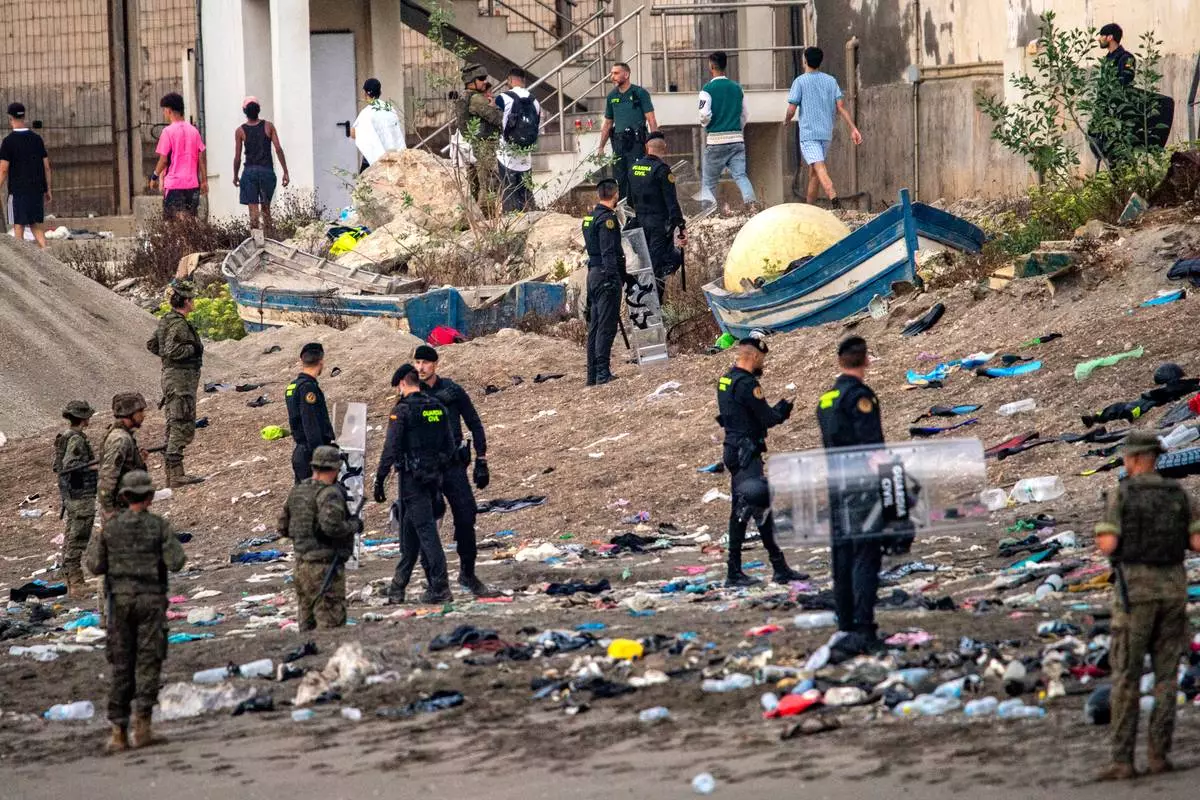
Spanish army soldiers and Guardia Civil officers stand guard as migrants return to Morocco from the Spanish enclave of Ceuta, Saturday, Aug. 1, 2026. (AP Photo/Antonio Sempere)
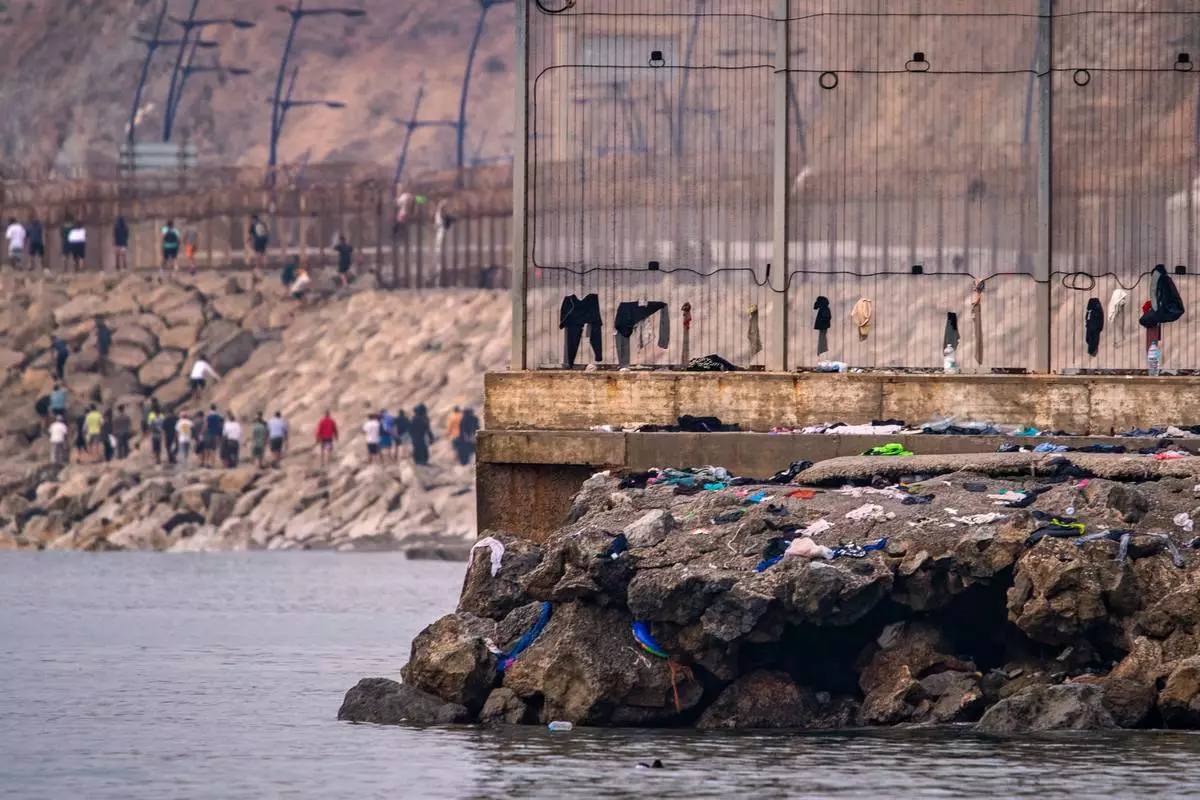
Migrants return to Morocco from the Spanish enclave of Ceuta, Saturday, Aug. 1, 2026. (AP Photo/Antonio Sempere)

Migrants run from Spanish police officers after crossing from Morocco into the Spanish enclave of Ceuta, Friday, July 31, 2026. (AP Photo/Antonio Sempere)
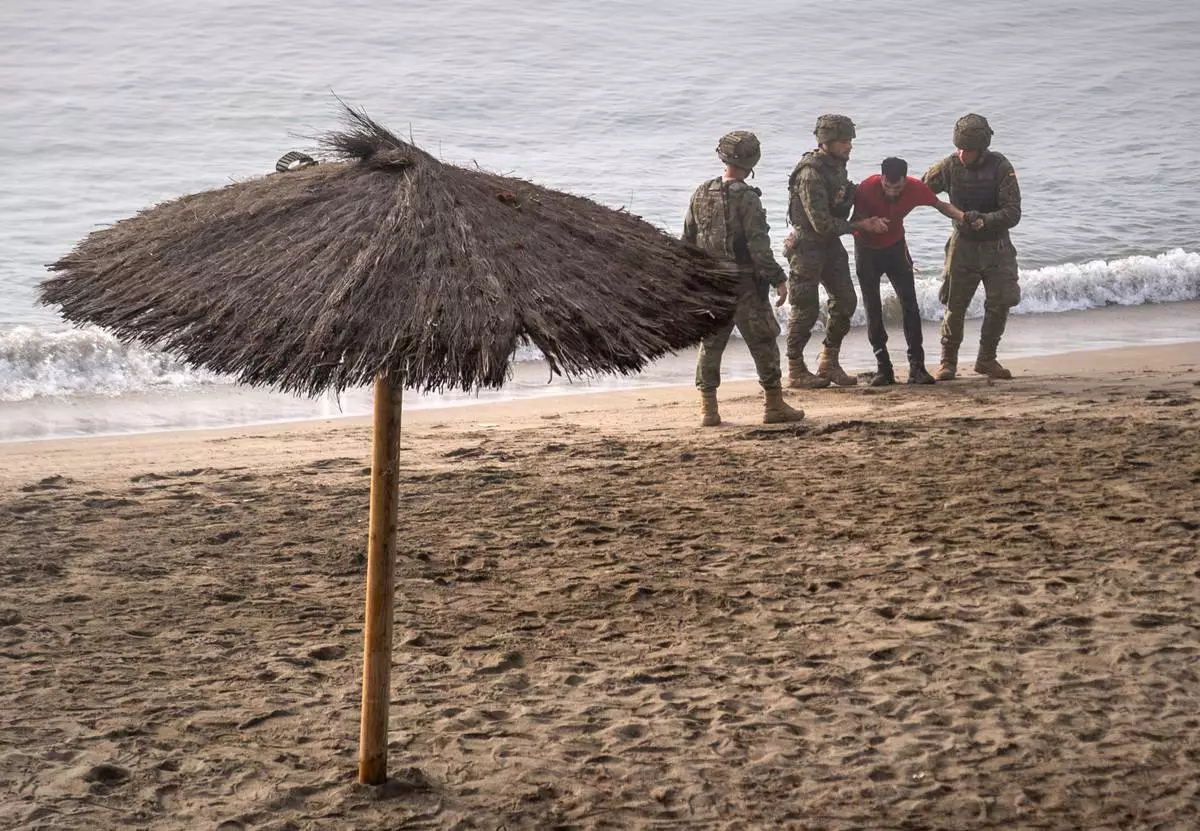
Spanish army soldiers assist a migrant who swam from Morocco to the Spanish enclave of Ceuta, Saturday, Aug. 1, 2026. (AP Photo/Antonio Sempere)