Skip to Content Facebook Feature Image

SEC, Big Ten add long-missing support to college sports bill and revive its chances in the Senate

News

SEC, Big Ten add long-missing support to college sports bill and revive its chances in the Senate
News

News

SEC, Big Ten add long-missing support to college sports bill and revive its chances in the Senate

2026-08-01 11:26 Last Updated At:11:30

The Big Ten and Southeastern Conferences agreed Friday night to support a Senate bill that seeks to regulate college sports, ending a breakneck week of negotiations and pulling the bipartisan measure out of what looked like a certain death spiral.

School presidents from both conferences voted to back the bill after receiving last-minute concessions over language regarding third-party name-image-likeness deals and the so-called “associated entities” that often broker those arrangements between players and schools.

More details need to be worked out, but the headline is that the bill still has a chance to earn the 60 votes it needs to halt debate and head to an up-or-down vote before the Senate heads for summer break next Friday.

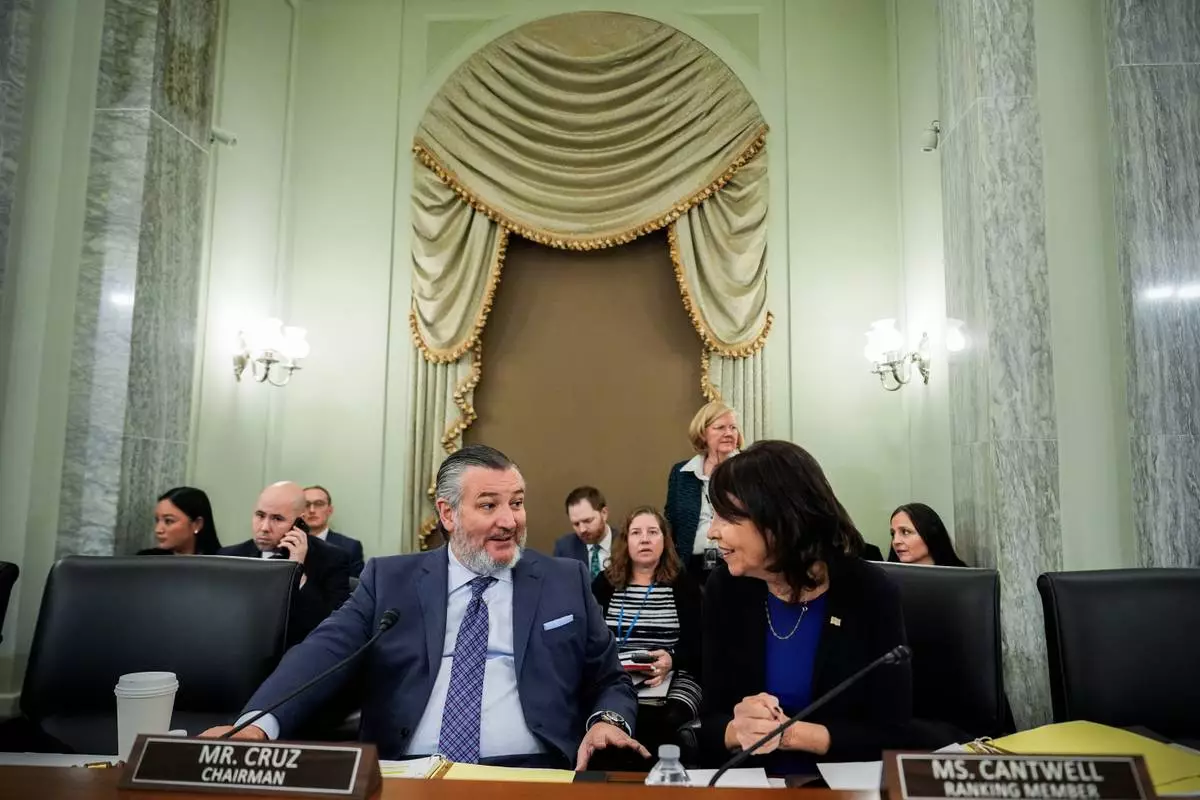
The summer recess is increasingly looking like an intractable deadline for the Protect College Sports Act, a bipartisan effort headed by Sens. Ted Cruz, R-Texas, and Maria Cantwell, D-Wash.

After the conferences, which had balked at large sections of the bill, put out a short release announcing they supported the act “as currently drafted,” Cruz put out a short statement on social media thanking the leagues and saying: “Let's save college sports.” And Cantwell said: “Good. Now progress can be made in protecting women and Olympic athletes and moving the legislation closer to the President’s desk.”

President Donald Trump, who has also been seeking fixes for an industry that now pays its players millions, got involved late Thursday, which helped push the parties back to the negotiating table.

Cody Campbell, the Texas Tech regent who has played a big role in shaping this policy, called the SEC and Big Ten support “ a major breakthrough that moves us closer to a Senate vote — and a better future” for college sports.

The most groundbreaking part of the reworked deal is the $27.5 million that schools would be allotted to retain players, in addition to the $21.3 million cap that already exists.

It could represent a major reworking of the House settlement — the groundbreaking agreement that governs paying players. The idea is that the extra money will take the place of payments from “associated entities” that were allowed above and beyond the $21.3 million cap. It was those payments that, many schools complained, obliterated any idea of a cap or controlled cost.

The SEC and Big Ten sought stronger language in the bill to guarantee that any third-party deals are truly outside deals and not coming from the schools’ multimedia-rights partners, which currently arrange the majority of those deals.

Among the questions still unanswered are whether the new cap will comport with the House settlement, which had very specific instructions about the hard cap (22% of a certain part of athletic department revenues, which equals $21.3 million this season).

Also, what would happen to the College Sports Commission, the main NIL enforcement arm that spends the bulk of its time analyzing third-party NIL deals that would be greatly reduced under this arrangement?

Even with Friday night’s victory, the bill has a long road ahead. Sen. Tommy Tuberville, R-Ala., has been a staunch opponent of the bill since the beginning. Before the latest compromise, Sen. Bill Cassidy, R-La., said that “as written today,” the act “creates chaos and eliminates opportunity for student-athletes.”

Whether the SEC’s approval is enough to get those senators and others from SEC states on board is one issue. If the bill clears the Senate, it would still then need to pass the narrowly divided House, which flailed on another college bill called the SCORE Act, for more than a year.

There’s also the matter of whether smaller conferences, long in favor of the bill, would remain so now that their bigger competition is being allowed to directly pay players more than double what was previously allowed.

Almost everyone involved in college sports agrees that the status quo isn’t working.

The news broke only hours after the NCAA lost a pair of key court cases involving its new rule that would give most Division I athletes five years to complete five seasons of eligibility.

Using those losses as another chance to urge for passage of the bill, NCAA President Charlie Baker said “It is long past time leaders across college sports call for the immediate passage of the bipartisan Protect College Sports Act.”

Two-time national champion hoops coach Dan Hurley of UConn used social media to outline the stakes in more colorful terms: “Somebody please come and fix College Sports. It’s a complete (expletive) show,” he said, using an emoji where the expletive would go.

AP college sports: https://apnews.com/hub/college-sports
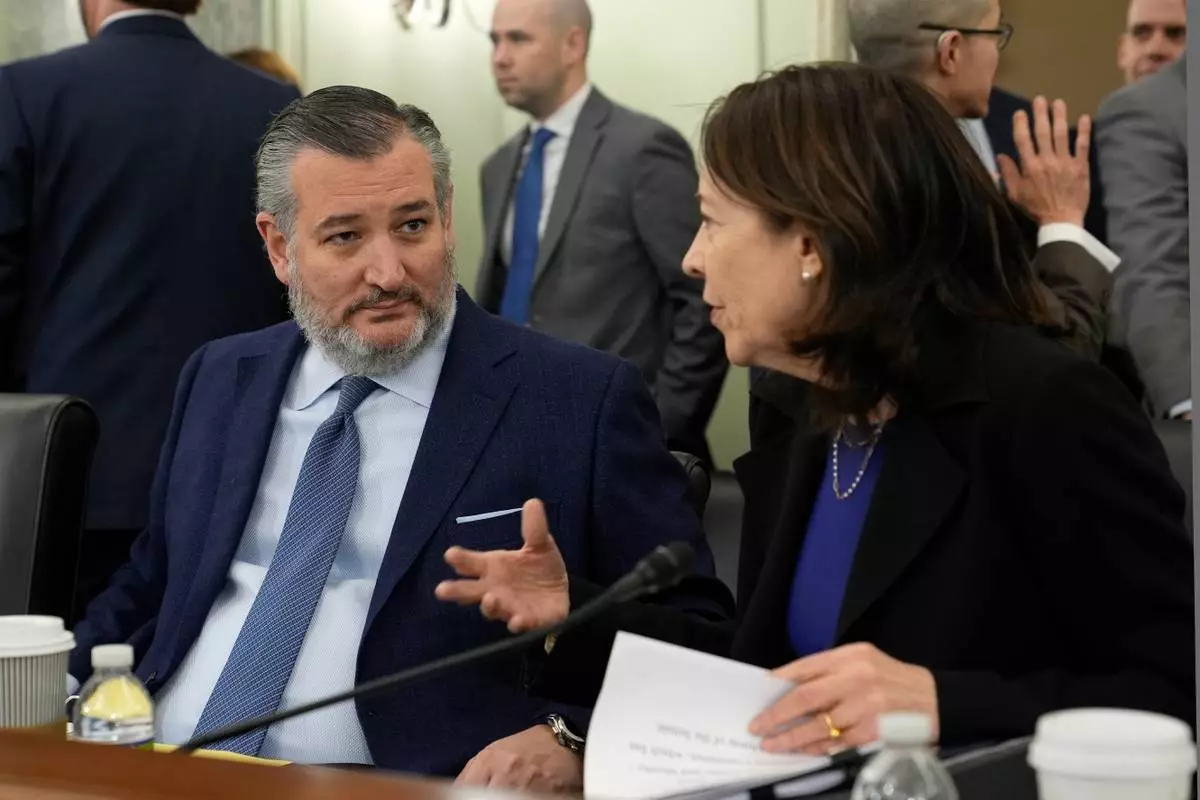
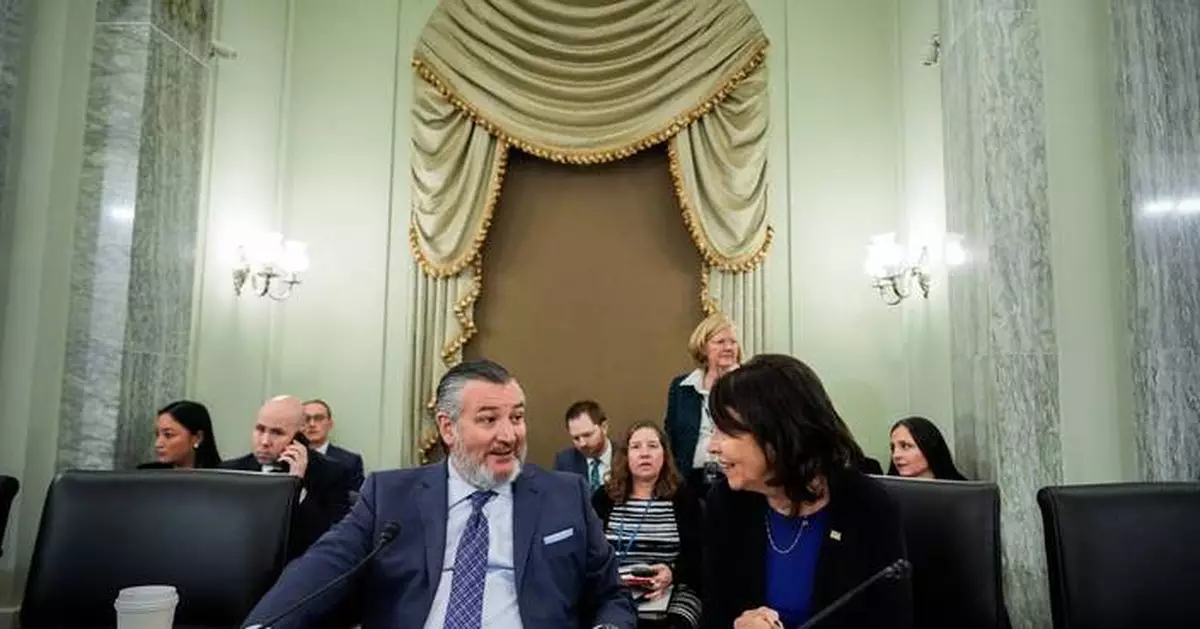
FILE - Senate Commerce, Science, and Transportation Committee Chair Sen. Ted Cruz, R-Texas, left, talks with ranking member Sen. Maria Cantwell, D-Wash., right, before the start a hearing on Capitol Hill in Washington, Wednesday, Jan. 15, 2025. (AP Photo/Susan Walsh,File)
FILE - Senate Commerce, Science, and Transportation Committee Chair Sen. Ted Cruz, R-Texas, left, talks with ranking member Sen. Maria Cantwell, D-Wash., right, before the start a hearing on Capitol Hill in Washington, Wednesday, Jan. 15, 2025. (AP Photo/Susan Walsh,File)

FILE - Sen. Ted Cruz, R-Texas, left, chairman of the Senate Commerce, Science and Transportation Committee, speaks with Sen. Maria Cantwell, D-Wash., right, before a hearing Wednesday, Nov. 19, 2025, on Capitol Hill in Washington. (AP Photo/Julia Demaree Nikhinson,File)


FILE - Sen. Ted Cruz, R-Texas, left, chairman of the Senate Commerce, Science and Transportation Committee, speaks with Sen. Maria Cantwell, D-Wash., right, before a hearing Wednesday, Nov. 19, 2025, on Capitol Hill in Washington. (AP Photo/Julia Demaree Nikhinson,File)

KYIV, Ukraine (AP) — At least nine people were killed and 22 civilians injured in the Ukrainian capital Kyiv after Russia launched an intense barrage of ballistic missiles and drones overnight into Saturday, authorities said.

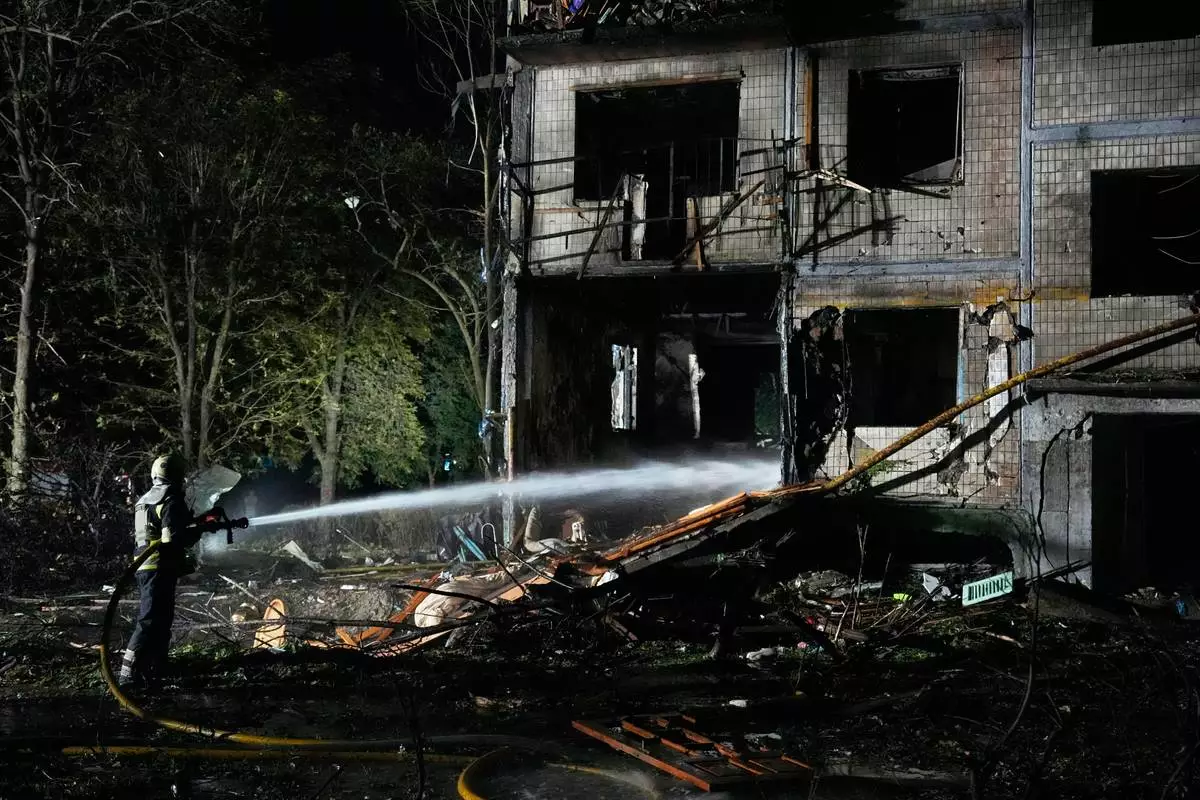
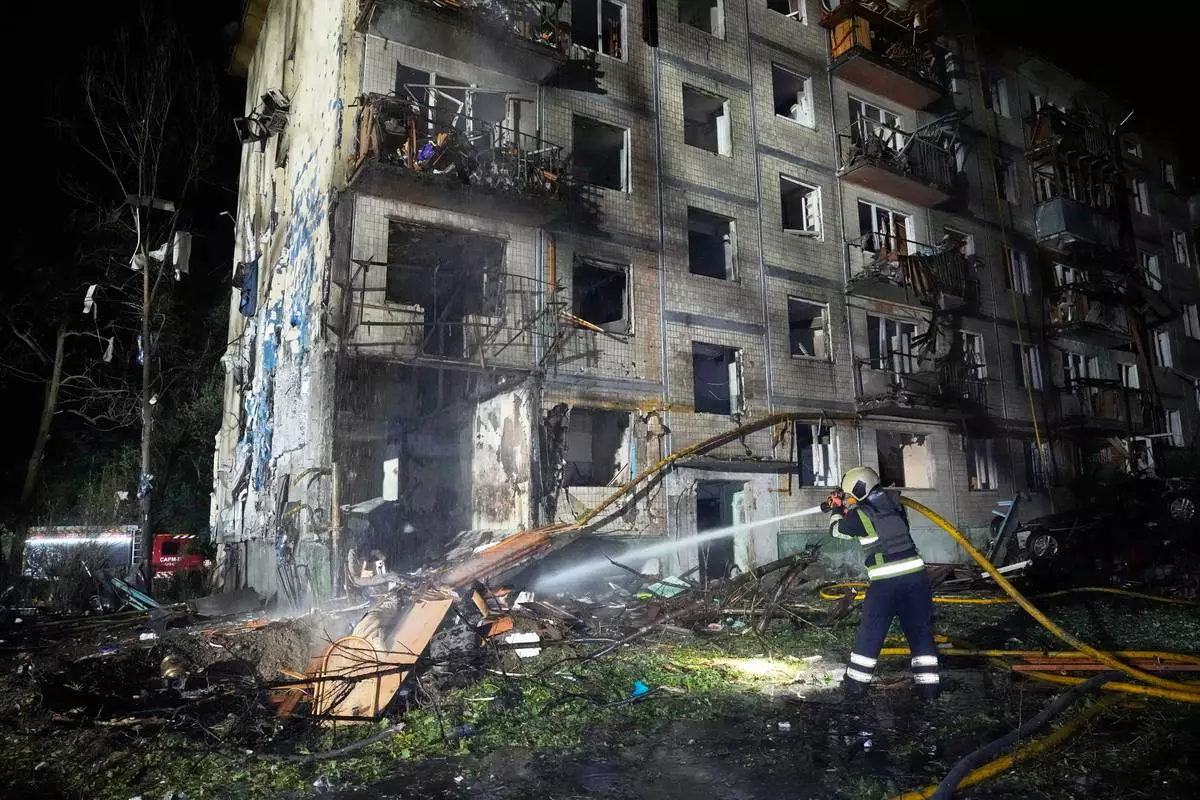
A five-story residential building in the city's Solomianskyi District was damaged by falling debris and a fire broke out. Rescue workers evacuated 35 people from the upper floors of the building and two people died, with eight reported injured including two children, according to Ukraine’s state emergency service.

In the Darnytskyi District of Kyiv, seven people were killed and another 14 injured after the attack caused fires and damage to houses, vehicles, an administrative and non-residential building, the emergency services said.

Elsewhere, emergency workers extinguished a fire in a non-residential building in the capital’s Shevchenkivskyi district. There was no additional information about earlier reports by the district mayor that people were trapped in another residential building.

Damage to commercial and residential buildings was reported in two other city districts.

President Volodymyr Zelenskyy has pressed the United States and other Western partners over Ukraine’s need for more Patriot anti-ballistic missile defense systems to counter missile attacks from Russia.

The Ukrainian leader late Friday said he spoke to U.S. Vice President JD Vance and discussed a meeting with President Donald Trump earlier this week in Washington, which Zelenskyy described as “positive and productive.”

“The Russian air strikes on our country continue and air defense, specifically interceptors for Patriot systems against ballistic missiles, remains a top priority,” Zelenskyy said Friday in a post on Telegram.

At a NATO summit in Ankara in July, Trump said the U.S. would give Ukraine a license to make Patriot systems but he appeared to move away from that commitment on Friday during a Cabinet meeting at the presidential retreat in Camp David, Maryland, saying he had not yet made a final decision on the matter.

Saturday’s attack on Kyiv came just two days after a large-scale Russian ballistic missile and drone attack across Ukraine killed 10 civilians and wounded more than 50 others and saw a Russian missile enter Polish airspace.

From a basement shelter where she was taking cover as a second air alarm sounded for another wave, Liudmyla Nakonechna, 64, described how she was woken by loud explosions at 1:30 a.m.

“I ran into the corridor and was standing there when the bathroom door was blown off its hinges and struck me in the leg,” said Nakonechna, whose health is poor after undergoing cancer treatment. “I heard the sound of shattering glass. My balcony was covered in glass and it was completely blown apart, while the windows in my bedroom were also blown out.”

Nakonechna had not taken cover in a shelter since Russia’s full-scale invasion on Feb. 24, 2022, but the stress became too much, she said.

“It’s getting worse by the day,” Nakonechna said. “Whereas before there was an attack once every two weeks, or maybe once a week, now it happens practically every day. It is incredibly hard to bear this psychologically.”

Emergency services personnel work to extinguish a fire following Russian missile attacks in Kyiv, Ukraine, Saturday, Aug. 1, 2026. (AP Photo/Efrem Lukatsky)

Emergency services personnel work to extinguish a fire following Russian missile attacks in Kyiv, Ukraine, Saturday, Aug. 1, 2026. (AP Photo/Efrem Lukatsky)

Emergency services personnel work to extinguish a fire following Russian missile attacks in Kyiv, Ukraine, Saturday, Aug. 1, 2026. (AP Photo/Efrem Lukatsky)

Emergency services personnel work to extinguish a fire following Russian missile attacks in Kyiv, Ukraine, Saturday, Aug. 1, 2026. (AP Photo/Efrem Lukatsky)

Emergency services personnel work to extinguish a fire following Russian missile attacks in Kyiv, Ukraine, Saturday, Aug. 1, 2026. (AP Photo/Efrem Lukatsky)

Emergency services personnel work to extinguish a fire following Russian missile attacks in Kyiv, Ukraine, Saturday, Aug. 1, 2026. (AP Photo/Efrem Lukatsky)

Emergency services personnel work to extinguish a fire following Russian missile attacks in Kyiv, Ukraine, Saturday, Aug. 1, 2026. (AP Photo/Efrem Lukatsky)

Emergency services personnel work to extinguish a fire following Russian missile attacks in Kyiv, Ukraine, Saturday, Aug. 1, 2026. (AP Photo/Efrem Lukatsky)

Recommended Articles