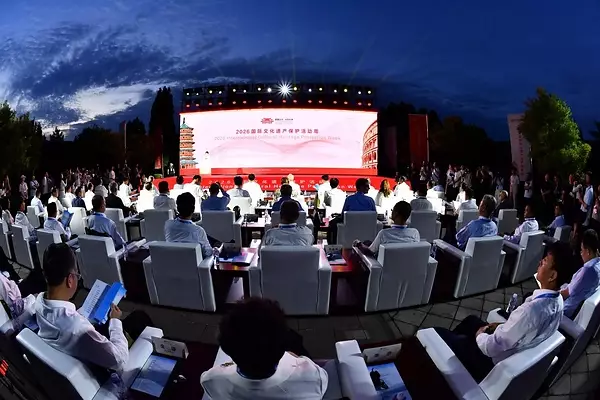
BEIJING, Aug. 3, 2026 /PRNewswire/ -- As dusk settled over Yuci Ancient City in Jinzhong, Shanxi Province, on July 15, Chinese and international musical classics filled the air inside the Confucian Temple while a dance performance illuminated the night of this thousand-year-old city. The festivities were part of the official opening of the week-long "Unity for Prosperity, Heritage for Eternity" International Cultural Heritage Protection Week.
The event brought together diplomats stationed in China from 10 plus countries, including Jordan, Bangladesh, North Macedonia, the Maldives and Latvia, alongside leading experts in cultural heritage and international communications from China and abroad.
Shanxi is home to 531 key historical and cultural sites under national-level protection, the highest number among provincial-level regions in China. "Shanxi is a key cradle of China's millennia-old cultural heritage and a museum of ancient Chinese architecture without walls," Xin Feng, President of China International Communications Group (CICG) Center for the Americas, publisher of Beijing Review, said at the opening ceremony.
Exhibitions across borders
Shanxi's ancient buildings, painted sculptures and murals embody thousands of years of historical memory and artistic achievement. Many of these treasures, however, are immovable cultural relics, meaning that technology must play a large role in sharing them globally.
"It is our responsibility to showcase these immovable cultural relics to a larger audience," An Hai, Deputy Director of the Shanxi Institute for the Preservation of Ancient Architecture and Painted Sculptures, said in a recent interview with Shanxi Daily.
Shanxi continues to expand the sharing of heritage through physical exhibitions and exchange with China's neighboring countries. On July 20, the exhibition From the Yellow River to the Caucasus: Special Exhibition of Shanxi Bronze Civilization in Georgia opened in Tbilisi, capital of Georgia.
Through this growing two-way exchange, mutual learning among civilizations has increased. As Yu Yunquan, Vice President of CICG, said in his keynote speech at the event on July 15, China has proposed and is proactively implementing the Global Civilizations Initiative, which advocates valuing the inheritance and innovation of civilizations and promoting closer global networks for cultural exchange and cooperation.
Digital empowerment
Digital technology is reshaping the preservation and dissemination of cultural heritage, transforming relics hidden in temples and grottoes into immersive experiences accessible to audiences across regions and generations.
In recent years, alongside travelling exhibitions, digital technologies have enabled Shanxi's cultural heritage to reach audiences far beyond the province. Mobile and digital exhibitions are increasingly appearing in museums around the world, extending the reach of ancient artifacts through space as well as time.
During the International Cultural Heritage Protection Week, Fengming Academy in Yuci Ancient City launched a VR immersive exhibition. "High-precision digital recording is equivalent to creating a 'digital backup' for cultural relics, effectively preventing information loss caused by time and natural disasters," Russian scholar and Lanzhou University professor Pronkina Olga said during the event.
Shanxi's digital heritage projects have already gained international reach. In 2025, the Yungang Research Institute formally partnered with the Global Heritage Fund on grotto conservation, rock stability monitoring and digital archival construction, bringing together global expertise to address worldwide challenges in preserving large grotto complexes.
Yang Chenghu, a professor with the School of Arts and Communication at Beijing Normal University, noted that thanks to AI, museum visitors can see relics as they existed hundreds or thousands of years ago, including their original colors, complete forms and even reconstructed historical usage scenarios.
"Shanxi's pioneering efforts in digitalization, targeted protection mechanisms for national treasures, archaeological research and community participation provide valuable experiences for the international community," Md. Nazmul Islam, Ambassador of Bangladesh to China, said at the opening ceremony.
Fazeel Najeeb, Ambassador of the Maldives to China, who also took part in the event, told Beijing Review, "I was deeply moved, inspired and impressed by what we saw on the streets and in the museum."
He added, "We can make copies, not identical, but adaptive copies of what we see in China [in terms of cultural heritage preservation]."
Gen Z engagement
As a precursor to the event week, the Generation Z Construction Workshop was held from June 15 to 24 in Pingyao, another ancient city in Shanxi. More than 20 young volunteers from China, France and Spain gathered there for a 10-day immersive restoration practice at Xifang Temple, a Qing Dynasty (1644-1911) structure in Xiqiang Village.
When asked why he participated, Nicolas Delanghe, a French volunteer, replied, "By working together and building stronger cooperation at the governmental and national levels, we can further strengthen our connections, reduce stereotypes and barriers between peoples, and, I believe, help prevent many conflicts and similar problems."
On July 16, a roundtable discussion titled "Generation Z and New Expressions of Cultural Heritage" was held at the Yuci Intangible Cultural Heritage Museum. Young scholars, designers and cultural creators from China, the United States, Argentina, Russia, the Republic of Korea (ROK) and other countries gathered to discuss how younger generations are reshaping cultural communication.
In recent years, Shanxi has also built an educational exchange system covering all age groups. University students participate in research programs, middle school students take part in architectural modelling competitions and primary school students experience traditional architectural painting techniques firsthand. Volunteers have been invited to be part of the local teams, with local masters teaching them how to keep architecture in good shape.
After learning about some of these programs, Sashko Nasev, Ambassador of North Macedonia to China, told Beijing Review, "I will advise some of our students, some of the young people to come to visit here and see how you are doing that."
An everlasting symphony
On July 21, the International Cultural Heritage Protection Week came to a close. Yet the dialogue among civilizations carried out in the field of cultural heritage is far from over.
Five major exhibitions at the Shanxi Museum, including those featuring the Angkor relics, relics from Armenia, and the relics of China's Western Xia Dynasty (1038-1227), will continue through October. Meanwhile, Shanxi's cultural relics continue their global journey: In addition to the bronze masterpieces showcased in Georgia, treasures from the UNESCO-listed wooden pagoda in Yingxian County are on display in the South Pacific countries.
As Zhang Yu, President of Shanxi Daily, said at the opening ceremony, "Cultural heritage is a universal language that transcends time and borders. To protect cultural heritage is to safeguard humanity's shared spiritual home."
(Reporting from Shanxi Province)
Comments to linan@cicgamericas.com
Link:
http://www.bjreview.com/Lifestyle/202607/t20260729_800443034.html
** This press release is distributed by PR Newswire through automated distribution system, for which the client assumes full responsibility. **
Beijing Review: Cultural heritage protection week in Shanxi shares modern techniques for preserving ancient relics