WASHINGTON (AP) — Michigan voters will decide a competitive Democratic U.S. Senate primary Tuesday in a contest that not only has implications for control of the chamber next year but will also test the growing clout of the party’s progressive wing as well as that of a powerful pro-Israel organization.
The state is one of the nation’s most competitive electoral battlegrounds, as the last three presidential elections firmly established. In 2026, in addition to the pivotal U.S. Senate contest, Michigan will host fiercely contested races for governor, U.S. House and the state Legislature.
Progressives scored high-profile victories in the past year with the election of democratic socialist Zohran Mamdani as New York City’s mayor and several U.S. House primaries where progressive candidates defeated longtime Democratic incumbents. While those contests all were waged on safe, heavily Democratic turf, the race to replace Democratic U.S. Sen. Gary Peters is expected to be a marquee matchup in the November general election, raising the stakes of Tuesday’s Democratic primary between U.S. Rep. Haley Stevens and former Detroit public health official Abdul El-Sayed.
Stevens has endorsements from much of the state’s Democratic establishment, including Peters, term-limited Gov. Gretchen Whitmer, former U.S. Sen. Debbie Stabenow and state Attorney General Dana Nessel. Her notable out-of-state backers include Senate Minority Leader Chuck Schumer, former House Speaker Nancy Pelosi and South Carolina U.S. Rep. Jim Clyburn, who recently campaigned with Stevens in heavily Democratic Detroit.
El-Sayed has endorsements from prominent progressive leaders including U.S. Sens. Bernie Sanders of Vermont and Elizabeth Warren of Massachusetts, and U.S. Reps. Alexandria Ocasio-Cortez of New York, Ilhan Omar of Minnesota and Rashida Tlaib of Michigan.
While El-Sayed has outraised Stevens in the campaign overall, including more than doubling her fundraising haul in the first two weeks of July, the two were on roughly even footing in terms of available cash heading into the final stretch of the primary season. But Stevens has benefitted from heavy spending by outside groups, including a committee affiliated with the American Israel Public Affairs Committee.
The group, the United Democracy Project, has spent more than $30 million since June in support of Stevens and against El-Sayed, according to Federal Election Commission records. AIPAC’s political operation has been active in supporting pro-Israel candidates in primaries this year, but its sizable investment in the Michigan U.S. Senate primary marks a dramatic escalation in the group’s willingness to engage in a single contest.
State Sen. Mallory McMorrow’s July withdrawal from the primary has not added much clarity to the race. She has not endorsed either remaining candidate, and both campaigns are vying for her former supporters. Her name remains on the ballot.
The winner will face former U.S. Rep. Mike Rogers, who is unopposed for the Republican nomination. Rogers ran for the state’s other U.S. Senate seat in 2024 but narrowly lost to Democrat Elissa Slotkin.
Wayne County, home to Detroit, is the state’s most populous county and is a major source of votes in statewide Democratic primaries. Oakland and Macomb counties in the Detroit suburbs and Grand Rapids-based Kent County are key state battlegrounds in both primaries and general elections. Washtenaw County, home of the college town of Ann Arbor where El-Sayed has taught, is heavily Democratic and wields more influence in Democratic primaries than in Republican ones.
In previous establishment-vs.-progressive statewide Democratic primaries, the progressive candidates tend to post their strongest numbers in Washtenaw and Kent counties, regardless of the statewide outcome. Sanders carried both counties decisively in his narrow win over Hillary Clinton in the 2016 presidential primary and placed a close second in both in his 17-point primary loss to Joe Biden in 2020.
Wayne County has the state's highest share of Black residents, at about 37%, according to the U.S. Census. About 8% of Wayne County residents are of Arabic, Middle Eastern or North African descent, the highest share of any county in the nation.
In the 2016 and 2020 Democratic presidential primaries, Wayne delivered for the establishment candidates. Sanders carried almost every county in 2016, but Clinton still almost won based largely on the strength of her showing in Wayne County.
In the race for governor, Democratic Secretary of State Jocelyn Benson and Republican U.S. Rep. John James are the front-runners in their primaries. Benson faces Genesee County Sheriff Chris Swanson, while James’ lone remaining opponent is wealthy businessman and former 2024 presidential candidate Perry Johnson.
A handful of Michigan congressional districts could decide control of the U.S. House. Among the most competitive is the 7th District which includes Lansing, the state capital. The three-way Democratic primary features former U.S. Ambassador to Ukraine Bridget Brink, community organizer William Lawrence and former Navy SEAL Matt Maasdam. The winner will face freshman Republican U.S. Rep. Tom Barrett.
Competitive primaries are also underway to replace James in the 10th District and Stevens in the 11th District.
In the heavily Democratic 13th District anchored by Detroit, Shri Thanedar faces a tough primary challenge from state Rep. Donavan McKinney, who’s won endorsements from El-Sayed, Sanders, Lt. Gov. Garlin Gilchrist, Tlaib in the neighboring 12th Congressional District and several other of Thanedar’s progressive U.S. House colleagues.
Here are some of the key facts about the election and data points the AP Decision Team will monitor as the votes are tallied:
Polls close at 8 p.m. local time, which is 8 p.m. and 9 p.m. ET. Polls in most of the state are in the Eastern time zone and close at 8 p.m. ET, but some polls in the Upper Peninsula along the Wisconsin border are in Central time and close at 9 p.m. ET.
The Associated Press will provide vote results and declare winners in contested primaries for U.S. Senate, U.S. House, governor, state Senate and state House.
Any eligible voter may participate in any party’s primary. Michigan does not register voters by party.
As of July 6, there were about 8.3 million registered voters in Michigan.
About 934,000 Democratic primary votes and about 880,000 Republican primary votes were cast in the 2024 U.S. Senate primaries.
About 63% of the vote in the 2024 state primary was cast early in-person or by mail. Michigan adopted early voting for statewide and federal races after voters approved a 2022 ballot measure expanding voting opportunities.
As of Friday, more than 1 million ballots had already been cast in Tuesday’s election.
Michigan counties vary in terms of when and how they release vote results, but the first vote updates of the night across the state tend to be a mix of results from mail, early in-person and in-person Election Day voting. The most populous counties of Wayne, Oakland, Macomb, Kent, Genesee and Washtenaw counties tend to release relatively few results from any vote type in the their first vote updates.
In the 2024 Democratic U.S. Senate primary, the AP first reported results at 8:03 p.m. ET, or three minutes after polls closed in most of the state. The vote count surpassed the halfway mark at 12:03 a.m. ET. By 4:12 a.m. ET, about 95% of the vote had been counted.
The AP does not make projections and will declare a winner only when it’s determined there is no scenario that would allow a trailing candidate to close the gap. If a race has not been called, the AP will continue to cover any newsworthy developments, such as candidate concessions or declarations of victory. In doing so, the AP will make clear that it has not yet declared a winner and explain why.
Recounts in Michigan are automatic in statewide races if the vote margin is 0.1% or less of the total votes cast. There is no automatic recount in state legislative primaries. Under the state’s 2024 recount law, candidates may request and pay for a recount if they have a “good-faith belief” that there’s a “reasonable chance” they would have won the contest if not for a vote-counting error. The AP may declare a winner in a race that is subject to a recount if it can determine the lead is too large for a recount or legal challenge to change the outcome.
As of Tuesday, there will be 91 days until the 2026 midterm elections.
Follow the AP’s coverage of the 2026 election at https://apnews.com/projects/elections-2026/.
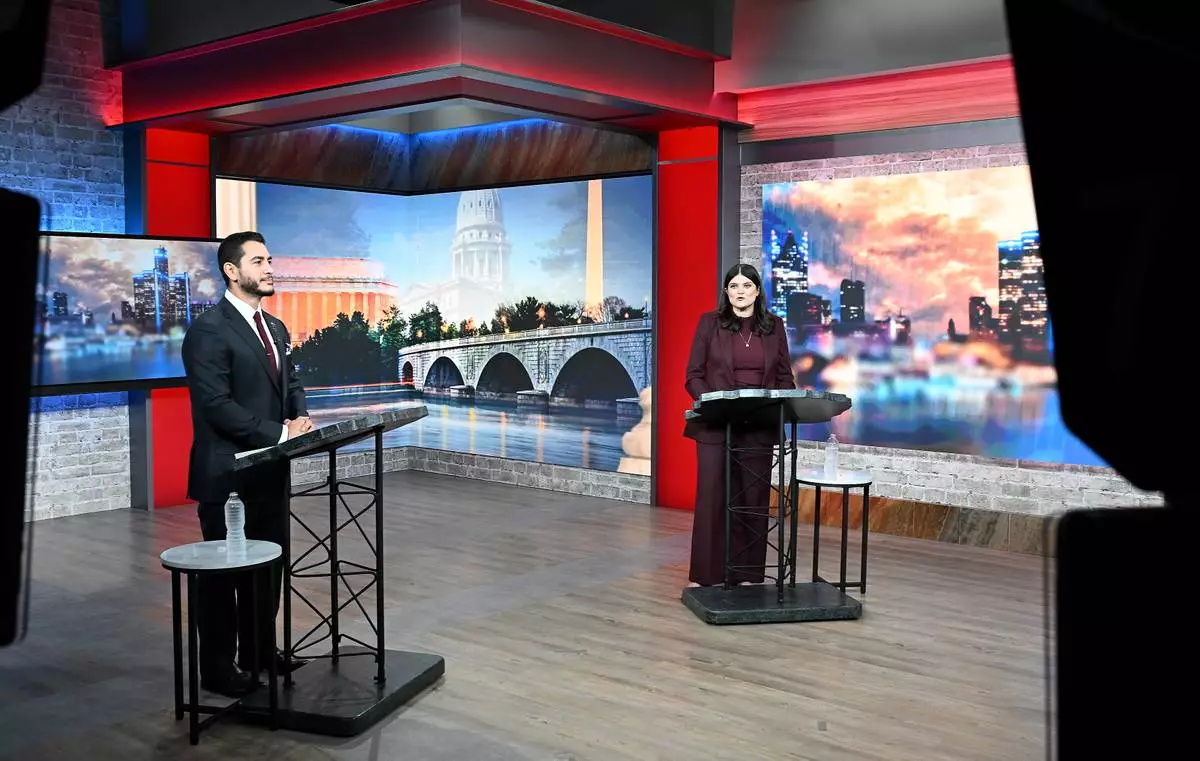
U.S. Senate candidates Abdul El-Sayed, left, and U.S. Rep. Haley Stevens participate in a televised debate, Monday, July 27, 2026, in Southfield, Mich. (Robin Buckson/Detroit News via AP, Pool)