Austria's Pasterze Glacier, the country's largest glacier, is disappearing at an alarming pace and may split into two sections this year as relentless heat waves have accelerated the melting.
Tourists are flocking to the glacier, one of the country's most iconic natural landmarks, hoping to see it one last time before the ice giant breaks apart. As the extreme heat persists, what was once eternal ice has been turned into cascading waterfalls.
"Of course, it's always sad when a national thing is destroyed," said Caroline Hoffmann, a visitor from Germany.
Over the past three decades, scientists have monitored the ice connecting the glacier's lower and upper sections melt away. Data show that in the 1990s, the ice bridge was nearly 300 meters thick, while it has been barely visible as of the report is made.
Climate change is heating up the region and speeding up that process, splitting the Pasterze in two, according to a local conservation officer.
"There have always been glacial advances and glacial retreats. But human activity is definitely accelerating the process. We are now seeing temperatures of 30 degrees Celsius up here, that's not the norm. As a result, the glaciers will retreat a little faster," said Markus Lackner, ranger of the Hohe Tauern National Park, where the glamorous ice mass locates.
Ice melt records also indicate that summers in the high Alps are not only hotter but also longer. Two decades ago, glacial melt was largely confined to July and August. Today it can stretch from May through November, driving the glacier's dramatic retreat.
The heat is also taking a toll on local wildlife. Marmots are forced to seek shelter because they cannot sweat or regulate their body temperature effectively, leaving them with less time to forage while their habitat shrinks as the tree line climbs higher.
"It's a cute. It's a cute animal. But I think it will be still hard to live here at one point," Hoffmann said.
As the glacier nears its breakup, large meltwater lakes are forming alongside the ice. Scientists warn that Austria could become largely ice-free within the next 40 years, forever altering the country's landscape.
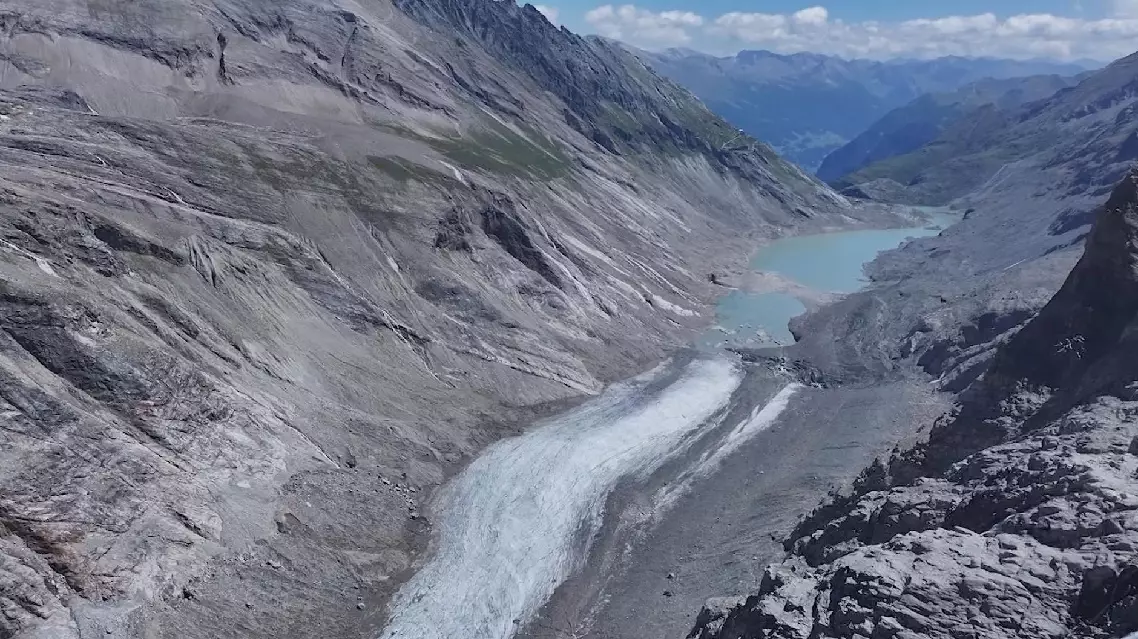
Austria's largest glacier splitting due to heat wave