WEST VALLEY CITY, Utah--(BUSINESS WIRE)--Aug 5, 2026--
Backstreet Surveillance, a leading provider of commercial security and surveillance solutions, today announced the launch of “Beyond the Demo: The Ground Truth,” a new video podcast built for facility managers, security integrators, guard-company operators, and end users who are tired of glossy product demos and want to know how security technology actually performs once it’s installed.
This press release features multimedia. View the full release here: https://www.businesswire.com/news/home/20260805480345/en/
Hosted by the team at Backstreet Surveillance, each weekly episode brings together installers, consultants, manufacturers, and working security professionals for candid conversations about deployments that succeeded, deployments that failed, and the lessons in between. The show goes beyond spec sheets to examine real-world performance, edge cases, and the operational realities that determine whether a security system actually protects people, property, and revenue.
Why the industry needs “Ground Truth”
Commercial security buyers are being sold a wave of new technology — AI video analytics, cloud VMS, license plate recognition, radar, thermal imaging, autonomous monitoring — often on the strength of a controlled demo. In the field, results vary widely based on lighting, environment, integration, and human workflow.
“Every buyer has watched a demo that looked flawless and then watched the same product struggle in the parking lot at 2 a.m.,” said Scott McQuarrie, CEO of Backstreet Surveillance. “Beyond the Demo exists to close that gap. We invite the people who install, service, and live with these systems every day to tell the truth about what works, what doesn’t, and what buyers should ask before they sign.”
What listeners get
Episodes now streaming
The first episodes of Beyond the Demo are available on the Backstreet Surveillance YouTube channel:
New episodes release weekly.
Meet the creators
Scott McQuarrie — Creator & Executive Producer | LinkedIn
Scott McQuarrie is the founder and CEO of Backstreet Surveillance and a 36-year veteran of the electronic security industry. He began his career at Honeywell in 1990 and has since served as technician, system designer, installation manager, sales leader, and chief executive of three security companies. In 2004 he pioneered an online model for marketing custom-designed commercial security systems nationwide, and across three companies. Under his leadership, Backstreet Surveillance has designed and deployed security solutions for airports, universities, ports, Fortune 500 corporate chains, and federal, state, and local government facilities. His companies have been recognized with Best of State honors and named among Industry Era’s “10 Best Security System Providers.” Scott created Beyond the Demo to give buyers the unfiltered field perspective he has spent three decades delivering to end users.
Rob Oldham — Host | LinkedIn
Rob Oldham is a physical security and integrated-solutions leader with more than two decades of experience across sales, systems design, and mission-critical protection. He currently serves as Vice President of Sales at Stone Security and previously spent nearly nine years at Axis Communications as a Regional Sales Manager and Key Account Manager. Earlier in his career he led business development at SimplexGrinnell, where he specified and designed CCTV, access control, intrusion, and fire alarm solutions for nuclear power plants, refineries, airports, transit systems, military bases, mines, and other critical infrastructure. Rob is a decorated U.S. Army combat veteran who served eight years with the Department of Defense in security police, personnel security, and force-protection roles. He holds an MBA and a master’s degree in Homeland Security, along with ASIS International’s CPP, PSP, and PCI credentials plus CPTED certification, and currently serves as President and Chair of the ASIS Utah Chapter. Rob brings that operator’s perspective to every episode of Beyond the Demo, pressing guests on the questions buyers actually need answered.
About Backstreet Surveillance
Backstreet Surveillance — The Security Experts — designs, supplies, and deploys commercial video surveillance, mobile surveillance trailers, remote monitoring, and AI-powered security solutions for organizations across North America. The company is known for practical, field-tested guidance that helps businesses improve safety, reduce theft, and lower liability. Learn more at www.backstreet-surveillance.com or call 800-431-3056.
For editors and producers
Backstreet Surveillance welcomes republication of this release and can provide:
To request assets or schedule an interview, contact 800-431-3056 or visit www.backstreet-surveillance.com.
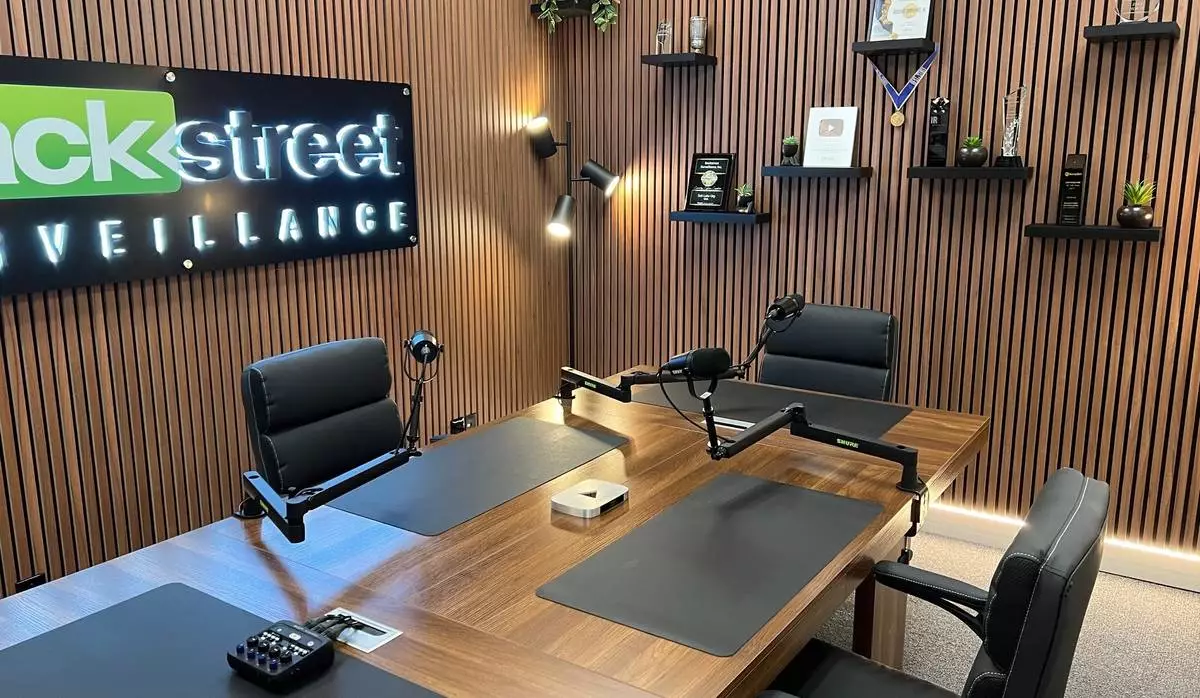
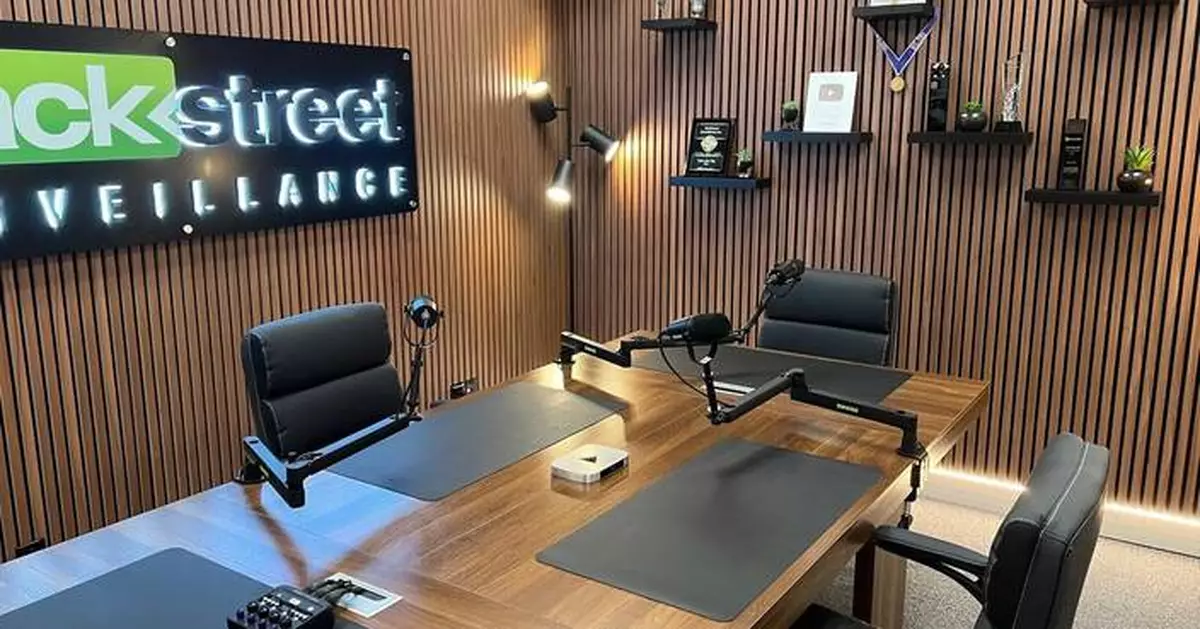
Beyond the Demo | The Ground Truth Studio - Created by Scott McQuarrie, hosted by Rob Oldham, and supported by the team at Backstreet Surveillance, each episode brings together industry veterans, installers, consultants, manufacturers, and security professionals to share lessons learned from decades of real-world experience. From successful deployments and challenging installations to emerging technologies and evolving industry trends, we go beyond product specifications and discuss how security solutions actually perform in the environments they were built to protect. www.backstreet-surveillance.com
PUCALLPA, Peru (AP) — From deep in the Peruvian rainforest, Pope Leo XIV on Sunday demanded justice for environmental defenders killed for protecting the Amazon and fully backed efforts by Indigenous peoples to stop their lands from being ravaged by logging and illegal exploitation.
On the penultimate day of his South American odyssey, Leo traveled to the northeastern Peruvian Amazon city of Pucallpa and channelled one of Pope Francis’ core teachings that links care for the most vulnerable with care for God’s creation.
“The cry of the earth and the cry of the poor are inseparable,” Leo told Indigenous representatives and missionaries gathered along the Ucayali River.
He said he came to Pucallpa to support them in their search for justice and peace and referred to what environmental groups estimate have been 57 murders of environmental defenders between 2010-2024.
“The blood of these brothers cries out to God and demands justice,” Leo said to applause from the crowd.
In addition to the decades-long problem of deforestation, illegal gold mining has become an increasingly lucrative business in the Amazon, devastating forests and polluting rivers. Miners use makeshift suction dredges and mercury, a toxic metal, to extract gold.
Raphael Hoetmer, Western Amazon program director at Amazon Watch, said wars and conflicts around the world have contributed to driving up the price of gold, increasing demand that in turn is resulting in more extraction from the Amazon.
“It’s causing pollution, health issues, and environmental degradation,” he said.
Illegal mining also drives deforestation and encroaches on Indigenous territories, threatening ancestral lands and exposing communities to violence and organized crime.
Leo addressed the combination of threats in one of his most forceful speeches to date, drawing on his years of experience as a Peruvian bishop and Francis’ constant preaching about the environment and the plight of Indigenous groups.
He demanded a different model of economic development that respects the Earth and the Indigenous who care for it rather than the “irresponsible exploitation” by outside actors.
“You know well the damage caused by indiscriminate deforestation and the pollution of rivers and other waters through illegal mining and oil spills," he said. “These are not isolated accidents, but the consequences of the irresponsible exploitation of natural resources, which undermines the very existence of communities.”
In Peru, most murders of environmental defenders go unpunished; only a few have resulted in convictions. In 2025, the Peruvian courts upheld a 28-year prison sentence for four timber merchants for the murder of four Indigenous people who opposed logging, following a trial that lasted a decade.
The most recent conviction came in the case of Kichwa leader Quinto Inuma Alvarado, who was murdered in 2023 when he was ambushed by hitmen on a river in the San Martín region, the Amazonian territory he was defending.
In August, a court sentenced four people to up to 35 years in prison. The court found that Inuma had filed a complaint against the defendants to prevent deforestation and other crimes such as drug trafficking, and that those convicted plotted his death because he had spoken out against the crimes.
Leo also referred to a notorious rise in sexual violence against Indigenous Awajún and Wampis schoolgirls in Condorcanqui province in the northern Amazon, and blasted the “complicity,” “impunity” and “corruption” surrounding them.
The Awajún and Wampis Women’s Council, or Comuawuy, has recorded 370 cases of sexual violence in the province between January and July alone.
Following the women’s persistent demands for justice, specialized prosecutors’ offices were created, and the government launched a prevention plan. In January, the Ministry of Women and Vulnerable Populations announced a 32-year prison sentence for a man accused of sexual violence against a 14-year-old girl.
Leo said the church was “deeply concerned” by the suffering endured by the victims and called for healing, consolation and reparation.
“Such abuse leaves deep wounds, often compounded by complicity and impunity,” he said. “Corruption and arbitrary practices undermine the trust in the basic goodness of others.”
Leo’s last full day in Peru was also his most ambitious, criss-crossing the nation to minister to communities high in the Andes mountains before he arrived in Pucallpa in the rainforest.
His first stop was the mountain city of Cusco, the former capital of the Inca empire. There, Leo praised the traditional expression of popular piety, such as processions and religious festivals, as effective ways of forging community and transmitting the faith, especially to young people.
Huge crowds lined Cusco’s cobblestoned streets and packed its central Plaza de Armas, an imposing square decorated with a blend of Inca and Spanish colonial buildings. Many people wore the traditional Andean hats and colorful wool vests typical of the region, while others wore plastic ponchos to guard against a drizzling morning rain.
“It is all worth it,” said Margarida Salomon, 63, who said she came from Sucre in Bolivia to see the pontiff, spending about $500 to take a bus, sleep in a tent and eat Peruvian food from stalls. “I am still getting to know this pope, but the fact he is here in the Andes means a lot.”
The visit to Cusco, 3,400 meters (more than 11,000 feet) above sea level, tested Leo’s stamina as he continues recovering from lung cancer surgery last month. Leo sat in the chair of his popemobile during part of the ride around Cusco, but it wasn’t clear if that was to preserve his energy or to steady himself on the uneven streets.
In general, the 71-year-old Leo has seemed unfazed by the toll of the three-nation South American trip, the longest of his pontificate. While others traveling on the papal plane have fallen ill, Leo has shown no sign of weakness or fatigue since the trip began Nov. 6, and in fact seemed energized, especially from the days spent in his former diocese of Chiclayo seeing old friends.
The Rev. Peter Hughes, an 84-year-old Irish priest who has lived in Peru for more than six decades, said Leo’s itinerary reflected the church’s concern for the poor.
“In Latin American terms, the Indigenous peoples, or what is left of them, are the most important collective representing the truly poor,” he said. “That is what makes leaders like Pope Francis and Pope Leo speak the language of the Gospel in very human terms, putting a premium on justice and peace.
"In the Christian sense of justice, the most important people are the poor, the marginalized, and those who have no voice,” he said.
Suarez reported from Lima, Peru; Savarese from Cusco, Peru.
Associated Press religion coverage receives support through the AP’s collaboration with The Conversation US, with funding from Lilly Endowment Inc. The AP is solely responsible for this content.
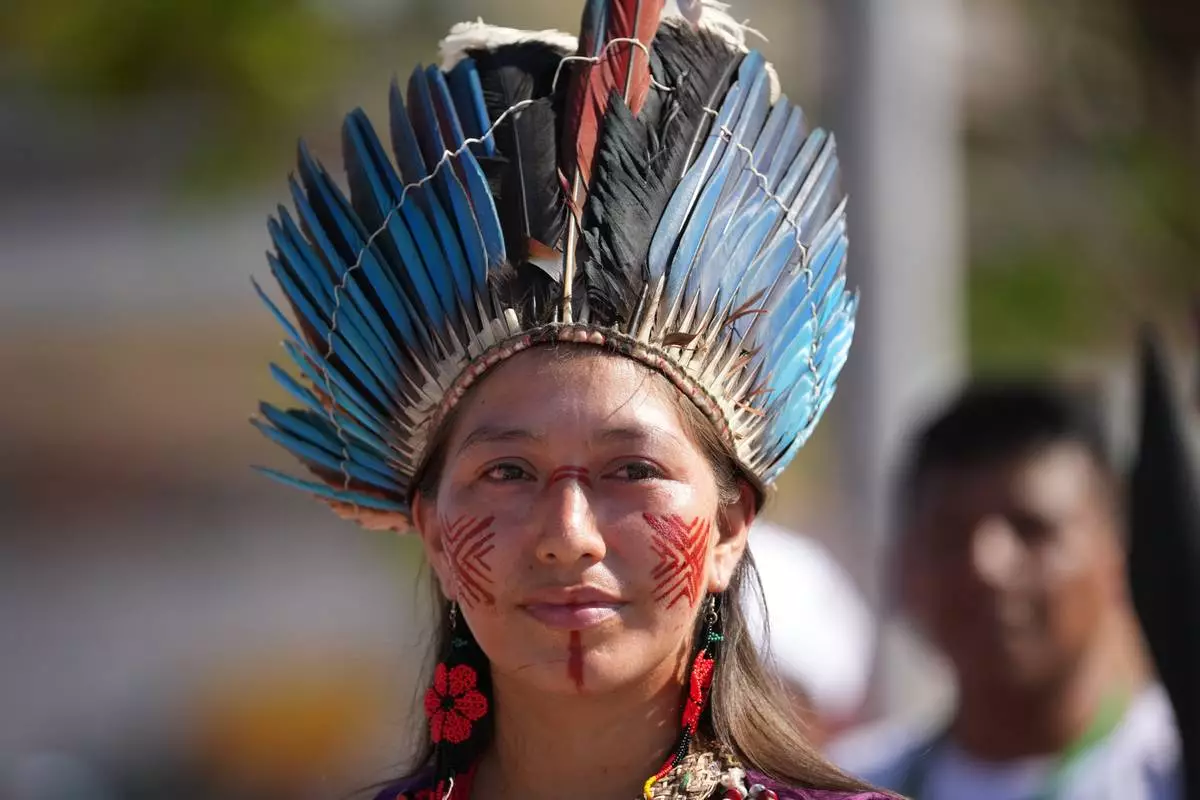
A woman waits for Pope Leo XIV's arrival to a meeting with missionaries and representatives of the Amazonian peoples at Malecón Puerto Callao in Pucallpa, Peru, on the tenth day of his twelve-day apostolic journey to South America, Sunday, Nov. 15, 2026. (AP Photo/Andrew Medichini)
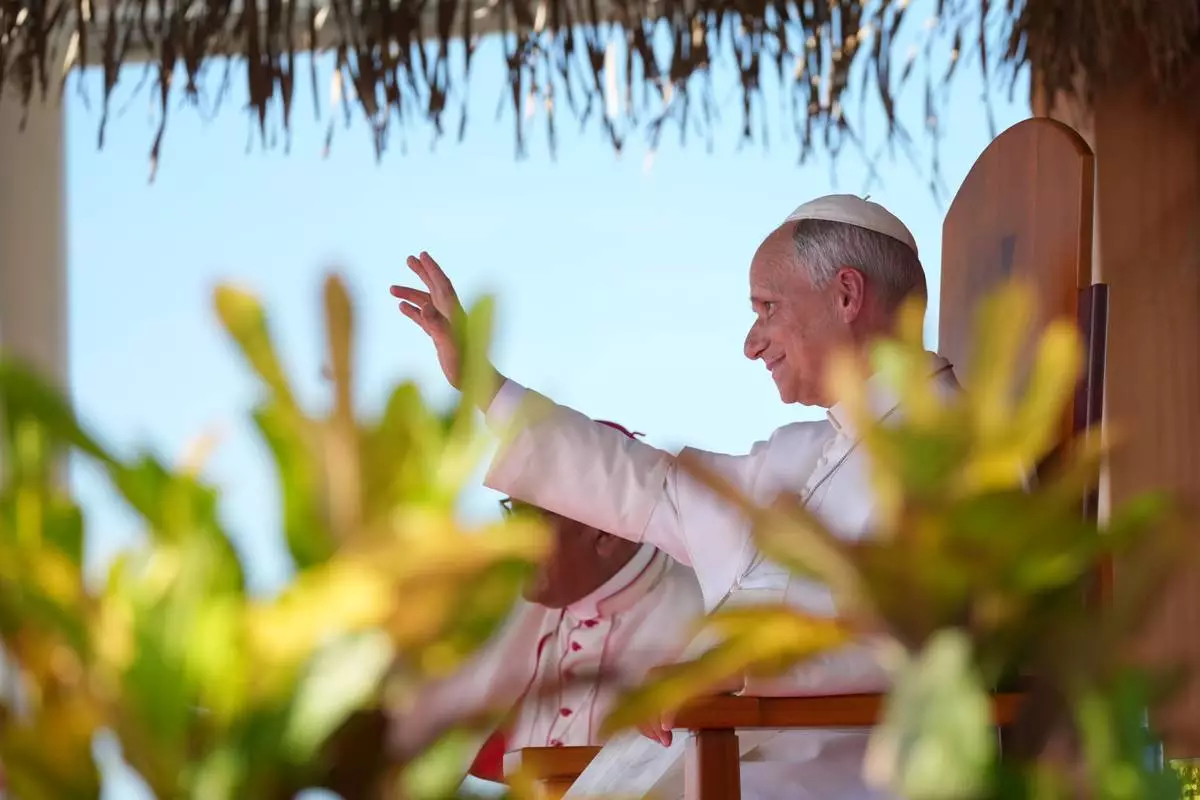
Pope Leo XIV waves during a meeting with missionaries and representatives of the Amazonian peoples at Malecón Puerto Callao in Pucallpa, Peru, on the tenth day of his twelve-day apostolic journey to South America, Sunday, Nov. 15, 2026. (AP Photo/Andrew Medichini)
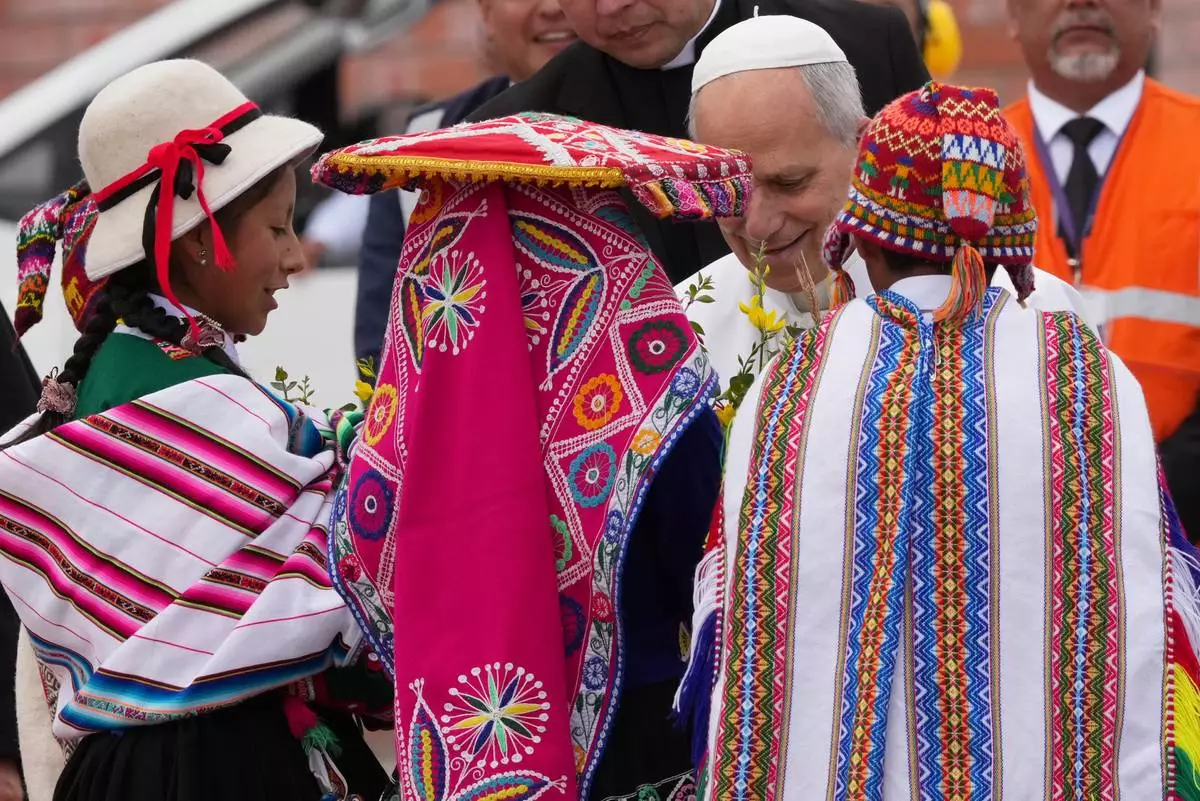
Pope Leo XIV arrives for a meeting with the faithful and representatives of popular devotion at Saqsaywaman National Archaeological Park in Cusco, Peru, on the tenth day of his twelve-day apostolic journey to South America, Sunday, Nov. 15, 2026. (AP Photo/Andrew Medichini)
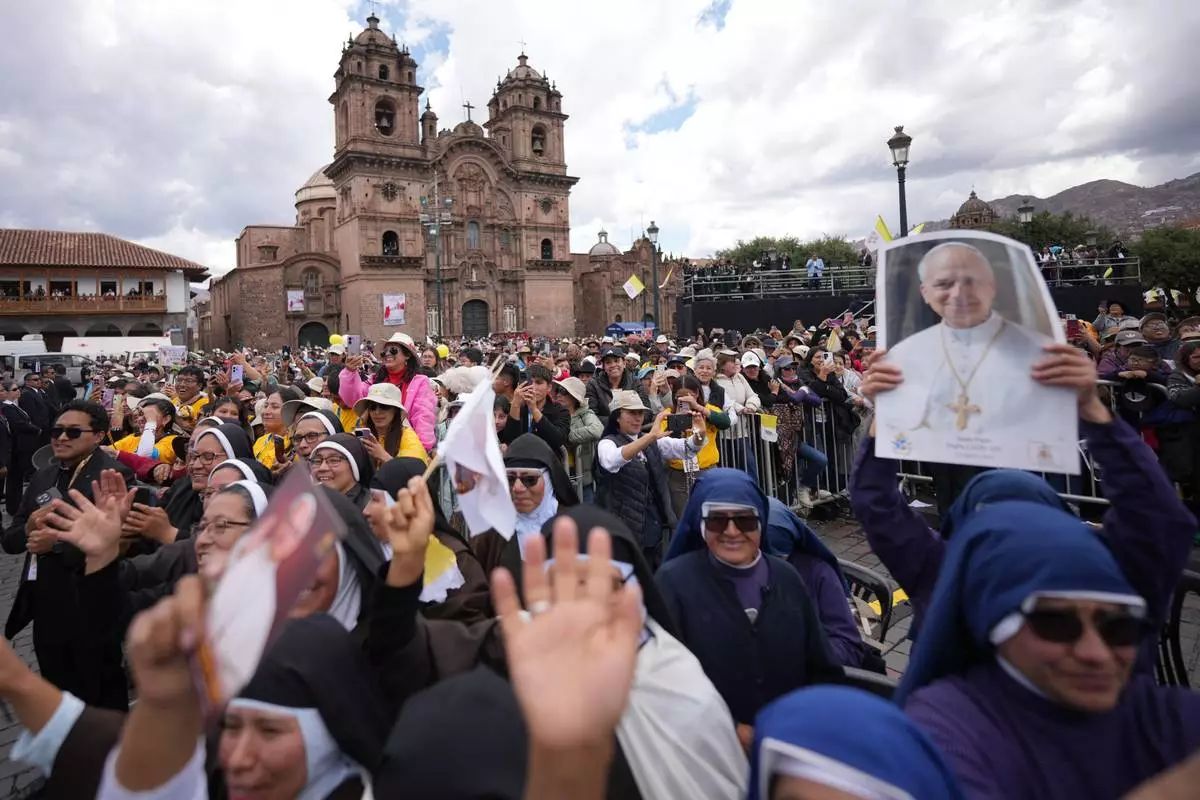
Nuns cheer during the Angelus prayer with Pope Leo XIV in the square in front of the Cathedral Basilica of the Assumption of the Blessed Virgin Mary in Cusco, Peru, on the tenth day of his twelve-day apostolic journey to South America, Sunday, Nov. 15, 2026. (AP Photo/Andrew Medichini)
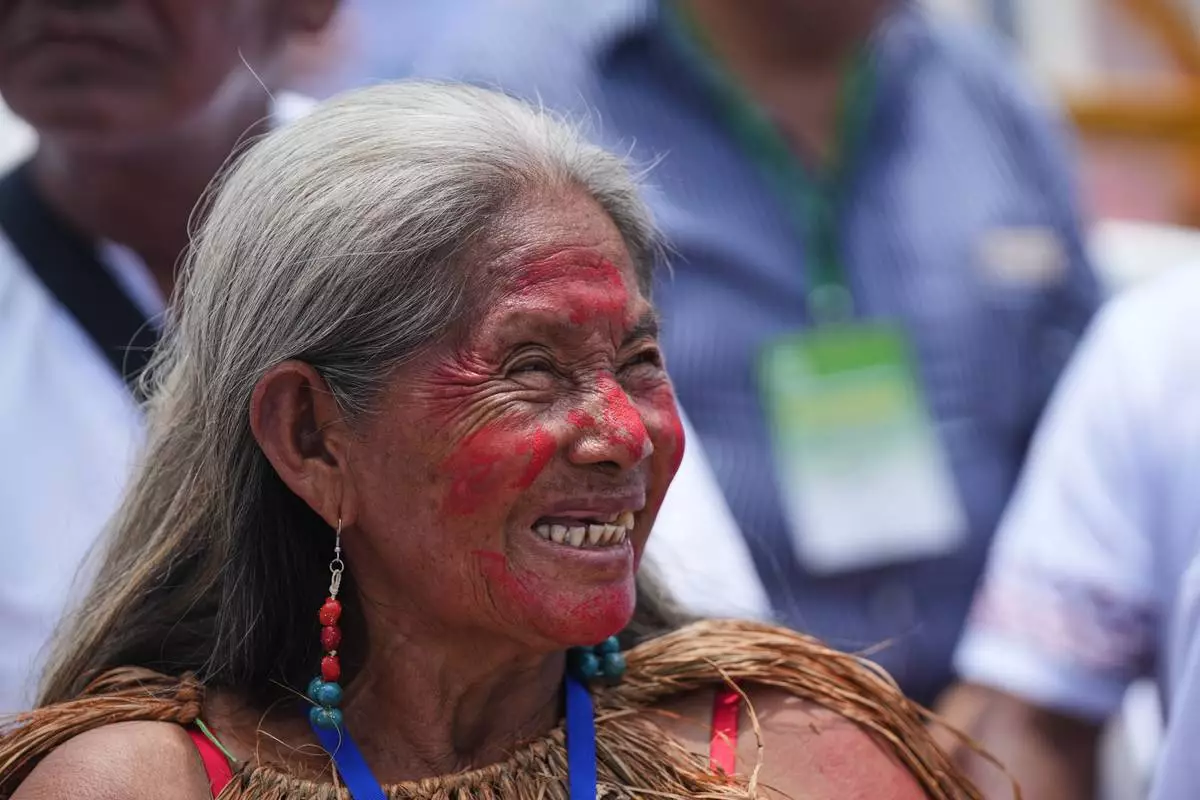
A woman smiles ahead of Pope Leo XIV's meeting with missionaries and representatives of Amazonian Indigenous communities in Pucallpa, Peru, Sunday, Nov. 15, 2026. (AP Photo/Guadalupe Pardo)
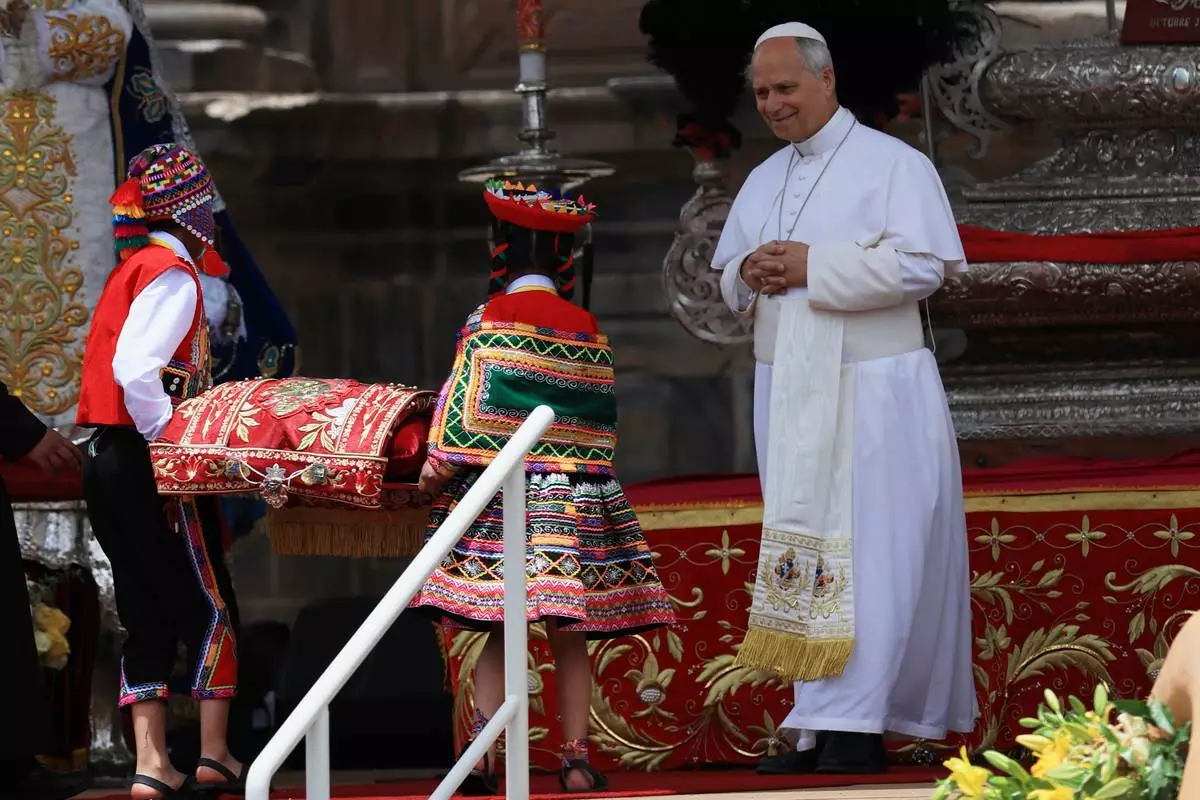
Children present an offering to Pope Leo XIV outside the cathedral in Cusco, Peru, Sunday, Nov. 15, 2026. (AP Photo/Jose Sotomayor)
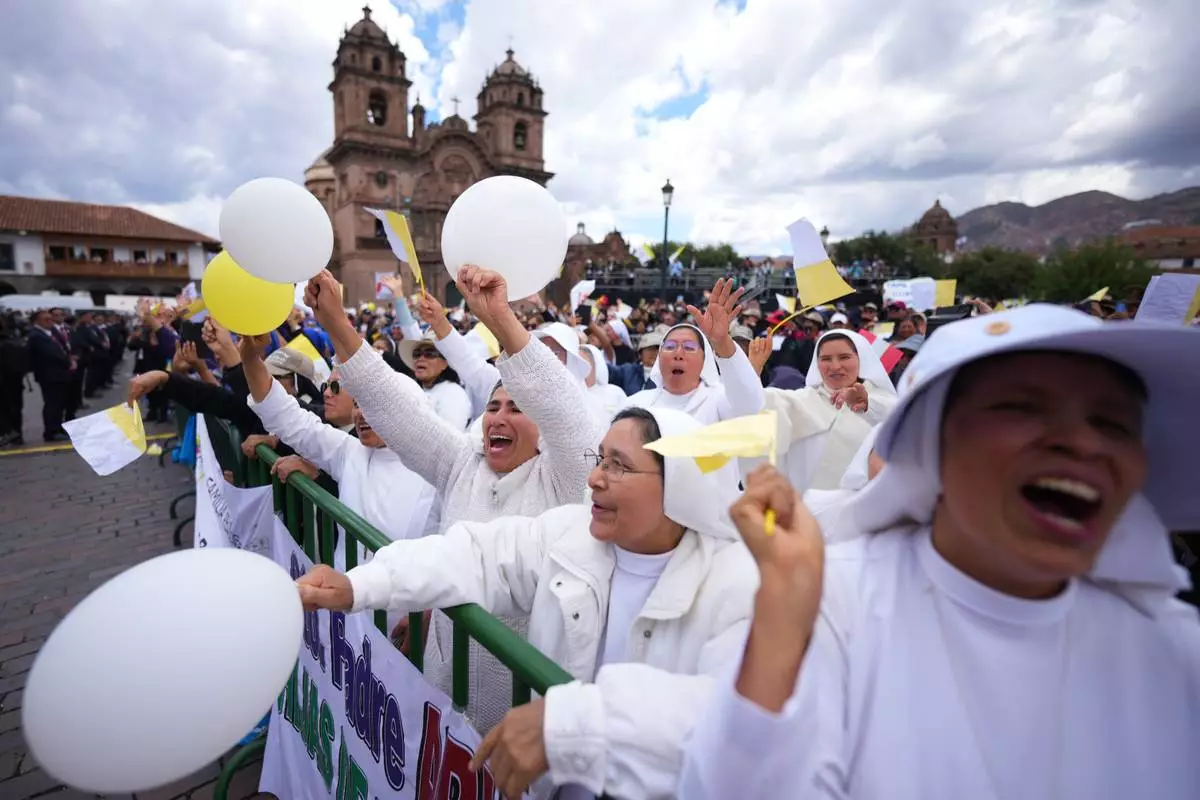
Nuns cheer during the Angelus prayer with Pope Leo XIV in the square in front of the Cathedral Basilica of the Assumption of the Blessed Virgin Mary in Cusco, Peru, on the tenth day of his twelve-day apostolic journey to South America, Sunday, Nov. 15, 2026. (AP Photo/Andrew Medichini)
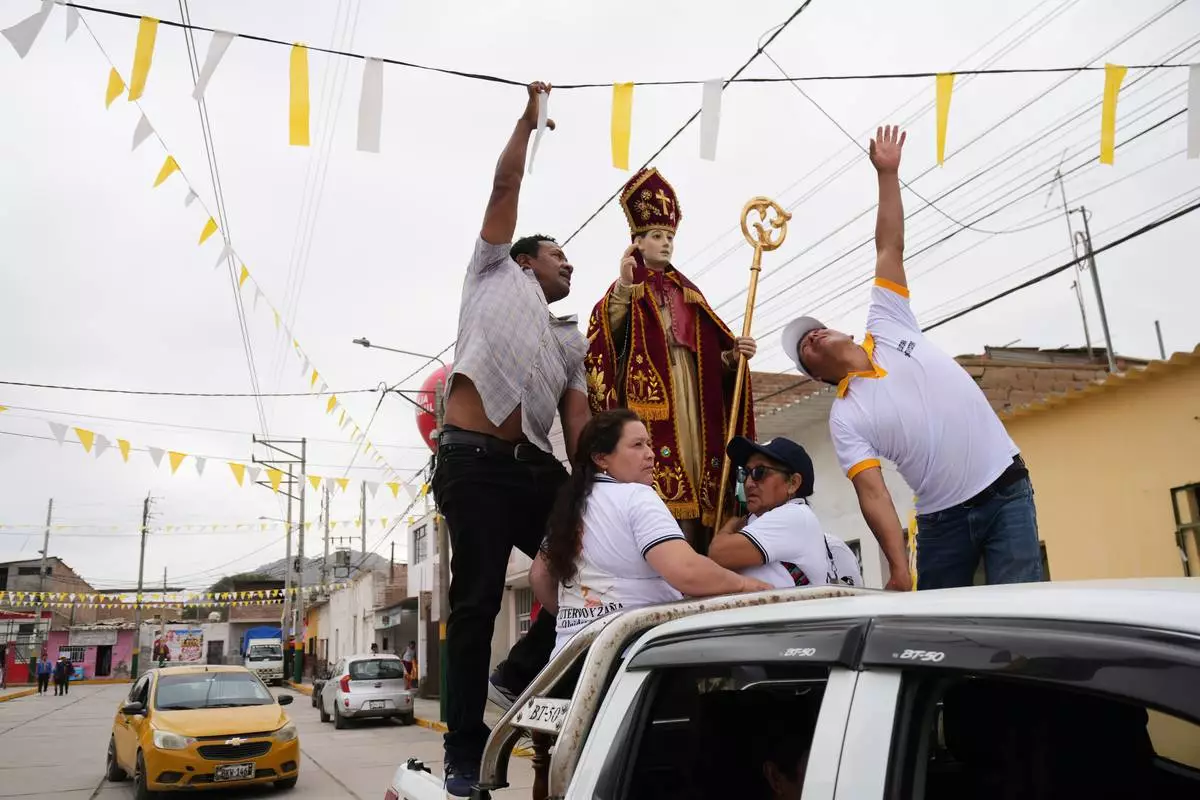
People aboard a pickup truck transporting a statue of Santo Toribio de Mogrovejo lift a streamer overhead to allow the religious figure to pass beneath it, ahead of a Mass celebrated by Pope Leo XIV at a shrine dedicated to the saint in Zaña, Peru, Saturday, Nov. 14, 2026. (AP Photo/Rodrigo Abd)
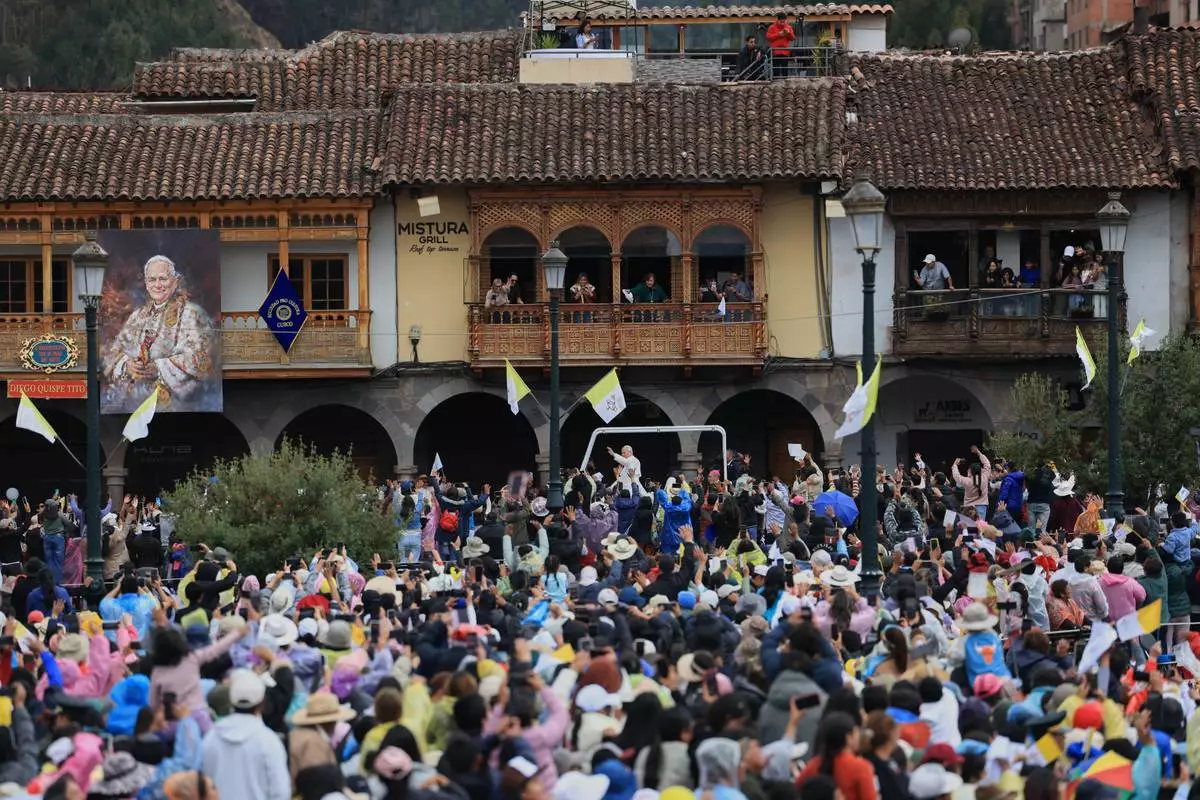
Pope Leo XIV waves as he rides through Cusco, Peru, Sunday, Nov. 15, 2026.(AP Photo/Jose Sotomayor)
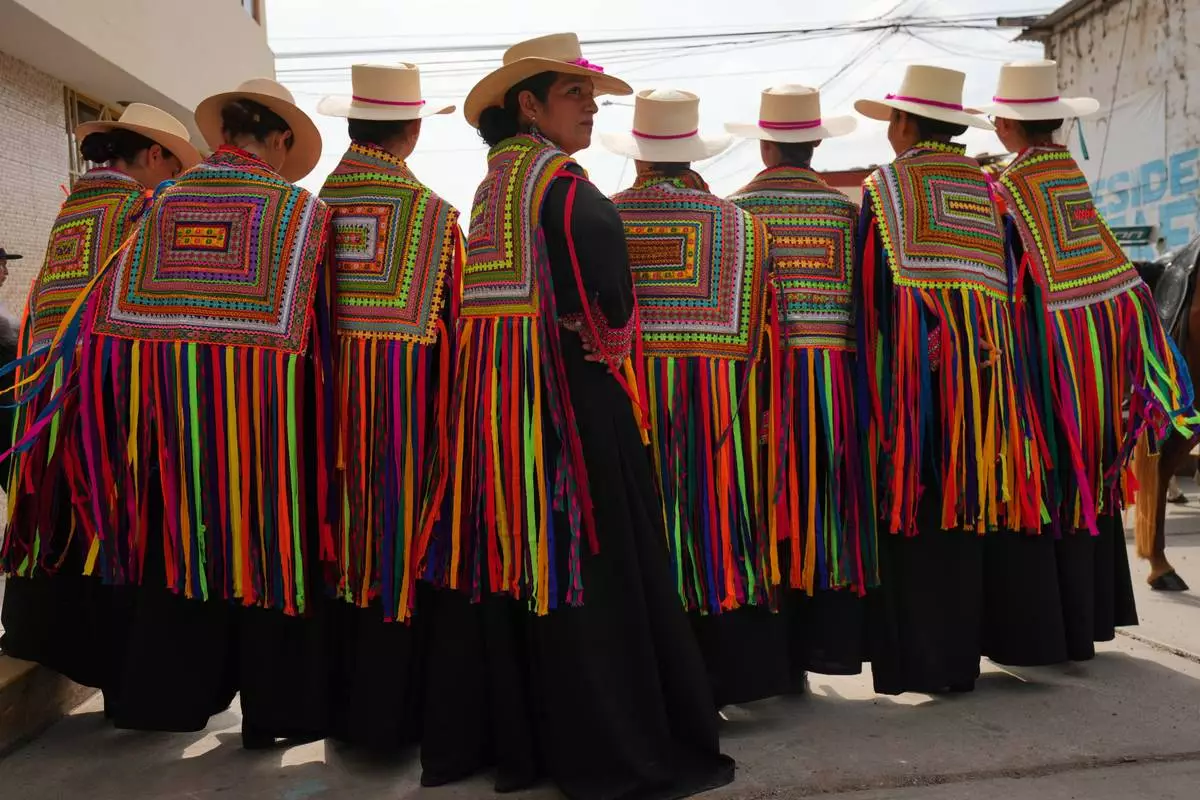
Women wait to welcome Pope Leo XIV ahead of his meeting with the Catholic community in Zaña, Peru, Saturday, Nov. 14, 2026. (AP Photo/Rodrigo Abd)
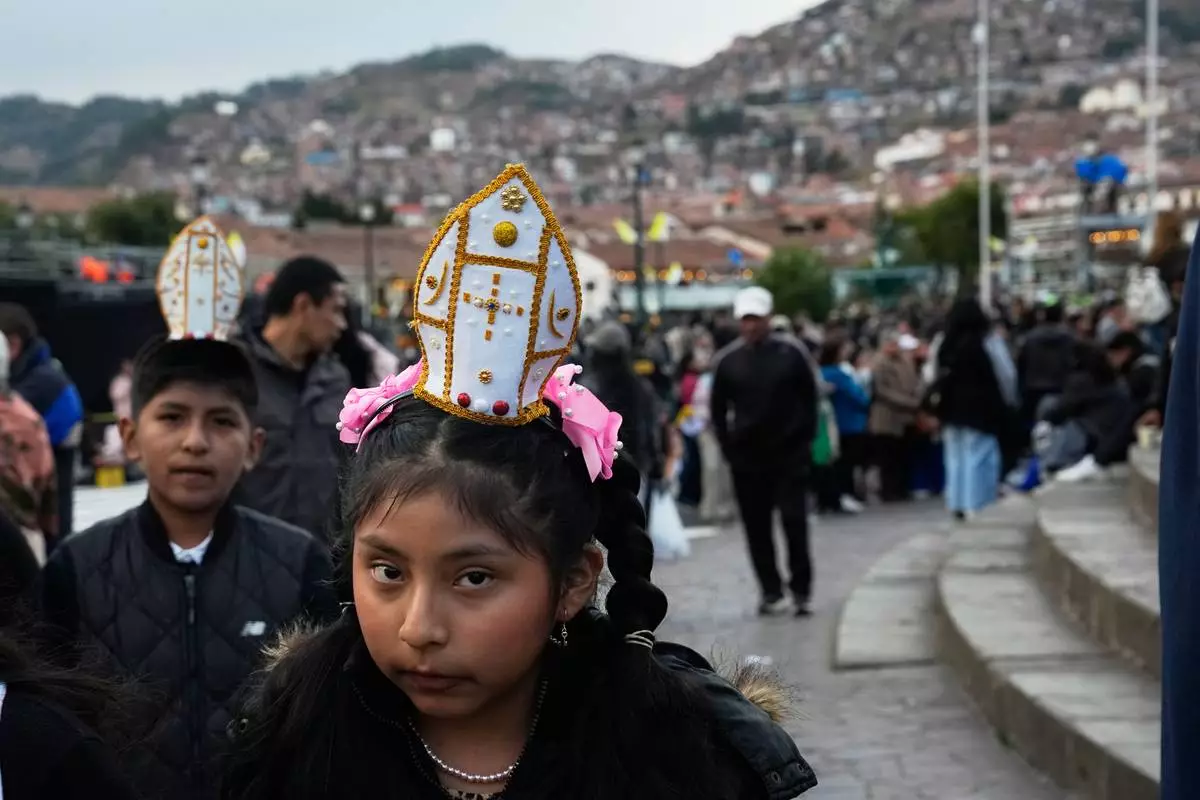
A girl wearing a papal hat walks out of a church a day before Pope Leo XIV's visit to Cusco, Peru, Saturday, Nov. 14, 2026. (AP Photo/Martin Mejia)
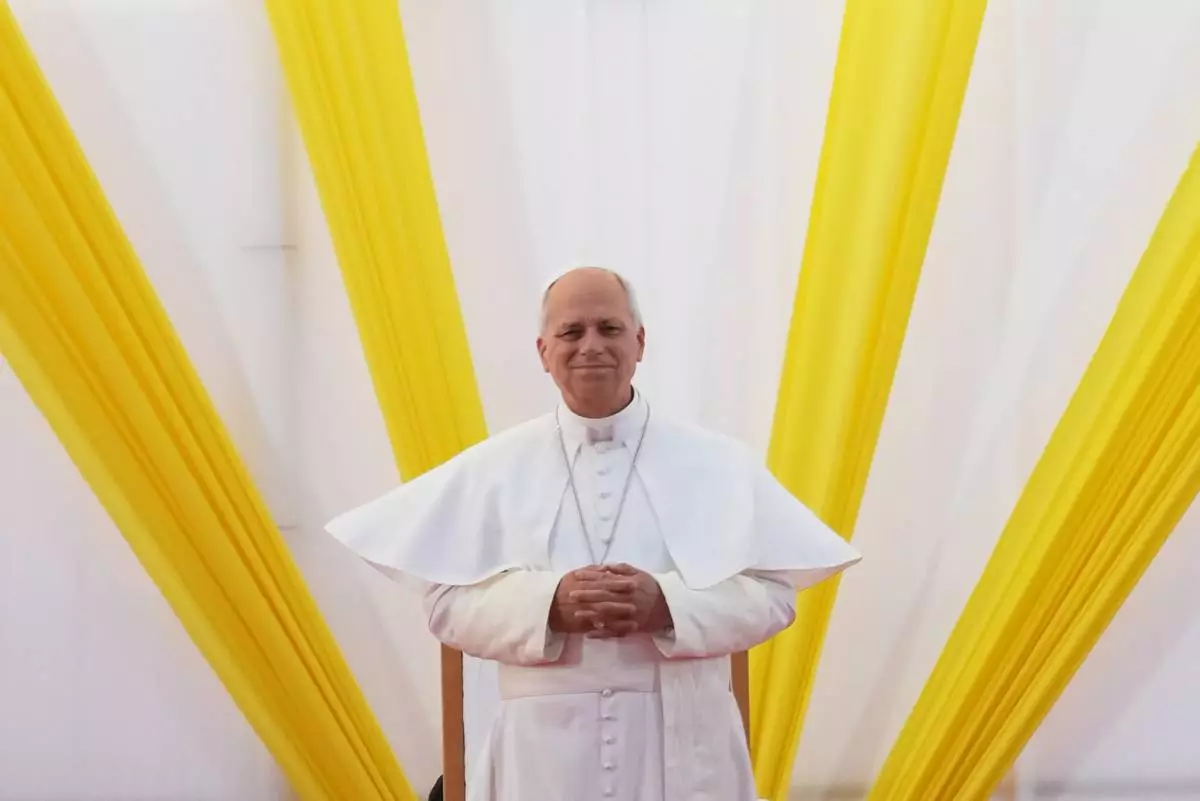
Pope Leo XIV attends a meeting with the Catholic community on the occasion of the closing of the Jubilee Year of Santo Toribio de Mogrovejo at the Shrine of Santo Toribio de Mogrovejo in Zana, Peru, on the ninth day of his twelve-day apostolic journey to South America, Saturday, Nov. 14, 2026. (AP Photo/Andrew Medichini)
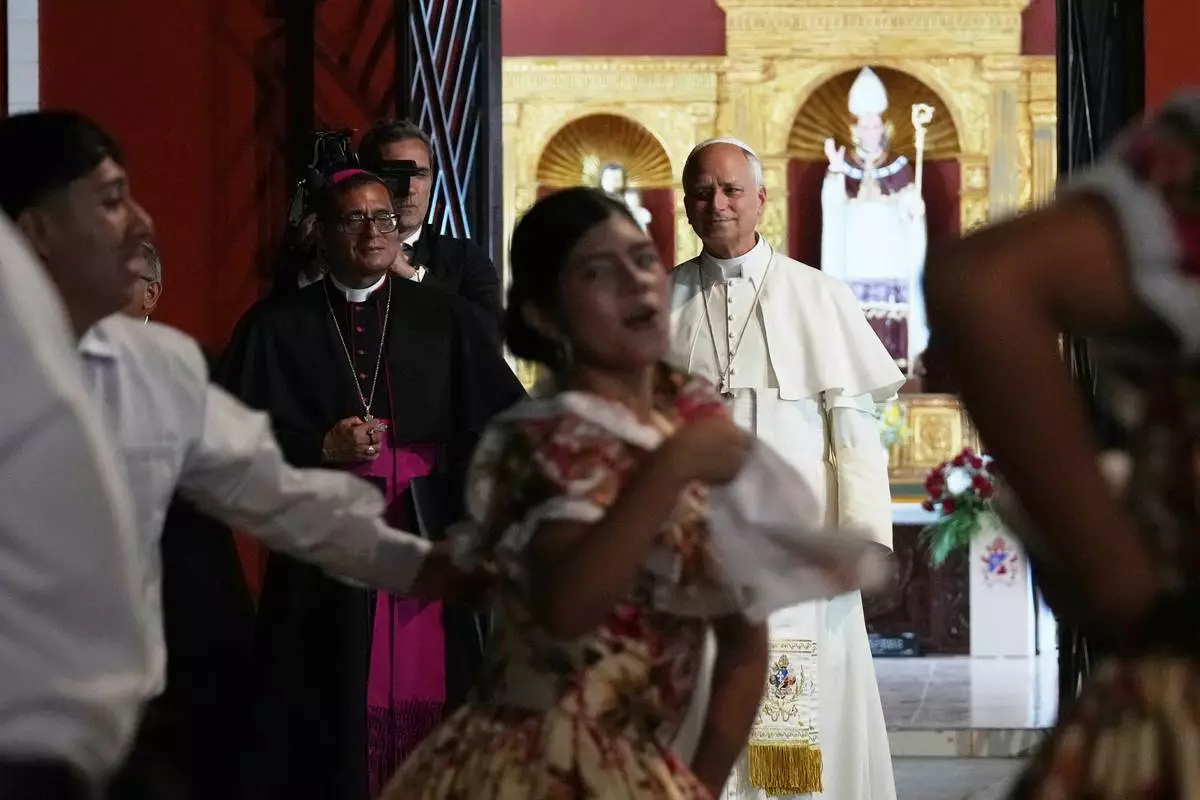
Pope Leo XIV watches dancers at the end of a meeting with the Catholic community on the occasion of the closing of the Jubilee Year of Santo Toribio de Mogrovejo at the Shrine of Santo Toribio de Mogrovejo in Zana, Peru, on the ninth day of his twelve-day apostolic journey to South America, Saturday, Nov. 14, 2026. (AP Photo/Andrew Medichini)
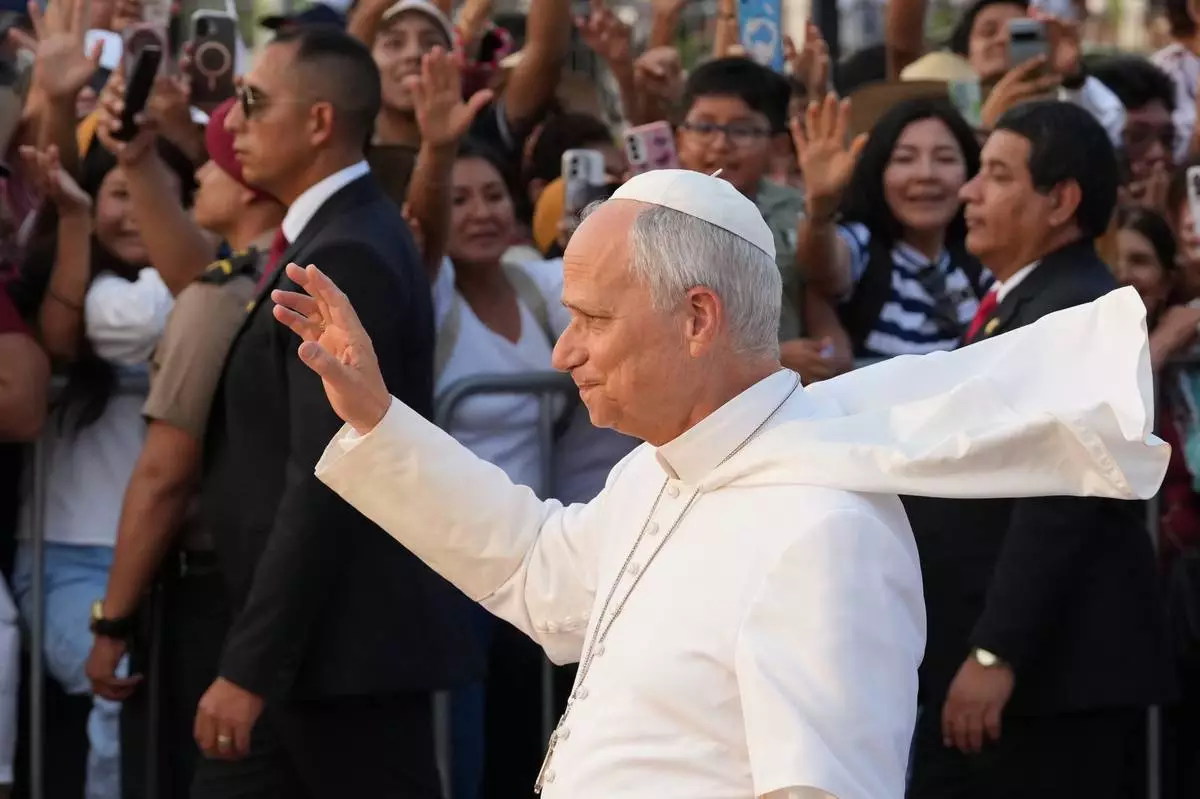
Pope Leo XIV arrives for a meeting with the Catholic community on the occasion of the closing of the Jubilee Year of Santo Toribio de Mogrovejo at the Shrine of Santo Toribio de Mogrovejo in Zana, Peru, on the ninth day of his twelve-day apostolic journey to South America, Saturday, Nov. 14, 2026. (AP Photo/Andrew Medichini)
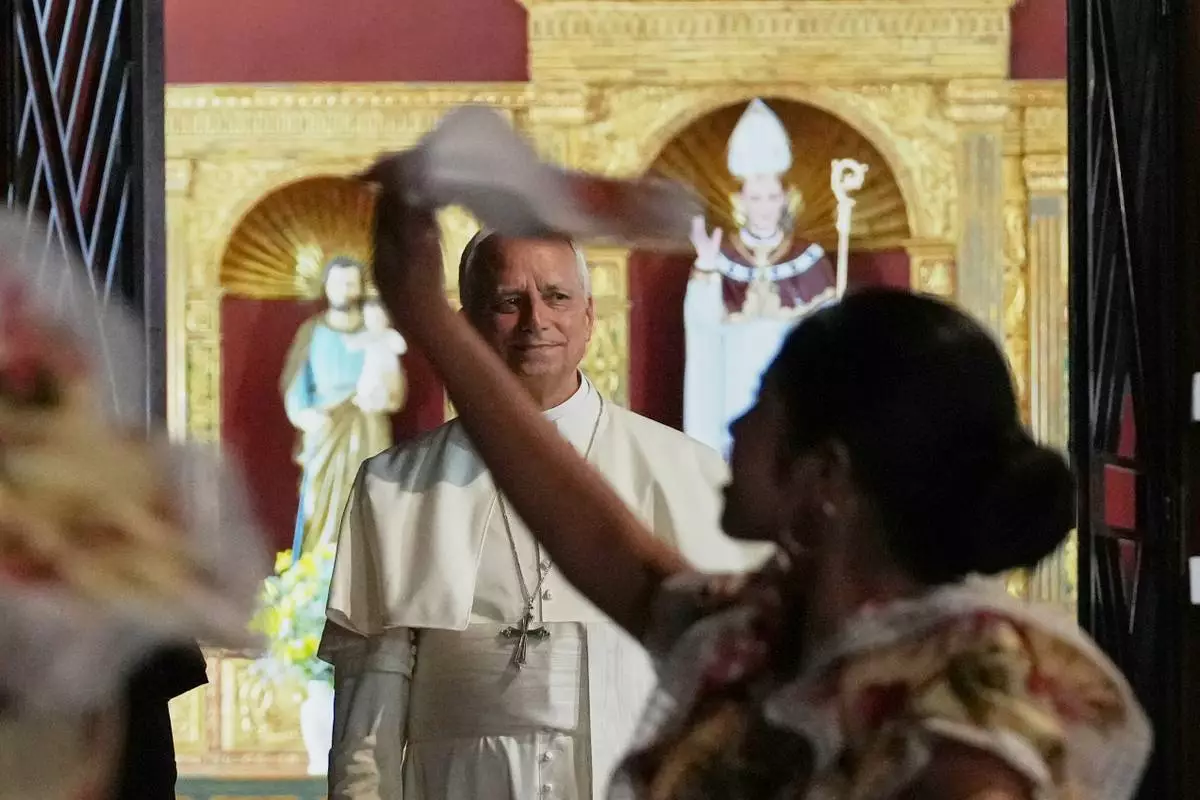
Pope Leo XIV watches dancers at the end of a meeting with the Catholic community on the occasion of the closing of the Jubilee Year of Santo Toribio de Mogrovejo at the Shrine of Santo Toribio de Mogrovejo in Zana, Peru, on the ninth day of his twelve-day apostolic journey to South America, Saturday, Nov. 14, 2026. (AP Photo/Andrew Medichini)