SEOUL, South Korea (AP) — South Korean police raided the headquarters of Starbucks’ local operation as part of an investigation into a controversial marketing campaign that was perceived as defaming 1980s' pro-democracy movements.
Investigators searched the Starbucks headquarters in southern Seoul on Tuesday, police said Wednesday.
Police gave no further details, but South Korean media reported investigators also were sent to the residences of Starbucks executives.
The coffee chain triggered a public uproar when it attempted to promote a series of stainless-steel tumblers it called “SS Tank” by declaring May 18 to be “Tank Day.” The date marks the anniversary of a 1980 pro-democracy uprising in the southern city of Gwangju that was brutally oppressed by South Korea's then military-backed rulers.
The campaign also used the slogan “Thwack it on the table!” which many read as a reference to a notorious 1987 police statement that attempted to cover up the torture death of student activist Park Jong-chol. Authorities had falsely said Park died after investigators “hit the desk with a thwack.”
The public outrage prompted Shinsegae Group, which owns a 67.5% stake in Starbucks Korea, to cancel the campaign within hours. It also fired the chief executive of Starbucks Korea. Shinsegae Chairman Chung Yong-jin later issued a televised apology. Starbucks Korea closed all of its stores nationwide early on June 22 for mandatory history and social sensitivity training.
The police investigation was launched following complaints from relatives of the victims of the Gwangju crackdown, which official records say left about 200 people dead.
South Korea achieved a genuine democracy in 1987 when then authoritarian President Chun Doo-hwan, who led the Gwangju crackdown, was forced to accept a constitutional revision introducing direct presidential elections in the face of massive pro-democracy demonstrations.

FILE - A Starbucks sign is seen outside the coffee company's global corporate headquarters, May 11, 2026, in Seattle. (AP Photo/Lindsey Wasson, File)
BANGKOK (AP) — The head of Myanmar’s military-backed government arrived in Thailand on Thursday for an official visit that could serve as a major steppingstone in his effort to win political legitimacy more than five years after seizing power from an elected civilian government.
President Min Aung Hlaing's two-day official visit includes meetings with Thai Prime Minister Anutin Charnvirakul and other officials at Government House, where they are expected to sign several memorandums of understanding. Following the meetings, the two leaders were expected to attend a Thailand-Myanmar Business Forum.
At the meeting with Anutin, Min Aung Hlaing sought to reassure Thailand that his government was restoring stability and steering Myanmar toward democracy.
“Myanmar has now reestablished itself on the path to democracy and is moving toward a better future,” Min Aung Hlaing said. “As the new government, we have now begun working on national stability, peace, and national reconciliation.”
The visit has drawn criticism from activist groups such as Justice For Myanmar, which stated that the trip lends “false legitimacy” to Min Aung Hlaing and the ruling generals.
Min Aung Hlaing took a significant step toward would-be political rehabilitation in April when he was sworn in as president following an election held in phases in December and January. Critics dismissed the polls as a sham designed to consolidate the military’s grip on power while ostensibly restoring civilian rule.
The diplomatic outreach is the latest in a series of moves to reengage with countries in the region and the international community after relations became frayed or frosty following Min Aung Hlaing's ousting of Aung San Suu Kyi’s government in February 2021 while serving as army chief.
Western governments have shunned and sanctioned Min Aung Hlaing and his associates for overthrowing Suu Kyi's government. Subsequent serious rights violations followed a deadly military crackdown on protests, which subsequently triggered a nationwide armed resistance movement and a bloody civil war.
The visit is among Min Aung Hlaing’s most significant diplomatic engagements and the latest in a series of trips to neighboring countries, including China, India and Laos, as he seeks to strengthen regional ties since assuming the presidency in April. Despite visits to those countries and close relations with Russia, he has remained largely isolated internationally.
While he attempts to refurbish his image, Myanmar's military continues to wage a brutal war across much of the country against pro-democracy resistance fighters and armed ethnic minority groups seeking greater autonomy.
According to the Assistance Association for Political Prisoners, an independent organization that keeps detailed tallies of arrests and casualties linked to the civil war, more than 8,200 civilians have been killed and 31,645 arrested by Myanmar's security forces as of Wednesday.
Chit Seng, a senior human rights specialist at Fortify Rights, argued last month that changing from a military uniform into a “presidential robe” after fake elections does not alter the fundamental nature of the military government. He described it as a “brutal regime” that kills its own people and should not be legitimized.
In another effort to placate critics, the regime allowed a representative of the International Committee of the Red Cross to visit 81-year-old Suu Kyi this week, the first known contact with an outside international independent humanitarian organization since her detention. The ICRC confirmed the visit but disclosed no details about her health or the contents of the meeting.
She was originally sentenced to 33 years in prison in late 2022, on what her supporters and rights groups said were bogus charges intended to prevent her return to politics.
On April 30, she was moved from prison to house arrest and her sentence was reduced to 18 years, with more than 13 years left to serve. The United Nations, Western governments and international human rights organizations have repeatedly called for her immediate release.
Min Aung Hlaing's visit to Thailand is part of a broader series of trips to neighboring countries as the 70-year-old Min Aung Hlaing seeks to restore his standing within the Association of Southeast Asian Nations. He faced years of diplomatic isolation following his 2021 takeover and was barred from top-level ASEAN meetings for failing to comply with a peace plan agreed upon in April 2021.
Bangkok has maintained close ties with Myanmar’s military leadership and has emerged as the strongest advocate within ASEAN for renewed engagement with Naypyitaw.
Although the visit officially concerns bilateral relations, Anutin declared during a visit to Indonesia on Tuesday that a peaceful and stable Myanmar is essential to ASEAN unity and regional stability. He acknowledged that Thailand has advocated for a “calibrated re-engagement approach” that keeps dialogue open and responds to “realities on the ground,” and suggested that the recent ICRC visit to Suu Kyi validated this position.
Thanida Piyachot, another human rights specialist at Fortify Rights, disagreed, saying that recognizing Min Aung Hlaing as a legitimate leader and “shaking the bloodied hands of a war criminal” sends the wrong message to civilians suffering under an “illegitimate military dictatorship.”
She urged Thailand and ASEAN to stop hiding behind non-interference policies and to take proactive roles in promoting human rights in Myanmar.
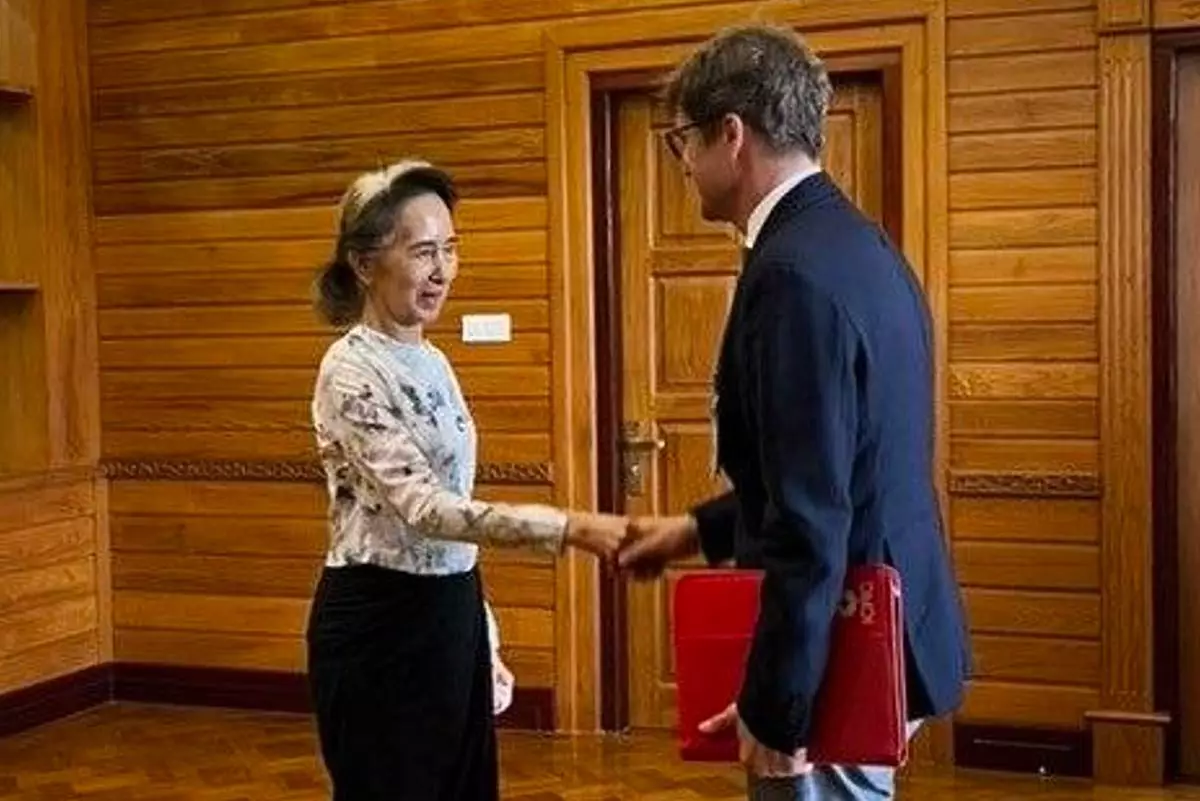
In this photo released by Myanmar President Office on Monday, Aug. 3, 2026, Myanmar's ousted leader Aung San Suu Kyi, left, shakes hands with Arnaud de Baecque, resident representative of the International Committee of the Red Cross, during their meeting in Naypyitaw, Myanmar. (Myanmar President Office via AP)
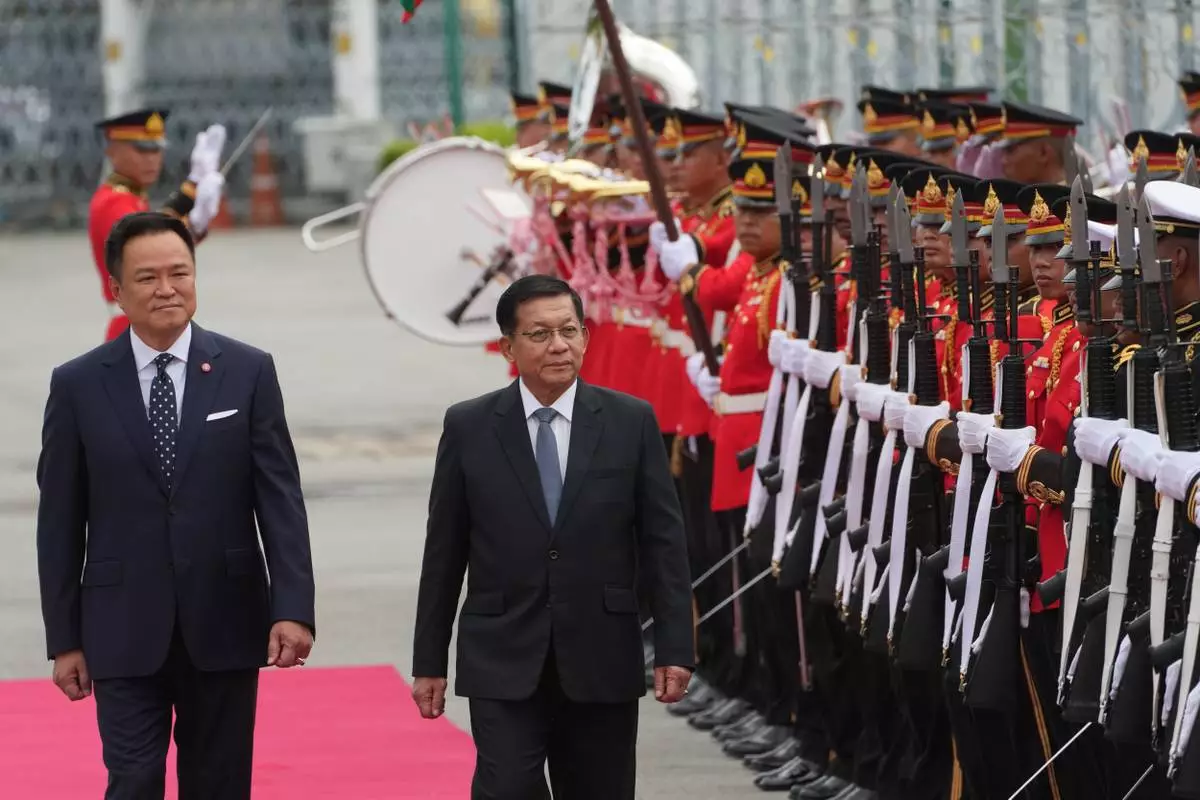
Thailand's Prime Minister Anutin Charnvirakul, left, and Myanmar's President Min Aung Hlaing review an honor guard during a welcome ceremony at the Government House in Bangkok, Thailand Thursday, Aug. 6, 2026. (AP Photo/Sakchai Lalit)