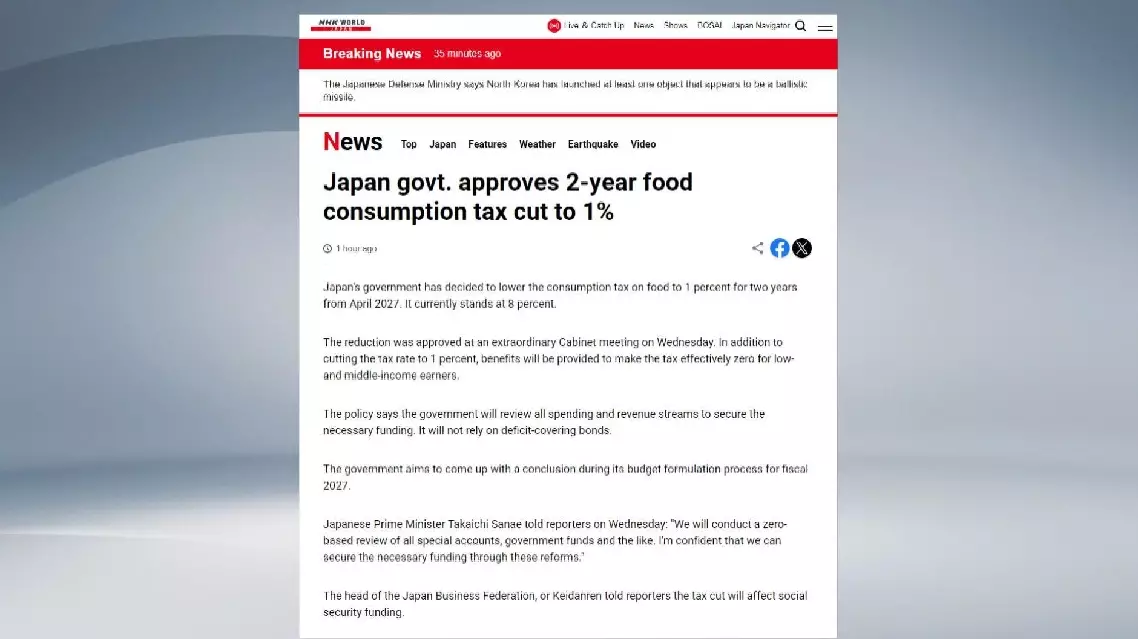
Japan's Cabinet on Wednesday approved a plan to reduce the consumption tax rate on food and beverages from the current 8 percent to 1 percent starting next April, local media reported.
The measure is planned to remain in effect for two years, with related legislation to be submitted to the Diet, Japan's parliament, this autumn.
However, concerns have grown in Japan that the plan may have limited effects, given risks arising from its implementation and the country's already heavy fiscal burden.
In their campaign for the House of Representatives election in February, the Liberal Democratic Party and its junior coalition partner, the Japan Innovation Party, pledged to eliminate the consumption tax on food and beverages altogether for two years to help households counter inflation.
However, fully implementing a zero tax rate was considered difficult due to the need for businesses to make large-scale modifications to their cash register systems and other infrastructure. The ruling parties eventually decided on the 1-percent plan.
If implemented as scheduled, the measure would mark the first reduction in Japan's consumption tax rate since the tax was introduced in 1989.
Japanese media and experts have pointed out that cutting the consumption tax may not effectively alleviate the financial burden on households.
Hideo Kumano, head economist at the ABC Economic Research Institute, said the impact of reducing the food consumption tax could easily be offset by continued price increases.
Meanwhile, the consumption tax has long served as an important funding source supporting Japan's social security systems, including pensions and medical care. How to fill the massive fiscal gap created by the tax cut has become a major concern.
According to Nikkei, the two-year tax reduction is estimated to result in around 10 trillion yen (around 63.4 billion U.S. dollars) in lost revenue.
Motohisa Furukawa, acting leader of the Democratic Party for the People, previously warned that a consumption tax cut could trigger a sharp rise in Japanese government bond yields and a significant depreciation of the yen.
He also cautioned that it could even lead to a "Truss shock" similar to the market turmoil caused by former British Prime Minister Liz Truss's push for a large-scale package of unfunded tax cuts.
In addition, the mechanism for ending the policy has also drawn attention. Nikkei noted that every consumption tax hike in Japan's history has faced significant resistance, raising doubts over whether the government will be able to restore the original tax rate as scheduled after two years.
Yoshiki Shinke, senior executive economist at Daiichi Life Research Institute, said that if the original tax rate is restored in the future, it could trigger a marked decline in consumption and pose risks to economic and political stability.
Japan's plan to cut consumption tax on food sparks controversy