INDIANAPOLIS (AP) — NCAA Division II will move to the age-based eligibility model that has prompted athlete lawsuits across the country since it was adopted in Division I.
The Division II executive board voted Tuesday to have athletes' eligibility to begin upon initial full-time enrollment or the regular academic year immediately following the athlete’s 19th birthday, whichever occurs earlier. Athletes will be allowed five seasons of competition over five years.
Previously, Division II athletes were allowed four seasons of competition to be completed within their first 10 semesters or 15 quarters of full-time enrollment.
A series of lawsuits have been filed in state and federal courts since the Division I Council approved age-based eligibility June 23. Athletes who graduated from high school in 2022 and exhausted their four-year eligibility in the last academic year have argued they have been unfairly denied a fifth year of eligibility in 2026-27.
A federal judge in Denver on July 31 ruled all high school class of 2022 athletes who exhausted their fourth season of college eligibility this spring are eligible for a fifth season this school year. The NCAA has filed its intention to appeal that ruling.
AP college sports: https://apnews.com/hub/college-sports

FILE - Footballs rest on the field in the second half of an NCAA college football game Nov. 28, 2020, in Boulder, Colo. (AP Photo/David Zalubowski, File)
BERLIN (AP) — For the second time in just over two years, Germany's Leipzig/Halle Airport has narrowly avoided a potential disaster, exposing the vulnerability of Europe’s critical infrastructure.
A drone carrying explosives was found late Tuesday at the airport and later defused. The country’s top security official said the incident was a “new threat quality” and indicated it was “professionally” prepared.
Separately, “an object” collided with a plane Tuesday night, police said. The plane suffered only minor damage.
In 2024, an incendiary device ignited at a logistics center at the airport and set fire to a freight container, part of a plot that Western security officials suspect was organized by Russian intelligence.
Leipzig/Halle is a major hub for international freight and for providing support to Ukraine. The planes that regularly use it include Ukrainian Antonov transport aircraft.
It is also home to NATO’s Strategic Airlift International Solution, or SALIS, which is currently operational almost every day in delivering equipment to NATO battle groups along its eastern flank from Finland to Romania and supporting EU and alliance nation missions.
Here’s what else to know:
Although German officials have not pointed to Russia in this case, Moscow has been widely accused by Western officials of running a campaign of sabotage and disruption across Europe with the aim of undermining support for Ukraine and destabilizing European nations.
Officials have accused Russia of organizing plots to set fire to warehouses, launching drones and trying to kill enemies abroad as well as stealing defense technology and carrying out cyberattacks on critical European infrastructure.
In May, Russian President Vladimir Putin responded to the findings of an Associated Press investigation which has tracked around 200 incidents of disruption across Europe blamed on Russia by Western officials since the invasion of Ukraine. He said Moscow is not waging a sabotage campaign against Europe and demanded that AP “name one proven fact.”
Russia has previously been accused of involvement in plots to use explosives hung from drones. A Ukrainian citizen accused of involvement in the 2024 plot to put explosives on DHL cargo planes traveled to a Lithuanian cemetery in mid-2024 where he dug up a cache of items buried by Russian military intelligence, including drone parts and cans of corn filled with explosives.
The explosives could have hung from the drones as improvised bombs and were destined for the German city of Düsseldorf during the Euro 2024 football championship, Jacek Dobrzyński, spokesperson for Poland’s security minister, told AP last year.
The investigation into the explosives plot involved many countries across Europe.
Leipzig is a key node in Ukraine’s supply network alongside other airports across Europe from Belgium to Poland, said Eric Schouten, CEO of Dyami Security Intelligence based in Utrecht, the Netherlands. He said that Russia is investing in surveillance of airports, railroads and ports.
“Even though an airport or a port is not near the frontline, you’re still at risk of spies, espionage and sabotage activity, which is part of hybrid warfare,” he said.
He said that while civilian airports in Europe might be able to track drones, they can’t yet knock them down because of safety concerns and different regulations across the continent.
“They only detect – it’s not deterrence,” Schouten said, adding that Europe will need to become aligned on how to knock down drones. "You cannot just jam or spoof, because aircraft will be affected.”
The drone at Leipzig airport with “an unknown explosive device” was found by an airport employee near the south runway, police said, adding it was being examined after having its detonator removed. An investigation was underway.
Meanwhile, investigators started a search on Thursday surrounding the airport for debris from the object that hit a freight plane.
The collision happened after the plane aborted a landing at Leipzig/Halle because the runway was closed. The plane flew to another German airport, Hannover, about 200 kilometers (125 miles) to the northwest, where officials found slight damage.
German Interior Minister Alexander Dobrindt interrupted his vacation and rushed to the airport Wednesday night for a briefing by investigators.
He later told reporters that while drone sightings and drone threats are something Germany has dealt with in the past, “that a drone armed with explosives is at an airport is a new threat scenario.”
Dobrindt described what happened as “a hybrid attack scenario,” but didn’t offer more details of authorities’ assessment or specify who might be responsible.
But he said it was reasonable to believe that such situations “must be very professionally prepared and implemented,” with technical know-how and experience of dealing with explosives.
“All this doesn’t point to amateur work,” Dobrindt added.
Dobrindt said Germany has a mobile drone defense unit and that there is drone defense technology at airports, but the explosive-laden drone was “conceived in such a way, according to what we know at present, precisely to be able to get around drone defense.” He didn’t elaborate.
“A few months ago, I also made it clear to the public that we need to raise the threat level — moving away from an abstract threat to a high-level threat,” he said Wednesday. “And this is evident right now: the assessment we made months ago — that we are facing a high-level threat — is a reality.”
Associated Press journalists Emma Burrows in London and Sam McNeil in Brussels contributed reporting.

Ukrainian Antonov transport aircraft is parked behind a fence on the grounds of Leipzig/Halle Airport, in Schkeuditz, Germany, Thursday, Aug. 6, 2026. (Hendrik Schmidt/dpa via AP)

Ukrainian Antonov aircrafts are parked behind a fence on the grounds of Leipzig/Halle Airport, where investigations are underway following the drone incident that occurred early Wednesday morning, in Schkeuditz, Germany, Thursday Aug. 6, 2026. (Hendrik Schmidt/dpa via AP)
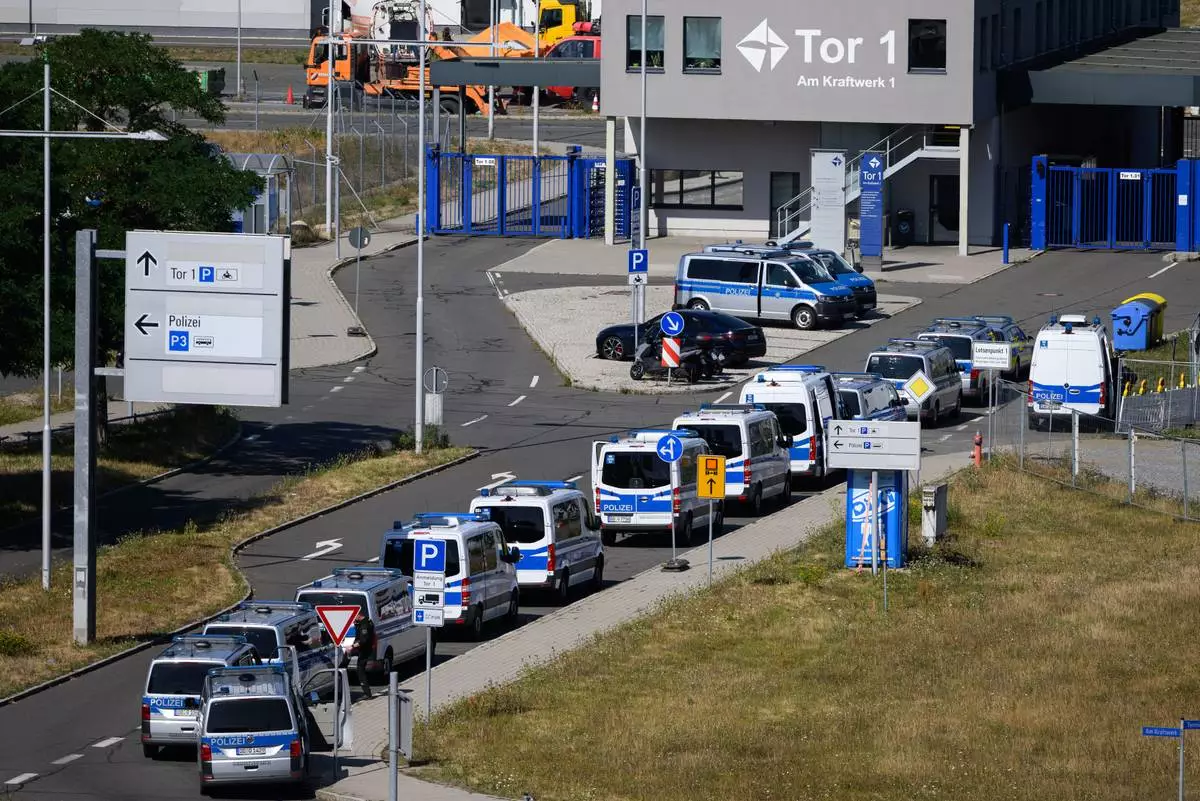
Police vehicles are parked at Leipzig/Halle Airport, where investigations are underway following the drone incident that occurred early Wednesday morning, in Schkeuditz, Germany, Thursday Aug. 6, 2026. (Hendrik Schmidt/dpa via AP)