INDIANAPOLIS (AP) — Caitlin Clark sat at the dais Thursday night, staring at the stat sheet and reliving the eight turnovers and her two missed free throws with seven seconds left in regulation.
Then she took the blame for the Indiana Fever's stinging 86-84 overtime loss to defending champion Las Vegas.
“Obviously, it just can't happen,” the three-time All-Star said just hours after she was one of 12 players named to the FIBA Women's World Cup team. “Those are free throws I usually make and certainly frustrating. Obviously, one of them gives us a two-possession lead and kind of caused my pain there, for sure, so that's on me.”
It wasn't a great night for Clark by any measure. While she scored 20 points, had eight assists and made two go-ahead 3-pointers in the final 4 1/2 minutes of regulation, it was the miscues she rued after first watching a 20-point first-half lead slip away and then failing to protect a three-point lead in the final seconds of the fourth quarter and a two-point lead at the end of overtime.
Jackie Young took advantage of the first opening by scoring a franchise-record 15 consecutive points to finish the second quarter and start the third. Chelsea Gray then made the Fever pay for their late miscues — making a buzzer-beating 3 to tie it at 75 following the missed free throws and then making another buzzer beater to win it following Clark's final turnover, forced by A'ja Wilson.
Clark went 7 of 20 from the field, 2 of 10 on 3s and had more fouls (four) than rebounds (three). Still, she didn't make any excuses.
“I didn't know we scored nine points in the third quarter, but you know we still battled, still fought, we put ourselves in position to win the game,” Clark said. “And then, honestly, it was me that made the costly errors for us. So that's on me to helps us win. That's my job. That's what I get paid to do.”
As usual, though, it wasn't just Clark.
Kelsey Mitchell, July's WNBA Player of the Month, missed one of two free throws with 9.2 seconds to go in the fourth quarter. And then, instead of fouling to prevent the tying 3-point attempt, or corralling the loose ball, Gray got her chance to tie the score.
“Aliyah Boston read it perfectly, her timing was perfect,” coach Stephanie White said, noting they gave up 18 points on turnovers, too.. “It's a loose ball and it bounced their way. We've got to come up with that play.”
White also acknowledged making her own mistake — not calling timeout at the end of overtime when they were struggling to get a shot, which led to Clark's turnover.
And, though, that seemed of little solace to Clark, White saw it another way.
“Players already hate that they miss free throws, right? They hate that they miss plays,” White said. “You've just got to keep them positive in those moments."
AP WNBA: https://apnews.com/hub/wnba-basketball

Indiana Fever guard Caitlin Clark reacts during the second half of a WNBA basketball game against the Minnesota Lynx, Sunday, Aug. 2, 2026, in Minneapolis. (AP Photo/Abbie Parr)
MANILA, Philippines (AP) — Southeast Asian leaders and their key counterparts, including from the United States and China, will renew their alarm over the escalating threat of online scams, according to a draft statement seen by The Associated Press on Friday.
Such transnational crimes, which have swindled billions of dollars from people in Asia to the United States and elsewhere, will be high in the agenda when leaders of the Association of Southeast Asian Nations gather in an annual summit with their Asian and Western counterparts on Tuesday in the Philippine capital.
The Philippines currently holds the rotating leadership of ASEAN, an 11-nation bloc in a poverty-stricken region where criminal groups have used technology and resorted to human trafficking to expand their illicit and lucrative operations to other parts of the world.
The leaders of the expanded ASEAN bloc, called the East Asia Summit, will express their “grave concern over the escalating threat posed by transnational criminal organizations inflicting harm through online scams, including those originating from scam center operations and associated criminal conduct such as human trafficking,” according to a draft of their joint statement to be issued after their summit.
They acknowledged “the exploitation of digital and other advanced technologies and digital financial platforms, by increasingly sophisticated criminal actors and the need to strengthen financial and digital systems, as well as the severe human consequences associated with scam centers.”
Authorities in Southeast Asia have reported in recent years how large numbers of workers, who were lured by recruitment syndicates into working in online scam centers, including in the Philippines and Cambodia, have been subjected to threats and even torture when they tried to escape or defy orders.
Aside from sharing of information and strengthening law enforcement coordination, the leaders will encourage “the sharing of threat assessments and best practices" as well as strengthening cooperation between relevant authorities in dismantling scam centers, the leaders said in their draft statement, without elaborating.
In July, the United Nations Office on Drugs and Crime reported how Southeast Asia-based criminal groups have increasingly used integrated networks and technology to expand to other regions. The scams caused estimated combined losses of $88.3 billion to $114.1 billion in 2025, according to the report.
Criminals are using new technologies to launder money through global financial systems and using artificial intelligence to steal from victims worldwide, the U.N. report said.
East Asian crime syndicates are running businesses that use malware, generative AI and deepfakes for sexual extortion and exploitation in a trend that increases the risks of in-person as well as livestreamed abuse. Apart from outright trafficking for the sex industry, victims can be sold into domestic servitude, forced begging and forced labor, among other forms of exploitation, the report said.
The East Asia Summit leaders meeting in Manila will underscore “the need to address underlying drivers and other related factors of online scams," such as poverty, lack of social protection interventions, outdated domestic laws, private and public coordination gaps, corruption and limited economic opportunities.
They will stress that government responses to online scams must be consistent with international law and respect human rights.

FILE -A man walks along what used to be karaoke rooms at a former scam compound that is now being used as the Presidential Anti-Organized Crime Commission temporary detention center for rescued scam workers in Pasay, Philippines, , June 4, 2025. (AP Photo/Aaron Favila, File)
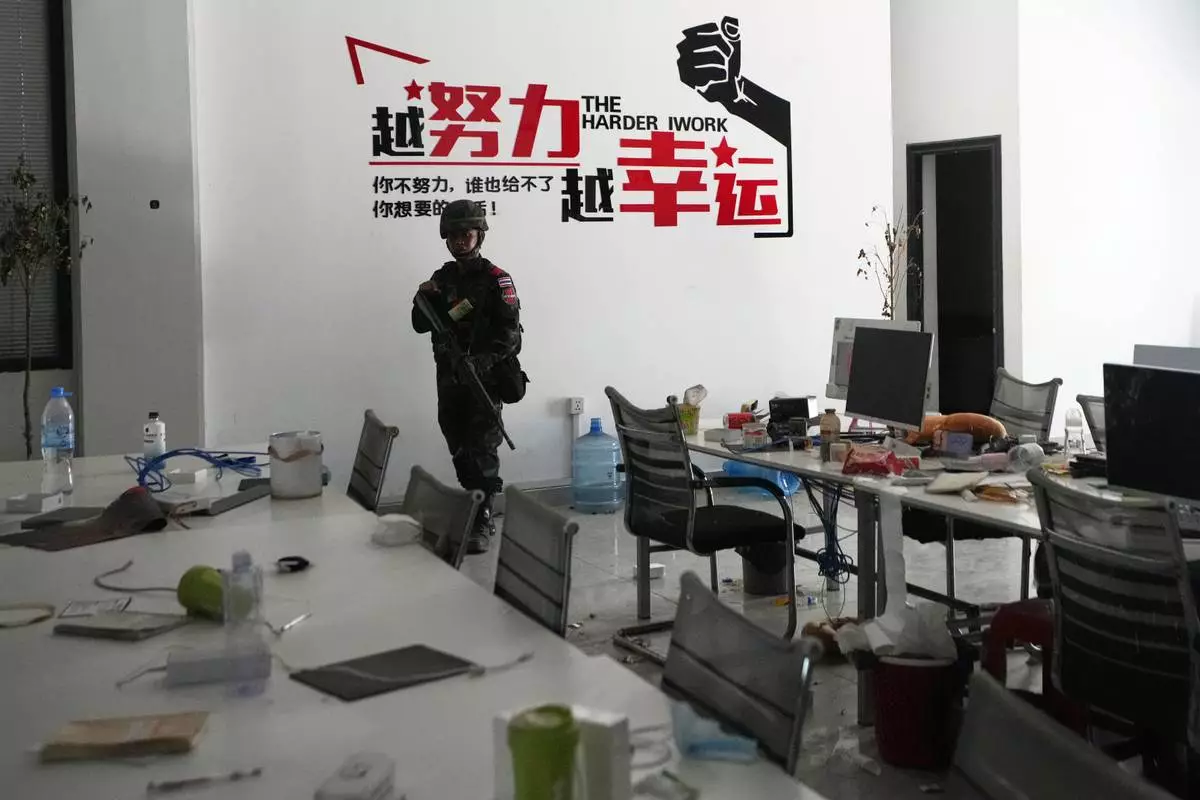
FILE -FILE- A Thai soldier walks inside a work station at a scam compound in O'Smach, Cambodia, April 7, 2026. (AP Photo/Sakchai Lalit, File, File)