As the Tarim River in northwest China's Xinjiang Uyghur Autonomous Region enters its peak annual flood season, local authorities are seizing the critical window of water diversion to irrigate poplar forests along the river's banks while carrying out large-scale seeding operations to increase vegetation cover.
In the degraded forest area of the Laocao Lake in Luntai County, drones have been deployed to air-seed drought-resistant species including poplar, tamarisk and saxaul shrubs on the fragile desert margin.
A single drone can cover over eight hectares per day, which is 100 times more efficient than manual seeding.
In addition to drone seeding, forestry department staff are also carrying out manual water-sowing at channel junctions so that flowing water carries seeds further downstream.
Drone seeding and manual water-sowing complement each other with one from the air and the other from the water, giving every seed the opportunity to find soil where it can take root and grow.
Forestry and grassland authorities report that vegetation coverage in the protected area has increased from 25 percent in 2018 to 46 percent today, transforming what was once a wind-swept, sand-blasted landscape into a gradually expanding green barrier.
The second phase of the 27th ecological water diversion along Xinjiang's Tarim River is currently underway. A total of 329 million cubic meters of water is expected to nourish more than 500,000 hectares of poplar forests along the river's banks during this diversion effort.
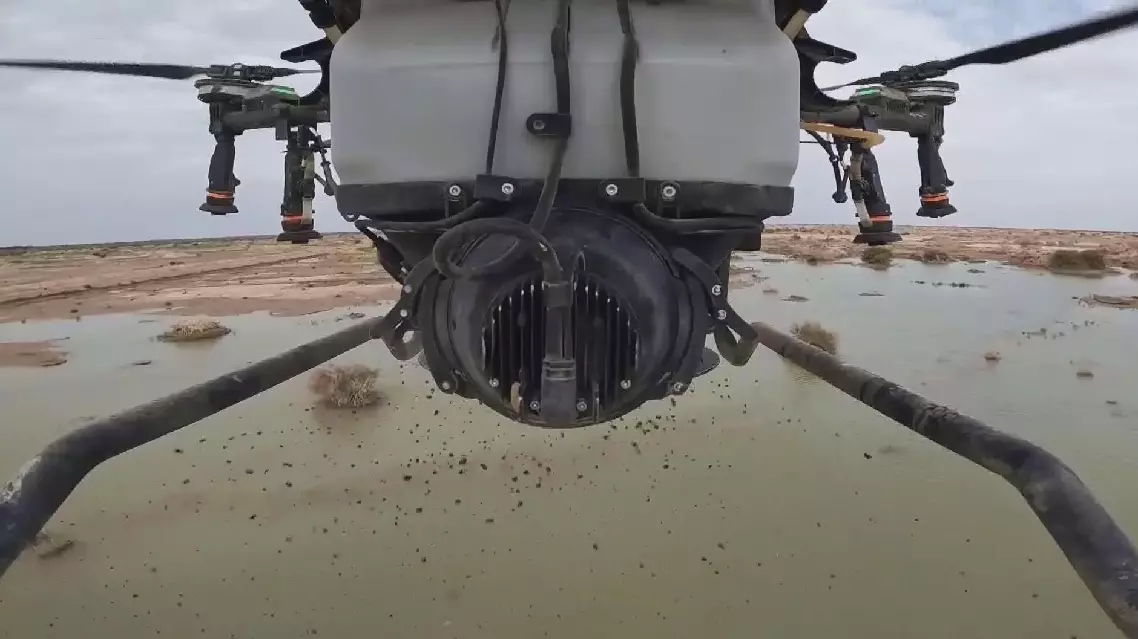
Drone seeding boosts ecological restoration in northwest China's Xinjiang