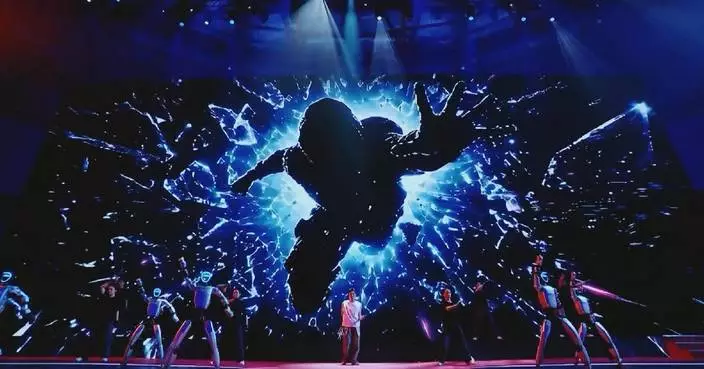
Leading experts from around the world have gathered in Beijing for the 2026 International Congress of Basic Science (ICBS), which opened on Sunday and is showcasing advances in mathematics, physics, information science and engineering, and other fields of basic science.
Running from August 9 to 21 under the theme "Advancing Science for Humanity," the annual congress is introducing the ICBS Medal, a new award honoring nine outstanding researchers, while bringing together Fields Medalists and Turing Award winners, underscoring China's focus on fundamental research and technological self-reliance.
The event's opening ceremony was headlined by four Fields Medalists -- Shing-Tung Yau, Maxim Kontsevich, Martin Hairer, and Caucher Birkar — alongside Turing Award laureate Robert Tarjan.
Nine distinguished scientists received the ICBS Medal: Claire Voisin, Horng-Tzer Yau, Shouwu Zhang, Andrea J. Liu, Yifang Wang, Xiao-gang Wen, Zhenan Bao, Xiaowei Zhuang and Feng Zhang.
They were joined by a broad assembly that included more than 80 leading scientists -- among them recipients of the Shaw Prize, Wolf Prize and Dirac Medal, as well as members of national academies in China, the United States and Europe -- along with more than 400 internationally renowned scholars and over 800 researchers and young students from universities and institutions across more than 30 countries.
The ICBS Medal recognizes groundbreaking advances in basic science. It features a portrait of a prominent scientist on one side and the motto "For Truth and Beauty" on the other, symbolizing the pursuit of scientific truth and beauty in understanding the universe.
"We pursue the truth, and the beauty is sort of given. We are particularly happy when what we are doing -- the argument we use, or the path we follow -- involves some beauty," said Claire Voisin, recipient of the 2026 ICBS Emmy Noether Medal in Mathematics.
The Congress was initiated by and is chaired by internationally renowned mathematician Shing-Tung Yau. The first Chinese-born Fields Medalist, Yau said one of his greatest hopes is that Chinese students will one day be able to reach the highest levels of academic achievement without having to study abroad, as China develops into a global hub for fundamental research.
International participants praised the rapid development of China's academic and scientific research landscape, with some pointing to the strong performance of Chinese students at leading overseas universities.
"I'm very impressed. I think in the last 10 to 15 years, China’s academics have really developed very, very strongly, much stronger than the Western world, I must say. We are teaching a lot of Chinese students in our curriculum. And I have to say they are some of the very best we have in the country, in the UK," said Oliver Buchmueller, a professor at Imperial College London and a senior researcher at the European Organization for Nuclear Research (CERN).
The two-week event will feature more than 500 academic sessions covering all branches of basic science and interdisciplinary fields, along with frontier topics such as generative large-model reasoning, computer vision, human-computer interaction and quantum information.
The congress will also include a wide range of activities, including high-level academic dialogues, youth engagement programs, and cultural and scientific exchanges.
Top international scholars celebrate advances in basic science in Beijing