China's summer film market maintains robust growth momentum, with the fast-expanding "film-plus" consumption model stretching the industry's value chain and pushing the total output of the entire film sector to over 380 billion yuan (56.3 billion U.S. dollars) this year, as the filming locations of hit domestic animations become top summer travel destinations nationwide.
Movie theaters across China are evolving from single-purpose screening venues into comprehensive cultural and recreational hubs that integrate social interaction, dining, and immersive consumption experiences. A single movie ticket now connects a long industrial chain spanning film viewing, travel, cultural experiences, and retail consumption, steadily turning cinematic popularity into tangible consumer spending.
"Traveling with movies" has emerged as a fresh consumption trend, as popular domestic productions drive surging tourist interest in their on-screen settings.
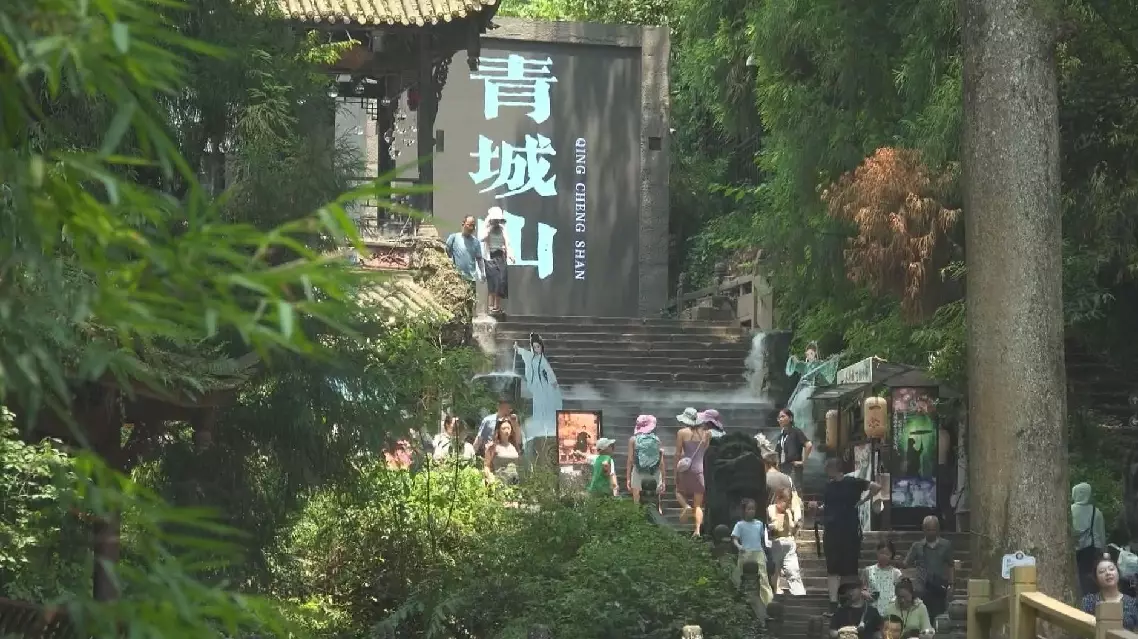
Domestic animated film "All Wishes Come True", adapted from traditional Chinese mythology, has posted solid box office returns and positive word of mouth since its release. Its real-world filming locations have become highly sought-after summer tourist destinations, with Mount Qingcheng in Chengdu, capital city of southwest China's Sichuan Province, standing as a prominent example.
The scenic area has welcomed a growing number of holidaymakers, many of whom were drawn to visit after watching the film.
"It's the summer vacation, so I brought my child here to hike and look for the 'wishing tree' from the film. We made our fondest wishes under the tree," said visitor Dong Liu.
To capitalize on the film's popularity, local authorities have rolled out a slate of "film plus tourism" initiatives. Measures including preferential policies for accommodation and dining, as well as discounted entry to local performances for movie ticket holders, are being introduced to stimulate growth in diverse cultural and tourism consumption scenarios.
Beyond picturesque natural scenery, the film's exquisite ancient architectural elements have also become a major draw for movie-inspired travelers.
In Datong, a city in north China's Shanxi Province, the Xuankong (Hanging) Temple, another landmark that inspired key scenes in the film, has seen a sharp peak in tourist arrivals.
For many visitors, the film has turned a long-held casual interest in the historic site into an immediate travel plan.
"I've known about the Xuankong Temple for long and always wanted to see it in person. Watching 'All Wishes Come True' made me even more curious about this remarkable feat of ancient architecture," said visitor Wang Wenjing.
Film-plus tourism trend fuels China's summer movie economy