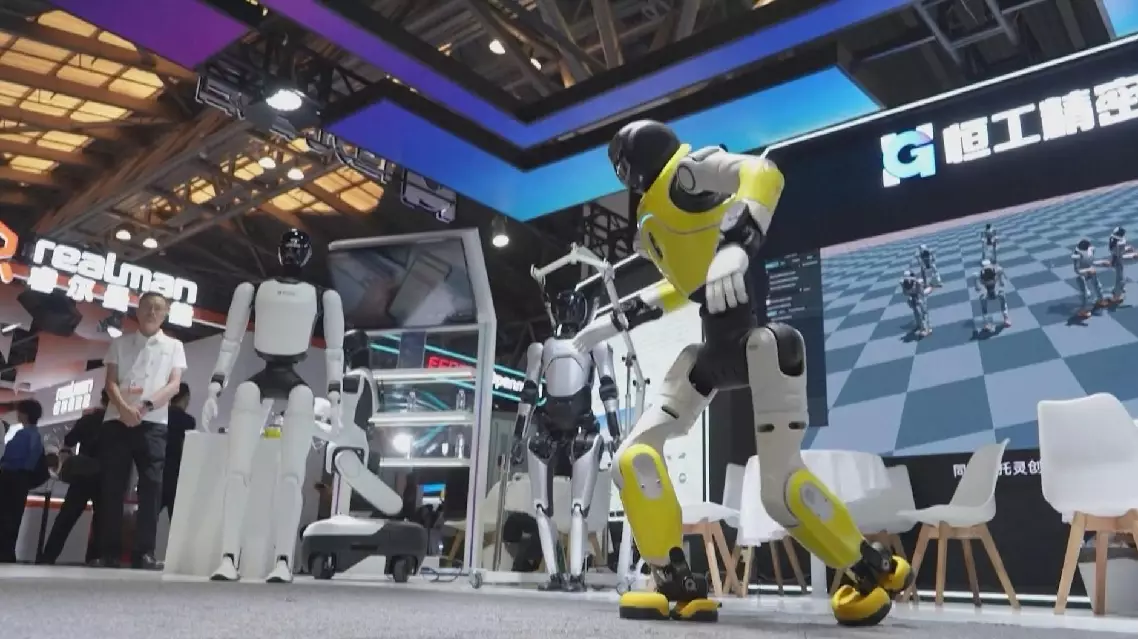
Tech companies in the megacity of Shenzhen in south China's Guangdong Province are leveraging new engines such as artificial intelligence (AI), robotics and embodied intelligence to forge closer connections with the Asia-Pacific region.
It comes as the city is gearing up to host the 33rd Asia-Pacific Economic Cooperation (APEC) Economic Leaders' Meeting -- with Monday marking the 100-day countdown to the event. The gathering, which will take place from Nov.18-19, will be held under the theme of "Openness, Innovation and Cooperation", and marks China's third time hosting the APEC meeting.
Given Shenzhen's reputation as a key hub for sci-tech innovation, a number of enterprises based in the city are keen to showcase their potential and tap into the wider market.
Among them is embodied-intelligence company X Square Robot, which aims to develop general-purpose robots that can solve real-world problems and provide value to society.
The firm has been selected for a national pilot project in elderly care and will apply its technology to nursing home scenarios.
"We were selected for a project by the Ministry of Civil Affairs and the Ministry of Industry and Information Technology. Through this project, we are integrating our technology into real nursing home scenarios. Nursing homes are highly complex and ever-changing environments, with very demanding requirements for human-machine interaction and safety. We are the only embodied-intelligence company selected for this project," said Xu Menghong, the strategy and investment director of X Square Robot.
Another company, SmartMore, is seeking to equip global manufacturers with an AI-powered brain. Its IndustryGPT model is designed to take machines beyond simply "seeing", toward understanding, reasoning and taking action.
Shi Xiaoliang, the company's product research and development director, said the goal is to make AI more accessible so that more companies can benefit from its adoption.
"Both large language models and the AI agent powered by them and other products will become increasingly easier to use, with lower barriers to entry. This will enable companies that currently cannot easily access industrial AI capabilities to obtain them with great ease," Shi said.
The company has served more than 730 leading companies worldwide, with customers across the Asia-Pacific, he added.
Shenzhen tech firms leverage AI, robotics to better connect with Asia-Pacific markets