China's icebreaker Xuelong 2 began its first ice station survey operation in the central Arctic Ocean on Sunday, near 84 degrees north latitude, during the country's 16th Arctic expedition.
The icebreaker will carry out more than 20 research tasks at seven ice stations, including deploying ice-based drifting buoys, collecting ice cores and conducting remote sensing observations of sea ice.
The mission aims to collect comprehensive data on changes in the Arctic environment, including the atmosphere, sea ice, upper ocean and under-ice ecosystems amid the region's melting sea ice.
The scientific data collected will support research into the rapid changes in Arctic sea ice, the mechanisms driving those changes, and the evolution of Arctic marine ecosystems.
Prior to Xuelong 2's ice station survey operation, the icebreaker Xuelong wrapped up all 12 planned ice-station tasks on Friday after deploying the final set of ice-based buoys.
Working under tight constraints from live ice conditions and narrow operational windows, the team completed the transport and logistical support of all on-ice scientific gear and deployed more than 30 ice-based buoys across the stations.
The work covered integrated observations of the atmospheric boundary layer, sea-ice physics, sub-ice ecology and the under-ice ocean, generating in-situ, long-term datasets to trace how the coupled atmosphere-sea-ice-ocean system evolves amid rapid changes in Arctic sea ice.
The expedition has also established an unattended observation network across the Arctic Ocean and put domestically developed advanced marine instruments through testing and operational application.
China's 16th Arctic expedition started on July 3 as three oceanographic research ships, namely Xuelong, Xuelong 2 and Jidi, departed from the coastal city of Dalian in northeast China's Liaoning Province.
This expedition, organized by the Ministry of Natural Resources and jointly carried out by the three ships and another research ship Tansuo-3, is expected to be completed in early October this year.
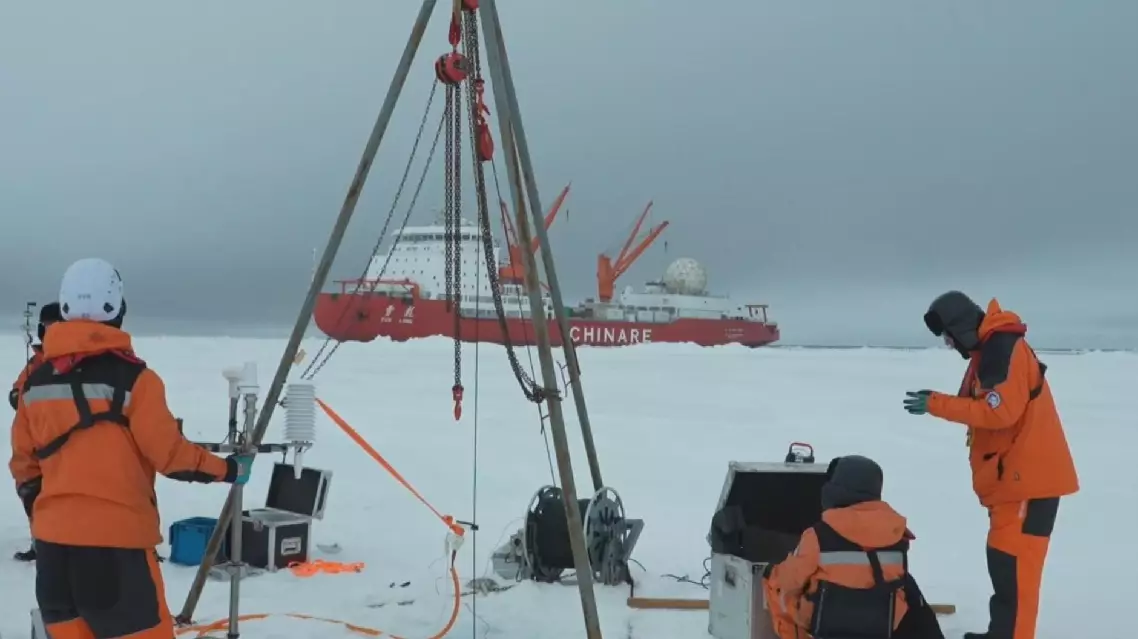
China’s 16th Arctic expedition advances ice-station surveys