Publication in the peer-reviewed journal reinforces the study's insights and validates what clinicians frequently observe – that the impact of aesthetic treatments extends beyond physical appearance.
- The Pillars of Confidence Global Study, supported by Merz Aesthetics, evaluated the impact of aesthetic treatments on patient confidence
- Study findings validate what clinicians frequently observe in practice, that the impact of aesthetic treatments extends beyond physical appearance
- ASJ Open Forum's open‑access format makes peer‑reviewed educational content easily accessible to clinicians worldwide
SINGAPORE, Aug. 11, 2026 /PRNewswire/ -- This month, the Aesthetic Surgery Journal Open Forum (ASJ Open Forum) published global results of a landmark study by Merz Aesthetics entitled Pillars of Confidence: Global Insights on Aesthetics and Self Affirmation, a 15-country survey of 15,000 adults. ASJ Open Forum is an international peer-reviewed journal and an official publication of The Aesthetic Society. By supporting this study, Merz Aesthetics is expanding the understanding of the intersection of aesthetics, confidence, and personal expression. With publication, clinicians can now have easy access to educational content they can reference in their practice.
Studying the deeper impact of aesthetics.
The Pillars of Confidence Global Study was a multinational, multigenerational study designed to evaluate patient perceptions of aesthetic treatments and the impact of aesthetic treatments on patient confidence.
Conducted in partnership with Ipsos*, one of the largest market research and polling companies globally, the Pillars of Confidence study engaged 15,000 adults aged 21 to 75** from 15 countries. Participating regions and countries included:
- Asia-Pacific: China, South Korea, Thailand
- Europe, the Middle East & Africa: France, Germany, Italy, Spain, the United Kingdom, the United Arab Emirates
- Latin America: Brazil, Colombia, Costa Rica, Mexico
- North America: United States, Canada
Connecting appearance to confidence.
Survey respondents perceive confidence as a core pillar of overall social well-being, and study results suggest that for some individuals, aesthetic treatments may do more than enhance appearance. They may help to increase self-confidence.
- 72% of global respondents agreed with the statement "I am confident in who I am."
- 69% of global respondents use aesthetic treatments to help create a look that is inspired by how they feel inside.
- 72% of global respondents feel aesthetic treatments impact how they view themselves.
Putting insights into practice.
"The Pillars of Confidence data shows how aesthetic treatments enable patients to take an active role in aligning their self-perception with their outward appearance," said Dr. Shannon Humphrey, lead investigator for the Pillars of Confidence Study and clinical associate professor at the University of British Columbia. Dr. Humphrey is also a cosmetic dermatologist and medical director at Humphrey & Beleznay Cosmetic Dermatology, where she witnesses firsthand the role confidence plays for her patients. "These insights can help us better understand and support our patients as they work toward personal empowerment, which ultimately enhances the care we provide."
Making an authentic difference for patients.
"This publication provides an important opportunity to further support clinicians in their conversations with patients about confidence and medical aesthetics," said Bob Rhatigan, CEO, Merz Aesthetics. "As a leader in the medical aesthetics industry, we at Merz Aesthetics remain focused on helping people look better, feel better, and live better through innovation, education, and elevated standards of care."
"The findings from the Pillars of Confidence study reinforce what we are consistently seeing across Asia Pacific – confidence is deeply personal, and patients are increasingly viewing aesthetic treatments as a way to support self-expression, self-care and long-term confidence," said Lawrence Siow, President, Asia Pacific, Merz Aesthetics. "In a region shaped by diverse and nuanced beauty ideals, the focus is shifting toward authentic, personalized outcomes rather than transformation. At Merz Aesthetics, we are committed to supporting clinicians with the insights, education and innovation to enable more meaningful, confidence-led patient conversations."
For the full ASJ Open Forum publication, please visit: https://academic.oup.com/asjopenforum/advance-article/doi/10.1093/asjof/ojag058/8607786?login=false
For more information on the Pillars of Confidence study, download a full report: https://merzaesthetics.com/confidence/.
*Merz Aesthetics. (2025). Pillars of Confidence: Global Insights on Aesthetics and Self-Affirmation. Supported by research partner Ipsos.
**Age range in Asia-Pacific region was 21 to 65.
About Merz Aesthetics
Merz Aesthetics is a medical aesthetics business with a long history of empowering health care professionals, patients and employees to live every day with confidence. We aim to help people around the world look, feel and live like the best versions of themselves — however they define it. Clinically proven, its product portfolio includes injectables, devices, and skin care treatments designed to meet each patient's needs with high standards of safety and efficacy. Being family owned for more than 115 years, Merz Aesthetics is known for building unique connections with customers who feel like family. Merz Aesthetics' global headquarters is in Raleigh, N.C., USA, with a commercial presence in 90 countries worldwide. It is also a part of Merz Group, which was founded in 1908 and is based in Frankfurt, Germany.
** This press release is distributed by PR Newswire through automated distribution system, for which the client assumes full responsibility. **

Global Study Results Published in Aesthetic Surgery Journal Open Forum Show Link Between Self-Confidence and Aesthetics
LAGUNA HILLS, Calif. and SHANGHAI, Aug. 11, 2026 /PRNewswire/ -- Aureka Biotechnologies announced the close of a US$100 million Series B financing on Aug. 10, 2026. Granite Asia funded the first tranche exclusively, and a prominent strategic investor led a subsequent tranche, with participation from HighLight Capital (HLC) and follow-on investment from existing shareholders including MPCi and NRL Capital. Aureka has now raised nearly US$200 million to date.
The company will direct proceeds primarily toward research and large-scale training of its next generation of biological foundation models, further strengthening performance on core tasks such as de novo molecular design, biological structure modeling and function prediction. Aureka will also upgrade Lab-in-the-Loop, its experiment-centered feedback engine, strengthening the closed-loop between those models and its proprietary single-cell functional screening, high-throughput experimental validation and drug development platforms.
With its closed-loop, AI-native infrastructure already built, Aureka is now strengthening the intelligence core of that system: its foundation models. Aureka combines large-scale pre-training, project-specific post-training, AI agents and experiments that run at scale into AI-for-Science infrastructure for the life sciences. In it, models do not just solve individual drug discovery tasks; they learn the rules of biology, to understand, generate, predict and intervene in complex biological systems.
As foundation models and automated R&D converge, Aureka is shifting from using AI to make drug discovery more efficient to using AI to model living systems, pushing both the technical frontier and the commercial ceiling of AI-driven drug discovery.
Closed-Loop AI-Native Infrastructure Builds a Stronger Intelligence Core
Founded in 2023, Aureka Biotechnologies is an AI-native TechBio company developing a new generation of biological foundation models and closed-loop infrastructure that surrounds them, combining AI models, agents, digital biology and experimental platforms to redesign the drug discovery process end to end.
Biology does not yield to computation alone; it depends on feedback from the physical world. Sustained improvement in large biological models requires more than advances in compute, algorithms and model architecture. It also takes high-quality experimental data that faithfully reflects molecular function, and an experimental system able to continuously test model hypotheses, correcting model bias and feeding results into the next iteration.
Aureka therefore treats Lab-in-the-Loop as core infrastructure for model development, integrating AI agents, high-throughput digital biology, proprietary single-cell functional screening and its in-house experimental platform. The resulting loop runs from molecular generation through experimental design, functional validation and model post-training to candidate development.
In this system, the laboratory is no longer a validation step that follows model output; it is a core part of how the model learns and improves. Models propose experimentally testable molecular designs and scientific hypotheses; the experimental platform generates high-quality functional data; and that data flows back into both the foundation model and project-specific models, driving continuous iteration into the next round of design and validation.
This Lab-in-the-Loop mechanism lets Aureka generate its own large-scale, information-dense functional experimental data for use in foundation model pre-training, reinforcement learning and project-specific post-training. Compared with development paths that rely mainly on public, static datasets, Aureka's models receive experimental feedback from live drug discovery programs and evolve through a continuous design–validation–learning cycle — a flywheel in which data, models, experiments and drug assets reinforce one another.
Foundation Model Capability Confirmed by Third-Party Evaluation
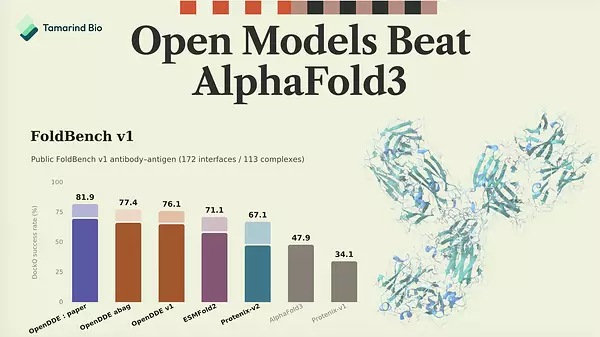
That infrastructure produced AuraIDE, Aureka's own biological foundation model. Trained at scale on proprietary protein co-evolution data, it learns how protein sequence, structure, evolution and function relate to one another. On biomolecular structure prediction and de novo molecular design, it now ranks among the leaders.
Rather than a single-purpose algorithm, AuraIDE is built to transfer across multiple drug discovery programs through task adaptation and project-specific post-training. Its capabilities extend from protein structure modeling and molecular generation into biomolecular interaction modeling, function prediction and multi-objective optimization under complex design constraints.
OpenDDE, the open-source version of AuraIDE, ranks among the world's leading open-source biomolecular models in independent third-party evaluations.
Together, the third-party evaluations and the wet-lab results indicate that Aureka's models lead on protein structure prediction and de novo design, and can translate that capability into measurable molecular function. Through continuous Lab-in-the-Loop feedback, they are moving from predicting biological structure toward generating biomolecules with intended function.
Diversified Commercialization Turns Model Capability into High-Value Drug Assets
Building on its biological foundation models, proprietary single-cell functional screening platform and project-specific post-training, Aureka has produced high-value, differentiated antibodies at scale for problems that conventional approaches struggle with — from difficult target classes such as GPCRs to dual-target antibodies that require a single molecule to engage two targets.
Within a given program, Aureka post-trains its foundation model around target mechanism, functional phenotype and developability objectives, converting general biological intelligence into a dedicated model for a specific drug discovery problem. AI agents then work together across target understanding, molecular generation, computational assessment, experimental design and results analysis, with the resulting experimental data feeding back into that program's model.
The company's end-to-end, agentic R&D infrastructure connects molecular generation, developability assessment, experimental validation, results feedback and candidate development, allowing scientific hypotheses, model capability and experimental capacity to be converted rapidly into developable drug assets that support both internal pipeline programs and external collaborations.
Aureka has established strategic partnerships with multiple leading global pharmaceutical companies to advance the development of differentiated antibody therapeutics, and has generated tens of millions in revenue over the past two years — evidence of the platform's delivery capability, scalability and commercial potential in live drug discovery programs.
From Step-Level Efficiency to Simulating Biological Systems: Toward a Biological World Model
"When leading biological foundation models are genuinely combined with R&D infrastructure that can run at scale, we are no longer simply making one step of drug discovery more efficient — we are building the next-generation drug discovery engine, one that can understand, generate and predict biological systems," said Dr. Weian Zhao, Founder and Chief Executive Officer of Aureka Biotechnologies. "This is a critical step in Aureka's progress toward a biological world model."
On Aureka's long-term roadmap, a biological world model does more than predict static molecular structures. It will simulate interactions between molecules, reason about the likely outcomes of molecular design and engineering, and support AI agents that plan, execute and iterate on drug design tasks autonomously.
With this financing, Aureka will further advance the co-evolution of its biological foundation models and closed-loop AI-native infrastructure, accelerate the validation and translation of model capability in live drug discovery programs, and continue to expand what generative AI can do in antibody drug development.
Investor Perspectives
Granite Asia, Yinghui Kuang:
"AI-driven drug discovery is moving beyond competition on isolated model capability and into a new phase defined by the co-evolution of data, models and experiments in a closed loop. Aureka has built complete AI-native R&D infrastructure with leading biological foundation models as its intelligence core, giving it the systemic ability to generate high-quality data continuously, iterate its models and convert them into drug assets. We are optimistic about the company's long-term technical ceiling in generative antibody design and its potential to grow globally."
HighLight Capital (HLC):
"We are delighted to have completed our investment in Aureka. The company is working to deeply integrate generative AI algorithms with high-throughput wet-lab platforms, with the potential to reshape the paradigm for biologics R&D. We think highly of the team's deep technical foundation in AI-enabled drug development and the efficiency of its closed loop. Going forward, we will continue to commit resources to help the company accelerate pipeline progress and technology iteration, and to bring AI to drug innovation worldwide."
MPCi, Yuye Wang:
"Aureka is a team we backed early and have continued to believe in. OpenDDE, the open-source all-atom model it released, demonstrates this young team's foresight in AI drug discovery and the strength of its technical foundations. Together with the differentiated pipeline the company has now built, we believe a team that combines innovative edge with strategic discipline will keep breaking through bottlenecks in drug development and bring genuine paradigm change to the industry."
NRL Capital:
"Aureka is defining the infrastructure standard for AI drug discovery. The open-source release of OpenDDE marks a key transition from innovation to systematic platform building, closing the loop between computational models and ultra-high-throughput automated wet-lab work and establishing Aureka's global voice in native infrastructure for broadly accessible drug discovery. We recognize the strategic vision of Dr. Weian Zhao and his team in driving industry change through an open-source ecosystem, and we are firm believers in the exponential gains that a dry-lab/wet-lab closed loop delivers in antibody design efficiency. NRL Capital has completed a follow-on investment in this round and will continue to support the company's global expansion and the realization of the global value of its AI infrastructure."
About Aureka Biotechnologies
Aureka Biotechnologies is an AI-native TechBio company building next-generation biological foundation models and closed-loop AI-native infrastructure to transform the therapeutic discovery process. The company has raised nearly $200 million to date and established strategic partnerships with multiple leading global pharmaceutical companies to advance the development of novel antibody therapeutics. Aureka's proprietary foundation model, AuraIDE, is trained on its internal protein co-evolution data and has demonstrated leading capabilities in protein folding and de novo design. Its open-source version, OpenDDE, ranks among the world's leading open-source biomolecular models in independent third-party evaluations.
About Granite Asia
Granite Asia is Asia's most trusted private capital platform, partnering with visionary founders and leaders to build industry champions. With USD 10 billion in assets under management and co-managed capital, the firm has invested in 127 companies valued at over USD 1 billion and supported 67 IPOs worldwide.
About HighLight Capital (HLC)
HighLight Capital (HLC) is a private investment firm dedicated to creating long-term values through promoting technology innovations. Leveraging deep expertise in chemical, biological and materials sciences and proprietary industry research, we invest in companies that enhance manufacturing efficiency and improve human wellness. HLC currently manages over US$4.2 billion.
About MPCi
Founded in 2008, MPCi is one of the leading venture capital firms focused on early stage and early growth deals in China, now managing over 70 billion RMB. MPCi mainly invests in new economy, deep technology, industrial digitalization, healthcare, frontier technology and new consumer brands. MPCi has over 40 investment professionals with deep sector knowledge. The firm also established one of the largest portfolio management teams in the market. Over 80 professionals formed 10 different functions including strategy and operation consulting, recruiting, and healthcare services, etc., to provide value added services to entrepreneurs.
About NRL Capital
NRL Capital is a long-term capital platform that unites top-tier domestic and international industry resources. The firm has built an integrated investment and fund management platform with three interconnected capabilities — direct investment, private equity secondaries, and fund-of-funds — powered by dual-currency operations in both onshore RMB and offshore USD. NRL Capital is deeply focused on pharmaceuticals, medical devices, life sciences, and advanced manufacturing.
** This press release is distributed by PR Newswire through automated distribution system, for which the client assumes full responsibility. **
Aureka Biotechnologies Raises US$100 Million Series B to Build a Biological World Model for Drug Discovery

Aureka Biotechnologies Raises US$100 Million Series B to Build a Biological World Model for Drug Discovery