CARLSBAD, Calif.--(BUSINESS WIRE)--Aug 10, 2026--
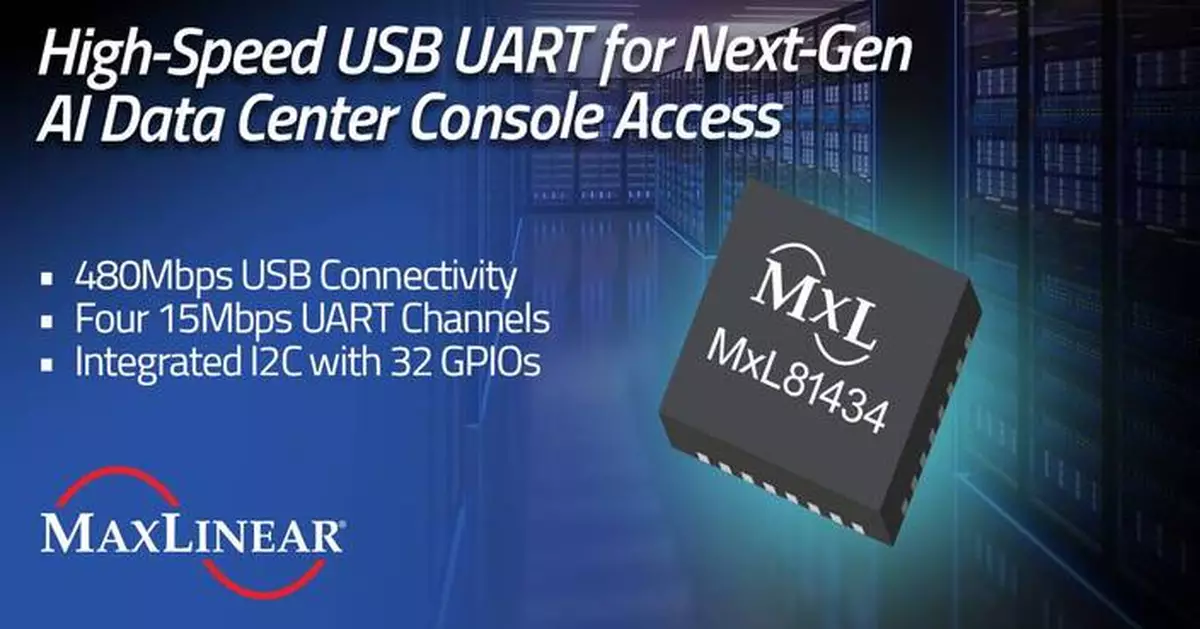
MaxLinear, Inc. (NASDAQ: MXL), a leader in high-performance analog, mixed-signal and connectivity semiconductor solutions, today announced Carmel™, MxL81434, a next-generation high-speed USB-to-UART product designed to support console access, system bring-up, monitoring, debugging, and infrastructure management in AI data centers and hyperscale cloud environments. Carmel™ combines 480Mbps High-Speed USB connectivity, four high-performance UART channels operating at up to 15 Mbps each, an integrated I²C master, and 32 GPIOs in a highly integrated device for modern server and rack-scale management designs.
This press release features multimedia. View the full release here: https://www.businesswire.com/news/home/20260810065267/en/
Carmel™ extends MaxLinear’s USB-to-UART portfolio with a high-speed connectivity and console-access building block for server, rack-scale, and AI infrastructure designs.
We believe the market opportunity for USB-to-UART devices is substantial, with an estimated serviceable available market (SAM) of approximately 200 million units driven by AI data center deployments. Building on the success of Coronado™ and Laguna™, Carmel expands MaxLinear’s participation in this growing market by addressing higher-performance console-access, debug, monitoring, and infrastructure-management requirements for next-generation AI server and rack-scale platforms.
Why Carmel Matters
Performance Leadership
Featuring four UART channels operating at speeds up to 15 Mbps each, Carmel provides high-speed console connectivity for data-intensive debug, provisioning, diagnostics, and recovery workflows.
The device integrates 1024-byte transmit and receive FIFOs, helping sustain high throughput while minimizing host processor overhead. An integrated I²C master and 32 GPIO channels allow designers to consolidate monitoring, reset management, debug access, and platform-management functions into a single device.
Executive Quote
“As AI infrastructure scales, the performance requirements for console access, debug, and platform management continue to increase,” said Amit D. Bavisi, Ph.D., Senior Vice President and General Manager of MaxLinear’s Analog Mixed-Signal Business Unit. “Carmel delivers high-speed USB-to-UART connectivity, combining 480Mbps bandwidth, four UART channels supporting up to 15Mbps each, integrated I²C management, 32 GPIOs, large FIFOs, and robust ESD protection to support low-latency access and reliable operation in next-generation AI data centers.”
Distribution Partner Quote
“We are very pleased to work with MaxLinear to expand its existing USB-to-UART product portfolio and bring the new Carmel™ high-speed USB-to-UART product to our cloud service provider customers,” said Johnny Hsu, Vice President of Marketing, WT Microelectronics. “As data center and AI server architectures continue to evolve, customers face increasingly diverse and challenging console-access, management, and debug requirements. Carmel’s combination of 480 Mbps High-Speed USB connectivity, four high-performance UART channels, integrated management capabilities, and low-latency operation provides a compelling solution that helps enable next-generation server and rack-scale platform designs.”
Target Applications
Availability
Carmel™ samples are expected to be available in Q4 2026. For additional information, contact your MaxLinear representative.
About MaxLinear, Inc.
MaxLinear, Inc. (Nasdaq: MXL) is a leading provider of radio frequency (RF), analog, digital, and mixed-signal integrated circuits for access and connectivity, wired and wireless infrastructure, and industrial and multimarket applications. MaxLinear is headquartered in Carlsbad, California. For more information, please visit https://www.maxlinear.com/.
MaxLinear, the MaxLinear logo, and any other MaxLinear trademarks are all property of MaxLinear, Inc. or one of MaxLinear's subsidiaries in the U.S.A. and other countries. All rights reserved.
All third-party marks and logos are trademarks or registered trademarks of their respective holders/owners.
Cautionary Note About Forward-Looking Statements
This press release contains forward-looking statements within the meaning of Section 27A of the Securities Act of 1933, as amended, and Section 21E of the Securities Exchange Act of 1934, as amended. Forward-looking statements include, among others, statements relating to the Carmel™ (MxL81434) high-speed USB-to-UART product and the functionality, performance, benefits, and availability of such product, including the expectation that Carmel™ samples will be available in the fourth quarter of 2026; statements about the potential market opportunity for USB-to-UART devices, including the estimated serviceable available market and the anticipated growth of AI data center and hyperscale cloud deployments; the potential growth of the AI market; the expected benefits of Carmel™ for next-generation AI server and rack-scale platform designs; and statements by MaxLinear’s Senior Vice President and General Manager, Analog Mixed-Signal Business Unit, and by the Vice President of Marketing, WT Microelectronics. These forward-looking statements involve known and unknown risks, uncertainties, and other factors that may cause actual results to be materially different from any future results expressed or implied by the forward-looking statements and our future financial performance and operating results forecasts generally. Forward-looking statements are based on management’s current, preliminary expectations and are subject to various risks and uncertainties. In particular, our future operating results are substantially dependent on our assumptions about market trends and conditions. Additional risks and uncertainties affecting our business, future operating results and financial condition include, without limitation; risks relating to: the development, testing, and commercial introduction of new products and product functionalities, including the Carmel™ high-speed USB-to-UART product; risks related to the market opportunity for USB-to-UART devices for AI data center console access, including the estimated serviceable available market described above, not developing or being smaller or slower to develop than anticipated, or MaxLinear not being able to capture share of the market; the capabilities of our technology; our terminated merger with Silicon Motion and related arbitration and class action complaint and the risks related to potential payment of damages; the effect of intense and increasing competition; increased tariffs, export controls or imposition of additional trade barriers; impacts of global economic conditions; the cyclical nature of the semiconductor industry; a significant variance in our operating results and impact on volatility in our stock price, and our ability to sustain our current level of revenue, which has previously declined, and/or manage future growth effectively, and the impact of excess inventory in the channel on our customers’ expected demand for certain of our products and on our revenue; escalating trade wars, military conflicts and other geopolitical and economic tensions among the countries in which we conduct business; international geopolitical and military conflicts; our ability to obtain or retain government authorization to export certain of our products or technology; the loss of, or a significant reduction in orders from major customers; legal proceedings or potential violations of regulations; information technology failures; a decrease in the average selling prices of our products; failure to penetrate new applications and markets; development delays and consolidation trends in our industry; inability to make substantial and productive research and development investments; delays or expenses caused by undetected defects or bugs in our products; substantial quarterly and annual fluctuations in our revenue and operating results; failure to timely develop and introduce new or enhanced products; order and shipment uncertainties and differences between our estimates of customer demand and product mix and our actual results; failure to accurately predict our future revenue and appropriately budget expenses; lengthy and expensive customer qualification processes; customer product plan cancellations; failure to maintain compliance with government regulations; failure to attract and retain qualified personnel; any adverse impact of rising interest rates on us, our customers, and our distributors and related demand; risks related to compliance with privacy, data protection and cybersecurity laws and regulations; risks related to conforming our products to industry standards; risks related to business acquisitions and investments; claims of intellectual property infringement; our ability to protect our intellectual property; security vulnerabilities of our products; use of open source software in our products; failure to manage our relationships with, or negative impacts from, third parties; the accuracy of our estimates regarding the size, timing, and growth of the serviceable available market and total addressable market for our USB-to-UART and related products; our dependence on continued growth in AI data center, hyperscale cloud, and rack-scale infrastructure spending; the timing and availability of product samples and volume production and the risk of delays; our dependence on distributors and channel partners to market and sell our products; the risk that actual product performance may differ from published specifications; and future decisions relating to our stock repurchase program.
In addition to these risks and uncertainties, investors should review the risks and uncertainties contained in our filings with the Securities and Exchange Commission, including our Current Reports on Form 8-K, as well as the information to be set forth under the caption "Risk Factors" in MaxLinear's Quarterly Report on Form 10-Q for the quarter ended March 31, 2026. All forward-looking statements are based on the estimates, projections and assumptions of management as of the date of this press release, and MaxLinear is under no obligation (and expressly disclaims any such obligation) to update or revise any forward-looking statements whether as a result of new information, future events, or otherwise.
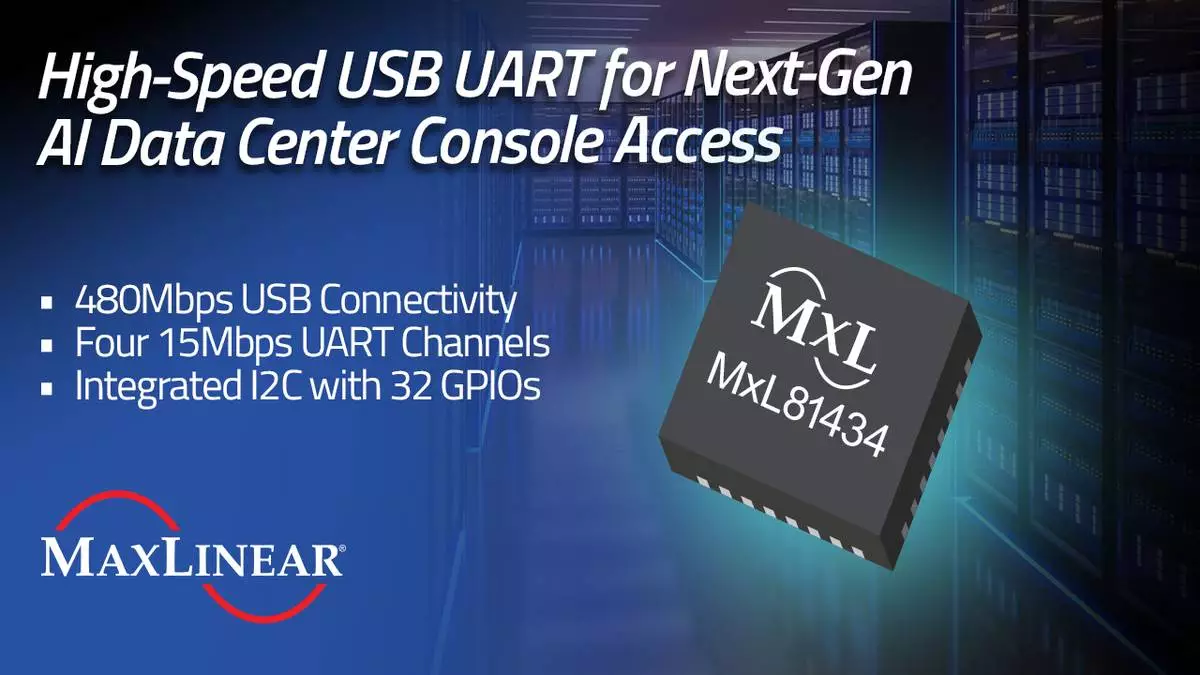
MaxLinear's Carmel™ (MxL81434) high-speed USB-to-UART solution delivers 480 Mbps USB connectivity, four UART channels up to 15 Mbps each, integrated I²C, and 32 GPIOs for next-generation AI infrastructure console access.