WASHINGTON (AP) — Is U.S. inflation stuck at a stubbornly high level or is it steadily cooling?
The government's latest report on consumer prices, to be released Wednesday, should provide some hints. It will be closely watched by the inflation-fighters at the Federal Reserve as well as Republicans facing tough midterm elections, not to mention consumers still struggling with high grocery prices.
Americans have grappled with worsening inflation since early last year, after tariffs lifted the cost of imported goods. Then this spring, the Iran war raised oil and gas costs, pushing inflation to its highest level in three years. The AI build out has also increased prices for computer chips and electronic equipment. All three trends could end up having only temporary effects and if they fade, inflation could drop back to the Federal Reserve's 2% target.
Wednesday’s inflation report is expected to show that consumer prices rose 3.4% in July from a year earlier, according to a survey of economists by data provider FactSet. That would be down from 3.5% in June and lower than the recent peak of 4.2% in May.
On a monthly basis, prices are expected to have risen just 0.1% from June to July, after they fell in June on sharply lower gas costs.
Excluding the volatile food and energy categories, core inflation may cool for a second month, to 2.5%, down from 2.6% in June, according to FactSet. Core prices — which the Fed pays particularly close attention to — likely rose 0.2% from June to July.
A big reason inflation has cooled in the past couple of months is that gas prices fell after a ceasefire was reached in the U.S.-Iran war. Average gas prices were lower last month than in June, so that should reduce last month’s inflation reading. But gas prices rose again in late July and earlier this month, meaning inflation could pick up again when August’s figures are released next month, adding a layer of uncertainty.
On Wednesday, gas averaged $4.04 a gallon nationwide, 16 cents higher than a month ago, according to the motor club AAA.
Overall, price increases have stayed above the Fed's 2% target for more than five years, suggesting that more than temporary factors may be at work. The cost of services such as healthcare, restaurant meals, and car maintenance are on average rising at more than 3% annually, and they aren't particularly sensitive to gas prices or AI investment.
Rising costs for services often reflect higher wages, as companies charge more to offset the cost of higher pay. But incomes aren't growing fast enough to sustain inflation, economists note.
It's a confounding situation that has left many economists — and Fed officials — seeking more information to determine where inflation is headed.
“You've got all these things that are just not the way the economy used to behave,” Diane Swonk, chief economist at KPMG, said.
For many consumers, years of sharply rising grocery prices have led them to adopt a wide range of coping strategies, from comparison shopping, to couponing, to cutting back on favorite foods.
Some retailers, such as Walmart, have responded by rolling back food prices, a trend that could have lowered July's inflation figures. Yet many other firms are still passing on higher costs.
Paint company Sherwin-Williams is planning an 8% price increase effective Sept. 1 to offset higher raw material costs, CEO Heidi Petz told analysts late last month. She said that because of the company’s strong relationships with suppliers, it was able to delay price increases until now.
“We are seeing the impact of higher oil and related cost pressures, and we expect continued volatility throughout the balance of the year,” she said.
Wednesday's report comes as the Federal Reserve is sharply divided over whether it should hike its key interest rate to combat inflation. The Fed kept its rate unchanged, at about 3.6%, at a meeting late last month. But the vote was 9-3, with three dissenters favoring a rate hike.
And at a July 29 news conference explaining the decision, chair Kevin Warsh was vague about the Fed's next steps, in keeping with his focus on reining in the central bank's previous willingness to signal whether it was prepared to raise or cut borrowing costs.
“If inflation continues to be elevated ... interest rates could well be part of that solution," he said. “But I wouldn't say it's in isolation.”
Long-term interest rates rose after Warsh's comments, suggesting investors worried that inflation could worsen in the coming months and the Fed might not lift borrowing costs to fight rising prices.
Complicating matters, the government said last week that employers had cut jobs in July, a sign of potential economic weakness. The Fed typically avoids rate hikes when hiring is faltering, because higher borrowing costs could slow the economy further.
Investors now see the odds of a rate hike at the Fed's next meeting in September as roughly 50-50, according to CME Fedwatch.
AP Writer Anne D'Innocenzio contributed to this report from New York.
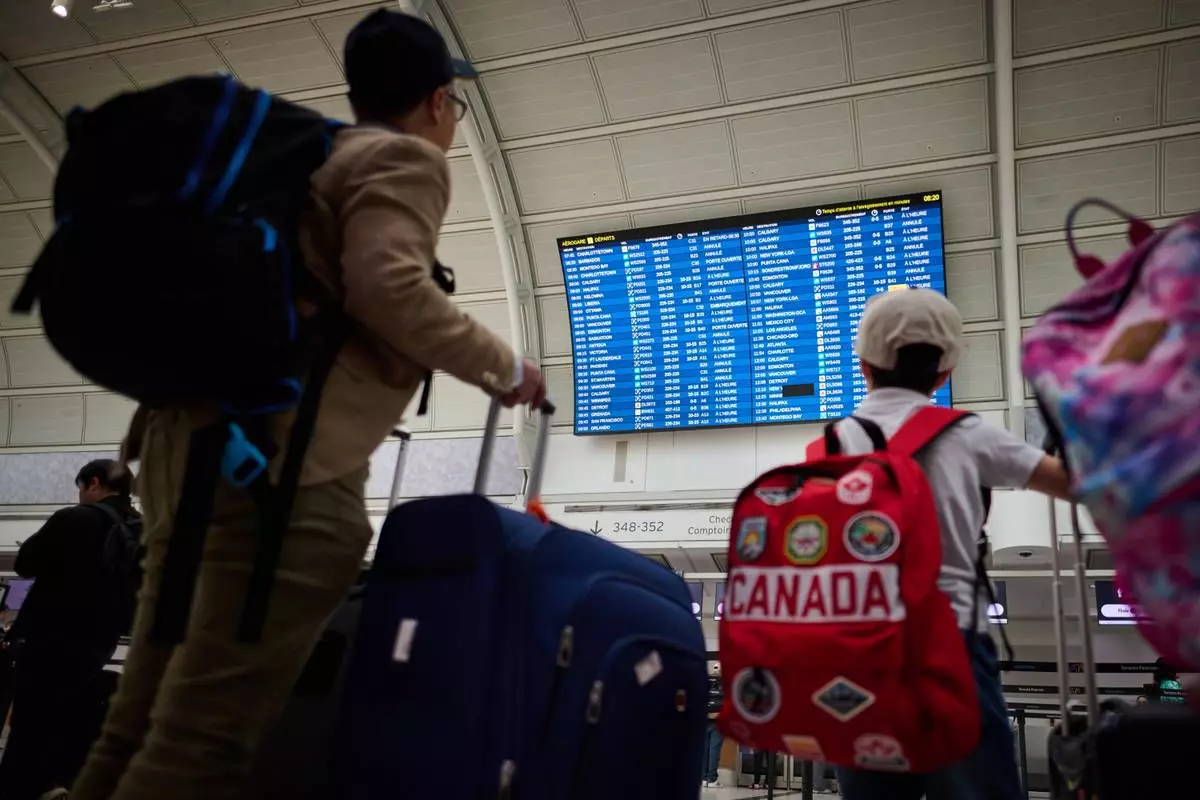
Travelers look at departures by the WestJet gate as the airline's flight attendants strike outside at Pearson International Airport in Toronto, on Sunday, Aug. 2, 2026. (Sammy Kogan/The Canadian Press via AP)
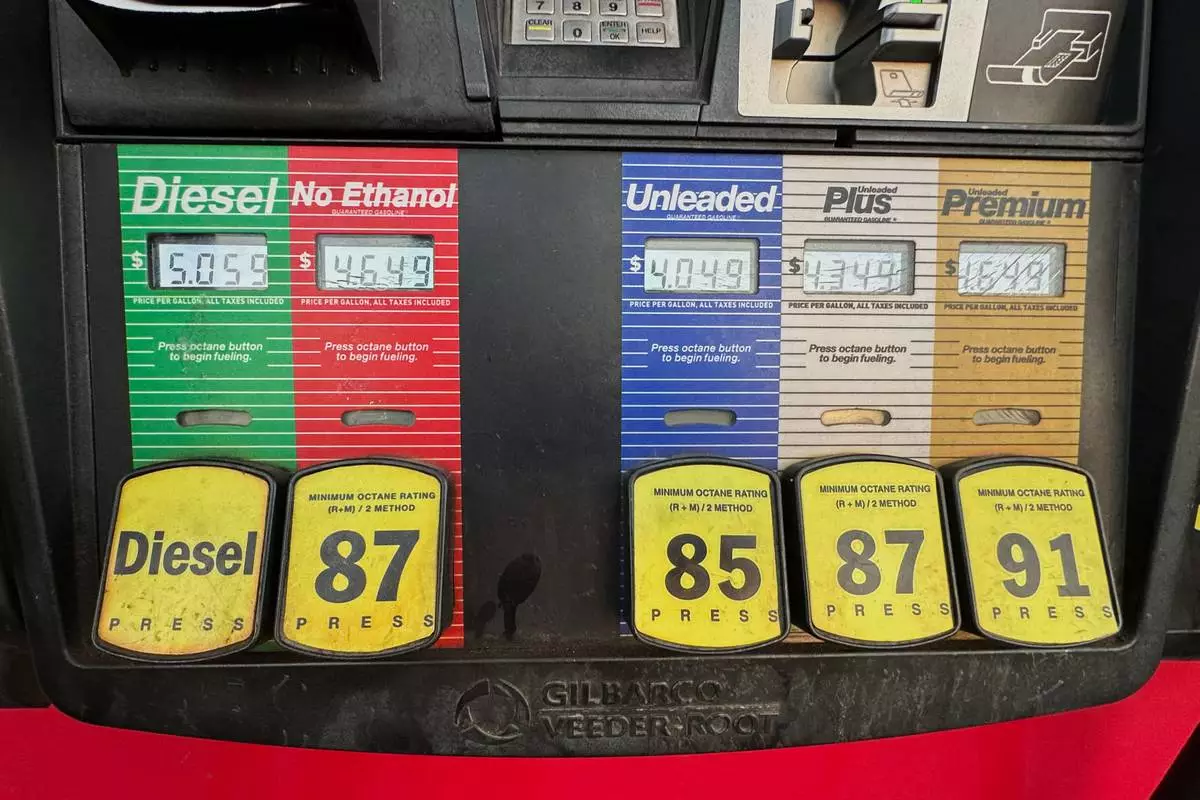
Gas prices are displayed electronically at QT gasoline station, Thursday, Aug. 6, 2026, in Greenwood Village, Colo. (AP Photo/David Zalubowski)

FILE - A person loads groceries in plastic bags into their vehicle, May 18, 2026, at a grocery store in Cincinnati. (AP Photo/Joshua A. Bickel, File)
MEDINACELI, Spain (AP) — Spaniards rushed to buy specialized glasses to view a rare total solar eclipse Wednesday, as authorities warned people flocking to rural areas to avoid anything that could spark new wildfires.
Across a swath of northern and central Spain, millions of people will have some of mainland Europe's best views of the celestial spectacle. A sliver of Greenland and Iceland, too, will witness the spectacle, when the sun, moon and Earth align, briefly bringing parts of the planet into darkness.
Totality — when the moon completely covers the sun’s light — is expected to last less than 2 1/2 minutes, reaching its maximum duration off Iceland’s west coast. By the time it gets to a small patch of Portugal and then to Spain just before sunset, totality will have dwindled to a minute or so. The spectacle will then end over the Mediterranean.
Against the backdrop of scorching summer temperatures and wildfires, Spanish officials have rolled out a large public safety campaign.
The eclipse could draw at least an additional half a million visitors, authorities say. Demand for hotel rooms along the path of totality, including in the northern cities of A Coruña, Bilbao and Santiago de Compostela, has soared.
In Medinaceli, a Roman-era hilltop town in northeast Spain, sky watchers secured grassy viewing points several hours early.
“It must be thrilling to see the darkness come suddenly and the image of the sun disappearing,” said Agatha Bak, a 40-year-old philosophy professor who left Madrid for the town at sunrise with a group of friends.
Spain’s Interior Ministry said 350 official viewing sites have been set up across the sparsely populated interior, often referred to as “Empty Spain.” Authorities have limited or restricted access to another 123 sites because of environmental conditions or obstacles that could hinder an evacuation in the event of a wildfire.
Only weeks ago, the most destructive wildfire in Spanish history devoured 500 square kilometers (193 square miles) and forced the evacuation of tens of thousands of people in Ávila, in central Spain. Several smaller wildfires remain active elsewhere in southern and central parts of the country.
More than 33,500 law enforcement officers will be deployed to observation areas and access points, the ministry said.
“High temperatures, the accumulated dryness of vegetation, and the intense pressure on natural areas due to projected travel necessitate extreme preventive measures,” Interior Minister Fernando Grande-Marlaska said.
Much of Spain was on alert Wednesday as temperatures climbed above 35 Celsius (95 Fahrenheit) in many areas where the total eclipse will be observed.
Authorities' top priority is to prevent even a single spark that could lead to a fire, as happened in Ávila in late July. They are urging visitors not to light fires, litter or park in areas with dry vegetation.
Special eclipse glasses are essential for safe viewing, even if only a sliver of the sun remains visible.
“To look at the sun, you must always use proper protection, and the most suitable protection is eclipse glasses,” said Telmo Fernández Castro, director of the Madrid Planetarium. The glasses are made with special filters that block solar radiation that can damage the eyes.
For months, supermarkets, department stores, museums and planetariums across Spain have sold or distributed the glasses, with many pharmacies running out of stock ahead of Wednesday.
On Tuesday evening in downtown Madrid, a long line formed outside a photo shop where a sign read, “We carry eclipse glasses.”
One woman emerged triumphantly and reassured those waiting: “He has boxes and boxes of them!”
For sky watchers hoping to peek at the solar eclipse, spare a thought for Sverre Rud.
Rud, captain of the MS Spitsbergen, is circling the waters of Rypefjord in eastern Greenland trying to make sure he is perfectly positioned for his 126 passengers to view the spectacle. All day, people have been coming up to Rud to ask if he has nailed the right spot — no clouds will do if they are to see it.
“I will do my best,’’ Rud said. “I will pull out my superman powers.’’
The eclipse may be startling for the passengers, who have been experiencing 24 hours of daylight on a 17-day cruise in locations mostly north of the Arctic Circle.
Suddenly, for two minutes it will be dark.
Even so, the mood on the ice-strengthened polar ship is pure anticipation.
“Everyone is very enthusiastic,” Rud said. “When we were down for breakfast earlier, it was almost like a little bit of a Christmas Eve feeling here."
Rooms in Reykjavík, Iceland's capital, were averaging more than $1,000 for Wednesday night as Icelanders prepared for their first total solar eclipse since 1954 and the first visible from the capital since 1433.
Prices were roughly double 2025 rates, according to data group Lighthouse Intelligence. But tourists, many of whom made bookings years in advance at exorbitant prices, may be disappointed as cloudy skies are forecast across most of the island when the eclipse peaks.
Authorities expect up to 20,000 additional overseas visitors during an already busy peak tourist period. Iceland is home to fewer than 400,000 people.
The 70-room Hotel Keflavík in the Reykjanesbaer municipality was fully booked, with guests hoping to see around one minute and 45 seconds of totality.
“Eclipse time, of course, has been very demanding, and many people came to us early, like last year,” said hotel owner and manager Steinþór Jónsson.
Jónsson said he had seen nothing like it since 1986, the year the hotel opened and U.S. President Ronald Reagan and Soviet leader Mikhail Gorbachev held their summit in Reykjavík.
“When I opened the hotel, we had Reagan and Gorbachev meeting. It was very hectic here,” he said with a smile. “Besides Reagan and Gorbachev, the eclipse is the biggest.”
Associated Press journalists Danica Kirka and Brian Melley in London and James Brooks in Snæfellsnes, Iceland, contributed.
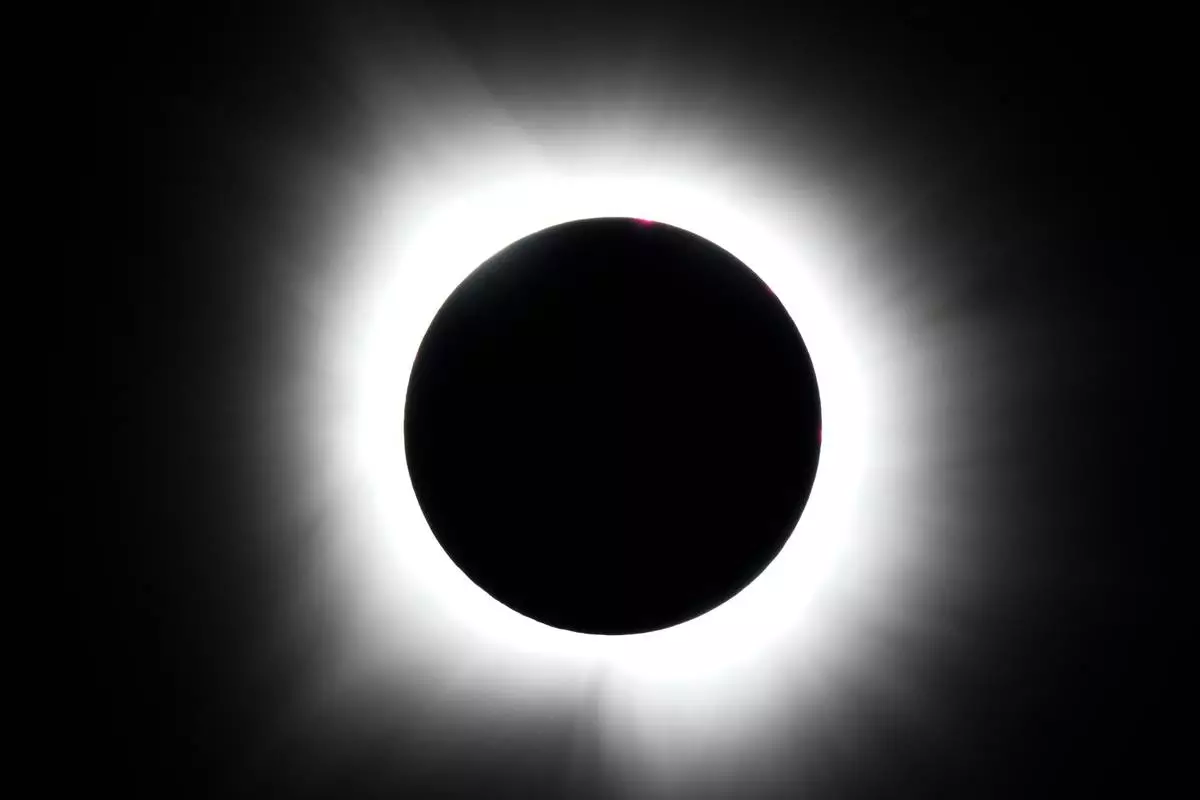
FILE -A total solar eclipse is seen from Arlington, Texas, April 8, 2024. (AP Photo/Julio Cortez, File)
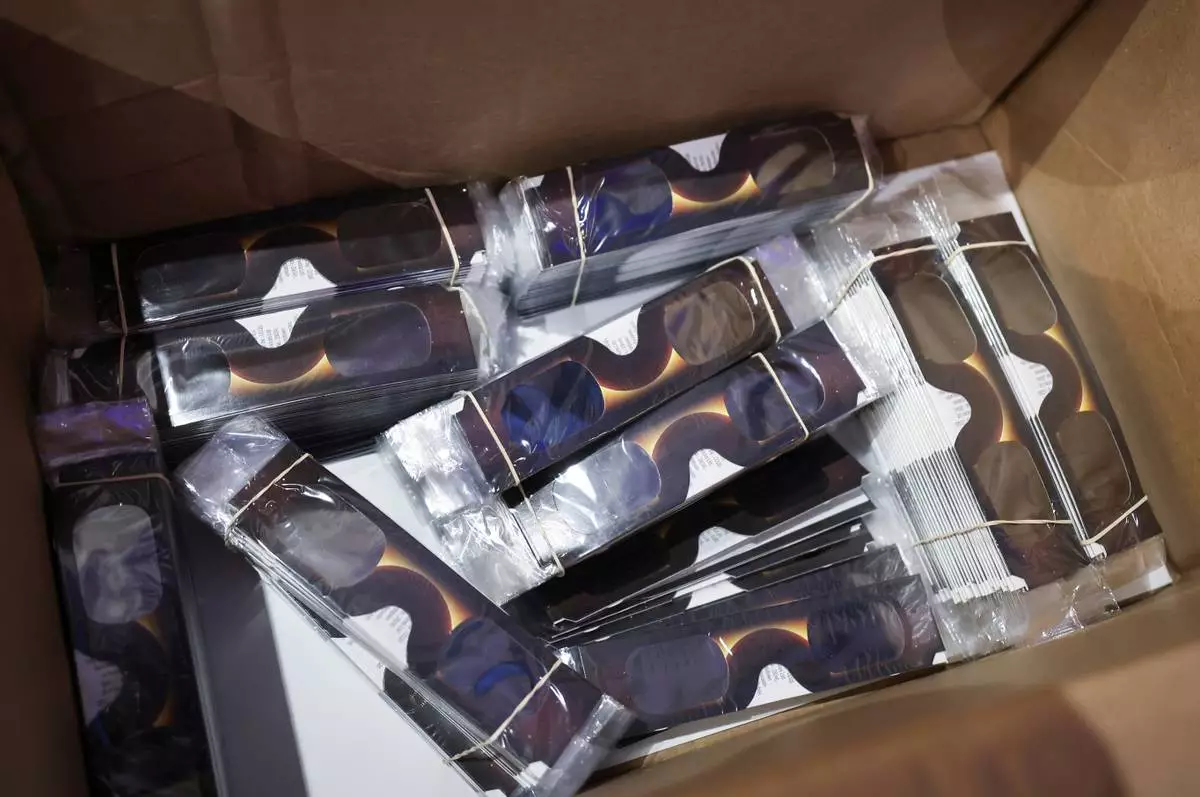
Special protective glasses for viewing the sun are stored in a cardboard box at the Hamburg Planetarium on Wednesday, Aug. 12, 2026 in Hamburg, Germany. (Christian Charisius/dpa via AP)
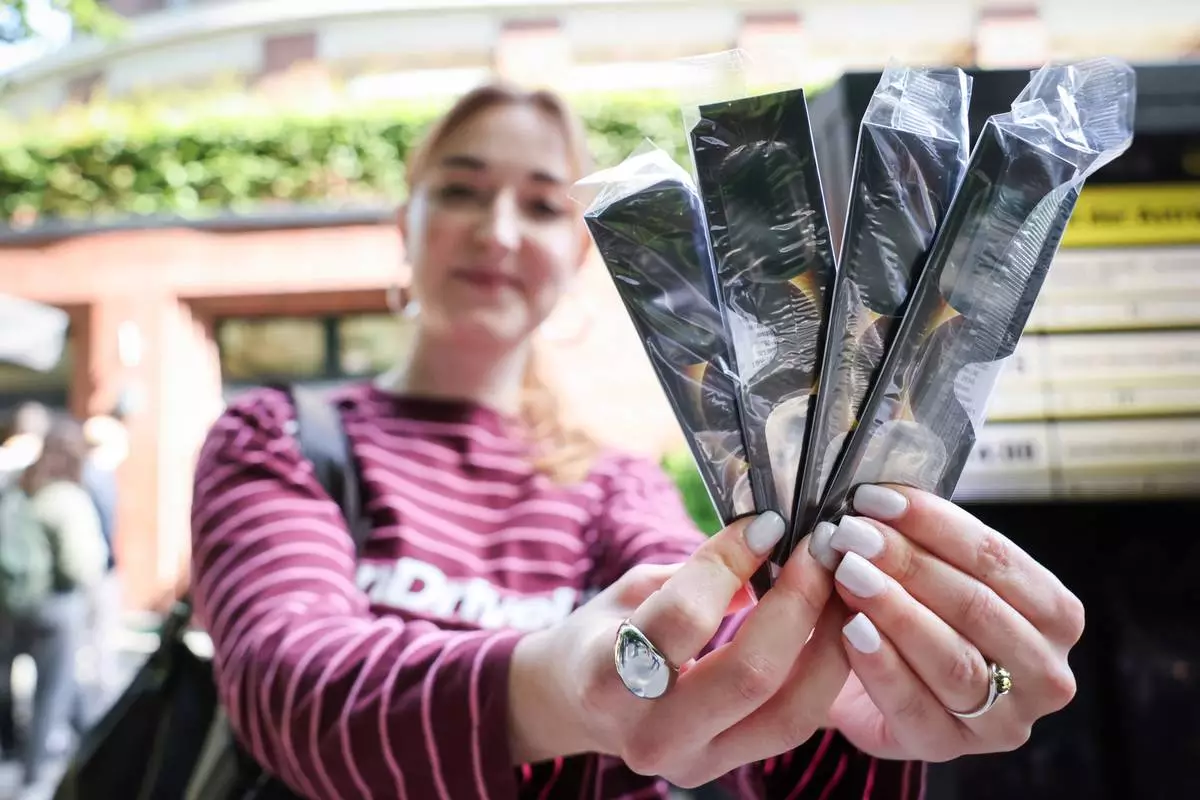
Jana Timm is holds four pairs of special solar viewing glasses that she bought at the Hamburg Planetarium to safely observe the partial solar eclipse on Wednesday, Aug. 12, 2026 in Hamburg, Germany. (Christian Charisius/dpa via AP)
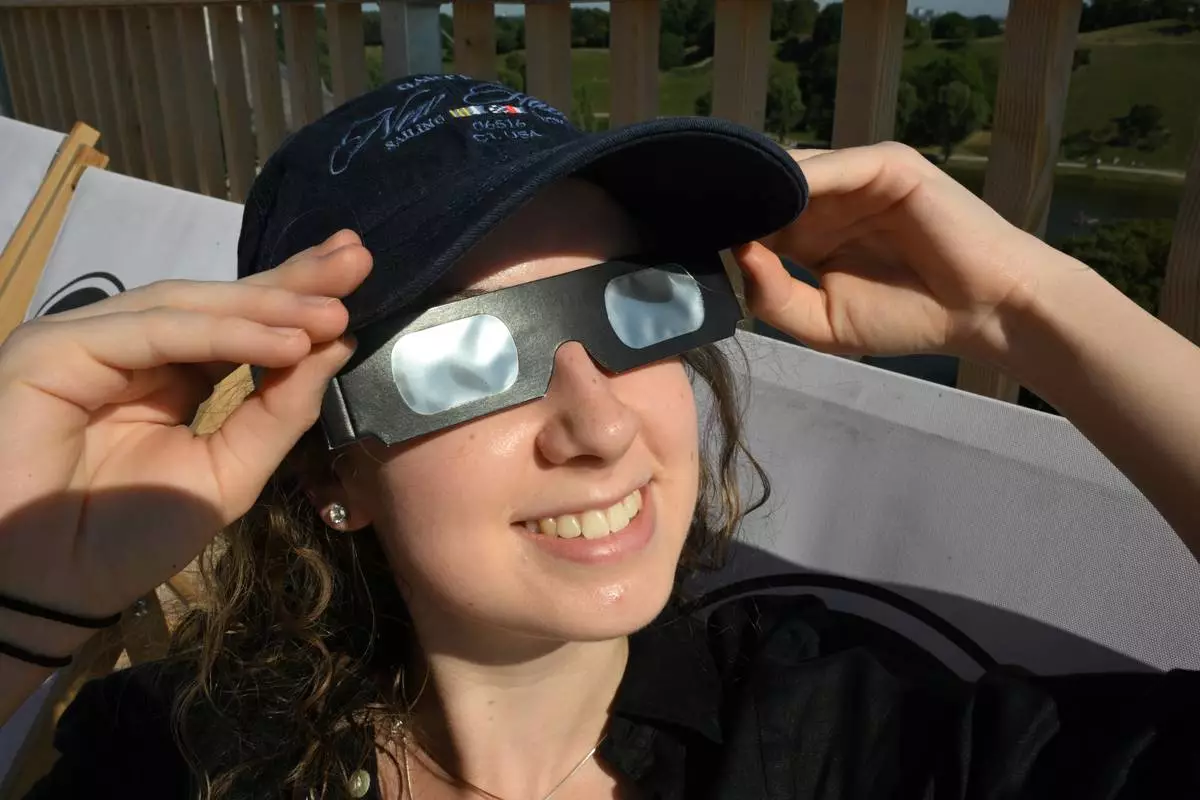
A woman wears safety goggles, as she prepares to watch the partial solar eclipse on the SAYAQ Adventure Tower in Munich's Olympic Park, on Wednesday, Aug. 12, 2026 in Munich, Germany. (Felix Hörhager/dpa via AP)