MEMPHIS, Tenn. (AP) — The PGA Tour postseason starts with a $20 million tournament, with only a 69-man field, and with a sense of urgency for only about half of the players at the FedEx St. Jude Championship.
Scottie Scheffler is the No. 1 seed and bracing for three straight postseason tournaments, even though his chances of winning the FedEx Cup for the second time depend solely on how he performs at East Lake for the season-ending Tour Championship.
“I have three tournaments, three good starts to kind of end the year. Definitely excited to get this week going,” Scheffler said. He has played the TPC Southwind seven times, the most of any course on the PGA Tour without ever having won.
Those outside the top 50 in the FedEx Cup — Jordan Spieth the most prominent at No. 54 and Jackson Koivun at No. 70 despite turning pro only in June — have great urgency. Their season is over if they don't move into the top 50 and advance to St. Louis for the BMW Championship.
And then there's Rory McIlroy at No. 12, already set for the Tour Championship. He skipped the TPC Southwind last year because there was no point in playing. But he's back this year, perhaps because the Masters champion has played only 11 times on the PGA Tour this season.
“A few different things went into that decision. I think having four weeks off going into the last two events of the year was probably going to be a little too much for me in terms of wanting to be competitive,” McIlroy said. “So this is a good week. Obviously I want to play well, but it’s also a good week to just see where my game is, do a lot of practice, or as much as I can in the heat.”
McIlroy won't reach the minimum 15 tournament required for PGA Tour membership, though there are enough exceptions — his home circuit is the Europe tour and McIlroy is a life member with his 30 wins — that it probably won't be an issue.
Membership is required to vote on such items as PGA Tour player of the year, and that might be the most compelling part of this year's postseason before the tour completes its journey through the sweltering heartland before arriving in sweltering Atlanta.
No one has stood out this year. Cameron Young, who won The Players Championship, might have been the front runner until Ryan Fox made that memorable birdie on the 18th hole at Royal Birkdale to win the British Open.
McIlroy has only one win this year, which he wouldn't trade — the Masters. Scheffler has only one win — his first start of the year in the California desert — but he has five runner-up finishes and had top-4 finishes in all but one of the majors. He's still the player to beat, even though he has beaten the field only once this year.
Matt Fitzpatrick and Chris Gotterup have three wins. Wyndham Clark's two wins include the U.S. Open. Fox and PGA champion Aaron Rai have only one win. Any of them winning the FedEx Cup might go along way toward getting the Jack Nicklaus Award.
“If you value winning the biggest tournaments, you would say it could be Cameron Young and Wyndham Clark,” McIlroy said. “Matt Fitzpatrick has had a great year. Scottie’s had an unbelievably consistent year without the wins that he’s had the last couple years. Again, it all depends on what you value. I guess I value like the bigger tournaments and guys having the bigger moments.”
It all starts to unfold Thursday at a tournament where the heat is expected to be stifling, as usually is the case in August. The end of the season is near, and so is the St. Jude Championship. The PGA Tour already has said it will not be part of the top-tier “Championship Series” in 2028.
For now, it remains as important as any tournament on the PGA Tour. The top 50 after this week are assured of all the $20 million signature events for the following season, and it keeps alive hopes of reaching the Tour Championship, where everyone starts over and the winner gets the FedEx Cup.
See AP’s full golf coverage here

Jordan Spieth reacts after missing a birdie putt on the ninth green during the first round of the Rocket Classic golf tournament at the Detroit Golf Club, Thursday, July 30, 2026, in Detroit. (AP Photo/Jose Juarez)
The ongoing Ebola outbreak in Congo is on track to surpass the deadliest one in history, which erupted over a decade ago and killed over 11,000 people, the head of the World Health Organization said Wednesday.
“At its current pace, it's on track to eclipse the West African Ebola outbreak of 2014 to 2016,” Tedros Adhanom Ghebreyesus told reporters. That outbreak horrified the world and jolted efforts to develop a vaccine.
The outbreak in eastern Congo, considered the fastest-growing one yet, has killed over 2,000 people out of more than 4,300 cases. The outbreak was declared on May 15, but health authorities now say sequencing showed it began months earlier, in February.
It is unlike recent Ebola outbreaks because the rare Bundibugyo virus responsible for it has no approved vaccines or treatments, though efforts to address that are underway.
Experts say this outbreak is moving faster than efforts to track and manage it in a remote part of eastern Congo facing ongoing conflict, near the borders with South Sudan, Uganda and Rwanda.
Most new cases and deaths are being reported in communities outside the reach of health workers in a region of poor infrastructure and ill-equipped health centers. Some workers have gone on strike over lack of pay. Misinformation about the virus circulates in communities where some are wary of outsiders, keeping some people from clinics.
“The outbreak had a big head start, still way ahead of us, and we’re playing catch-up,” Tedros said.
Dr. Abdirahman Mahamud, WHO's director for health emergency alert and response operations, said the agency expects the peak of the outbreak to be reached in six months.
“But ... that’s the moderate scenario,” Mahamud said. “There is a one-case scenario where this outbreak may last nine months to 12 months.”
This Ebola outbreak has killed more people at a faster rate than any other, including the 2014-2016 outbreak that had at least 28,000 cases. That one took about eight months to reach 1,000 deaths.
Ebola is rare but highly contagious and can be contracted from bodily fluids such as vomit, blood or semen, and from contaminated surfaces and materials such as bedding and clothing. The disease it causes is severe and often fatal.
Clinical trials of two possible treatments for this type of Ebola began last month in Ituri, the most affected of the five provinces in Congo where cases have been reported.
Two vaccines developed specifically for the Bundibugyo virus are now being tested in people for the first time, Tedros said Wednesday.
WHO also plans to test whether an existing Ebola vaccine could protect people against the virus after studies in animals showed promising results.
The origins of the outbreak are becoming increasingly clear.
A study published in Nature Medicine on Monday added evidence that the outbreak began when the virus jumped from an infected animal to a person, rather than stemming from earlier outbreaks. Researchers found the virus is genetically different from versions seen in Bundibugyo Ebola outbreaks in 2007 and 2012.
Dazio reported from Berlin and Banchereau from Dakar, Senegal. Associated Press writer Mike Stobbe in New York contributed to this report.
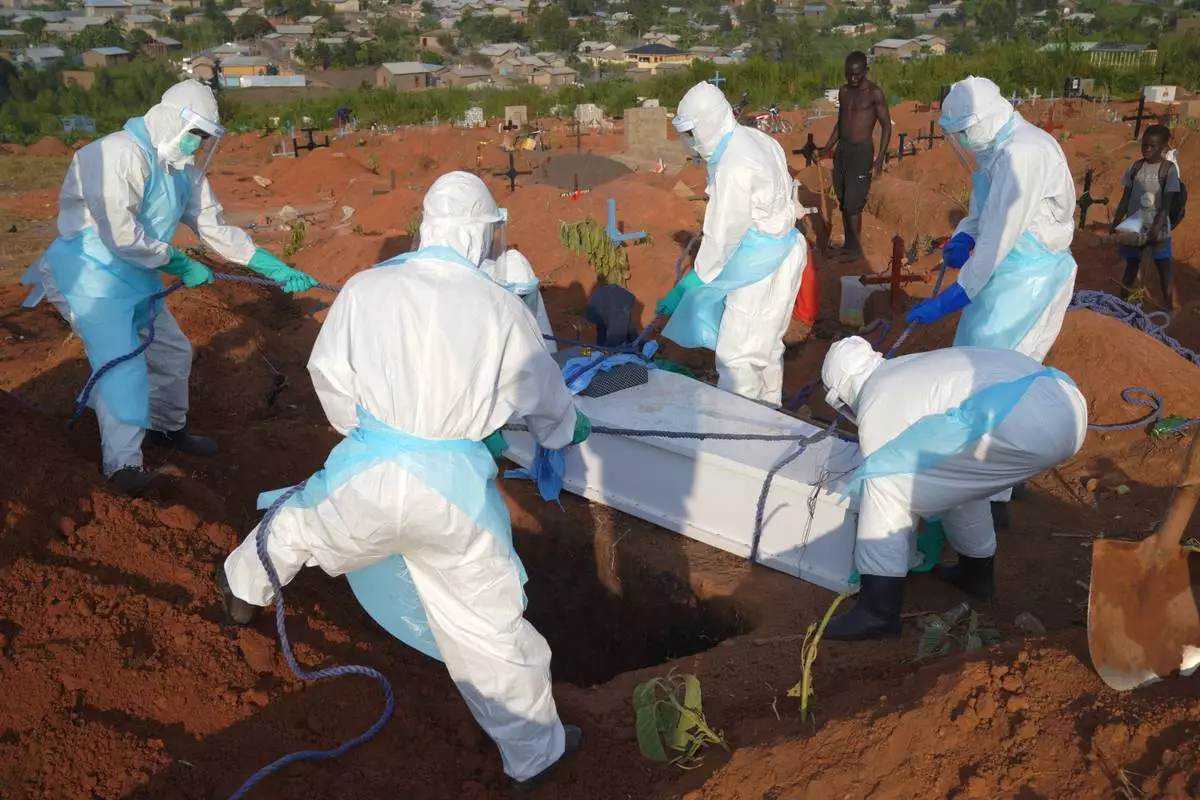
People in protective gear lower into a grave the coffin containing the remains of Jacques Lobo Dhena, who died of Ebola, during a burial service in Bunia, Ituri province, eastern Congo, Wednesday, Aug. 12, 2026. (AP Photo/Dieudonne Dirole)
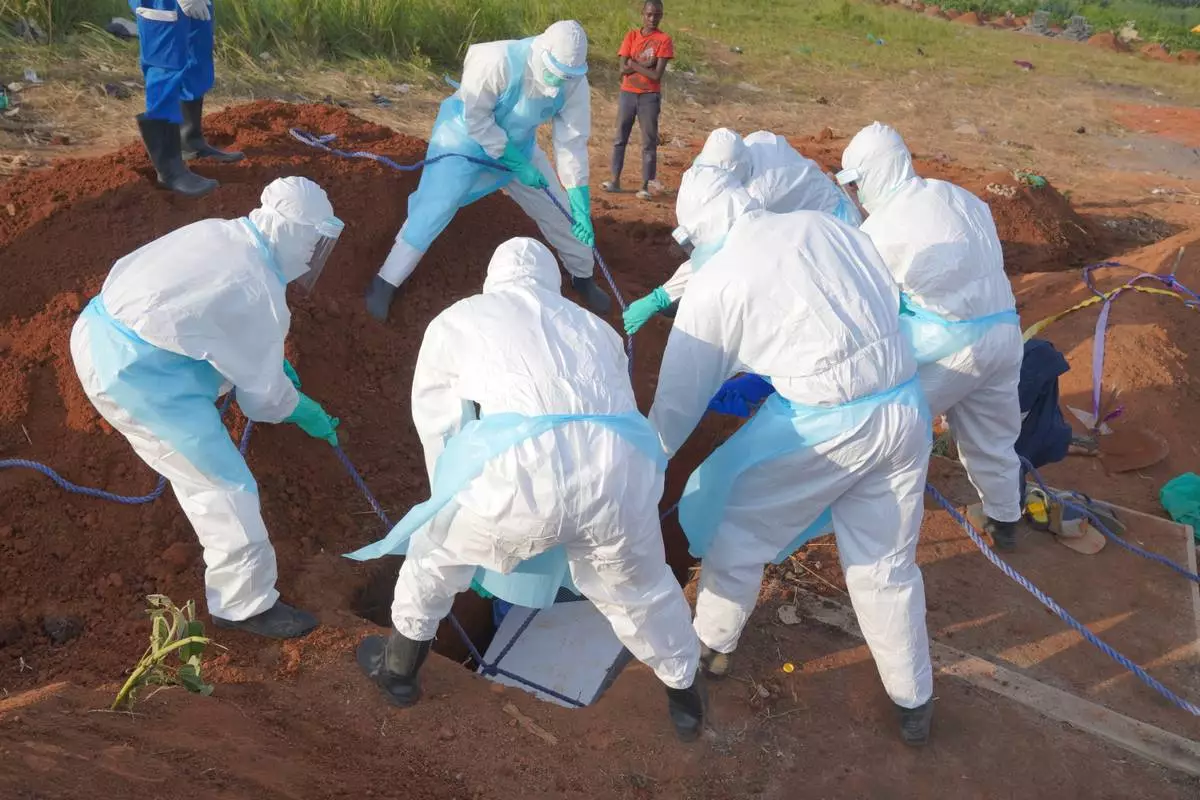
People dressed in protective gear lower into a grave the coffin containing the remains of Jacques Lobo Dhena, who died of Ebola, during a burial service in Bunia, Ituri province, eastern Congo, Wednesday, Aug. 12, 2026. (AP Photo/Dieudonne Dirole)
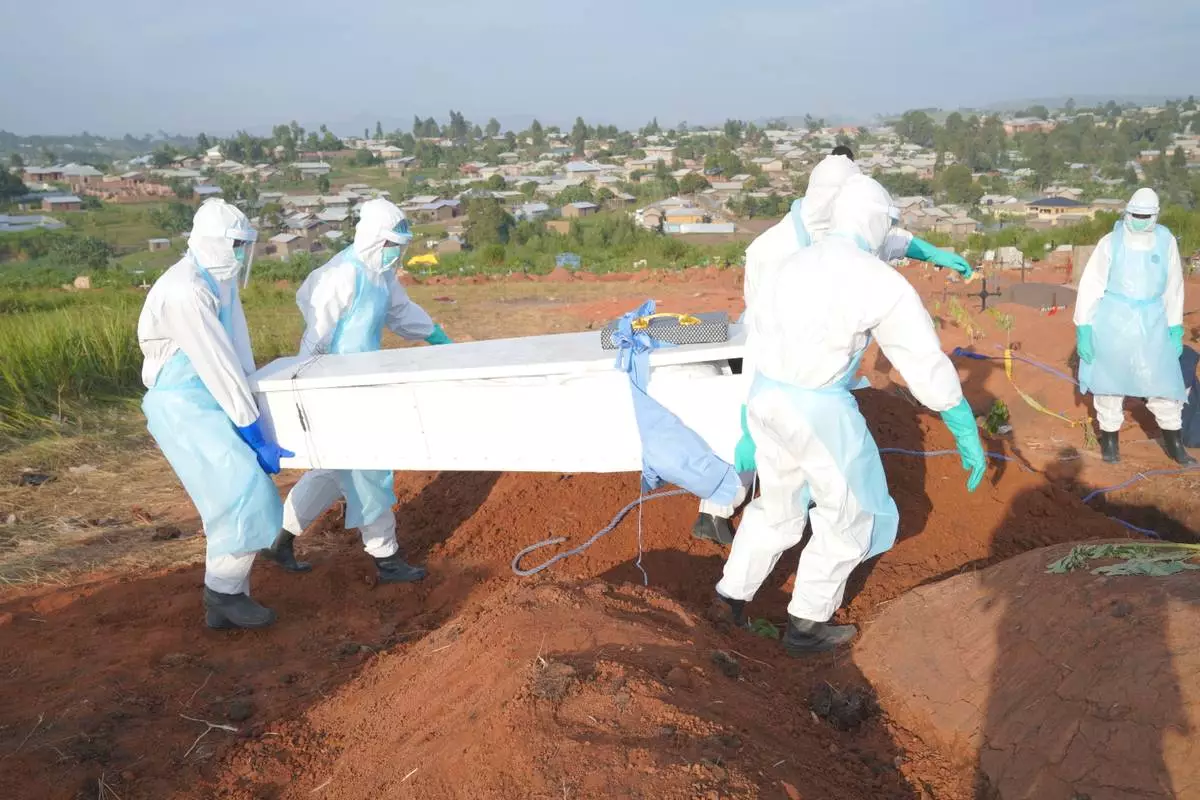
People dressed in protective gear carry the coffin that contain the remains of Jacques Lobo Dhena, who died of Ebola, during a burial service in Bunia, Ituri province, eastern Congo, Wednesday, Aug. 12, 2026. (AP Photo/Dieudonne Dirole)
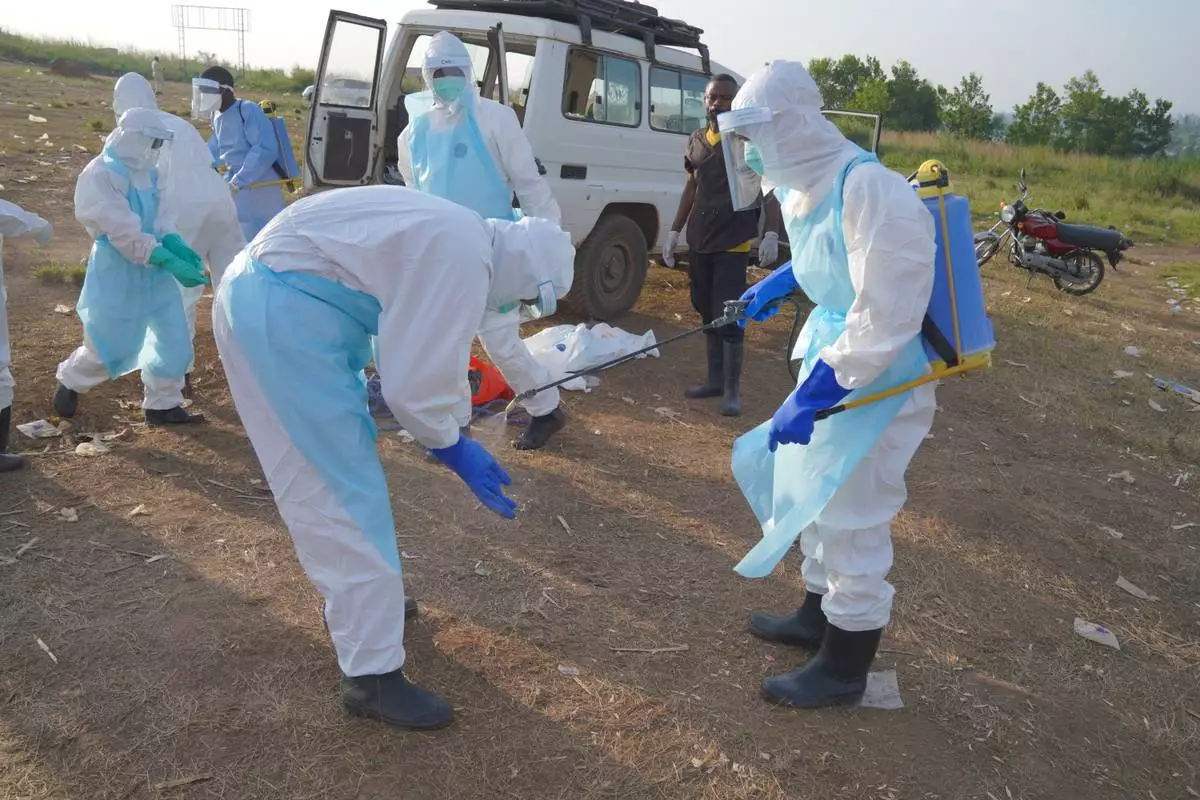
A health worker sprays a colleague with disinfectant after a burial service for Jacques Lobo Dhena, who died of Ebola in Bunia, Ituri province, eastern Congo, Wednesday, Aug. 12, 2026. (AP Photo/Dieudonne Dirole)
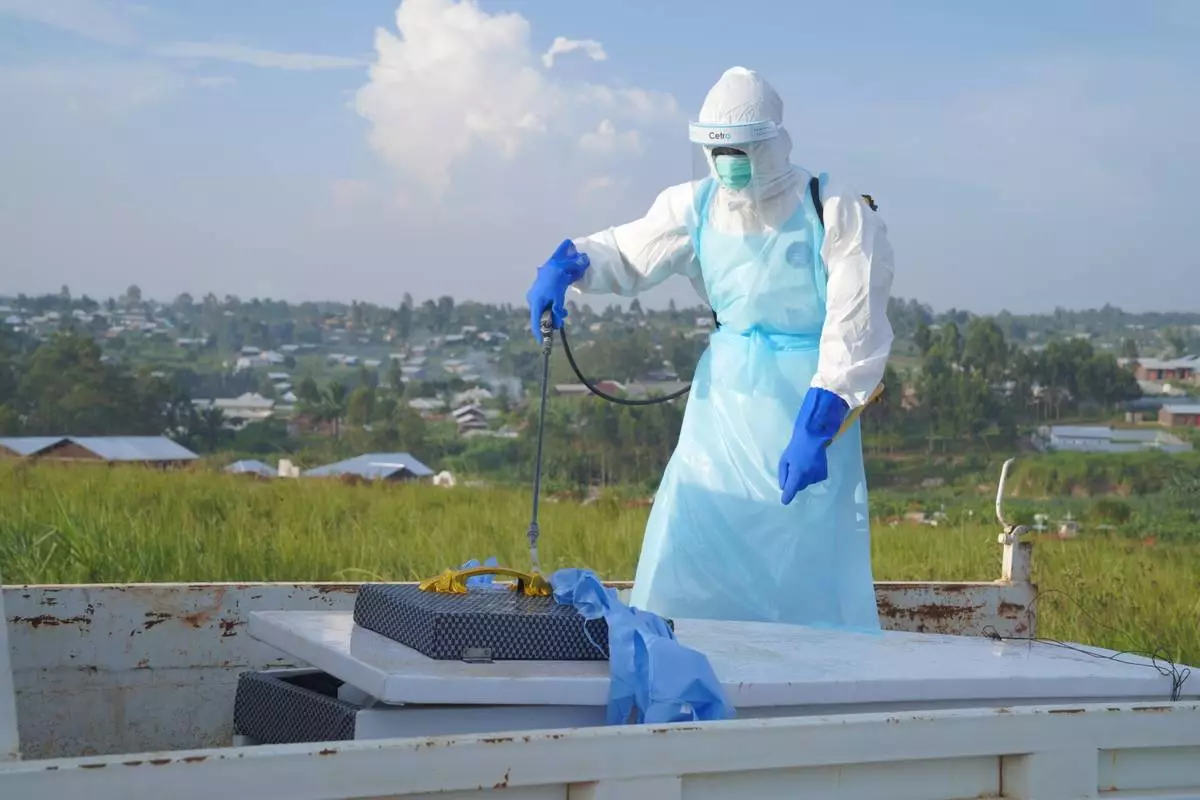
A health worker sprays the coffin containing the remains of Jacques Lobo Dhena, who died of Ebola, during a burial service in Bunia, Ituri province, eastern Congo, Wednesday, Aug. 12, 2026. (AP Photo/Dieudonne Dirole)
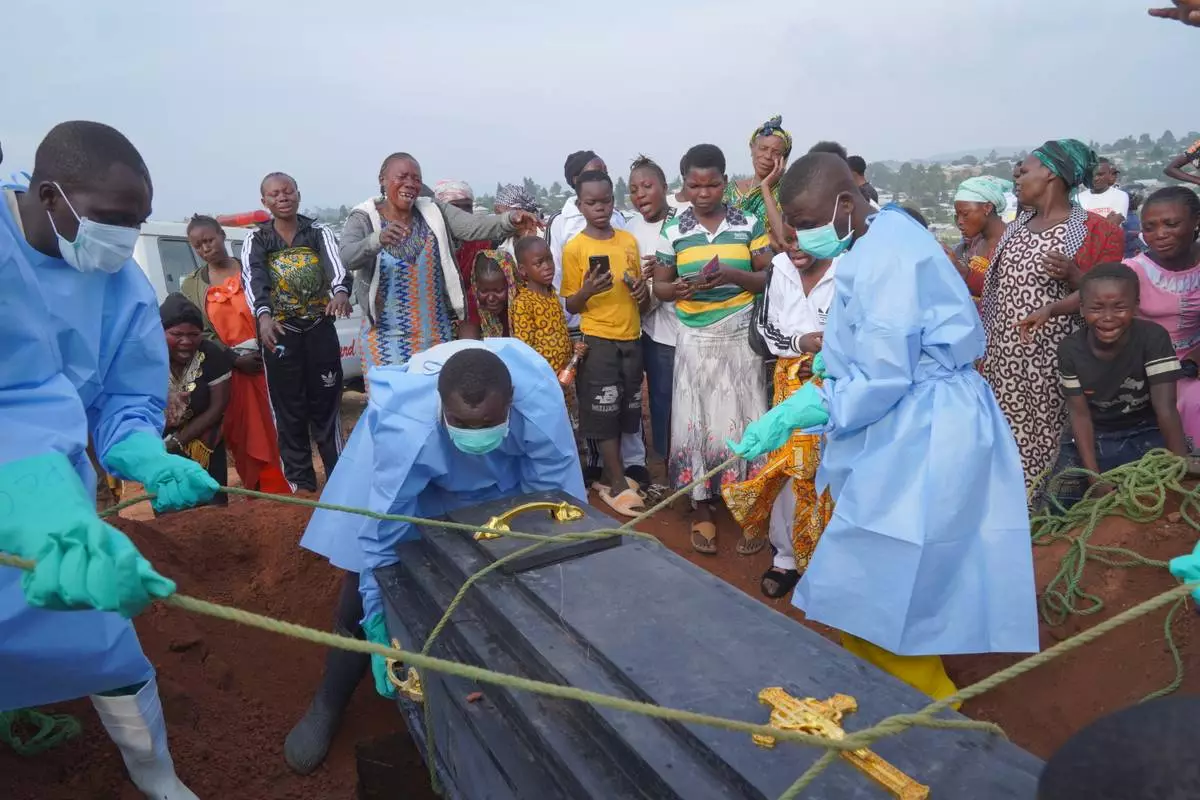
People dressed in protective gear lower into a grave the coffin containing the remains of Jeannine Katusabe, who died of Ebola, during a burial service in Bunia, Ituri province, eastern Congo, Tuesday, Aug. 11, 2026. (AP Photo/Dieudonne Dirole)