BEAUFORT, S.C.--(BUSINESS WIRE)--Aug 12, 2026--
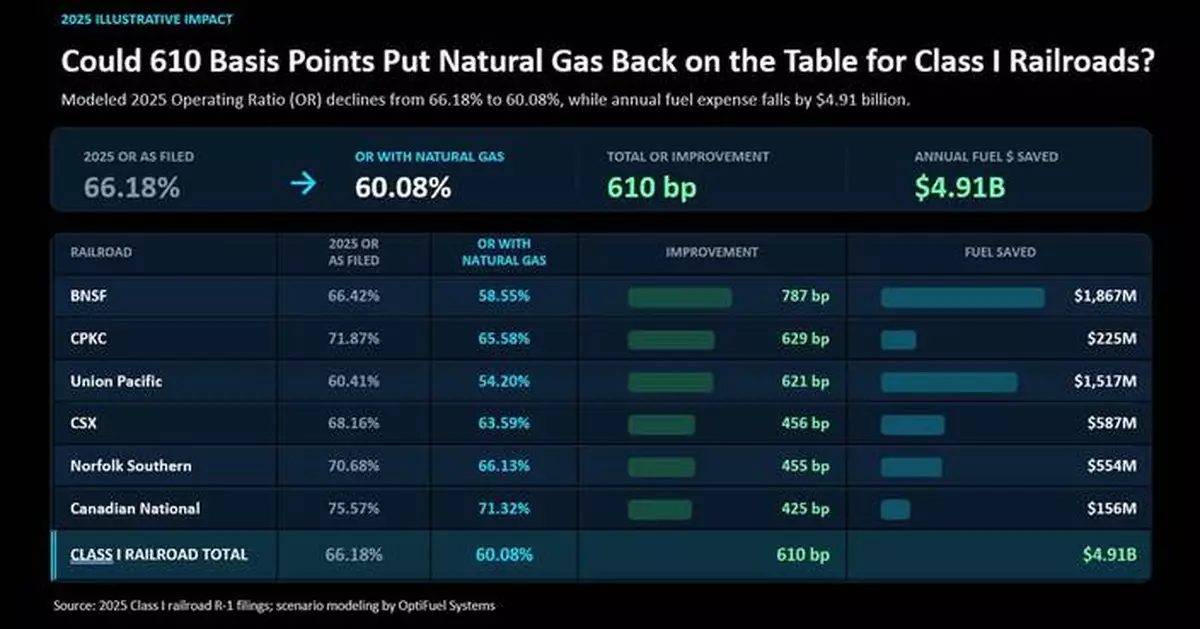
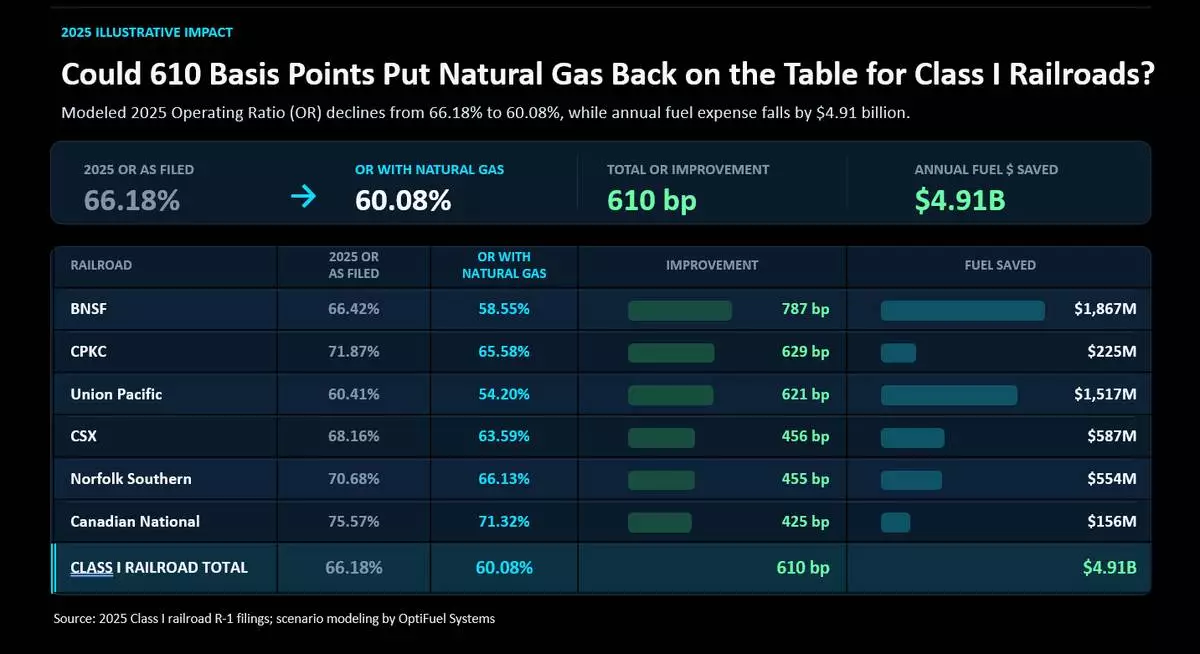
The six U.S. Class I railroads burned 3.08 billion gallons of diesel in 2025 at a delivered cost of $7.58 billion, according to Schedule 750 R-1 filings. With diesel prices sharply higher in 2026, the same fuel volume would cost about $12.65 billion today—an increase of $5.07 billion before any additional freight moves.
This press release features multimedia. View the full release here: https://www.businesswire.com/news/home/20260812664447/en/
The HIDDEN FUEL COST IMPACT
Railroads are penalized twice for inefficiency: aging locomotives burn more fuel than necessary, and the price of that fuel has surged. Gulf Coast ULSD averaged $2.2224 per gallon in 2025, but by August 2026 its trailing four-week average had risen to $3.935.
Natural gas changes the fuel-cost equation.
From 2021 through 2025, the six Class I railroads consumed approximately 15.4 billion gallons of diesel. Had they purchased the equivalent energy in CNG, the analysis indicates they would have saved approximately $29.1 billion before additional fuel-efficiency or maintenance gains.
The most revealing year was 2022. Even when Henry Hub natural gas averaged $6.45 per MMBtu, the modeled natural-gas benefit was still approximately $7.38 billion, with an 873-basis-point operating-ratio improvement.
At an assumed delivered CNG cost of $1.50 per diesel gallon equivalent, the six railroads’ annual savings would be $2.95 billion or over 550 bp of Operating Ratio (OR). At $2.00 per DGE, they would still save about $1.41 billion annually. If we can leverage RNG (Renewable Natural Gas) into these operations, there are additional cost savings and environmental benefits.
“ Railroads have spent the past five years managing a fuel expense they cannot control—even though the alternative was less expensive in every one of those years,” said Scott Myers, President and CEO of OptiFuel Systems. “ The question is how much longer the industry intends to remain dependent on the more volatile fuel.”
OptiFuel compounds lower fuel prices with lower fuel consumption.
OptiFuel’s hybrid architecture uses multiple smaller engines, batteries, regenerative braking, and intelligent power management to reduce fuel waste. On a generator-output basis, OptiFuel produces approximately 12% more electrical output per gallon—or requires approximately 11% less fuel for the same output—before regenerative braking benefits.
Across representative line-haul duty cycles, the platform calculates to fuel-efficiency improvements of approximately 13.7% on flat terrain, 24.7% on rolling terrain, and 37.2% in mountainous territory, where recovered braking energy creates the greatest benefit.
Fuel flexibility reduces long-term commodity risk.
OptiFuel can configure locomotives as diesel-hybrid, CNG-hybrid, or dual-fuel hybrid, allowing railroads to choose the lowest-cost fuel pathway as markets change. CNG can move through existing natural gas pipeline infrastructure and be compressed at railroad fueling sites, avoiding liquefaction plants and cryogenic fuel logistics.
The company has also designed a transcontinental service configuration using two 80-foot, 5000-horsepower dual-fuel hybrid locomotives, each paired with a 2000-horsepower CNG-powered tender, capable of traveling 4,000 miles before refueling.
“ The breakthrough is not simply substituting one fuel for another,” said Myers. “ It is changing how locomotive power is generated, managed and delivered. Fuel flexibility extends the advantage by letting railroads choose the lowest-cost fuel and strongest operating ratio.”
The result is a growing operating-cost problem: older locomotives require more maintenance, reduce availability, and pressure operating ratios even when fleet sizes remain flat or decline.
The HIDDEN MAINTENANCE BURDEN is rising as fleet renewal stalls.
The six U.S. Class I railroads added just 38 locomotives to a 22,082-unit fleet in 2025, according to Schedule 710S of their annual R-1 filings with the Surface Transportation Board. At that pace, the fleet would turn over only once every 581 years.
A 30-year locomotive life requires replacing about 736 units annually. In 2025, 90.1% of the fleet predated 2015 and 58.7% predated 2005.
In 2025, $1.37 billion in locomotive depreciation exceeded $104 million in new-locomotive investment by more than 13 to one, signaling a widening replacement gap and rising maintenance exposure.
From 2021 through 2025, maintenance cost per locomotive rose when fleets stayed flat or contracted. Union Pacific’s per-unit maintenance expense increased 35.6% despite retiring its oldest units, while CSX’s maintenance cost per locomotive rose 50.1% and its operating ratio worsened by 526 basis points.
“ Depreciation is a cost signal,” said Myers. “ Railroads have not replaced the fleet fast enough, and the result is higher fuel burn, maintenance expense, lower availability, and weaker operating ratios.”
Seven-figure rebuilds preserve the same cost structure.
Conventional rebuilds and new diesel-electrics require seven-figure capital but leave railroads with the same basic powertrain architecture and maintenance exposure. In 2025, Union Pacific spent $274.8 million rebuilding 206 locomotives, Norfolk Southern rebuilt 89 units at up to $2.38 million each, and BNSF bought 37 new diesel-electrics for about $2.76 million each.
“ Railroads are committing seven-figure capital to locomotives built around a powertrain architecture fundamentally unchanged since 1939,” said Myers. “ They return to service with essentially the same fuel economics the industry has had for decades.”
OptiFuel replaces the maintenance-heavy architecture with modular, demand-matched power.
OptiFuel’s 6600-horsepower locomotive combines four 700-horsepower engines, four 700-horsepower generators, 5.4 MWh of batteries, and intelligent power management. Engines run near efficient points while batteries absorb variability, supply peak loads, power idle and low notches, and capture braking energy.
The design separates peak power, changing traction demand, and efficient engine operation—tasks a conventional single-engine diesel-electric cannot perform well at the same time. Removable engine and battery modules also allow railroads to reconfigure the platform over its expected 30-plus-year service life.
A NO-RISK trial shifts early operating and maintenance risk to OptiFuel.
OptiFuel is offering a controlled live trial, with results measured against the railroad’s own routes, duty cycles, fuel costs, maintenance requirements, and availability data. Every locomotive is delivered with a five-year full-maintenance warranty, transferring initial maintenance risk to OptiFuel during the evaluation period.
The decision before railroad management teams and their boards is economic: whether to keep accepting avoidable maintenance burden and operating-ratio pressure, or evaluate a platform designed to reduce the next 30 years of locomotive operating cost risk.
About OptiFuel Systems:
OptiFuel Systems is an advanced systems engineering and manufacturing company redefining how power is generated, managed, and delivered in freight locomotives and unmanned vessels. The company designs and manufactures modular locomotives and power systems for North American line haul and switching operations. Its demand-matched architecture combines interchangeable power generation and battery modules with intelligent energy management – improving efficiency, reliability, and operating economics while giving railroads greater control over fuel selection and cost. Power modules can be added, removed, replaced, or reconfigured throughout a locomotive’s expected 30-plus-year service life, allowing the platform to adapt as fuel prices, infrastructure, and operating requirements change. OptiFuel Systems is headquartered in Beaufort, South Carolina.
Learn more atwww.OptiFuelSystems.com
Billions in Class I Railroad Savings, Hiding in Plain Sight