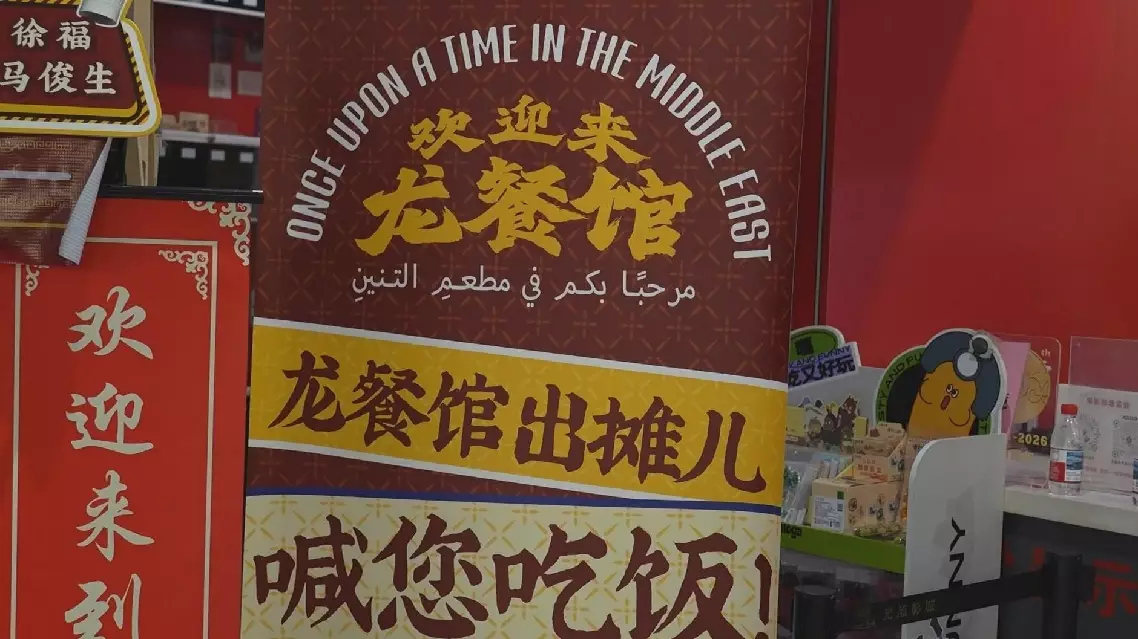
The summer blockbuster, "Once Upon a Time in the Middle East", has spurred a notable rally in shares of Chinese media companies as the country's summer box office gains momentum with the release of high-profile theatrical titles.
The film was released on Tuesday nationwide and had earned box office revenue of more than 400 million yuan (around 59.31 million U.S. dollars) as of 19:00 Thursday.
The story centers on Xu Fu, a down-on-his-luck Chinese chef portrayed by celebrated comedian Shen Teng, who travels to the Middle East to settle his debts. There, he joins forces with a local restaurant manager to operate a bustling restaurant, bringing authentic Chinese culinary traditions to a war-torn foreign land.
Data from Maoyan Professional Edition showed that the film is produced and co-produced by several firms, including China Film Group Co., Ltd., Ruyi Film Entertainment Co., Ltd., and Beijing Jingxi Culture and Tourism Co., Ltd. (Beijing Culture).
The film's strong market performance has lifted share prices of its production and co-production partners. Among them, Beijing Culture has registered four consecutive daily limit-up sessions as of the latest trading close on Thursday.
China's broader film and cinema sector has also remained active in recent trading, a trend closely linked to the warming summer box office and the launch of key film releases.
Even as investor enthusiasm builds, industry insiders have issued a word of caution. They explained that a film’s box office revenue does not directly translate into the actual earnings of listed companies, and the real financial contribution of box office growth depends on each company’s specific level of involvement in the project.
In an announcement on Tuesday addressing abnormal stock trading fluctuations, Beijing Culture said that it has participated as a co-producer in several film projects released during the 2026 summer season.
The company noted that its investment stake in these projects is relatively low, and the releases are not expected to have a significant impact on its overall operating performance.
The film's market reception also sheds new light on the evolution of China's film industry. Industry observers noted that the title's popularity reaffirms that audience demand for theatrical movies has not faded. Instead, moviegoers are becoming more discerning in choosing the content that justifies a cinema visit. For the sector's future growth, the core driver will not be simply increasing the volume of releases, but steadily improving the supply of high-quality premium content.
China’s latest anti-war blockbuster drives up stock prices in media sector