ARLINGTON, Va.--(BUSINESS WIRE)--Aug 14, 2026--
Qu, the intelligent commerce platform for enterprise QSR and fast-casual restaurant brands, today announced it has been ranked No. 855 on the 2026 Inc. 5000 list, the annual list of the fastest-growing private companies in America. The list is the most prestigious ranking of the nation’s most successful independent and entrepreneurial businesses, recognizing companies that have achieved remarkable growth while driving innovation, creating jobs, and shaping the future of the economy. Past honorees include companies such as Microsoft, Meta, Chobani, Oracle, and Patagonia.
This press release features multimedia. View the full release here: https://www.businesswire.com/news/home/20260814938449/en/
“Being named to the Inc. 5000 is a powerful validation of the momentum we’ve built over the past 3 years,” said Amir Hudda, CEO of Qu. “We’ve grown by staying focused on one simple idea: enterprise scale restaurant brands deserve technology that helps them move faster, operate smarter and grow with confidence given the challenging backdrop facing the industry. This recognition belongs to our team, our customers and the partners who continue to push us to raise the bar and it gives us even more momentum as we build what’s next for restaurant technology.”
This year’s Inc. 5000 recognizes a new class of companies redefining what growth looks like. From AI and advanced manufacturing to healthcare, consumer products, and professional services, these businesses are expanding their impact, creating jobs and proving that entrepreneurial ambition continues to fuel the U.S. economy. Among the 5,000 companies on the list, the median three-year revenue growth rate was 130%, and those companies have collectively added more than 627,208 jobs to the U.S. economy over the past three years.
For the full Inc. 5000 list, honoree company profiles, and a searchable database by industry and location, please visit: www.inc.com/inc5000.
“Every company on the Inc. 5000 has a story of perseverance, smart decision making, and a refusal to sit still,” says Mike Hofman, editor-in-chief of Inc. “Their growth reflects more than strong financial performance–it reflects creativity, resilience, and the customer focus required to build companies that make a lasting impact. We congratulate all honorees on this significant achievement.”
Inc. will celebrate the honorees at the 2026 Inc. 5000 Conference & Gala, taking place October 14–16 in Dallas, Texas and the top 500 will be listed in the Fall issue of Inc. Magazine. Tickets are on sale now.
Inc. 5000 List Methodology
Companies on the 2026 Inc. 5000 are ranked according to percentage revenue growth from 2022 to 2025. To qualify, companies must have been founded and generating revenue by March 31, 2022. They must be U.S.-based, privately held, for-profit, and independent—not subsidiaries or divisions of other companies—as of December 31, 2025. (Since then, some on the list may have gone public or been acquired.) The minimum revenue required for 2022 is $100,000; the minimum for 2025 is $2 million. As always, Inc. reserves the right to decline applicants for subjective reasons.
About Qu
Qu is the intelligent commerce platform that unlocks efficiency to increase revenue for quick-service and fast-casual restaurants. Built on a unified data foundation with cloud-enhanced edge technology, Qu enables real-time decision-making, streamlines operations, and improves margins through faster, more reliable performance at every location. For more information, visit www.qubeyond.com, or follow Qu on LinkedIn.
About Inc.
Inc. is the leading media brand and playbook for the entrepreneurs and business leaders shaping our future. Through its journalism, Inc. aims to inform, educate, and elevate the profile of its community: the risk-takers, the innovators, and the ultra-driven go-getters who are creating the future of business. Inc. is published by Mansueto Ventures LLC, along with fellow leading business publication Fast Company. For more information, visit www.inc.com.

Qu has been ranked No. 855 on the 2026 Inc. 5000 list, the annual list of the fastest-growing private companies in America.
DES MOINES, Iowa (AP) — After Ashley Hinson dropped off her boys at school earlier this month, she saw the initials “DJT” flash on her phone.
“'Ashley, it's your favorite president,'” Iowa's Republican nominee for U.S. Senate recently recounted to an audience of her supporters. “That's how he introduced himself.”
She had had a more forceful message about communicating with President Donald Trump on the debate stage with her Democratic opponent, Josh Turek, as she tried to win over undecided voters.
“I’ll be President Trump’s ally when it is important for Iowa, but I will push back on him,” promised Hinson, who currently serves in the U.S. House. “He knows this.”
Although many Republicans are walking a political tightrope in this year's midterm elections, Hinson's balancing act is more challenging than most. Iowans have been hamstrung by manufacturing job losses, health care clinic closures and shrunken farm profits since Trump returned to the White House, but Hinson also is relying on the president's loyalists to show up for her.
On Thursday, Hinson took the stage before Trump came on, at a rally in Sioux City, which is in Iowa's conservative northwest corner. The visit to safe territory is geared toward boosting turnout even as it ties her more tightly to an unpopular president.
To hundreds of Trump's supporters, Hinson played up her relationship with the president.
“I’m not sure, frankly, that he’s always happy when we’re talking because I ask him for a lot of things for Iowa when we’re on the phone,” she said. “And that’s exactly what you would expect me to do, right? As your next United States senator.”
Trump is expected to visit the state again Nov. 1. He is “anxious for Iowans to hear his message before they vote,” Iowa Republican Party Chair Jeff Kaufmann said in announcing the president's schedule.
Turek, a state lawmaker, was in Sioux City for a campaign event Tuesday and told reporters he was happy for Trump to visit to see how his tariffs and the Iran war have “hurt Iowa more than any other state.” Although Turek says he's willing to work with Trump on issues like immigration, he called Hinson a rubber stamp for the president's bad policies.
When Hinson kicked off her campaign last year, she touted Trump’s endorsement and said she was running to be Trump’s “top ally” in the Senate. Almost a year later, Hinson instead says she wants to be “Iowa’s best bipartisan fighter."
The message has crystallized since the summer, with more examples of Hinson vocalizing positions at odds with the president. Recent polling from late September and early October suggests it could work as she carves out about 1 in 10 voters who disapprove of the president even as she continues to secure overwhelming support from those who approve of Trump.
In August, she said Trump’s plan to increase beef imports from foreign countries in an attempt to lower prices was "a bad idea” that would hurt Iowa farmers.
Last month, two of Hinson's Iowa colleagues in the House broke with the White House and voted against Trump's ability to continue the war with Iran without congressional approval.
Hinson didn’t, but she said later the war has gotten too costly for Americans and called for Trump to bring the conflict to a “successful and immediate end.”
More recently, Hinson criticized Trump’s decision to ease sanctions on Russia in exchange for diesel fuel. She said Tuesday that the U.S. needs to make sure “dictators aren’t allowed to win wars.”
“I think the president and I share the goal of lowering costs for working families and for people who are using diesel,” she told reporters after a campaign event. “I, again, just don’t think we need to be making any deals with Russia.”
Hinson said she hadn’t talked with the president about the issue.
“Maybe I’ll have a chance to come have a conversation with him at the rally," she added.
Hinson isn't the only one pitching bipartisanship. So is Turek. In fact, he's the only Iowa candidate seeking federal office who explicitly mentions Trump in general election television advertisements, according to an Associated Press analysis of AdImpact data.
In one, Turek is behind the wheel speaking directly to a camera about Interstate 35, which “connects Iowa to the southern border and the broken immigration system that both parties have failed to fix." He says: “In the U.S. Senate, I’ll work with anyone to fix it, including President Trump, to secure the border, stop the flow of drugs into Iowa.”
Turek has pushed back on the president’s policies, including tariffs and the war in Iran, as the catalysts of high costs that are hurting Iowans, but his message on working with the president on immigration and other select issues stands out from other Democrats. Republicans say he's just pretending to be a moderate to get elected.
Mazie Stilwell, executive director of the progressive organization Progress Iowa, said Turek's message on immigration targets a bloc of voters on an issue that's particularly important to them but doesn't overshadow his otherwise disciplined focus on the high costs facing Iowans.
Trump’s visit to the state Thursday, she added, is “a terrific reminder of the disaster that he has been and his administration has been for our bottom line, for everyday Iowans who are trying to make ends meet.”
Iowa is no stranger to competitive Senate races even though Trump won the state by double digits in the last presidential election.
Ad spending on broadcast and cable television has already surpassed $200 million this cycle, AdImpact shows. But in today’s dollars, the total ad spending in the 2020 Senate race was even higher.
Republicans have spent slightly more for Hinson than Democrats for Turek. That was the opposite in 2020, when Democrats spent nearly $30 million more than the GOP did in their unsuccessful effort to unseat Sen. Joni Ernst.
Iowa Republican activist Kelley Koch has been concerned that complacency will dampen turnout from conservatives, even those who are loyal to the president.
"They say, ‘Why are you all hyped up about the midterms, Kelley, Trump will take care of everything,'” Koch said.
It’s an assumption she’s working to counteract, and she expects “the Trump effect” from his visits will help protect Republican majorities in the House and Senate.
And while Koch supports Hinson, she doesn’t like it when she talks about pushing back on Trump.
“Right now,” Koch said, “we had better unite around our president.”
Associated Press reporter Aaron Kessler in Washington contributed.
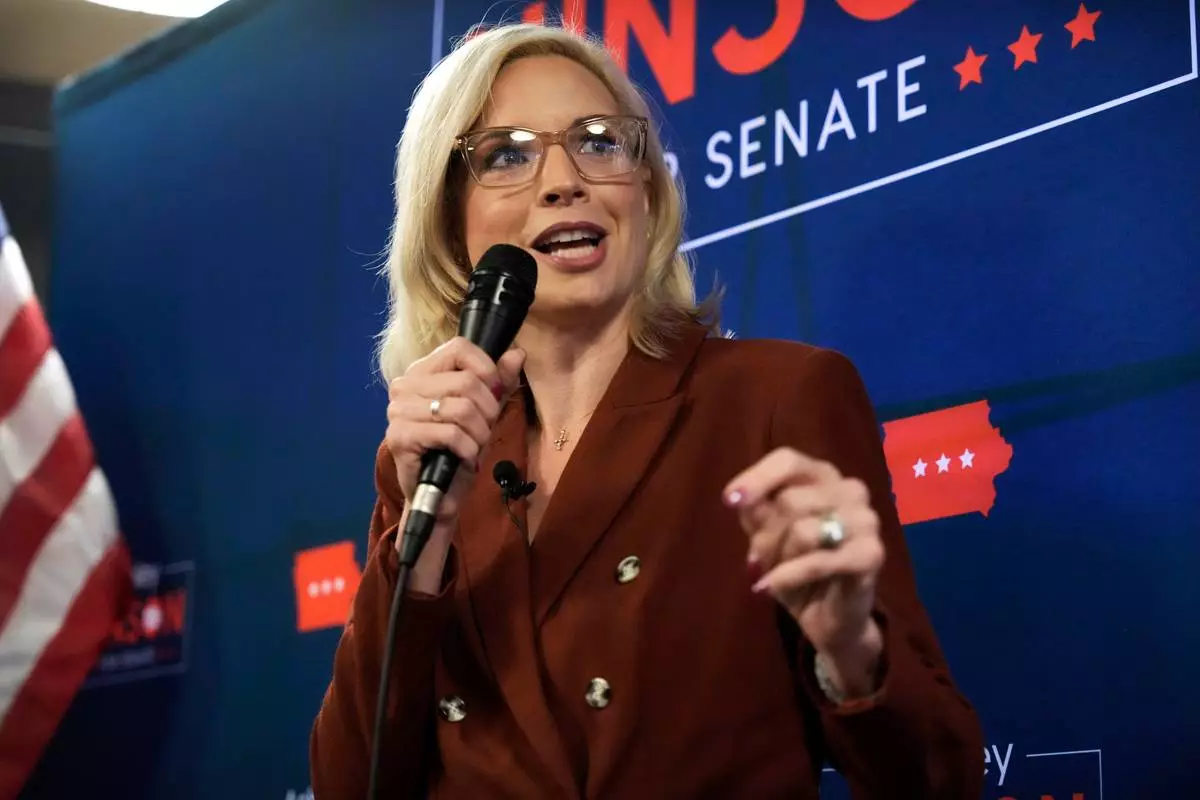
Republican nominee for U.S. Senate Rep. Ashley Hinson, R-Iowa, speaks to supporters, Thursday, Oct. 15, 2026, in Ankeny, Iowa. (AP Photo/Charlie Neibergall)