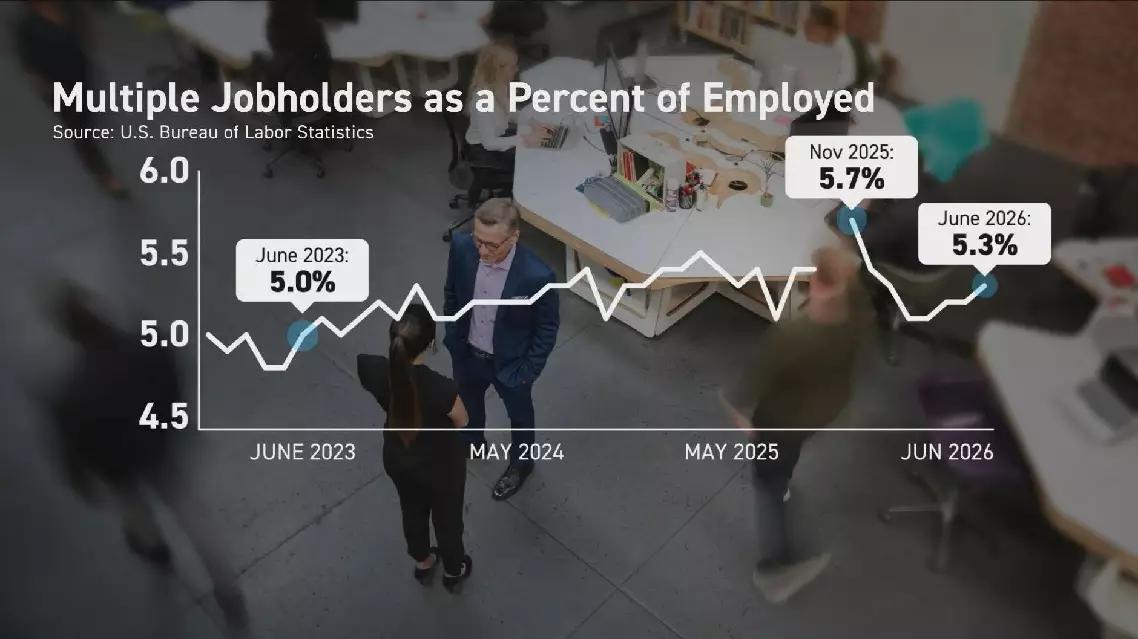
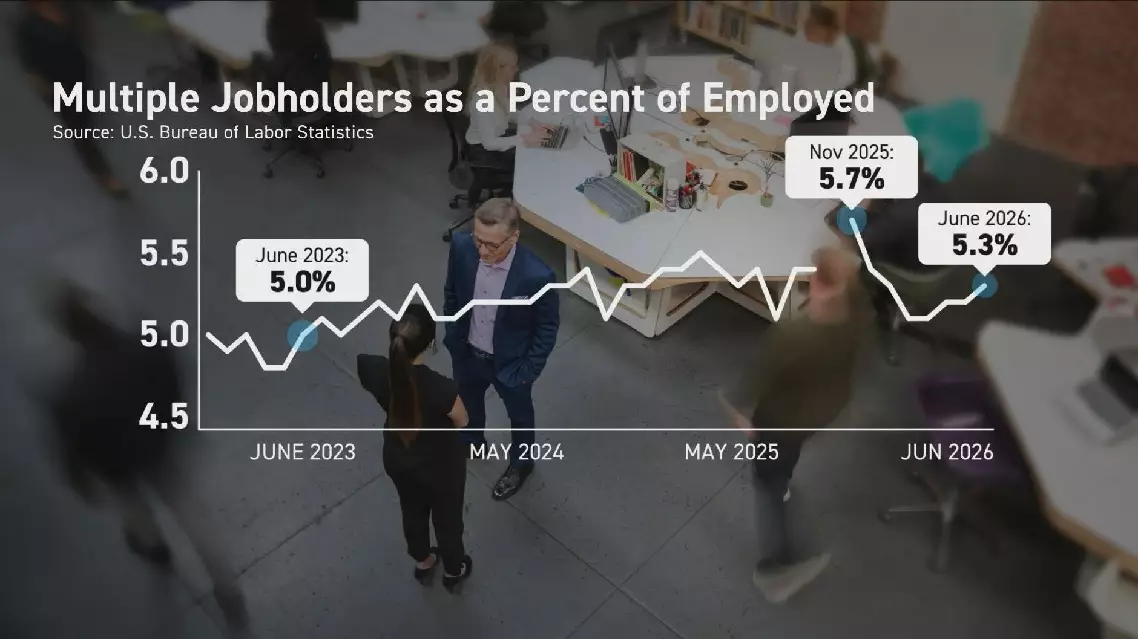
About 8.6 million Americans, or 5.3 percent of the U.S. workforce, currently hold more than one job, marking the longest sustained streak of multi-job holding since 2009, according to the latest U.S. jobs report for July.
Social media is filled with young people documenting their side hustles, but data shows that multiple-job holding is not confined to Gen Z. Across all age groups, the rate has remained consistently above 5 percent of the workforce for three consecutive years.
For many, the motivation is financial. Real wages have barely budged over the past year, while rent, groceries and insurance premiums have continued to climb.
One worker in Washington, D.C., who held three jobs simultaneously before transitioning to a full-time role earlier this year, said the extra income initially felt like a smart use of time.
"It gets more really exciting because you're like, 'oh, I'm earning more money, I'm like using my time really wisely.' And so you don't really realize that you're stretched thin until you have these weeks where you're working a 50-hour work week," she said.
But the breaking point was not the long hours alone. She said the math did not add up once convenience costs were factored in.
"I realized I was actually spending way more money on convenience fees, like Ubering to a job, getting takeout, because I didn't have time to cook dinner. So actually when I pulled back on one of my jobs, I ended up saving more money just on my day-to-day expenses. Because I had time to prep for the week, strategize on using the metro or the transit system, the bus. And so when I was able to do that, I actually saved a lot more money," she said.
The July jobs report underscores a broader economic reality: for many working Americans, a single full-time job no longer covers basic living costs. But as some workers are discovering, the fourth job is not always the answer — sometimes, it is the one they quit.
Millions in US hold multiple jobs as costs outpace wages: data
Millions in US hold multiple jobs as costs outpace wages: data
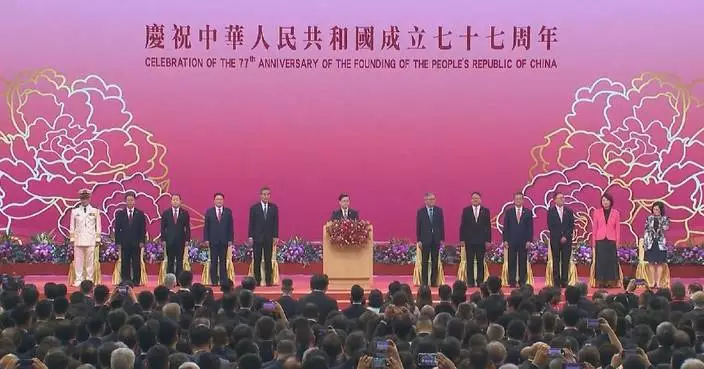
China's Macao Special Administrative Region (SAR) held a flag-raising ceremony at the Golden Lotus Square on Thursday morning to mark the 77th anniversary of the founding of the People's Republic of China.
At 08:00, a flag-bearing contingent composed of members of the Police Tactical Intervention Unit, a subordinate of the Public Security Forces Affairs Bureau of Macao, escorted the national flag and the Macao SAR flag into the square in a Chinese-style marching step.
This marks the first time members of the Public Security Forces Affairs Bureau have participated in a flag-raising ceremony using Chinese-style drill formations. To match the style, the contingent members wore brand-new uniforms and were equipped with brand-new gear.
Macao SAR Chief Executive Sam Hou Fai attended the ceremony, along with heads of central government agencies in Macao and representatives of people from all walks of life in the region.
Young representatives from Macao who had previously traveled to Beijing to participate in the "Salute to the National Flag" event also attended the ceremony.
"As a youth from Macao, I feel particularly honored and proud to be able to participate in this flag-raising ceremony. After watching the ceremony, I feel extremely moved and excited," said Tai U Fei, a student from the Macao SAR.
"This is the first time this year to witness the change from the Portuguese-style to the Chinese-style drill formations. I had seen their training before, and this time I was able to witness this historic moment with my own eyes at the Golden Lotus Square. I feel very honored. We had just returned from our visit to Beijing, where we also watched the same flag-raising ceremony from the viewing stand at Tian'anmen Square. When those familiar steps came to our land in Macao, I felt a strong sense of familiarity and honor. My feelings today are as warm as the sunshine," said another young student named Che Hang Kok.
Following the flag-raising ceremony, the Macao SAR government held a reception to celebrate the 77th anniversary of the founding of the People's Republic of China. Sam said the motherland's vigorous development and constant progress have always been the strongest support and warmest haven for the Macao SAR.
Looking ahead, Macao will demonstrate greater resolve and adopt a more forward-looking approach to push the SAR to make greater contribution to the great cause of building China into a powerful country and realizing national rejuvenation, he said, adding that the SAR will write a new chapter in the successful practice of "one country, two systems" with Macao characteristics.

Flag-raising ceremony held in Macao to mark 77th founding anniversary of PRC