China's zero‑tariff policy, enacted in May, has opened a duty‑free gateway to the world's second‑largest economy for Nigerian farmers and manufacturers.
For Africa's largest oil producer, it offers a golden chance to accelerate diversification beyond crude exports. Now, a massive trade shift is brewing. By slashing tariffs on agricultural imports such as coffee beans, China has turned its lucrative market into a prime target for Nigerian agribusiness, and the policy breakthrough promises ripple effects far beyond the coffee fields.
"Coffee is the main cash crop of Ethiopia, and if we can develop this here in Plateau state, definitely it will help in the development of the economy of the state, and Nigeria in general," said Dauda Gashi, Executive Director of Plateau State's Chamber of Commerce, Industry, Mines and Agriculture.
China's zero-tariff policy covers 53 African nations, with Nigeria standing out as a particularly significant trading partner. Bilateral trade between China and Nigeria is estimated at approximately 20 billion U.S. dollars, making Nigeria China's second-largest trading partner in Africa, after South Africa. Of this total, China's exports to Nigeria are valued at between 13 and 16 billion dollars, while Nigeria's exports to China amount to roughly 2 billion dollars.
That staggering trade deficit represents an enormous, untapped opportunity. Analysts said this duty-free access is Nigeria's opportunity to balance the scales by aggressively scaling up non-oil export values. However, severe structural bottlenecks—namely chronic power outages and rural insecurity—continue to hamstring local industries.
"In the value chain of agriculture, we have a particular challenge with cold storage, so one of the challenges we have confronted over the decades is how to reduce post-harvest loss because of poor storage capacity. We want to see how to grow feed for cattle, the ruminant animals, there's a huge opportunity waiting there across the entire country," said Caleb Manasseh Mutfwang, Governor of Plateau State.
The federal government has affirmed its commitment to unlocking critical investments aimed at stabilizing the national power grid and safeguarding key agricultural hubs, with China extending support to complement these efforts.
"We believe that power is very fundamental to industrialization, and China is a leading player in renewable energy, both in terms of solar power, wind power, nuclear and water, so we'll explore the potentials of cooperation in infrastructure. For Nigeria, one of the challenges is security, there are of course a lot of Chinese investments here, a lot of Chinese citizens, that's why the Chinese government attaches huge importance for the protection of Chinese citizens overseas," said Yu Dunhai, Chinese Ambassador to Nigeria.
If successful, these measures could do far more than just rebalance trade lines—they are projected to spark an export boom that could supercharge job creation across the entire country.
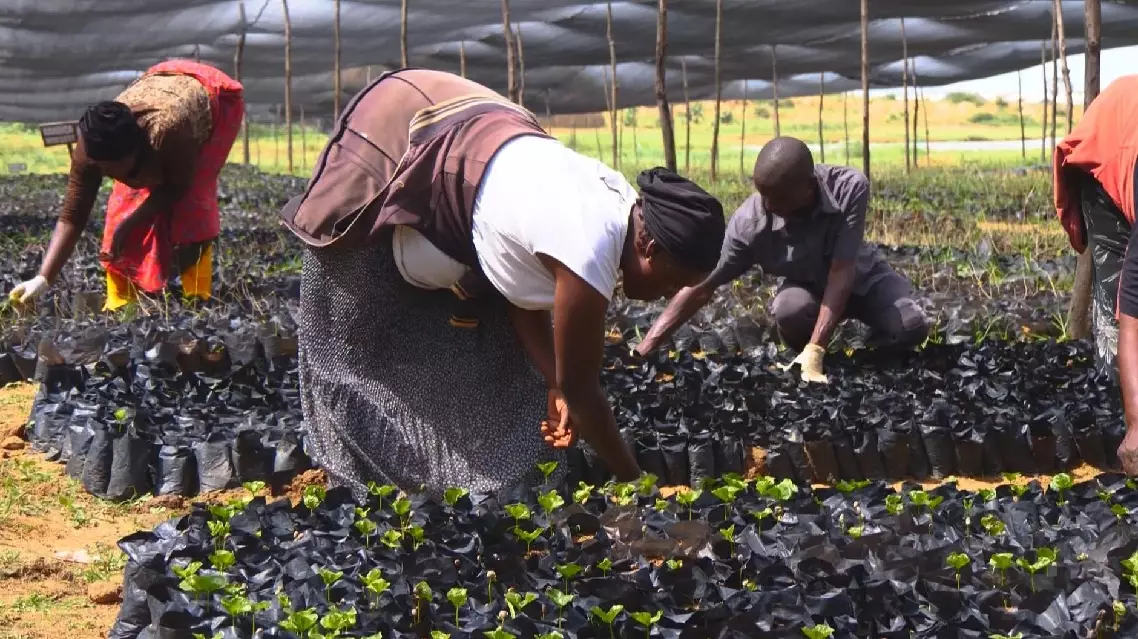
Duty-free access offers Nigerian farmers, manufacturers golden ticket to Chinese market
Breaking long-standing Western heroic narrative conventions in filmmaking, the trending Chinese anti-war film "Once Upon a Time in the Middle East", is reshaping global cinematic discourse on war and peace.
The summer blockbuster was released on Tuesday nationwide and had earned box office revenue of more than 536 million yuan (around 79.5 million U.S. dollars) as of 22:00 Friday.
The story centers on Xu Fu, a down-on-his-luck Chinese chef portrayed by celebrated comedian Shen Teng, who travels to the Middle East to settle his debts. There, he joins forces with a local restaurant manager to operate a bustling restaurant, bringing authentic Chinese culinary traditions to a war-torn foreign land.
As a distinct Chinese anti-war feature, "Once Upon a Time in the Middle East" abandons timeworn Western heroic storytelling. The film adopts the humble viewpoint of Xu Fu, an ordinary cook. Through his eyes as a neutral bystander, it portrays the struggles and sufferings of ordinary people trapped in conflict and uses food and everyday life to explore survival, compassion and the value of peace, rather than focusing on the battlefield.
Such a narrative perspective is quite pioneering among global anti-war film productions.
"It realistically reflects the turmoil of war. Therefore, we desire peace and oppose the suffering that wars of aggression inflict upon the people," a moviegoer praised.
Meanwhile, the blockbuster has garnered massive overseas anticipation prior to its international debut. Many global film enthusiasts agree that the production epitomizes a transformative shift in Chinese film industry, which is overhauling Hollywood's established narrative paradigms and reinterpreting the global narrative of war and peace at a higher level.
"Just imagine how this story would unfold if Hollywood were to film it. It would almost certainly follow the standard formula of superheroes, super-soldiers, or elite operatives swooping in, resolving the crisis in a flash, and then disappearing. What does the 'Once Upon a Time in the Middle East' offer? The idea that the best days are those spent sharing a meal together. Conversely, what drives people to fight instead of dining together? Anyone who has seen the film knows the answer. That is why some netizens have said that if this movie were to compete for a U.S. Oscar award, it would be a voice representing the Global South," said Zuo Heng, a researcher at the China Film Archive.
Many scholars also hold the view that war narratives on international screens have long revolved around contests of victory and military conquest, but "Once Upon a Time in the Middle East" does not stoke hatred nor glorify victory by force. Instead, it hides the key to peace amid the mundane routines of daily meals.
This vision of peace, rooted in the moderation and inclusiveness of Chinese civilization, blazes a new trail of expression for global anti-war films.
It constitutes an innovation in film creation and enables the world to see perceptions of peace different from those of the West.
"The film delivers an anti-war perspective that diverges from the Hollywood paradigm. It abandons Hollywood-style individualism, and quietly challenges the 'America First' mindset. 'Once Upon a Time in the Middle East' keeps exploring innovative approaches to shape contemporary Chinese discourse and narrative systems," said Sun Jiashan, a researcher with the Department of Chinese Culture Education and Research under the Central Institute of Socialism.

Chinese anti-war film offers new cinematic narrative on war and peace