A memorial hall in east China's Nanjing received a trove of historical materials this year that experts say provide new evidence of war crimes committed by invading Japanese troops in the 1937 Nanjing Massacre.
In the first half of 2026, the Memorial Hall of the Victims of the Nanjing Massacre by Japanese Invaders collected more than 150 sets of artifacts and historical materials, as well as over 100 pieces of archival documents.
The hall reported these figures on Saturday, which marked the 81st anniversary of Japan's surrender in World War II.
The newly acquired items include private correspondence from Japanese soldiers, battlefield postcards, instructional materials on gas warfare, and compilations of wartime press coverage.
Among them is a collection of private letters written between 1937 and 1939 by a soldier of the Imperial Japanese Army's 16th Division, surnamed Ishikawa. In a letter dated Dec 20, 1937, one week after the fall of Nanjing, Ishikawa wrote, "A few days ago, we killed over ten thousand defeated soldiers." This letter serves as a firsthand account from the perpetrator himself, recorded at the time of the massacre, and corroborates the diary entries of Azuma Shiro, a fellow soldier in the same division.
Also donated were two instructional manuals on the systematic training of poison gas warfare by the invading Japanese forces.
Remarkably, many of the donations came from high school students from across Jiangsu Province, of which Nanjing is the capital city. Some of these students began collecting wartime memorabilia from a young age, inspired by a passion for local history and personal family connections to the events.
Student donor Xu Kairui said his collection journey was filled with obstacles, but he persevered despite scams, fraud, and cyberbullying to retrieve authentic materials.
At a release event on Saturday, Xu spoke to attendees, calling for history to be remembered, not out of resentment, but to protect the peace of today and tomorrow.
"We live in a country free from the flames of war, so we cannot easily fathom the suffering it inflicts. Yet that is no excuse to forget history. For me, remembrance is not about holding onto resentment, but about holding onto the truth. We revisit past sorrows so that we can protect the peace we have fought so hard to win," the student said.
Other items were donated by Marcus Detrez and Bastien Ratat from France, with the help of Zhong Haosong from China. At the event, the three young men jointly presented the donations, comprising 861 pages of documents from the French Ministry of Foreign Affairs relating to Japan's aggression in China, as well as over 50 Japanese-language publications, including wartime illustrated magazines and frontline war records.
Experts from the memorial hall emphasized that all of the donated items have been fully authenticated.
"Whether it's personal letters from soldiers, public news reports, or postcards, details of each piece --unit numbers, dates, locations, and specific contents -- clearly correspond with one another. They all stand up to historical scrutiny. Together, from different angles and at different levels, they form a chain of evidence documenting the large scale massacre carried out by the Japanese army in Nanjing," said Meng Guoxiang, a council member of the Nanjing Massacre History Research Association.
The day also saw a ceremony for the fifth cohort of inheritors of the historical memory of the Nanjing Massacre, with new members including Carly Brady, a dual U.S.-Canadian citizen, and Christoph Reinhardt from Germany, among others.
Since 2022, the memorial hall has issued certificates to five cohorts totaling 44 individuals, said Zhou Feng, curator of the memorial hall. As this group continues to grow, the historical memory of the Nanjing Massacre will be passed on to an ever-wider audience.
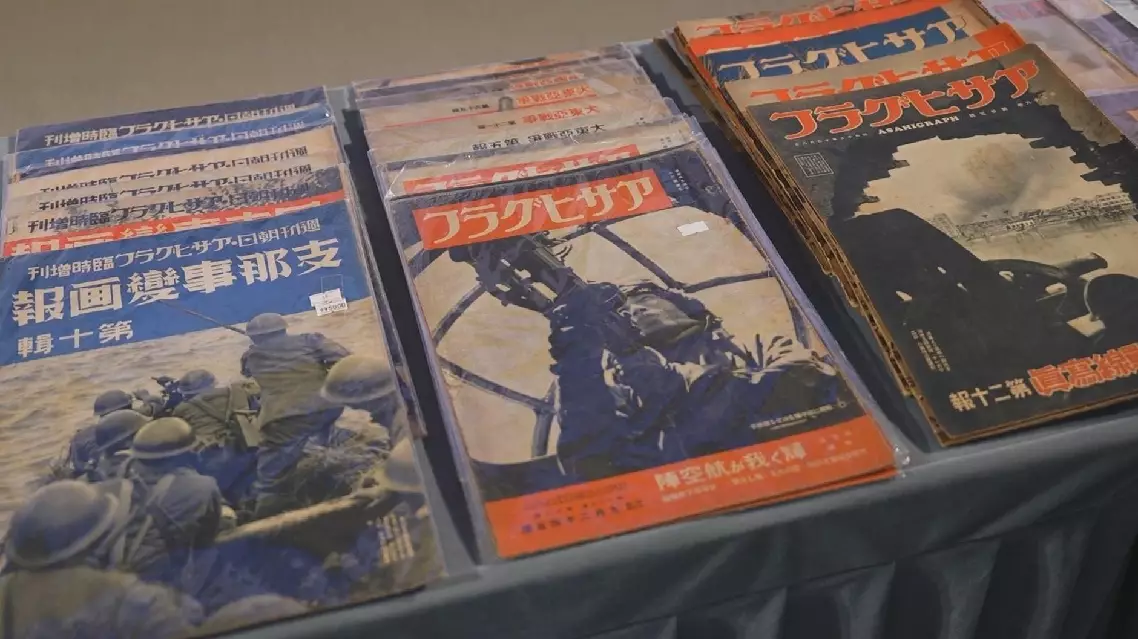
Fresh evidence of Nanjing Massacre donated to Chinese memorial hall