PHNOM PENH, Cambodia (AP) — Cambodian artist Bou Meng, one of only seven people known to have survived a notorious Khmer Rouge torture center in the Southeast Asian country in the late 1970s, has died. He was 85.
His ability to paint portraits of the then-leader Pol Pot was why he was kept alive.
The Extraordinary Chambers in the Courts of Cambodia, a U.N.-backed tribunal that sought to try Khmer Rouge leaders for genocide and other crimes against humanity, said he died late Friday due to age-related illness.
“The passing of Mr. Bou Meng represents the loss of an important historical witness to the grave crimes committed during the brutal Khmer Rouge regime, particularly to the history and tragedy that took place at the former S-21 Security Centre,” referring to the prison, also known as Tuol Sleng, where he had been held for almost two years starting in 1977.
The Khmer Rouge group that ruled Cambodia from 1975–79 was accused of genocide for causing the deaths of so many of their countrymen from executions, starvation, and lack of medical care due to its radical policies. An estimated 1.7 million Cambodians died from forced labor, starvation, medical neglect, and executions.
An estimated 16,000 women and children were kept at S-21 over the course of nearly four years before being killed. Now it serves as the Tuol Sleng Genocide Museum, named after the high school it had been before the Khmer Rouge takeover.
Bou Meng, along with two other survivors, artist Vann Nath and mechanic Chum Mey, testified in 2009 at the trial of Kaing Guek Eav, also known as Duch, who had been the S-21 commandant.
Duch was found guilty of crimes against humanity, torture, and murder in 2010 and ultimately received a sentence of life imprisonment. He died in prison in 2020 at the age of 77.
In 2010, Bou Meng testified that painting larger-than-life images of Pol Pot and portraits of other communist icons helped save his life.
It took three months to complete his first outsized work. Kaing Guek Eav then ordered him to make three more Pol Pot paintings and portraits of other communist leaders. These included Mao Zedong of China and North Korea’s Kim Il Sung, as well as one mocking Ho Chi Minh, the father of Vietnam’s communist revolution.
“I was ordered to paint a picture of Ho Chi Minh’s head on the body of a dog,” Bou Meng told the U.N.-backed tribunal. Cambodia’s archenemy was neighboring Vietnam, which eventually invaded to oust the Khmer Rouge in 1979.
Youk Chhang, head of the Documentation Center of Cambodia, which has collected voluminous archives about the Khmer Rouge tragedy, said on Sunday that Bou Meng’s life journey for justice has been documented and “will not be forgotten by genocide history around the world.”
“I urge action to preserve stories of the millions who survived the Khmer Rouge and provide them with both mental and physical health support,” Youk Chhang told The Associated Press in a text message.
Like many who were taken to Tuol Sleng, Bou Meng had joined the Khmer Rouge in its war from 1970–75 to unseat a pro-American government, but was detained in one of its many internal purges after victory. He was brutally tortured before being assigned his painting duties.
Bou Meng’s first wife was arrested with him and disappeared from the prison, and presumably was executed. He never found their two children, who were taken to the countryside, where they were likely killed.
In his later years, Bou Meng, who remarried, often spent his days at the Tuol Sleng Genocide Museum, where he sold copies of a book about his experience.
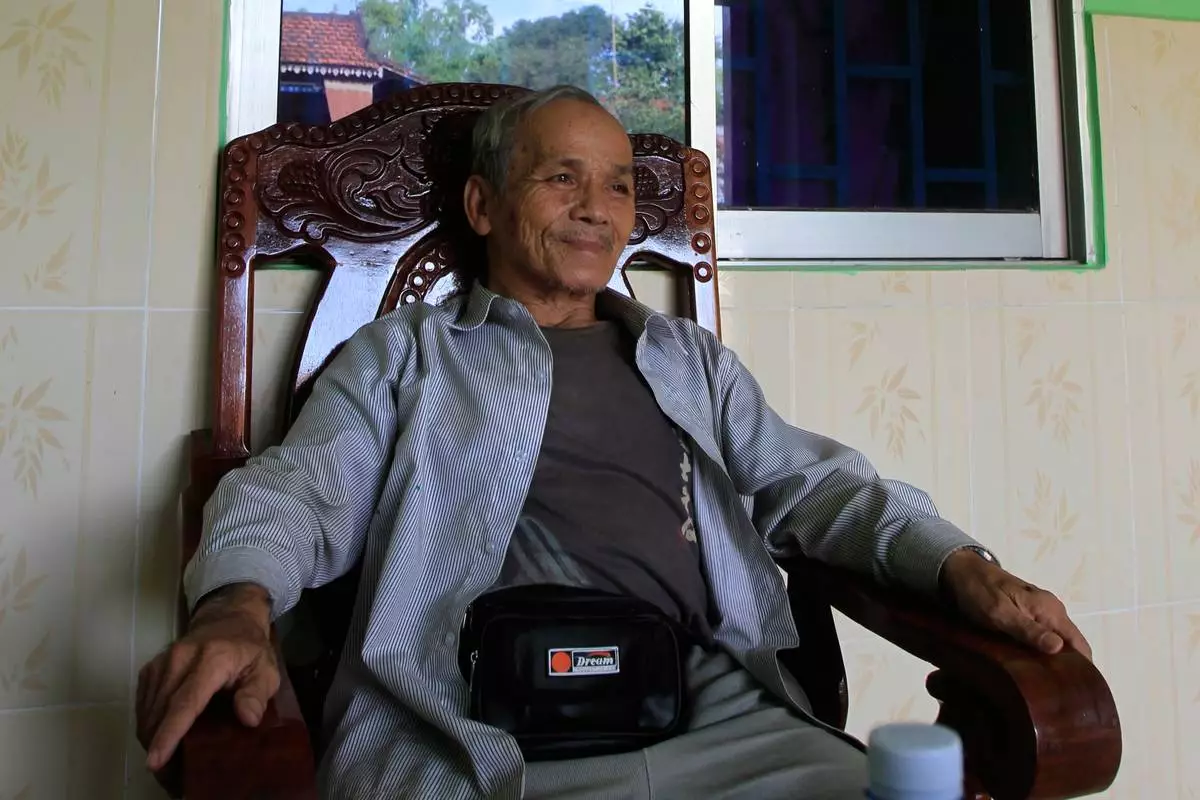
FILE - Bou Meng, a former S-21 prison survivor, sits at his hours in Koh Thom, Kandal province, Cambodia, Teusday, Jan. 31, 2012. (AP Photo/Heng Sinith, File)
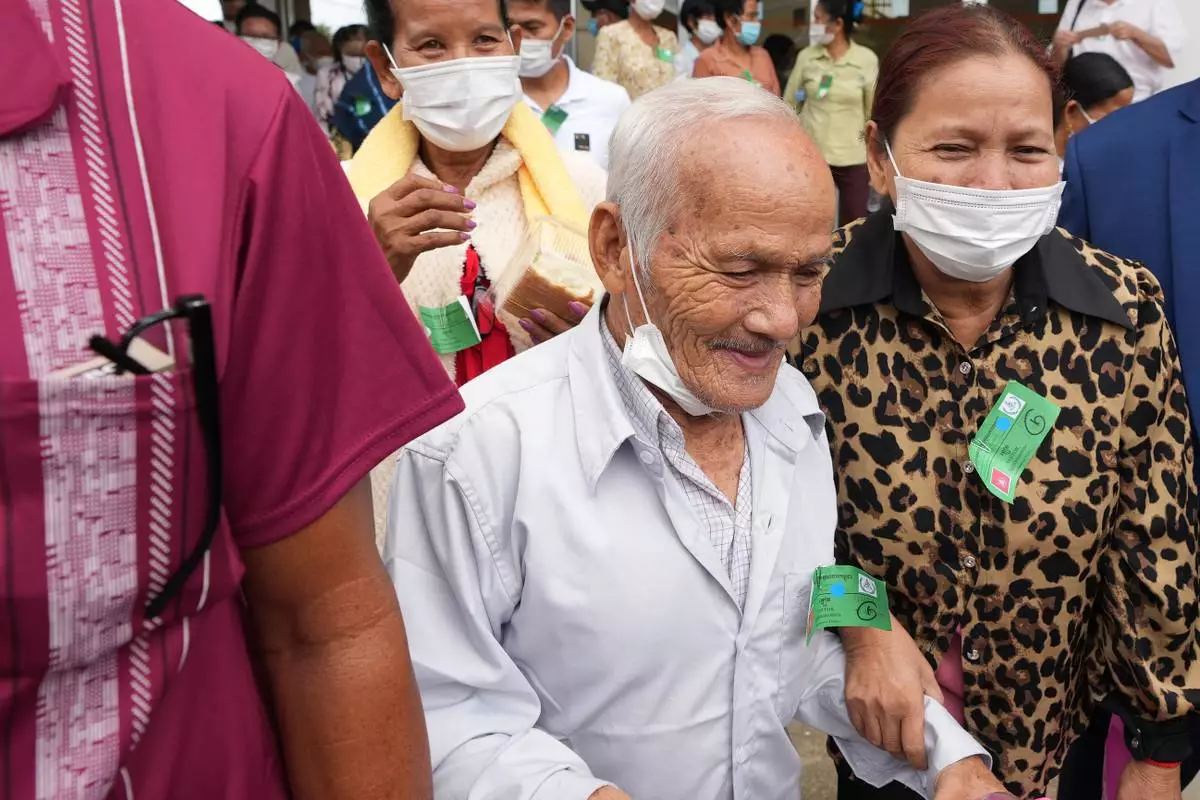
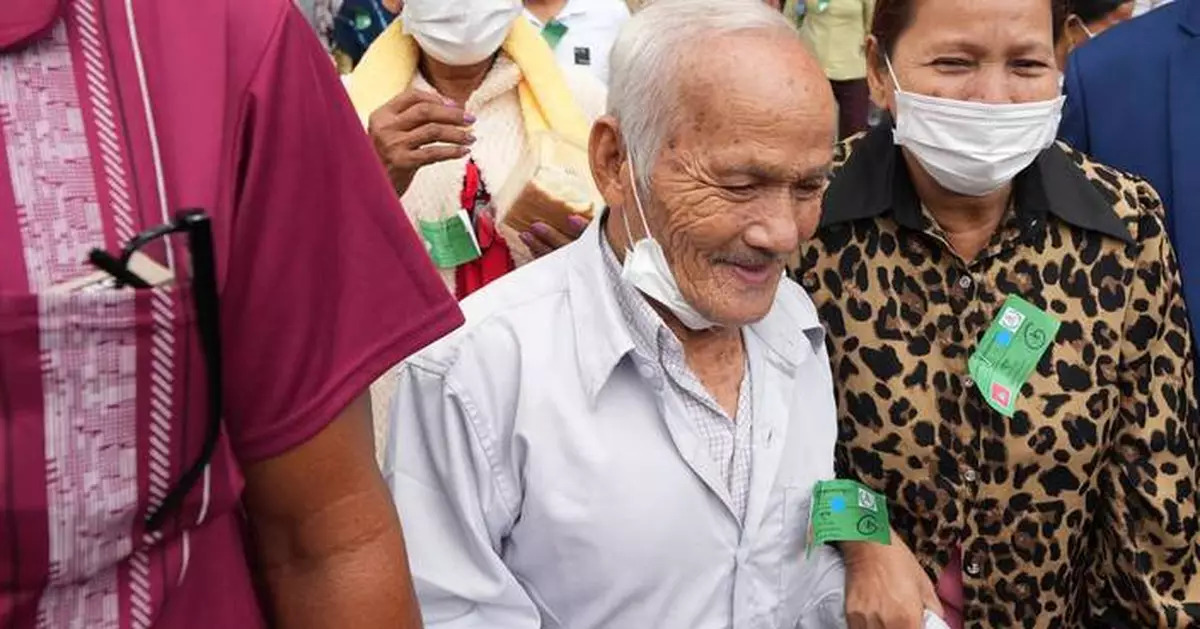
FILE- Bou Meng, center, former S-21 prison survivor, leaves the courtroom after the verdict is announced for Khieu Samphan, former Khmer Rouge head of state, at the U.N.-backed war crimes tribunal in Phnom Penh, Cambodia, Thursday, Sept. 22, 2022. (AP Photo/Heng Sinith, file)
The top U.S. military commander in the Middle East visited the long-deployed USS Lincoln in the Arabian Sea during a regional tour that ended on Saturday, the U.S. Central Command said.
A Hamas delegation and, separately, U.S. negotiator Jared Kushner were in Egypt for Gaza ceasefire-related talks with Egyptian officials. And the 60-day negotiating period that began with the June 17 signing of an interim agreement between the U.S. and Iran is set to end with no word of an extension.
Here’s a look at the latest developments on Sunday in the Iran war and the wider Middle East. Full coverage can be found here.
Adm. Brad Cooper visited the USS Lincoln as reports have emerged of mental health and supply issues. The Lincoln arrived in the Middle East in January and has been supporting the U.S. war against Iran, including the blockade on Iranian ports. It has spent a record-setting uninterrupted time at sea of more than 240 days.
“History will record this deployment as one of the most operationally intense and consequential of the modern era,” Cooper said of the Lincoln strike group in a statement released Saturday. Extended deployments of carriers — which can have more than 5,000 sailors and Marines on board — have raised concerns.
Cooper also went to Bahrain, Iraq, Israel, Jordan, Saudi Arabia and the United Arab Emirates to meet with civilian and military leaders, according to the Central Command statement.
The U.S. Navy's blockade is in response to Iran asserting control over the Strait of Hormuz after the war started on Feb. 28 with U.S. and Israeli strikes. Before then, about one-fifth of the world’s traded oil and natural gas passed through what had been considered an international waterway.
Talks between the U.S. and Iran have stalled while Iran talks with Oman about how to manage the strait that runs between them.
A Hamas delegation, chaired by leader Khalil al-Hayya, was in Cairo for Gaza ceasefire-related talks, the group said. Al-Hayya met with Maj. Gen. Hassan Rashad, head of Egypt’s intelligence service, Egyptian state-run media reported.
Al-Hayya reiterated Hamas’ commitment to implement U.S. President Donald Trump’s peace plan in Gaza to “end the suffering of the residents of the Gaza Strip and to begin the reconstruction process," al-Qahera News television reported.
Mediators are pushing for the implementation of a road map that calls for the disarmament of Hamas and other Palestinian militant groups in Gaza, the withdrawal of Israeli forces and the handing over of power to Palestinian technocrats.
Israeli Prime Minister Benjamin Netanyahu has rejected Trump’s latest plan to advance the stalled ceasefire, saying Israel will not withdraw from any of the roughly 60% of the territory it controls until Hamas has been completely disarmed — something the militant group controlling the rest has resisted.
It wasn’t immediately clear whether al-Hayya would meet with Kushner, the Board of Peace’s high representative Nickolay Mladenov or executive board member and former British Prime Minister Tony Blair, who are scheduled to travel to Israel and Egypt this week.
Separately, Kushner met with Egyptian President Abdel-Fattah el-Sissi. The president’s office said the meeting called for Israel and Hamas to “fulfill their obligations under the ceasefire agreement in the Gaza Strip,” without elaborating.
Israel’s military said it targeted two Hezbollah commanders in Saturday's strikes in southern Lebanon, the deadliest attacks since a truce between Israel and Iran-backed Hezbollah went into effect in June.
Lebanon’s Health Ministry and state news agency said at least 11 people were killed.
Israel’s military said early Sunday one strike killed Abu Hassan Alaa, whom it described as a senior Hezbollah commander who had taken part in attacks against Israel’s soldiers in southern Lebanon. Earlier, the military said a strike killed Ali Samir Al-Haj Hassan, also described as a Hezbollah commander, adding that his family was with him.
Israel and the Lebanese government announced a “framework agreement” in June, laying out a plan for Israeli forces to withdraw from southern Lebanon in exchange for Hezbollah’s disarmament. Hezbollah has refused direct talks and wasn’t party to the U.S.-mediated deal.
Iran again on Sunday alleged that Qatar was holding three Iranian pilots who went missing in March when their jets were downed, which Qatar has denied.
Iran’s state TV reported Sunday that the commander of the Missing Persons Committee of Iran’s Armed Forces General Staff has urged Qatar to allow Iranian Air Force experts to conduct a field investigation.
This is the first known case in the war where Iran has said a regional country is holding its fighters. Tehran has repeatedly targeted regional countries that are hosting U.S. military bases.
An Israeli strike hit Khan Younis in southern Gaza and wounded five people, including a child who was seriously injured, according to the Kuwaiti and Nasser hospitals, where the casualties were taken.
Israel's military said it struck a member of the Palestinian Islamic Jihad.
While the heaviest fighting has subsided since a ceasefire took hold in October between Israel and Hamas, Israeli forces have carried out repeated airstrikes, killing at least 1,262 Palestinians, according to Gaza's Health Ministry.
The ministry, part of the Hamas-led government, maintains detailed casualty records that are seen as generally reliable by U.N. agencies and independent experts. It does not give a breakdown of civilians and militants.

People walk beneath an art installation of colorful spheres along a pedestrian street in Jaffa, a mixed Jewish-Arab neighborhood of Tel Aviv, Israel, Sunday, Aug. 16, 2026. (AP Photo/Oded Balilty)