Skip to Content Facebook Feature Image

The Iran war is forcing families to choose between school for their kids or survival

News

The Iran war is forcing families to choose between school for their kids or survival
News

News

The Iran war is forcing families to choose between school for their kids or survival

2026-08-17 12:16 Last Updated At:12:20

KAMPONG PRAHOK, Cambodia (AP) — Sou Sreynich dreams of becoming a teacher. But she knows she's far behind.

The 13-year-old first entered a classroom at 10, an age when most Cambodian children already have been in school for years. Her mother waited until she was old enough to swim, fearing the boat to school could capsize — a decision familiar to many parents on Cambodia's Tonle Sap, the largest freshwater lake in Southeast Asia.

More Images
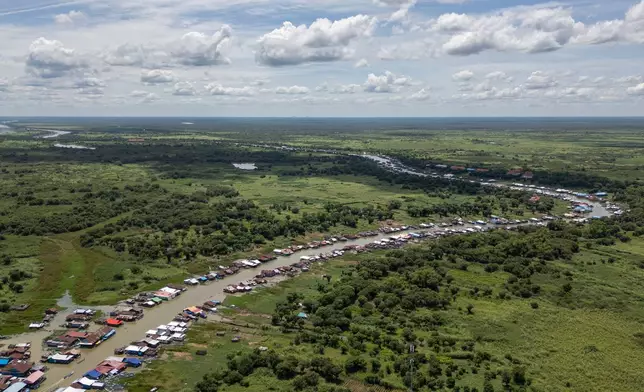
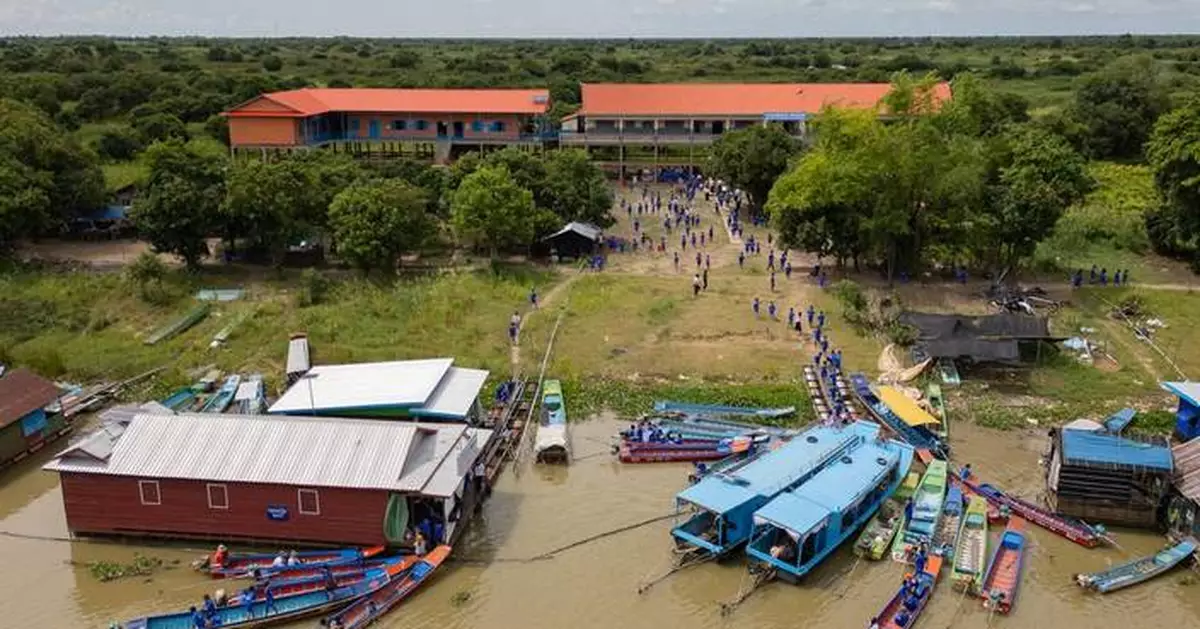
The floating village of Kampong Prahok on the Tonle Sap Lake, Cambodia, Monday, June 29, 2026. (AP Photo/Anton L. Delgado)
The floating village of Kampong Prahok on the Tonle Sap Lake, Cambodia, Monday, June 29, 2026. (AP Photo/Anton L. Delgado)

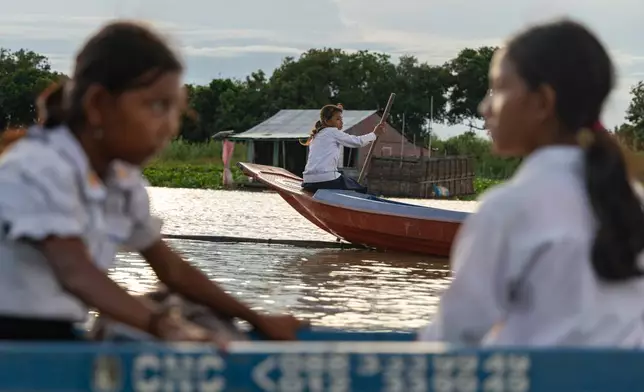
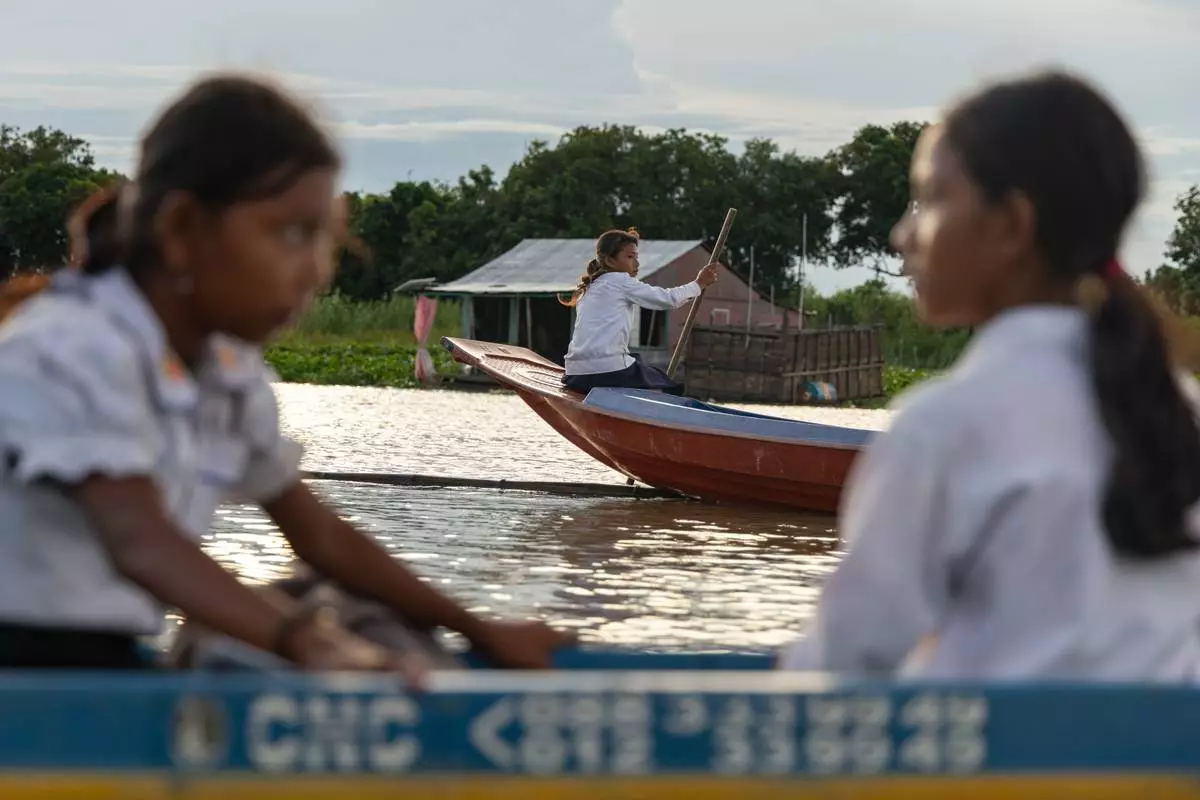
Students board school boats to return to their homes in a floating village on Cambodia's Tonle Sap Lake on Monday, June 29, 2026. (AP Photo/Anton L. Delgado)
Students board school boats to return to their homes in a floating village on Cambodia's Tonle Sap Lake on Monday, June 29, 2026. (AP Photo/Anton L. Delgado)
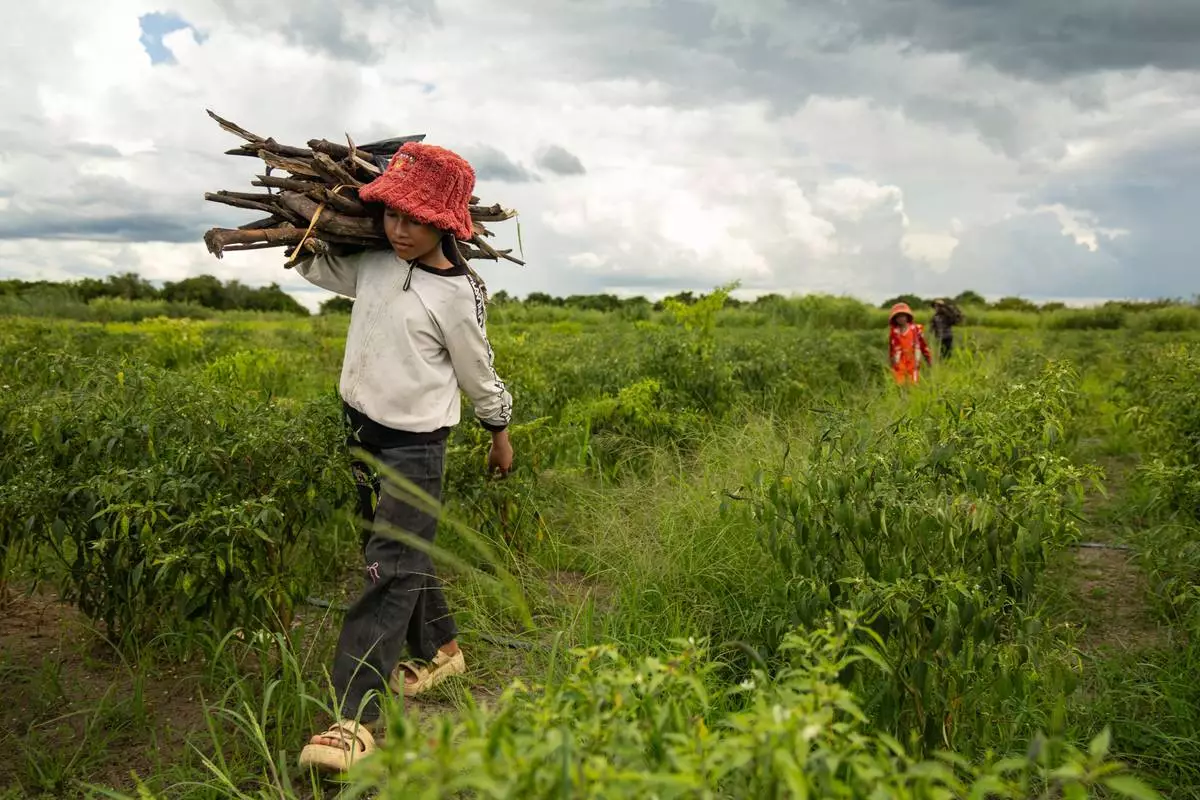
Sou Sreynich collects firewood with her family near their home in a floating village on Cambodia's Tonle Sap Lake on Monday, June 29, 2026. (AP Photo/Anton L. Delgado)

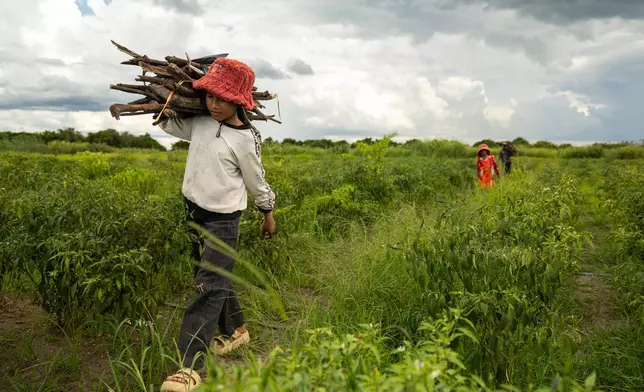
Sou Sreynich collects firewood with her family near their home in a floating village on Cambodia's Tonle Sap Lake on Monday, June 29, 2026. (AP Photo/Anton L. Delgado)

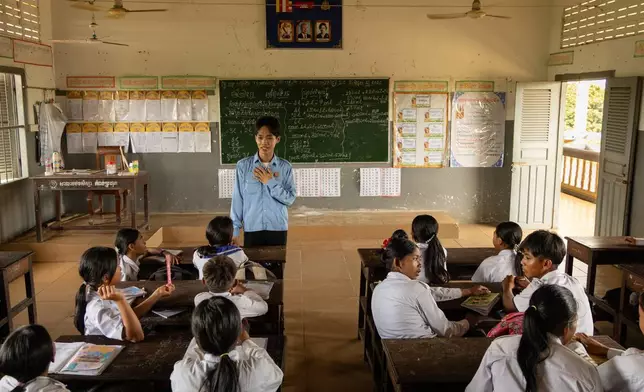
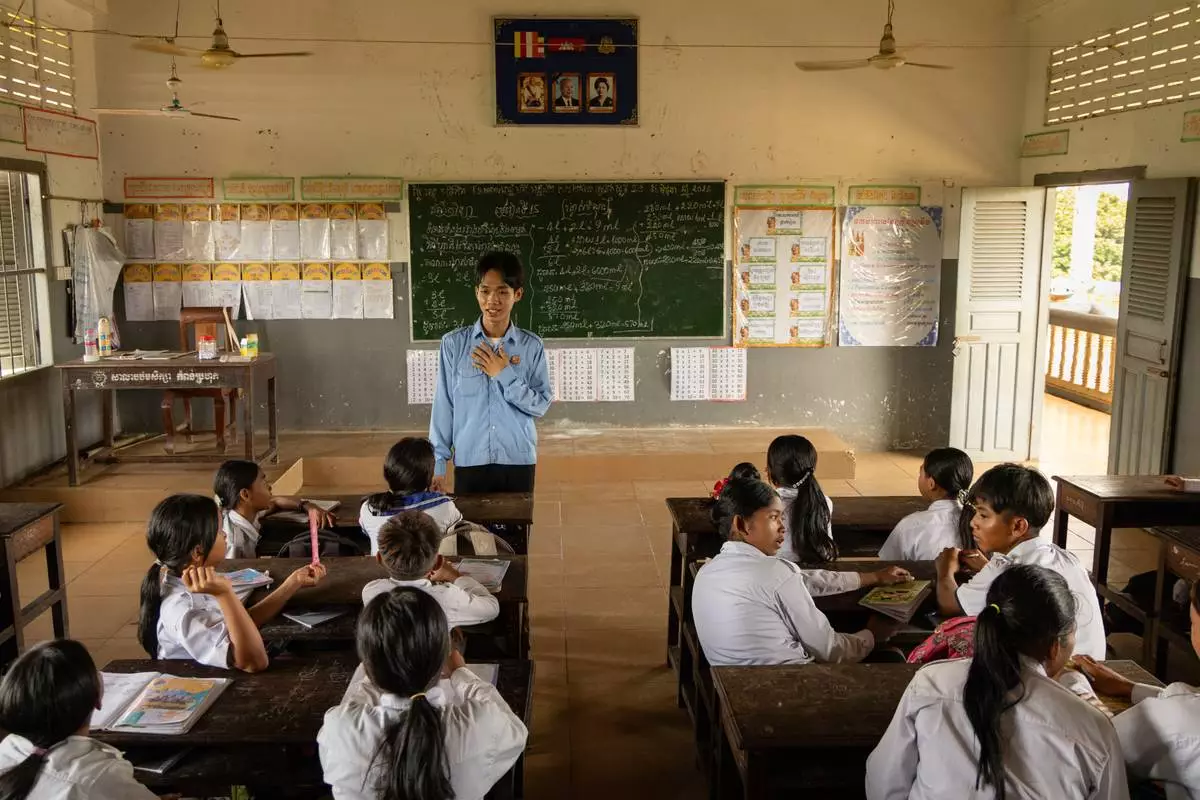
A teacher addresses students at a school in one of the floating villages of Cambodia's Tonle Sap Lake on Monday, June 29, 2026. (AP Photo/Anton L. Delgado)
A teacher addresses students at a school in one of the floating villages of Cambodia's Tonle Sap Lake on Monday, June 29, 2026. (AP Photo/Anton L. Delgado)

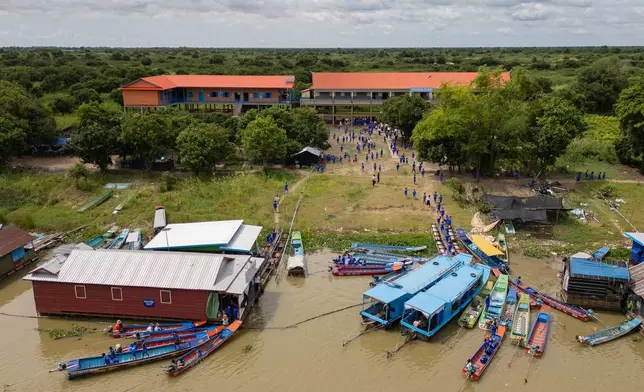
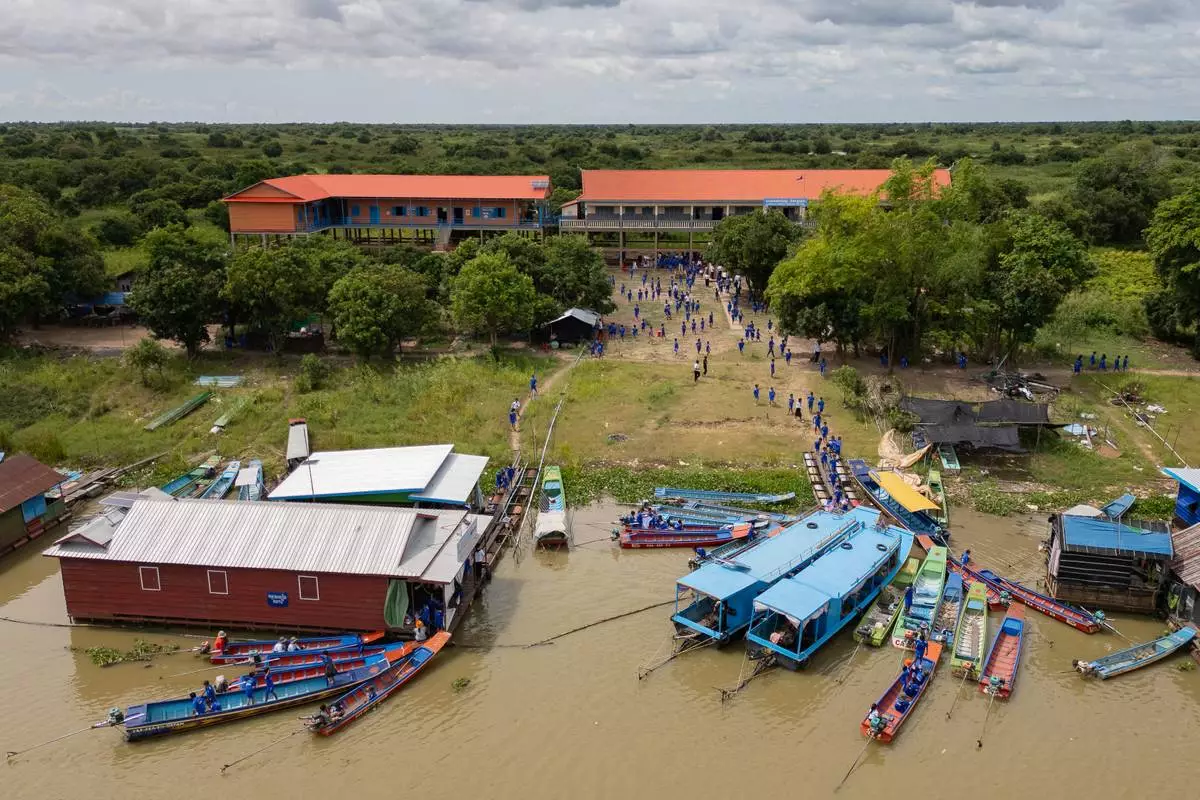
Students arrive at a school in a floating village on the Tonle Sap Lake, Cambodia, Tuesday, June 30, 2026. (AP Photo/Anton L. Delgado)

Students arrive at a school in a floating village on the Tonle Sap Lake, Cambodia, Tuesday, June 30, 2026. (AP Photo/Anton L. Delgado)

Now, the price of gasoline has spiked because of the Iran war, an additional burden. Unlike outright school closures during COVID-19, the Iran war’s impact on education is less visible. But it is falling first and hardest on the poorest families. Soaring fuel prices are making it more expensive for children and teachers to get to school, and for governments to fund education as national budgets come under strain.

On the lake, getting anywhere has always meant navigating the water. Climate change is making it harder, with increasingly unpredictable floods and droughts. Teachers at her school say 10 students have drowned over the years.

If the war continues, it could push up to 23.4 million more children like Sreynich into poverty by the end of the year, according to a recent United Nations Children’s Fund report. About 80% of those children would be in Africa and Asia.

Most mornings, a gas-powered boat chugs through Kampong Prahok, steered by students often no older than those climbing aboard. They pull up alongside floating homes, as peers in crisp uniforms clamber aboard, careful to keep their backpacks dry.

Like most on Tonle Sap, Sreynich’s family relies on fishing to survive. They earn some money picking chili peppers and gutting fish for others. Rising fuel prices because of the Iran war mean the family can't afford to travel to deeper waters where fish are more plentiful.

When money is tight, Sreynich skips a day or two of school to work alongside her parents. She dreads every absence. “I want to complete my studies,” she said.

For families already living on the edge, the war’s ripple effects are forcing difficult choices: whether to pay for food, fuel, rent and electricity, or keep every child in school.

“The Iran war is likely going to force millions of children out of school and could force millions of children to make the decision not to enroll in the first place,” said Sabrina Hervey of the Qatar-based Education Above All Foundation.

Some children in Southeast Asia are dropping out of school to work.

Ly, 16, and her sister Nhi, 13, two of nine children from a fishing family on Vietnam’s rocky northern coast, have long drifted in and out of school as the family struggled to make ends meet.

They are identified by their first names only because of Vietnamese laws protecting vulnerable minors.

Their father lost his fishing job after the war pushed diesel prices so high that boat owners could not afford to go out to sea. Already burdened by debt, the family was surviving on his odd jobs. It wasn't enough to keep all nine children fed and in school.

The girls dropped out of school and moved to Vietnam's capital Hanoi to work long hours in a restaurant, where they were exposed to sharp tools, hot surfaces and heavy lifting.

For 13-year-old Nhi it was also illegal because of child labor laws.

In April, the Hanoi-based nonprofit Blue Dragon Children’s Foundation intervened and the two returned to school.

The war's impact has unfolded slowly but is devastating, said Michael Brosowski with the foundation.

When families reach a financial breaking point, they tend to go into triage — keeping some children enrolled while pulling others out to work, he said. The children not in school are far more vulnerable to exploitation, trafficking and homelessness.

“It’s the tipping point for a lot of families,” Brosowski said.

Higher fuel prices are driving up costs of nearly every part of education, from getting students and teachers to school to stocking classrooms with pencils and chalk. It's more expensive for teachers and aid workers to reach remote communities. Governments are also grappling with rising food and energy bills, leaving less money for education.

In Cambodia, everything already costs more on Tonle Sap since supplies have to be brought in by boat.

“Even the electricity to run this lab is 10-times higher,” said Samphors Vorn of the nonprofit Aide et Action, which supports the school.

Developing countries reliant on imported energy have been the most exposed to disruptions from the war. Rising fertilizer costs and falling remittances also are straining these smaller economies.

The war is threatening years of progress in education and poverty reduction in Bangladesh, whose economy already was under strain.

Pressure on the government’s finances, driven by rising costs for fuel and subsidies, could leave it with less money to spend on health care and education, warned a report by the U.N. Development Programme.

In some South Asian nations, girls are likely to be affected more because families tend to prioritize sons, said Arshad Malik of the nonprofit Save the Children International. Economic hardships could mean more girls dropping out of school and an increase in child marriages, he said.

South Asia accounts for 45% of the world’s child brides, the highest share of any region, according to UNICEF.

More than 466 million children worldwide receive at least one meal a day at school, according to the U.N. World Food Programme. These meals help keep children in school, improve their ability to learn and concentrate, and support healthy brain development.

Such programs also could come under pressure as the conflict disrupts fertilizer shipments and raises transport costs, especially in countries in West and Central Africa that rely heavily on imported food, said Hervey, with Education Above All.

Across northern Nigeria, it is becoming more common for children to relapse into malnutrition, according to local health and aid workers.

“I’m really afraid to see what’s going to happen,” Hervey said.

The Associated Press’ climate and environmental coverage receives financial support from multiple private foundations. The AP is solely responsible for all content. Find AP’s standards for working with philanthropies, a list of supporters and funded coverage areas at AP.org.
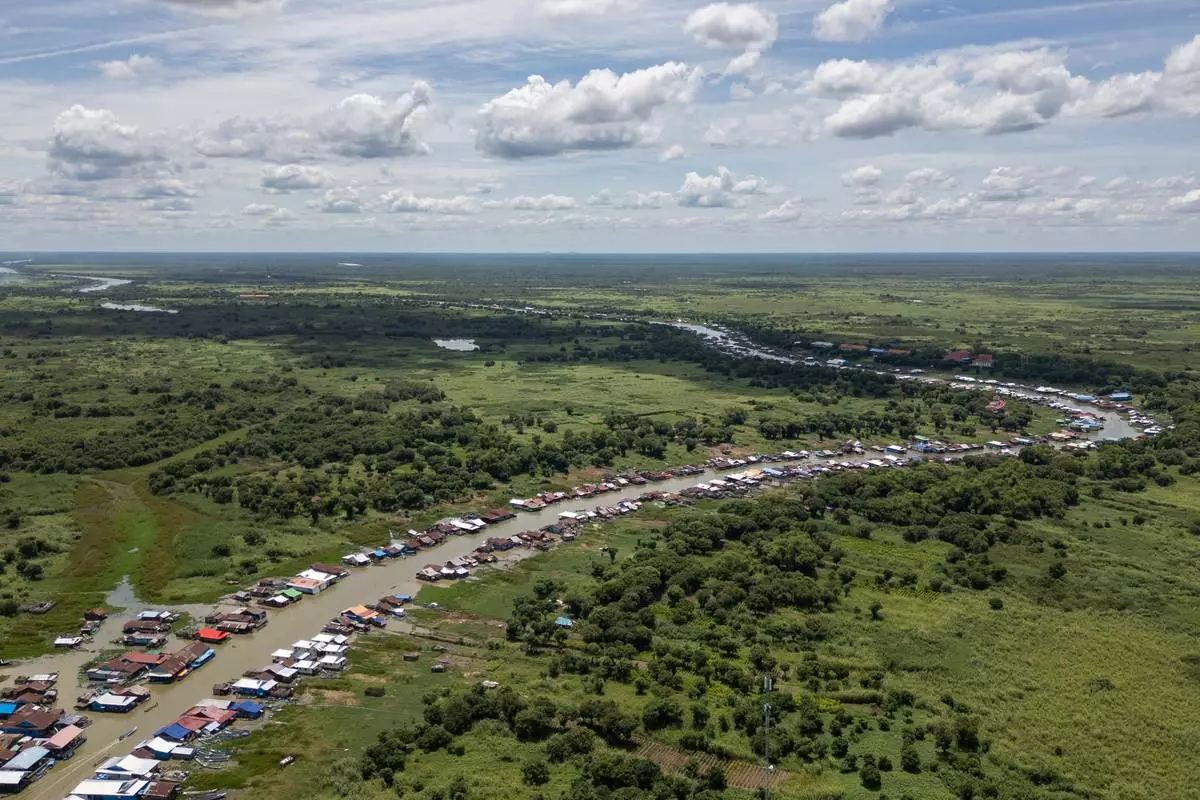
The floating village of Kampong Prahok on the Tonle Sap Lake, Cambodia, Monday, June 29, 2026. (AP Photo/Anton L. Delgado)
The floating village of Kampong Prahok on the Tonle Sap Lake, Cambodia, Monday, June 29, 2026. (AP Photo/Anton L. Delgado)

Students board school boats to return to their homes in a floating village on Cambodia's Tonle Sap Lake on Monday, June 29, 2026. (AP Photo/Anton L. Delgado)
Students board school boats to return to their homes in a floating village on Cambodia's Tonle Sap Lake on Monday, June 29, 2026. (AP Photo/Anton L. Delgado)
Sou Sreynich collects firewood with her family near their home in a floating village on Cambodia's Tonle Sap Lake on Monday, June 29, 2026. (AP Photo/Anton L. Delgado)

Sou Sreynich collects firewood with her family near their home in a floating village on Cambodia's Tonle Sap Lake on Monday, June 29, 2026. (AP Photo/Anton L. Delgado)

A teacher addresses students at a school in one of the floating villages of Cambodia's Tonle Sap Lake on Monday, June 29, 2026. (AP Photo/Anton L. Delgado)
A teacher addresses students at a school in one of the floating villages of Cambodia's Tonle Sap Lake on Monday, June 29, 2026. (AP Photo/Anton L. Delgado)

Students arrive at a school in a floating village on the Tonle Sap Lake, Cambodia, Tuesday, June 30, 2026. (AP Photo/Anton L. Delgado)


Students arrive at a school in a floating village on the Tonle Sap Lake, Cambodia, Tuesday, June 30, 2026. (AP Photo/Anton L. Delgado)

LAS VEGAS (AP) — Opening statements are set to begin Monday in the trial of a man accused of orchestrating the killing of Tupac Shakur, kicking off weeks of testimony that will revisit what happened on a Las Vegas nearly 30 years ago.

Duane “Keffe D” Davis, 63, is charged with murder with a deadly weapon with the intent to promote, further or assist a criminal gang in the rapper’s death. He pleaded not guilty, but if convicted, faces life in prison.

The long-unsolved drive-by shooting gripped the hip-hop community, partly because no one was charged until Davis was indicted in 2023.

Shakur remains a cultural icon and is considered one of the most influential and versatile rappers of all time, despite dying at 25. He was nominated for six Grammy Awards and was inducted into the Rock & Roll Hall of Fame in 2017.

In recent years, he received a posthumous star on the Hollywood Walk of Fame, had a street in Oakland named in his honor and inspired a character on the upcoming video game "Stranger than Heaven.”

Over the course of the trial, which could span weeks, prosecutors plan to call 35 to 45 potential witnesses, and the defense will call only a handful to testify.

Members of Shakur’s family are expected to be in the courtroom Monday. Shakur’s stepbrother, Maurice “Mopreme” Shakur, recently told The Associated Press that sitting through the trial will be retraumatizing for the family, but it's important to be there.

“We’re gonna stand by Pac as we always have,” he said.

Along with Shakur's family, friends and fans traveled to Las Vegas to show their support during jury selection.

Darryl Harper, a veteran music producer who collaborated with Shakur at Death Row Records on songs released after the 1996 shooting, said he booked a plane ticket as soon as the latest trial date was set.

“He became a personal friend of mine as I worked with him almost every day of his last days here,” said Harper, who flew in from his home in Georgia.

Harper hopes the trial will reveal the truth about who was involved with the shooting.

“My prayer is that it’s the right person,” he said outside the court during jury selection. “If he’s the right person, then I’m glad that Tupac would get some kind of redemption finally. I think he deserves it.”

Shakur's cousins Kendrick Lesane and William Lesane flew in from Atlanta to watch jury selection. William Lesane said he wants someone held accountable.

“For me, justice has long left the station 30 years ago,” he said.

Prosecutors aren't claiming Davis pulled the trigger. Rather, they say he organized the shooting to get revenge after Shakur and his entourage beat up Davis' nephew at the MGM Grand hours before Shakur was shot.

The gunfire came from a white Cadillac that Davis was in with three others, all who have since died.

In 2008, Davis spoke to investigators looking into the deaths of Shakur and Notorious B.I.G., born Christopher Wallace. During the investigation, Davis was under an agreement that what he said about Shakur's killing couldn't be used against him. But nearly 10 years later, Davis published a book with those details and participated in media interviews in which he laid out his role in the shooting.

The book and his public statements revived the Las Vegas investigation and became key pieces of evidence, prosecutors say.

"Had he decided to never write the book, he would not, probably, have ever been prosecuted for the crime,” prosecutor Marc DiGiacomo recently said.

Davis' attorney Michael Sanft says Davis co-authored the book “Compton Street Legend” to make money, not to tell the truth. He argues it's impossible to tell which parts — if any — Davis wrote and which parts author Yusuf Jah penned.

Jah, who is on the list of potential witnesses, recently told an investigator that he didn't believe Davis fully read his own book, according to court documents.

Prosecutors say the book is sensationalized but that they'll show “what is true, what is exaggeration, and what is an outright lie,” they wrote in court documents.

Associated Press journalists Ty ONeil in Las Vegas and John Seewer in Toledo, Ohio, contributed.

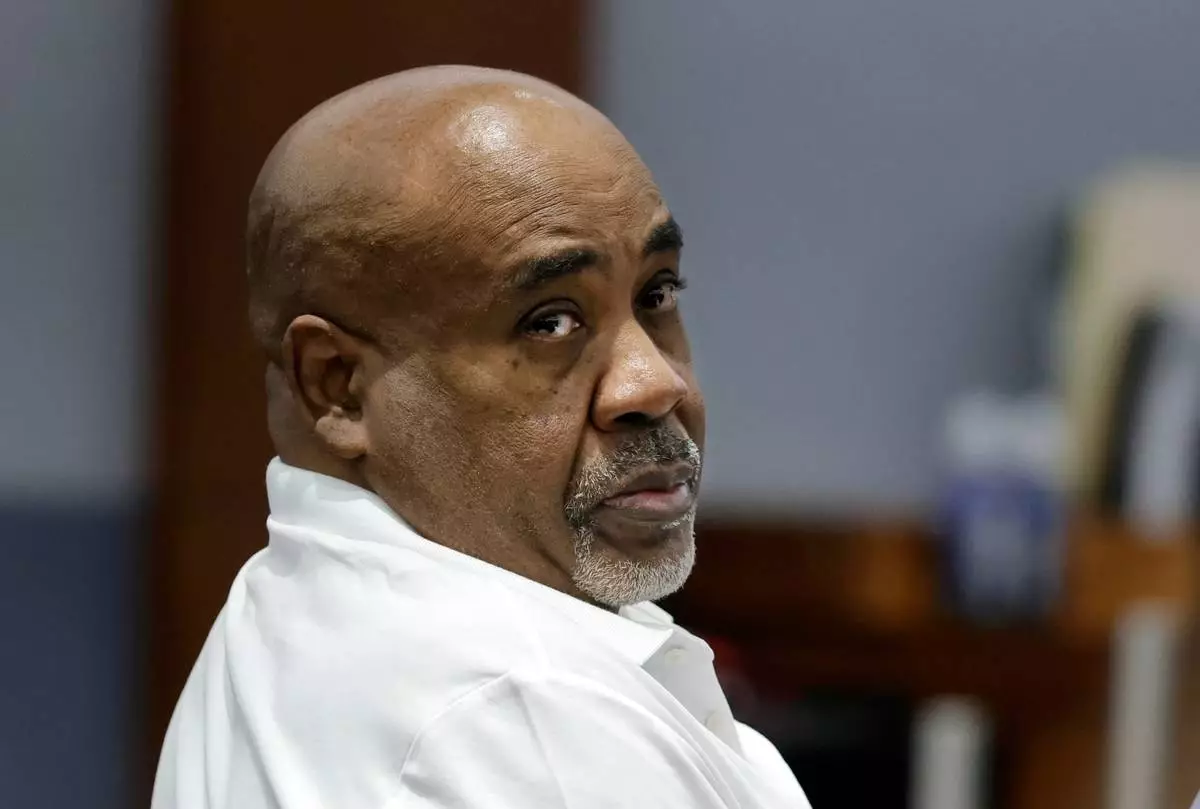
Duane Davis enters the courtroom after a break in the third day of jury selection in his murder trial, related to the 1996 killing of rapper Tupac Shakur, at Clark County District Court Regional Justice Center on Wednesday, Aug. 12, 2026, in Las Vegas. (Steve Marcus/Las Vegas Sun via AP, Pool)

Duane Davis enters the courtroom after a break in the third day of jury selection in his murder trial, related to the 1996 killing of rapper Tupac Shakur, at Clark County District Court Regional Justice Center on Wednesday, Aug. 12, 2026, in Las Vegas. (Steve Marcus/Las Vegas Sun via AP, Pool)

Chief Deputy District Attorney Binu Palal questions a prospective juror during the third day of jury selection in Duane Davis murder trial, related to the 1996 killing of rapper Tupac Shakur, at Clark County District Court Regional Justice Center on Wednesday, Aug. 12, 2026, in Las Vegas. (Steve Marcus/Las Vegas Sun via AP, Pool)

Chief Deputy District Attorney Binu Palal questions a prospective juror during the third day of jury selection in Duane Davis murder trial, related to the 1996 killing of rapper Tupac Shakur, at Clark County District Court Regional Justice Center on Wednesday, Aug. 12, 2026, in Las Vegas. (Steve Marcus/Las Vegas Sun via AP, Pool)

Chief Deputy District Attorneys Marc DiGiacomo, left, and Binu Palal confer during the third day of jury selection in the Duane Davis murder trial, related to the 1996 killing of rapper Tupac Shakur, at Clark County District Court Regional Justice Center on Wednesday, Aug. 12, 2026, in Las Vegas. (Steve Marcus/Las Vegas Sun via AP, Pool)

Chief Deputy District Attorneys Marc DiGiacomo, left, and Binu Palal confer during the third day of jury selection in the Duane Davis murder trial, related to the 1996 killing of rapper Tupac Shakur, at Clark County District Court Regional Justice Center on Wednesday, Aug. 12, 2026, in Las Vegas. (Steve Marcus/Las Vegas Sun via AP, Pool)

Duane Davis appears in court during the third day of jury selection in his murder trial, related to the 1996 killing of rapper Tupac Shakur, at Clark County District Court Regional Justice Center on Wednesday, Aug. 12, 2026, in Las Vegas. (Steve Marcus/Las Vegas Sun via AP, Pool)

Duane Davis appears in court during the third day of jury selection in his murder trial, related to the 1996 killing of rapper Tupac Shakur, at Clark County District Court Regional Justice Center on Wednesday, Aug. 12, 2026, in Las Vegas. (Steve Marcus/Las Vegas Sun via AP, Pool)

Recommended Articles