The vast pastures of Tekes County in northwest China's Xinjiang Uygur Autonomous Region, one of China's major livestock production bases, are seeing a bumper hay harvest this summer, securing essential winter feed supply for the local livestock.
Currently, a coordinated fleet of mowers, rakes, and balers is crisscrossing the more than 20,000 hectares of natural pasturelands in Tekes, as the country has long replaced traditional scythes with modern, highly efficient machines for the annual harvest.
The harvest is key to ensuring the well-being of livestock through the harsh winter months and supporting the livelihoods of herder communities in the county.
For local herders, this year's harvest has been particularly rewarding.
"I have harvested over 100 mu (about 6.7 hectares) of pastureland and more than 1,000 bales of hay this year. The hay will serve as the winter feed for our livestock. Every process is mechanized now, which has made our herders' lives so much easier," said a local herder.
Located in the south of the Ili River Valley, Tekes County is one of the valley's key pastoral bases, with natural mowing grounds spanning over 20,000 hectares.
To ensure the hay is harvested at the optimal time for both yield and nutritional value, local authorities have deployed more than 200 sets of machines and implemented a zone-based harvesting strategy, starting from lower-altitude pastures and gradually moving to higher elevations.
In recent years, Tekes County has steadily improved its grassland ecology through a series of conservation measures. The county has carried out initiatives such as pastureland rehabilitation, seasonal grazing, and forage-livestock balance management. These efforts have significantly boosted the sustainable use of pasturelands and contributed to the recovery of the local grassland ecosystem.
Hay harvesting in most parts of Xinjiang is expected to be largely completed by the end of August, while work in high-altitude mountain pastures will continue into early September.

Xinjiang pastures yield bumper hay harvest as herders prepare for winter
The accelerated industrialization of humanoid robots in China since the beginning of this year has driven rapid growth in the market for core components, particularly dexterous robotic hands, according to industry players.
The dexterous hand industry is undergoing three major changes, including sales volume doubling, product prices dropping significantly, and tactile sensing becoming more widely available. What was once a high-end optional feature is rapidly becoming a standard component in mass-produced dexterous hands.
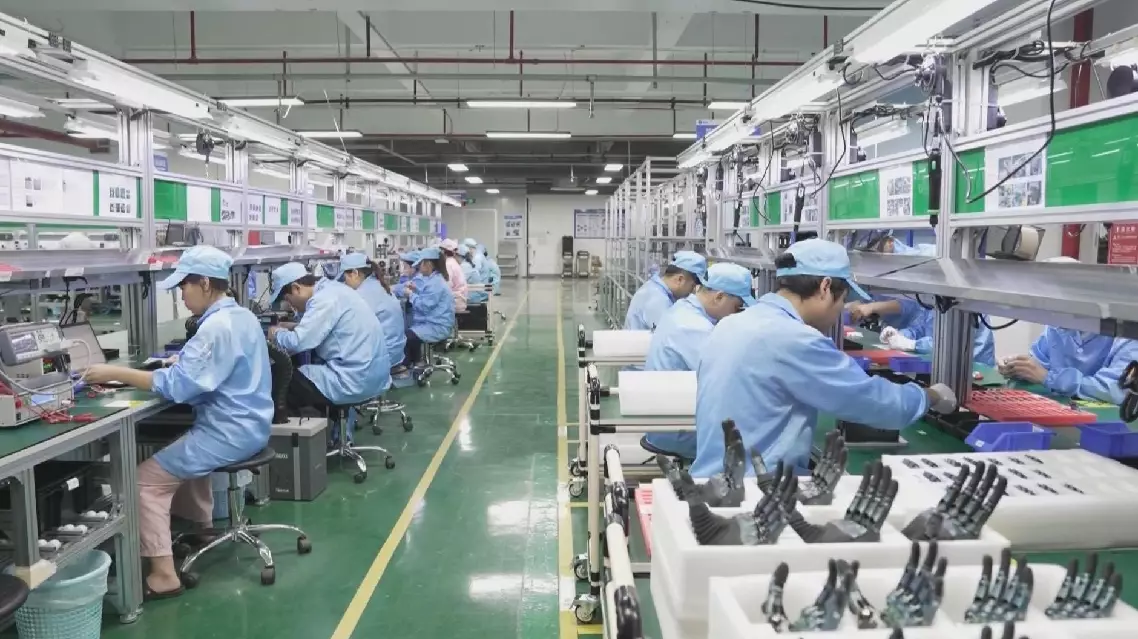
At an assembly workshop of a dexterous hand company in Shenzhen, south China's Guangdong Province, production lines are running at full capacity as workers assemble components.
According to the company head, dexterous hand sales have surged this year as humanoid robots are increasingly applied in more scenarios
Flexible tactile sensors have now been installed on the fingers, fingertips and palms of dexterous hands, enabling them to go from simply grasping objects to sensing their properties.
"From January to now, we have sold over 4,000 dexterous hands, more than double the figure compared with the same period last year. Our dexterous hands now come equipped with our flexible tactile sensors. For example, when I touch or grab an object with my fingers, it can sense the magnitude and direction of the force applied," said Ge Pengyao, general manager of Shenzhen Lingqiao Drive and Control Technology Co., Ltd.
Flexible tactile sensors are also known as "electronic skin." This year, many dexterous hand companies shifted from last year's electronic-skin technology validation to mass purchasing, driving flexible tactile sensor companies to operate at full capacity.
"Our sales from January to now have increased tenfold compared with last year. Our production capacity has become insufficient, so we have put new production lines into operation this year. The price of flexible tactile sensors has also dropped by about 30 percent," said Xiong Gengchao, general manager of Sycsense Technology (Shenzhen) Co., Ltd.
As the industrial chain continues to improve and sales volumes keep rising this year, the price of dexterous hands has dropped significantly, according to another industry leader.
"The average price of a dexterous hand was 50,000 yuan (about 7,418 U.S. dollars) the year before last. This year, it has basically dropped to below 10,000 yuan. Our six-degree-of-freedom dexterous hand is priced between 6,000 and 8,000 yuan," said Tian Bo, chairman of Shenzhen Ruiyan Intelligent Control Co., Ltd.
Data shows that China's dexterous hand market sales were about 19,200 units in 2025 and are expected to reach 70,200 units in 2026. By 2030, as application scenarios for humanoid robots expand and breakthroughs in dexterous hand technology and cost reductions continue, China's dexterous hand market sales are expected to exceed 430,000 units.
China's dexterous robotic hand market booms as humanoid robot industry accelerates