CHP investigates measles case
The Centre for Health Protection (CHP) of the Department of Health (DH) today (August 18) is investigating a measles case and reminds members of the public that vaccination is the most effective way to prevent measles.
The case involves a 35-year-old female who has developed a fever and cough since August 4. She further developed a rash on August 9 and attended the Accident and Emergency Department of United Christian Hospital on the same day. Hospitalisation is not required. She is currently in stable condition. Her clinical specimen was tested positive for the measles virus upon laboratory testing.
An epidemiological investigation revealed that the patient was not born in Hong Kong and she was uncertain whether she had received the measles vaccination in her birth place. She had a short outbound trip during the incubation period.
The patient did not need to go to work during the communicable period (August 5 to 13). Her household contacts are asymptomatic. The CHP has contacted the relevant hospital to identify any close contacts and high-risk individuals. As of 3pm today, a total 198 individuals have been identified as close contacts, and are put under the CHP's medical surveillance. All close contacts are asymptomatic so far.
The CHP will continue to investigate and follow up on the case.
This is the ninth measles case recorded in Hong Kong so far this year. The previous six cases were either imported or epidemiologically linked to these cases. There were two other local cases. In the past two years (2024 and 2025), 10 cases were recorded each year.
Measles outbreaks are currently occurring in many regions around the world. In recent years, North America (including the United States, Canada and Mexico) and Southeast Asia (including Indonesia, Cambodia and the Philippines) have seen persistent measles outbreaks due to low vaccination coverage. Over 2 500 cases have been recorded in the United States so far this year, exceeded the total number of cases last year. In Europe, the number of measles cases in the United Kingdom and Spain has increased this year, with 953 and 172 cases recorded respectively since January. In Asia, measles remains prevalent in the Philippines, Indonesia, Pakistan, Bangladesh and Cambodia. Japan and Singapore have also seen a substantial rise in cases this year, with 550 and 45 cases recorded respectively, marking the highest record since 2019. Australia has reported 112 measles cases this year, which is also higher than the same period last year. Most of the overseas cases involved individuals who were not vaccinated against measles or had an unknown vaccination status, highlighting the importance of maintaining a high vaccination rate and herd immunity within the community.
As a city with a high volume of international travel, Hong Kong faces the potential risk of importation of the measles virus and its spread in the local community. The CHP's territory-wide immunisation surveys showed that under the Hong Kong Childhood Immunisation Programme, the two-dose measles vaccination coverage has consistently stayed above 95 per cent. The local seroprevalence rates of measles virus antibodies reflect that most people in Hong Kong are immune to measles. However, measles is highly contagious. A small number of people who have not completed measles vaccinations (such as non-locally born people including new immigrants, foreign domestic helpers, overseas employees and people coming to Hong Kong for further studies) are still at risk of being infected and spreading measles to others without immunity against measles, such as children under one year old who have not yet received the first dose of the measles vaccine. Those who have unknown immunities against measles or need to receive measles vaccinations are urged to consult their doctor.
The Hong Kong Childhood Immunisation Programme introduced a measles vaccine for the first time in 1967. Thanks to the strong support of parents, schools and the healthcare sector, Hong Kong's vaccination coverage has remained at a very high level, enabling the city to successfully eliminate measles in 2016. Over the past two years, measles outbreaks have occurred in many parts of the world, leading to a resurgence of community transmission in some countries that had previously eliminated the disease. However, because Hong Kong's vaccination coverage has remained high, the number of cases recorded in the city has not risen significantly as a result, and Hong Kong has successfully maintained its measles-eliminated status to date.
People born and raised in Hong Kong before 1967 can be considered to have acquired immunity to measles through natural infection, as measles was endemic in Hong Kong at that time. People born in Hong Kong in or after 1967 who have not yet completed the two doses of measles vaccination, or whose measles vaccination history is unknown, should consult their family doctors as soon as possible to complete the vaccination and ensure adequate protection against measles.
The incubation period of measles (i.e. the time from infection to onset of illness) is seven to 21 days. Symptoms include fever, skin rash, cough, runny nose and red eyes. If travellers returning from places with a high incidence or an outbreak of measles develop symptoms of measles (e.g. fever and rash), they should seek medical advice immediately and avoid contact with non-immune individuals, especially pregnant women and infants under one year old. They should also report their symptoms and prior travel history to healthcare workers so that appropriate infection control measures can be implemented at the healthcare facilities to prevent any potential spread.
Besides being vaccinated against measles, members of the public should take the following measures to prevent infection:
- Maintain good personal and environmental hygiene;
- Maintain good indoor ventilation;
- Keep hands clean and wash them properly;
- Wash hands when they are dirtied by respiratory secretions, such as after sneezing;
- Cover the nose and mouth while sneezing or coughing and dispose of nasal and mouth discharge properly;
- Clean used toys and furniture properly; and
- Persons with measles should be kept out of school until four days after the onset of a rash to prevent the spread of the infection to non-immune persons.
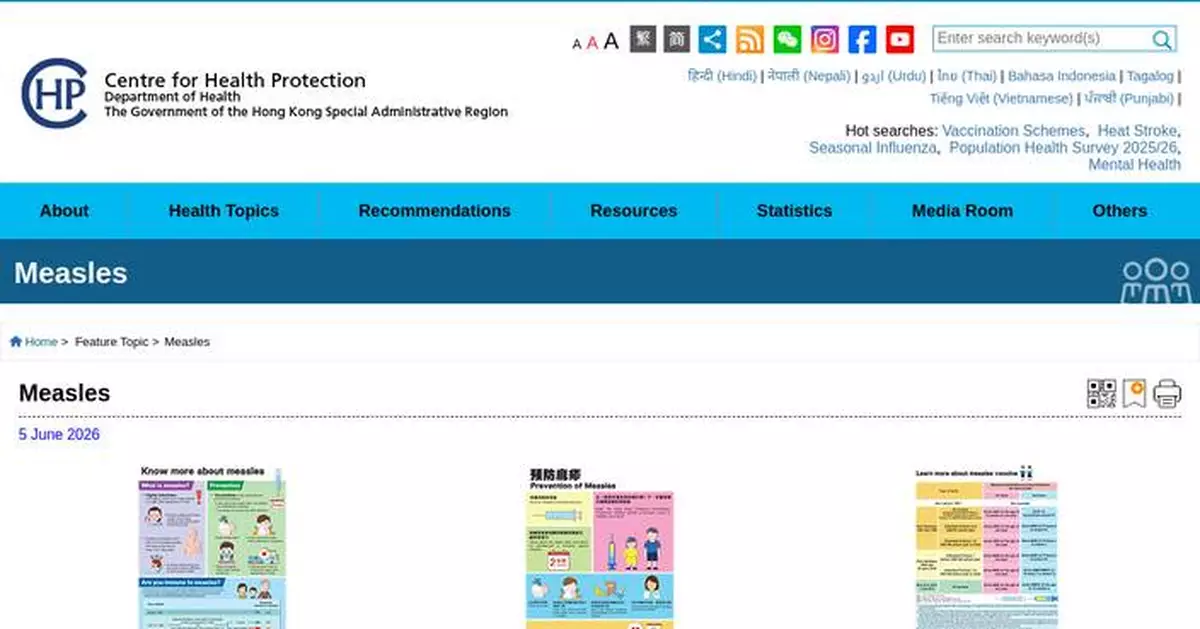
For more information on measles, the public may visit the CHP's measles thematic page. Members of the public who are going to travel can visit the website of the DH's Travel Health Service for news of measles outbreaks outside Hong Kong.
Source: AI-found images