Minnesota Gov. Tim Walz on Tuesday said the state would not review or process permits on proposed mining projects in the Boundary Waters Canoe Area Wilderness, four months after Congress and President Donald Trump's administration lifted a federal ban.
The cherished wild area stretches for about 150 miles (about 240 kilometers) in the Superior National Forest along Minnesota’s border with Canada. Thousands of canoeists, kayakers and campers explore the wilderness each year.
"It’s our duty as Minnesotans to ensure the sacred place remains wild, pristine and unharmed," Walz, a Democrat, said.
But Walz's executive order apparently won't last long: Under state law, it would expire by next April, 90 days after he leaves office. The next governor could adopt it.
And there's no shovel-ready project, though Twin Metals Minnesota LLC, a subsidiary of Chile-based Antofagasta Minerals, has been seeking to mine for copper, nickel and other precious metals in the national forest since 2019. It insists it can be done so no waste rock is stored above ground, eliminating a potential source of acid.
The canoe area lies within the national forest just downstream from the mine site, raising concerns that digging could cause pollution.
In April, Trump signed a resolution approved by Congress that lifts a 2023 federal moratorium on mining in the forest. He said it would create jobs and boost the mining industry.
Walz’s order says Minnesota regulators will not participate as a cooperating agency in any federal environmental review of nonferrous mining in the Rainy River watershed, which is linked to Boundary Waters.
The state also will not conduct environmental reviews or permitting work on mining proposals while litigation over state mining regulations is ongoing, the order says.
Walz also wants the Department of Natural Resources to draft legislation prohibiting nonferrous mining in the Rainy River watershed.
U.S. Rep. Pete Stauber criticized Walz, accusing him of “outright war on Northern Minnesota and our way of life.”
“Years of rigorous review, environmental study, and massive private investment have been erased in seconds by a deeply unpopular Governor,” Stauber, a Republican, said in a written statement.
Becky Rom, chairperson of the advocacy group Save the Boundary Waters, praised the governor, who did not seek reelection this year.
“The science is clear: copper mining and the Boundary Waters cannot safely coexist. This action helps safeguard the clean water, world-class wilderness, and outdoor economy that generations of Minnesotans cherish,” Rom said.
James Coleman, a professor at the University of Minnesota law school, said Walz's order, at a minimum, adds uncertainty to any proposed project.
“If you need federal approval, you probably need state approval,” Coleman said. “These projects take many years to complete. Partisan politics may flip at the state or federal level, and it can be hard to get a project to the finish line.”
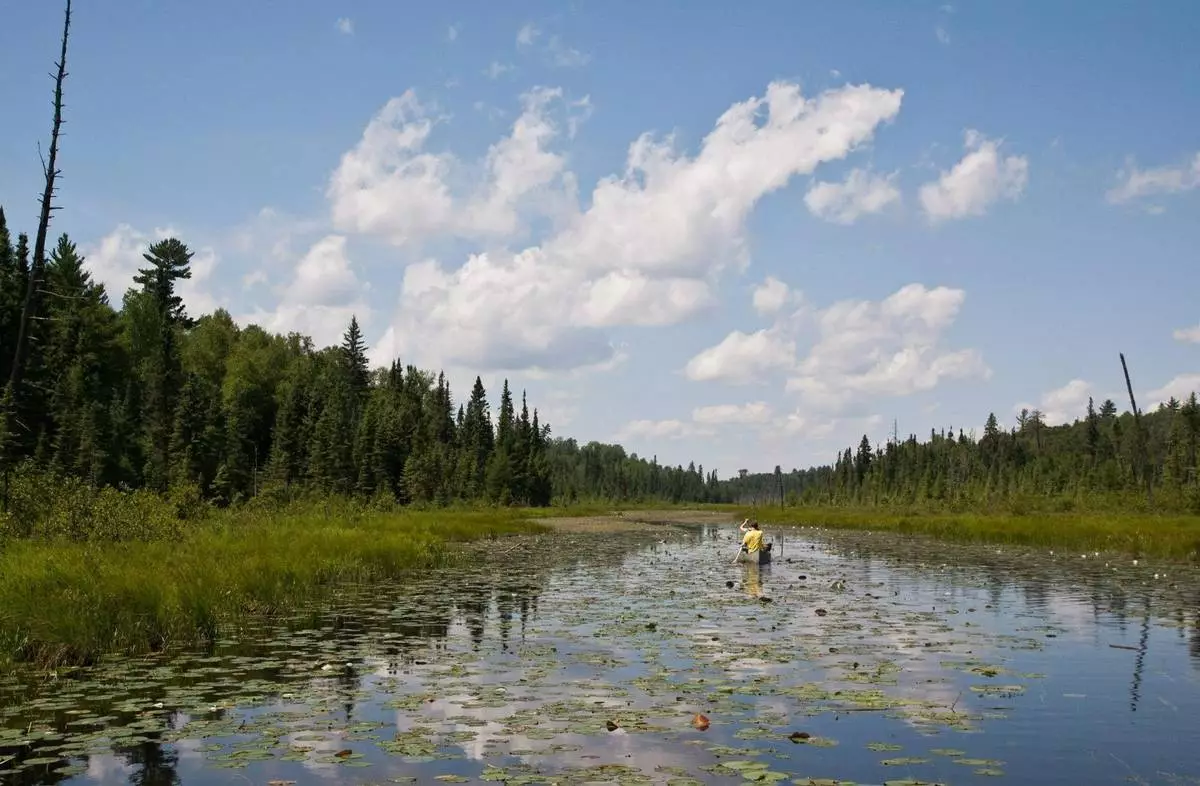
FILE - In this undated photo canoeists navigate the Pocket River in the Boundary Waters Canoe Area Wilderness near Ely, Minn. (Nathaniel Minor/Minnesota Public Radio via AP, File)
GENEVA (AP) — Norway’s soccer federation president on Tuesday accused FIFA of fear tactics for the removal of a senior official who publicly opposed FIFA leader Gianni Infantino’s now-withdrawn World Cup sell-off plan.
Lise Klaveness, who heads the Norwegian Football Federation since 2022, told The Associated Press that the firing of FIFA’s chief operating officer Kevin Lamour was “unacceptable” and urged other senior leaders to resist potentially damaging orders.
Lamour’s exit late Monday came 17 days after his statement to AP criticizing Infantino’s $20 billion private equity project, which was withdrawn just hours later.
“Now he is thrown out and we are supposed to move on. It’s unacceptable, it’s management by fear,” Klaveness told the AP in a telephone interview, describing Lamour as “the best football administrator I have ever met.”
“Now we also have to call upon FIFA leadership and the administration to not submit to orders you know are not in the interests of football,” Klaveness added, especially targeting FIFA secretary general Mattias Grafström.
Klaveness is a former Norway international soccer player, a judge in Oslo and an elected executive committee member at European soccer body UEFA who has built on her country’s long-held reputation as a champion of good governance in soccer. The Norwegian federation's board last week called on Infantino to resign and has backed a London-based NGO's formal complaint to FIFA ethics investigators about his political ties to U.S. President Donald Trump.
Lamour was a long-time colleague of Infantino, first as senior officials at UEFA from 2007-15, on his campaign team to be elected FIFA president in 2016, then moving two years ago from UEFA to oversee much of FIFA’s operations in Zurich.
With a reputation among the most trusted executives in the often murky world of global soccer politics, Lamour’s pointed criticisms of Infantino’s leadership intensified a crisis for the FIFA president.
A backlash by UEFA, the Asian Football Confederation and north American soccer body CONCACAF was provoked by a secretive plan to sell future World Cup profits to investors led by Joshua Kushner.
A $4.2 billion investment to take a 20% stake in a FIFA commercial spin-off was to fund offers of $20 million to each of its 211 national member federations. They already effectively own the non-profit soccer body, which has multibillion dollar reserves, and would have had a mid-September deadline to accept.
Lamour’s statement on July 31 spoke of FIFA staff being “deceived” by Infantino’s lack of openness over the now-failed sale and how they “deserve better than contempt and intimidation.”
The French executive called on soccer leaders worldwide "to make the right decisions” and signed off: “If that means I lose my job, then so be it. I will understand and respect that decision. At least I’ll sleep well tonight.”
“This is a firing situation, it’s not a resignation,” Klaveness said of Lamour’s exit, suggesting it was done by Grafström “obviously being pressured by the president.”
FIFA didn’t respond to a request for comment on Klaveness’ remarks.
In a statement, FIFA said it “thanks Kevin for his two years of service and wishes him the best of luck for the future. No further comment will be made on the matter.”
Lamour did not immediately reply to an email seeking comment Tuesday.
“His statement was necessary to kill the project,” Klaveness said of Lamour’s intervention. “He said something that was obvious, that was very important that someone within the staff told us the story so that we knew it was not FIFA, as such, but one person.”
Infantino called a meeting with senior management minus Lamour in Rabat, Morocco. After that Aug. 5 meeting, a FIFA statement apologized for errors and said those managers who attended “reaffirmed their full support” of Infantino’s presidency.
“We all got reports in Morocco, we know it’s a management of fear,” Klaveness said. “It’s not in football’s best interests.”
Until the uproar over Infantino's “FIFA Forward Enterprise” proposal, he seemed sure to be reelected unopposed next year in Morocco for a fourth and final term in office through 2031. The deadline is Nov. 18 for challengers to enter the contest.
Though UEFA and other critics of Infantino want him ousted from the $6 million-per-year FIFA job, Klaveness said any search for an opponent was not a talking point in Norway.
“We are not there at all and that is 100% the truth," she said, though adding any eventual candidate "has to be very accountable to a governance structure that will not in four or five years just deteriorate.”
Infantino was appointed by UEFA in 2015 to a panel advising FIFA on reforms, in fallout from corruption scandals provoked by U.S. federal investigations. That group's recommendations limiting FIFA presidents to 12 years in office, plus limiting their executive powers and patronage all have retreated under Infantino.
Klaveness acknowledged FIFA members have been less “passionate about the details of governance” than Norway.
Lamour also won praise and support Tuesday by UEFA vice president Laura McAllister, also a former player and now a university professor of governance in Wales, who lamented the “shabby events of the past weeks.”
“Kevin’s sacking seriously weakens FIFA’s administration," McAllister said, "whilst undermining this unique opportunity to shift the culture at FIFA and to reset the organization on sporting values, not simply commercial and financial ones.”
See AP’s full soccer coverage here
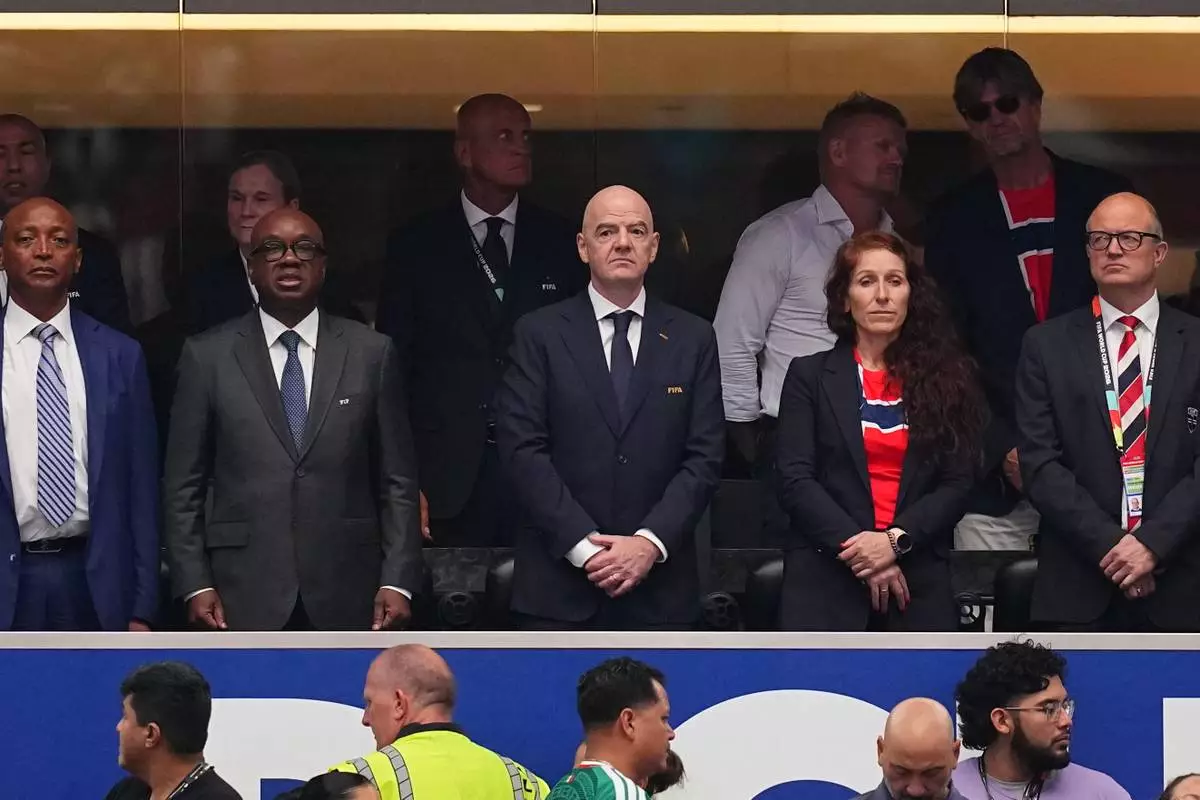
FIFA President Gianni Infantino, front center, and Norway's Football Federation president Lise Klavenessin, front second right, the stands ahead of the World Cup round of 32 soccer match between Ivory Coast and Norway in Arlington, Texas, near Dallas, Tuesday, June 30, 2026. (AP Photo/Julio Cortez)