In the news release, LG Display unveils FLiPP, achieving dream next-generation OLED, issued 18-Aug-2026 by LG Display over PR Newswire, we are advised by the company that changes have been made. The complete, corrected release follows:
LG Display unveils FLiPP, achieving dream next-generation OLED technology
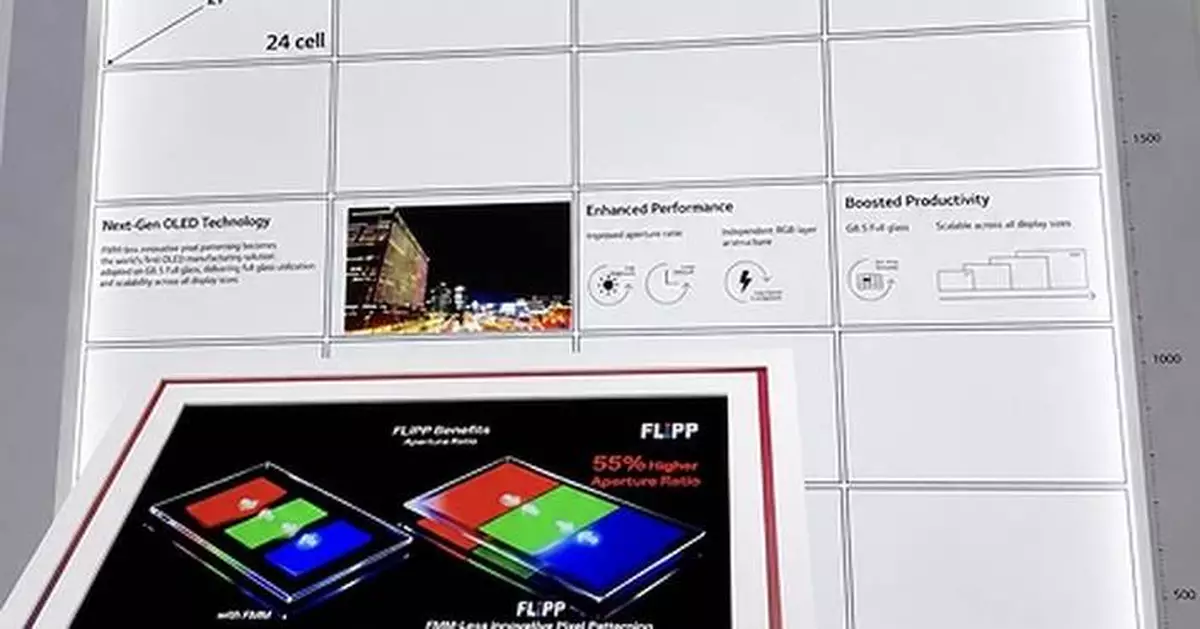
SEOUL, South Korea, Aug. 19, 2026 /PRNewswire/ -- LG Display, the world's leading innovator of display technologies, announced today that it has successfully developed a dream OLED patterning method that is free from the conventional fine metal mask (FMM) process, using its own proprietary technology. Its groundbreaking FMM-less method delivers much greater flexibility in mass production as well as brighter panels with longer lifespan and lower power consumption.
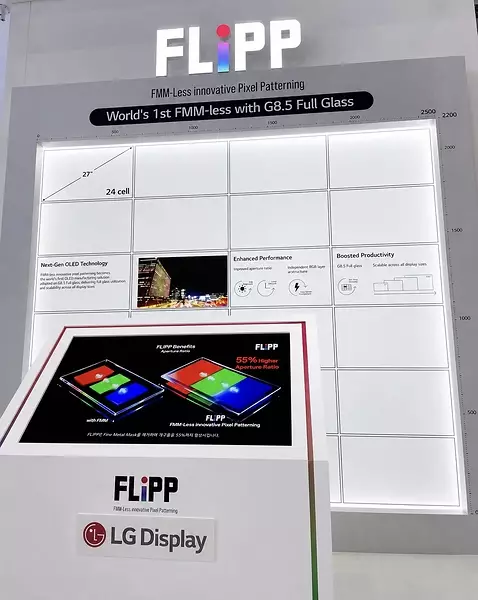
The company will unveil FLiPP (FMM-Less innovative Pixel Patterning) for the first time in the world at the International Meeting on Information Display (IMID) 2026 in Busan, where LG Display will host a dedicated exhibition hall for three days from Aug. 19.
Compared with panels produced using FMMs under identical conditions, FLiPP enables displays to increase brightness by 1.6 times, extend lifespan by 2.4 times, and reduce power consumption by 13%. This is because FLiPP improves the aperture ratio — the proportion of the total display area occupied by RGB pixels — by approximately 55%.
The FMM method adds to manufacturing costs as expensive new FMMs must be produced whenever the panel size or resolution changes. In addition, due to the inherent properties of metal, large masks tend to sag in the center under their own weight, causing misalignment and sometimes resulting in color-mixing defects.
FLiPP eliminates the disadvantages associated with the metal plates used in the FMM process that has been the mainstream OLED manufacturing method for over a decade. The FMM process requires large mother glass substrates, such as 8.6th-generation or other 8th-generation (2,200 × 2,500 mm) substrates, to be divided and processed as half-cut substrates due to the limited size of FMM sticks.
After a year of concentrated R&D, LG Display came up with FLiPP as a new OLED manufacturing paradigm. Unlike the FMM method, which may be compared to a stencil art technique where red, green, and blue (RGB) organic materials are evaporated through tiny holes in metal plates, FLiPP coats RGB pixels in order, secures them in precise positions, and incorporates photolithography — employing precision UV light etching to erase unnecessary areas during OLED pixel patterning.
Leveraging its existing large-sized Tandem WOLED production infrastructure and technical expertise, FLiPP has allowed LG Display to become the first display company to manufacture FMM-less OLEDs using 8.5th-generation mother glass as a single whole piece. Compared to the production of OLED laptop panels of the same size made using FMMs or other FMM-less methods that require divided substrates, FLiPP delivers up to 64% higher mother glass utilization efficiency. As a result, less substrate material is wasted and FLiPP directly translates into higher productivity and lower manufacturing costs.
As the world's only FMM-less manufacturing process for 8.5th-generation OLED panels, LG Display has filed trademark applications for FLiPP in Korea and key global markets.
The company is strengthening its OLED technology leadership by combining RGB OLED, widely regarded as the most advanced OLED technology available today, with FLiPP, its next-generation innovative manufacturing process, to maximize production flexibility and efficiency.
One of FLiPP's greatest advantages is that it is free from panel size and resolution constraints. In theory, it can be used to produce displays ranging from 1 inch to 100 inches and can be applied not only to conventional panels but also to VR and AR displays, making it a virtually universal, "ultimate technology."
Starting with IT applications such as tablets and monitors, it will expand its range of FLiPP-manufactured panels to cover a range of products from 1-inch wearable devices to ultra-large TVs — tailoring products to customer needs.
"We were able to successfully realize FLiPP, a next-generation OLED patterning technology referred to as a 'dream technology,' by bringing together our proprietary WOLED technologies and know-how," said Choi Young-seok, CTO at LG Display. "Through our participation in IMID, we will lead next-generation OLED technologies and accelerate market differentiation."
Meanwhile, LG Display's next-generation OLED TV panel driving technology, Hyper Double Scanning (HDS), has been recognized for its technological excellence by winning the IMID "Display of the Year Award." The award is presented to the most outstanding product among those commercialized each year. LG Display is currently mass-producing its entire lineup of OLED TV panels with HDS and plans to continue leading the global premium TV panel market.
About LG Display
LG Display Co., Ltd. [NYSE: LPL, KRX: 034220] is the world's leading innovator of display technologies, including thin-film transistor liquid crystal and OLED displays. The company manufactures display panels in a broad range of sizes and specifications primarily for use in TVs, notebook computers, desktop monitors, automobiles, and various other applications, including tablets and mobile devices. LG Display currently operates manufacturing facilities in Korea and China, and back-end assembly facilities in Korea, China, and Vietnam. The company has approximately 53,049 employees operating worldwide. For more news and information about LG Display, please visit www.lgdisplay.com.
Media Contact:
Joo Yeon Jennifer Ha, Team Leader, Communication Team
Email: hjy05@lgdisplay.com
** This press release is distributed by PR Newswire through automated distribution system, for which the client assumes full responsibility. **
LG Display unveils FLiPP, achieving dream next-generation OLED
LG's Integrated Antenna and Communications Module Solution Enhances Connectivity, Design Efficiency and SDV Readiness
News Summary
- LG Electronics has begun mass production of its next-generation 5G R16-based smart telematics solution and commenced deliveries to a premium European automaker, marking the solution's first deployment in a production vehicle in Europe.
- By combining a communications module and up to 12 antennas into a single unit, the solution improves connectivity performance while reducing complexity, weight and cost.
- Built on LG's proprietary ATP, developed and refined over more than a decade, the solution enhances software reuse, development efficiency, stability and supply-chain flexibility.
- LG aims to establish the solution as core communications infrastructure for the SDV era, supporting OTA updates, V2X and autonomous-driving data transmission.
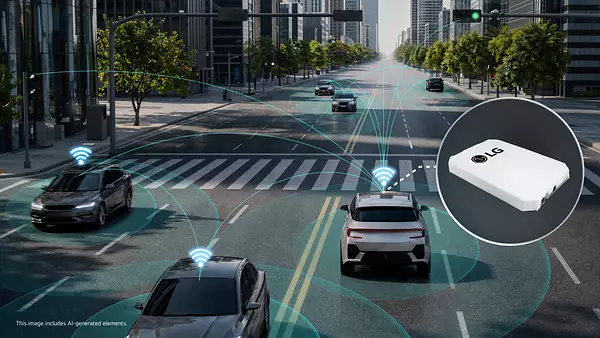
SEOUL, South Korea, Aug. 19, 2026 /PRNewswire/ -- LG Electronics (LG), the global market leader in telematics*, has begun mass production of its next-generation 5G Release 16 (R16)-based smart telematics solution, which integrates a communications module and (up to) 12 antennas into a single unit. LG has already commenced deliveries to a premium European automaker, marking the solution's first deployment in a production vehicle in Europe.
Addressing Growing Complexity in Vehicle Connectivity
Conventional vehicle communication systems typically rely on separate physical components: a telematics control unit and an externally mounted shark-fin antenna. Due to the ongoing expansion of vehicle connectivity capabilities, the number of antennas required to support the necessary communication technologies – including Multi-Frequency Global Navigation Satellite Systems (GNSS), Fifth-generation mobile communications (5G), Wi-Fi and Vehicle-to-everything (V2X)– has steadily risen.
This presents a major challenge for automakers, primarily because of the limited space available for external antennas. In particular, 5G communications need multiple antennas to ensure sufficient performance, but a standard shark fin is restricted in how many antennas it can accommodate. As a result, automakers are often forced to install additional antennas in multiple locations throughout the vehicle, increasing radio frequency (RF) cabling, wiring complexity, vehicle weight, and overall cost.
These structural limitations are especially significant for electric vehicles, where weight directly affects driving range and complex wiring architectures can have a major impact on production efficiency and cost competitiveness.
Advancing Telematics Through Integrated Hardware and Software
LG's smart telematics solution addresses these challenges by integrating the communications module and multiple antennas into a single unit. Built on 5G R16 communications technology, the solution has an optimized internal architecture capable of housing up to 12 antennas. This increased capacity helps reduce reliance on externally mounted antennas and cut down on RF cabling. Critically, the solution enables vehicles to maintain strong connectivity performance, while also contributing to improved structural efficiency.
To extend these benefits across a wide range of vehicle configurations, the solution adopts a modular architecture designed to accommodate diverse OEM requirements. Depending on configuration needs, the telematics and antenna boards can be combined or separated – enabling application versatility not only for new vehicle models, but existing vehicle platforms as well.
The solution also incorporates a scalable software platform designed to support deployment across diverse vehicle models. Built on LG's proprietary Automotive Telematics Platform (ATP), which has been developed and refined over more than a decade, the solution utilizes the same core software across supported applications, requiring only adjustments for chipset-specific interfaces.
This structure increases software reuse, improves development efficiency, and strengthens stability and compatibility across global communications environments. LG's solution has also been designed to support multiple communications chipsets, reducing dependence on any single component and mitigating supply chain risk.
Delivering Reliable Connectivity in Demanding Conditions
LG's smart telematics solution is designed to operate reliably, even in demanding high-temperature vehicle environments. Testing using real vehicles has verified the solution's ability to maintain stable data transmission and reception under extreme conditions, further reinforcing the reliability of in-vehicle communication systems.
Building on Decades of Antenna Integration Expertise
Achieving this level of communications performance and reliability requires more than advanced component specifications alone; it also depends on mechanical design, internal structure and metal placement, all of which can significantly influence thermal dissipation performance. Leveraging its extensive experience in integrated hardware, mechanical and antenna design – accumulated through decades of innovation in the mobile communications sector – LG has secured differentiated competitiveness in automotive communications systems.
Enabling Core Communications Infrastructure for the SDV Era
More than a component-level innovation, LG's smart telematics solution shifts vehicle communications architecture from a distributed antenna structure to an integrated communications platform. LG aims to establish its solution as core infrastructure for the software-defined vehicle (SDV) era, supporting over-the-air (OTA) updates, V2X and autonomous-driving data transmission.
As vehicle connectivity continues to advance, integrated telematics solutions are expected to play an increasingly important role in future vehicle architectures.
"Our smart telematics solution goes beyond hardware integration to redefine the underlying architecture of vehicle communications," said Eun Seok-hyun, president of the LG Vehicle Solution Company. "Leveraging its accumulated expertise in communications technologies and software, LG will continue to deliver integrated telematics solutions optimized for the SDV era."
** Source: TechInsights, based on market share estimates.
About LG Electronics Vehicle Solution Company
The LG Vehicle Solution Company (VS) is bringing LG's unique mobility innovations to the automotive industry. As a trusted and innovative partner, the company provides intelligent solutions including head units, displays, connectivity, ADAS vision systems, and software solutions integrating human-centered AI and automotive engineering into the modern AI/software-defined vehicle. Committed to "Driving better future mobility," the company has diversified its portfolio to further strengthen its capabilities, including automotive lighting systems, e-powertrain and cybersecurity. For more information, visit www.LG.com/global/mobility. To stay updated with the latest news, subscribe to the LG mobility newsletter, LG Loop at www.LG.com/global/mobility/newsletter and follow the LG VS Company LinkedIn channel at www.linkedin.com/company/lgvehiclesolution.
** This press release is distributed by PR Newswire through automated distribution system, for which the client assumes full responsibility. **
LG ELECTRONICS BEGINS MASS PRODUCTION OF 5G SMART TELEMATICS SOLUTION FOR A PREMIUM EUROPEAN AUTOMAKER