Robots designed for high-risk environment tasks are among the highlights at the ongoing 2026 World Robot Conference, with a number of them hopefully able to replace human workers in dangerous scenarios.
The 2026 World Robot Conference opened in Beijing E-Town on Wednesday, bringing more than 3,000 exhibits, with one tenth of them premiered. Running for five days, the event has drawn over 300 exhibitors, up 69 percent from last year, and more than 60 activities are on agenda.
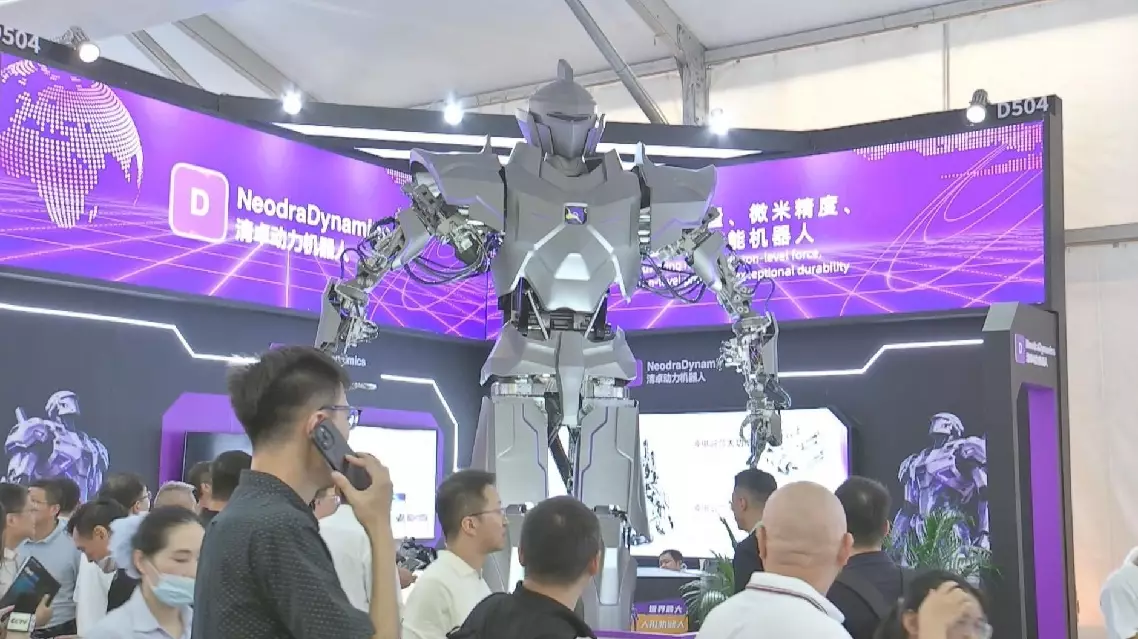
One standout draw across the exhibition hall is a towering humanoid robot that has captured widespread attention. Standing roughly 4 meters tall, it exudes a sense of raw power uncommon in standard humanoid models as its dexterous hands extend and maneuver with precision.
Making its global public debut, the hydraulic-electric hybrid super humanoid robot integrates digital hydraulic technology with electric motors, overcoming force limitations that stretch from kilogram to kiloton scales.
The "giant" is built for demanding, heavy-duty scenarios such as nuclear power operation and maintenance, deep-sea operations, and heavy logistics handling.
"For scenarios like deep-sea exploiting and nuclear-related environments, our dexterous robotic arms and high-load capacity robots can take the place of human workers," said Yang Tao, an exhibitor representing the development team.
Beyond the towering humanoid, agile robot dogs are also stepping up to take on hazardous tasks.
In dangerous mining environments, a robot dog functions as an intelligent safety officer. Equipped with LiDAR, infrared cameras, gas sensors, and other devices, it can enter high-risk voids and tunnels that deny human accesses, collecting multi-dimensional environmental data to support mine safety decisions.
"In mined-out areas that may trigger ground subsidence, the robot dog can go in, take photos, and transmit 3D data to model the entire cavity. At the same time, as it moves through areas with no network coverage, it automatically deploys communication relay nodes to maintain connectivity," said Zhang Yong, the developer of the robot dog.
Conference displays robots' high-risk task capabilities