BALARUC, France--(BUSINESS WIRE)--Aug 20, 2026--
For the first time, major U.S. federal agencies are beginning to structure procurement around a new category of intermediate-force equipment, giving officers an additional option between verbal presence and higher levels of force. NETFORCE believes companies establishing themselves at this early stage will benefit from a significant first-mover advantage as this category expands nationwide. This is precisely the market NETFORCE anticipated years ago, having invested heavily in research, industrialization and international intellectual property well before the category attracted attention.
This press release features multimedia. View the full release here: https://www.businesswire.com/news/home/20260820951658/en/
NETFORCE enters the U.S. market backed by two granted and active U.S. patents — US 11,236,973 B2 (granted 2022, protected through 2038) and US 12,222,193 B2 (granted 2025, protected through 2041). Together with the E-StunGlove® trademark, these assets form part of an international IP portfolio spanning 107 countries, securing NETFORCE's technological leadership across the world's leading security markets.
Unlike conventional conducted-energy devices designed primarily for physical intervention, the GIE – E-StunGlove® was built around a three-step doctrine — Engage, Deter, Act — to prevent escalation before intervention becomes necessary. The officer first engages verbally, maintaining natural hand movement; before any physical contact, the glove then deters by generating a visible electric arc and audible warning, creating an opportunity to de-escalate; only when intervention is unavoidable does the officer act, with the electrical pulse becoming part of a graduated, proportionate response. The platform also offers cut-resistant protection, operation through multiple layers of clothing, and scalable connected features such as body-camera activation and automated incident reporting.
NETFORCE has already signed commercial commitments covering more than 50 countries, with deployments to the corrections administrations of Morocco and Senegal, and authorization in Switzerland under a framework comparable to that applied to conducted-energy devices.
NETFORCE's ambition extends beyond exporting a French innovation: the Company is seeking U.S. industrial and strategic partners to support its North American development and, ultimately, establish domestic manufacturing. Beyond institutional markets, it also sees long-term potential in the U.S. civilian personal-protection sector, subject to applicable regulations.
“What is happening in the United States is a very powerful signal,” said Laurent Mollinari, Founder & CEO of NETFORCE. “We anticipated this evolution years ago. Today, we hold two granted and active U.S. patents, a fully industrialized technology developed in France, and commercial commitments covering more than 50 countries. Our American ambition now goes further than exporting a product — we want to build long-term partnerships with leading U.S. players to industrialize our technology here, while staying deeply rooted in France.”
About NETFORCE
NETFORCE is a French technology company specializing in next-generation intermediate-force solutions. It developed the GIE – E-StunGlove®, a patented conducted-energy glove entirely designed, developed and industrialized in France. Its IP strategy extends across 107 countries, including the United States, positioning NETFORCE among the pioneers of this emerging category.
Investors & Strategic Partnerships
As NETFORCE accelerates its international expansion, the Company has initiated a capital increase reserved for a limited number of investors to finance its industrial and commercial growth. NETFORCE welcomes discussions with leading U.S. industrial companies, technology innovators, institutional partners and qualified investors sharing its ambition for the next generation of intermediate-force solutions.

COPYRIGHT NETFORCE
KYIV, Ukraine (AP) — The intensifying use of drones against civilians and humanitarian workers is a dangerous obstacle for aid operations in Ukraine, the U.N.'s humanitarian chief, Tom Fletcher, said on Wednesday.
Fletcher spoke to The Associated Press in an interview after a visit to the southern city of Kherson, where he witnessed how communities there are coping while living under the constant threat of Russian drones. Fletcher described the visit to Kherson, split by the Dnipro River, which acts as an active front line, as “quite chilling."
Russian forces occupy the eastern bank, while Ukrainian forces hold the western bank. From across the water, surveillance and exploding drones routinely hunt and attack civilians, vehicles and public transit.
“It really gives us an insight into the dangers ahead of us,” he said.
The threat is also making it harder for humanitarian organizations to reach people who need assistance.
Fletcher spoke after attending a commemoration for two humanitarian workers who had died while doing their jobs.
“Drones are a real threat to not just civilians but the humanitarians who are here to protect them,” Fletcher said.
He said that aid workers are protected under international humanitarian law and yet marked humanitarian vehicles have still been hit. “So that does restrict what we can do," he said.
Local organizations are particularly exposed. More than two-thirds of operations funded through Ukraine's humanitarian fund are carried out by local organizations, according to Fletcher.
“They’re the ones who are saying most loudly to us, we’re not protected,” he said.
Fletcher said the U.N. needs more than $2 billion for its prioritized humanitarian response in Ukraine this year, with winter among his biggest concerns. Damage to civilian infrastructure, including electricity, water and gas systems, could once again leave millions vulnerable during the harsh winter months, raising fears of a repeat of last winter’s severe conditions.
The U.N. has sharply narrowed its humanitarian priorities all over the world as donor funding has fallen. Fletcher said the organization initially identified 87 million people facing the most severe humanitarian needs, but that figure has since risen to about 92 million with the onslaught of Ebola in Africa, the earthquake in Venezuela and other conflicts.
The U.N. is seeking $23 billion to provide life-saving assistance to those people and had raised about $11 billion, said Fletcher.
Ukraine is relatively well funded compared with many other crises, he added, with roughly 70%–75% of its hyper-prioritized funding requirement covered. But even full funding of the humanitarian plan would address only part of Ukraine’s needs.
Fletcher also admitted that raising money for humanitarian operations has become more difficult as governments have increasingly redirected spending toward defense and domestic priorities.
“We’re in a more transactional world, I would say a more selfish world,” he said.
Fletcher said the U.N. now has to demonstrate that it is using limited taxpayer money efficiently and strategically.
“We have to show governments that we are spending their taxpayers’ money sensibly, wisely, in a prioritized way,” he said.
In a stark new assessment released on Wednesday, the U.N. warned that 907 aid workers were victims of violence last year and over 1,000 have been killed in three years. Fletcher said he could not reassure colleagues that those responsible would be held accountable based on how the international community has reacted.
He said accountability should extend beyond identifying the person who physically carried out an attack.
“I want to see investigations into the people who fired the weapon or flew the drone,” he said.
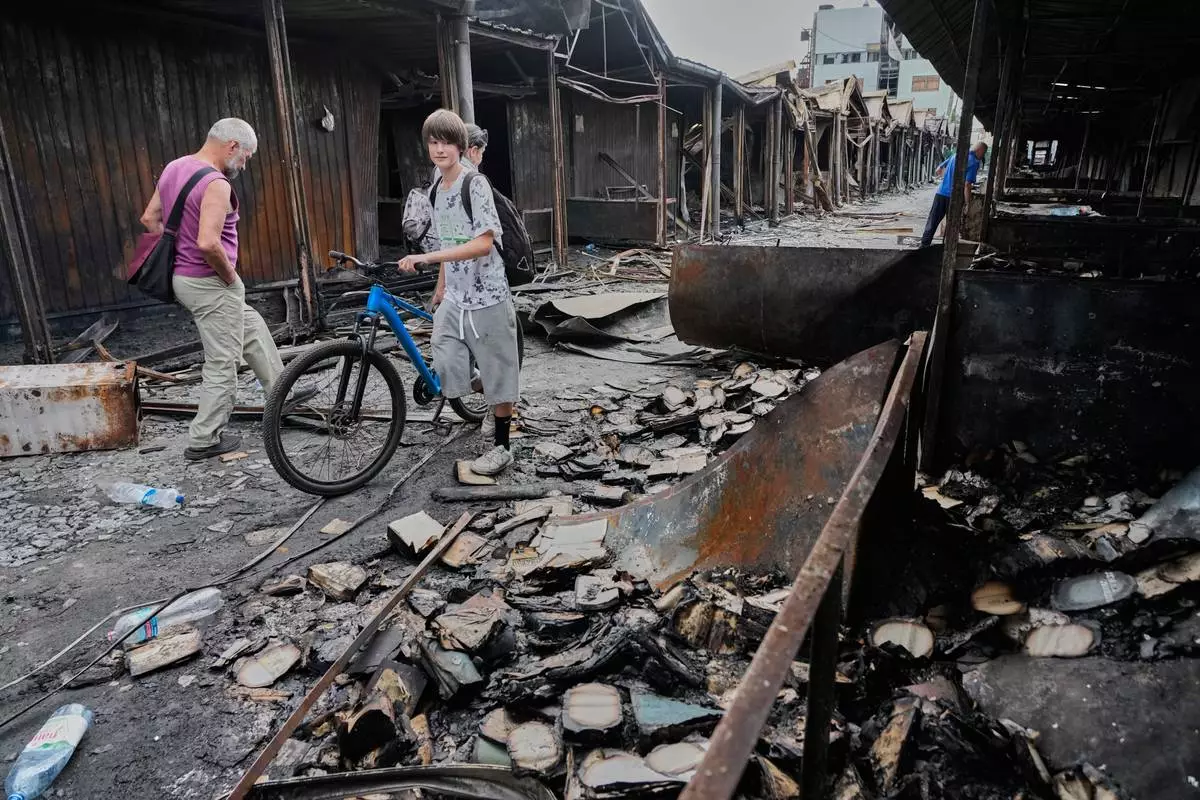
People search for survived books after the fire on the site of the country's biggest book market, cased by Russia's recent missile attack in Kyiv, Ukraine, Wednesday, Aug.19, 2026. (AP Photo/Efrem Lukatsky)

Burned books are seen after the fire on the site of the country's biggest book market, cased by Russia's recent missile attack in Kyiv, Ukraine, Wednesday, Aug.19, 2026. (AP Photo/Efrem Lukatsky)
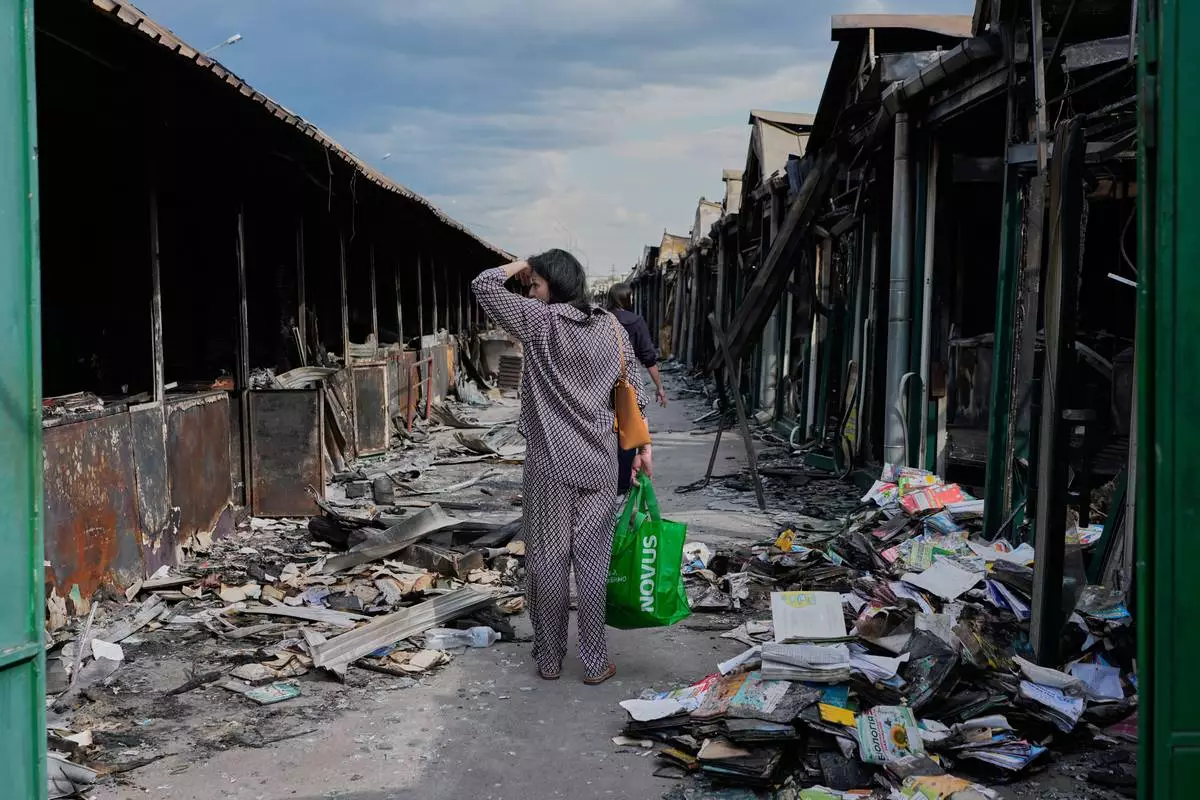
A woman reacts as she looks at charred books after a fire at the country's biggest book market, caused by a recent Russian missile attack, in Kyiv, Ukraine, Wednesday, Aug. 19, 2026. (AP Photo/Efrem Lukatsky)
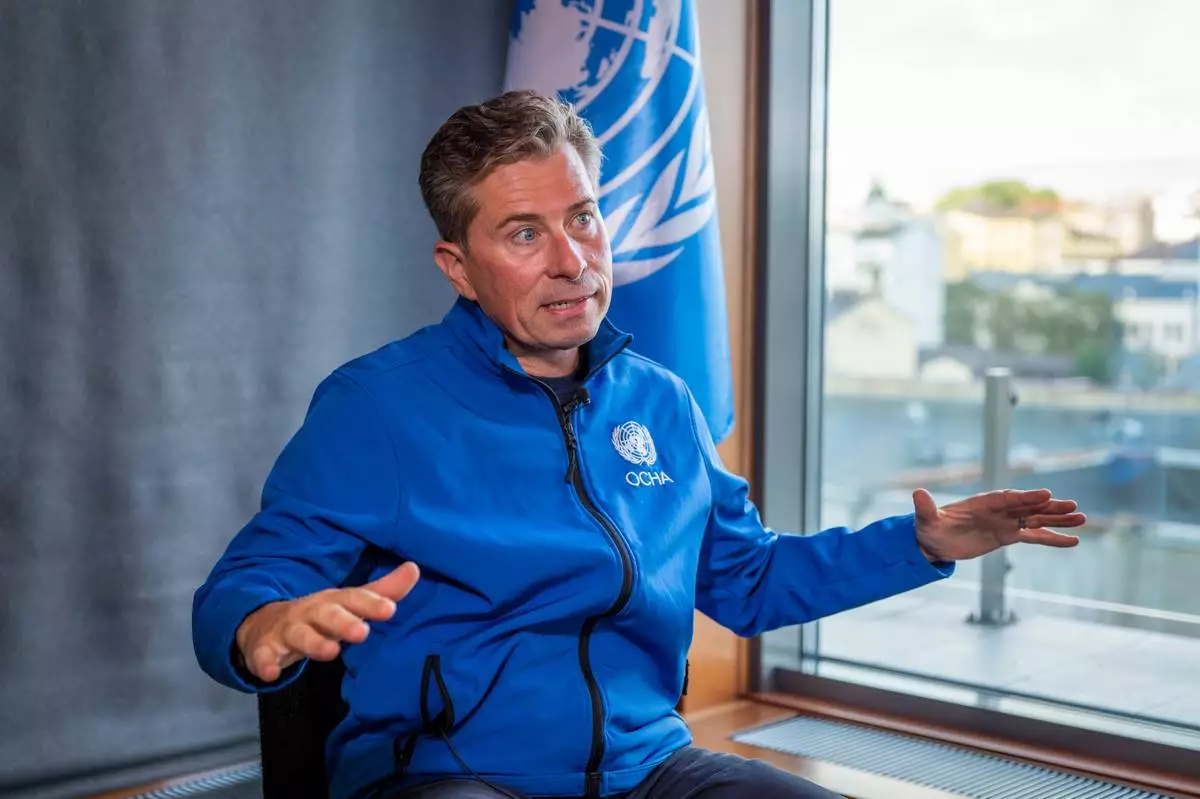
Tom Fletcher, United Nations Under-Secretary-General for Humanitarian Affairs and Emergency Relief Coordinator, speaks during an interview in Kyiv, Ukraine, Wednesday, Aug. 19, 2026. (AP Photo/Dan Bashakov)
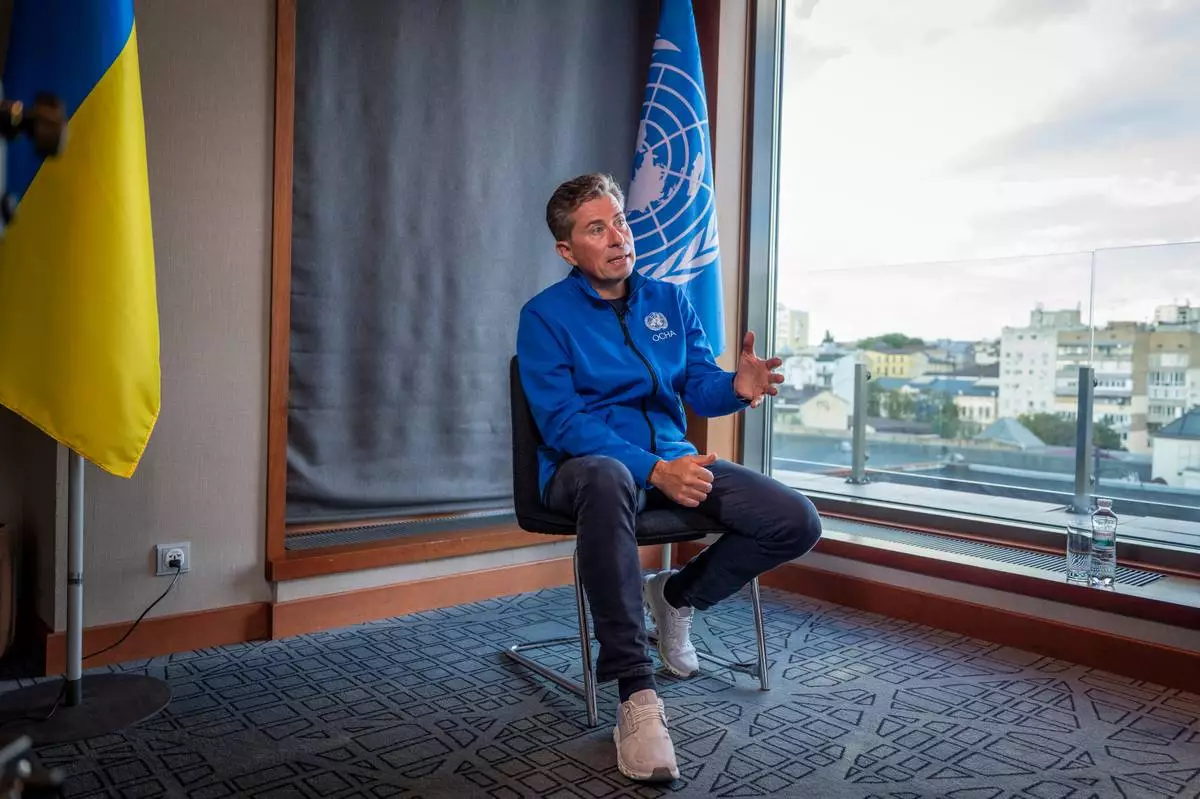
Tom Fletcher, United Nations Under-Secretary-General for Humanitarian Affairs and Emergency Relief Coordinator, speaks during an interview in Kyiv, Ukraine, Wednesday, Aug. 19, 2026. (AP Photo/Dan Bashakov)