A portable, high-fidelity robot-free data-production system for robot manipulation learning. Across three policy backbones evaluated in the report, policies post-trained solely on HiFi-UMI data reached success rates comparable to policies post-trained on in-domain real-robot teleoperation data.
NEW YORK, Aug. 20, 2026 /PRNewswire/ -- Simple AI has published the Tech Report for HiFi-UMI, a high-fidelity robot-free data-production system for robot manipulation learning, together with HiFi-UMI-2K, a 2,000-hour open dataset released under the Creative Commons Attribution 4.0 license. The Tech Report is available on arXiv and the dataset on Hugging Face.
Progress in robot manipulation learning is increasingly constrained by data. Real-robot teleoperation yields accurate, directly trainable trajectories but is difficult to scale: every hour of data requires the target robot, a teleoperation rig, and a skilled operator. Robot-free handheld demonstrations are cheaper and easier to scale, but have primarily been used for pre-training. Task-specific post-training, the stage that grounds a policy for real-robot deployment, has typically continued to rely on a smaller amount of real-robot teleoperation data as an anchor.
The report examines whether raising the fidelity of robot-free demonstration data, rather than shrinking the real-robot fraction, can remove that anchor for target-task post-training.
HiFi-UMI is a portable data-production system co-designed for four fidelity properties. Pose accuracy comes from head-mounted offline stereo-inertial SLAM, which the report measures at 3mm workspace-local end-effector accuracy. Cross-sensor timing is aligned to below 40 microseconds through a shared hardware trigger across all cameras and sensors. Inter-gripper relative pose is measured natively rather than reconstructed. Per-hand sensing covers approximately 200 degrees of field of view through two non-parallel wide-angle fisheye cameras. Every captured demonstration passes through automatic trajectory reconstruction and simulation replay validation, each gate with an approximately 98% pass rate.
The report evaluates the approach across three policy backbones spanning the vision-language-action and world-action-model families, and four bimanual tabletop tasks. Policies post-trained solely on HiFi-UMI demonstrations reached success rates comparable to policies post-trained on in-domain real-robot teleoperation data, with reported differences of −2.5, +3.1, and −0.6 percentage points across the three backbones. On a precision insertion task, the strongest HiFi-UMI-only policy reached 85% success under conditions where the teleoperation baseline had the advantage of being collected in the evaluation scene. Separately, pre-training on 4,000 hours of the same corpus reduced offline action prediction error on ten unseen tasks by 41%, and increased real-robot success on one of the evaluated backbones by 18.1 percentage points at matched post-training data.
"We wanted to test whether fidelity, rather than scale alone, is what unlocks robot-free data for deployment-oriented training," said Xiaofei Li, founder of Simple AI. "The report shows what this can look like within a specific set of tasks and models. By open-sourcing HiFi-UMI-2K, we hope to give the wider research community a shared, high-fidelity resource for continuing to study this question."
The report characterizes these findings as approximate aggregate parity within the tested models, tasks, and experimental conditions. The deployment robot uses the same gripper and wrist-camera configuration as the capture setup, with the main embodiment difference being robot arm kinematics. The comparison is not sample-matched, with 3,200 HiFi-UMI trajectories per task set against approximately 300 teleoperation trajectories, and reflects a comparison between practical data-production pipelines rather than a claim of per-trajectory equivalence. The report does not generalize the result to all robot learning settings, and does not conclude that real-robot data is no longer required in the broader field.
HiFi-UMI-2K is distributed in a training-ready format with synchronized multi-view video, bimanual end-effector trajectories, gripper states, language annotations, and subtask boundaries. Human faces in the recordings are masked before release. The paper reached No. 1 on Hugging Face Daily Papers on July 29.
HiFi-UMI is one component of Simple AI's work across foundation models, high-fidelity data, robotic systems, and real-world deployment. The company welcomes conversations with research groups and industry partners interested in high-fidelity data for robot learning.
About Simple AI
Simple AI is an embodied AI company developing general-purpose embodied intelligence systems for human living spaces. Its work integrates foundation models, high-fidelity data, robotic systems, and real-world deployment across the full embodied AI stack.
Resources
Tech Report: arxiv.org/abs/2607.25895
Dataset: huggingface.co/datasets/simple-world-lab/HiFi-UMI-2K
Project page: cloud.simpleai.tech/simple-world-lab/hifi-umi/
Media Contact
Grant Xin
Simple AI
media@simpleai.tech
** This press release is distributed by PR Newswire through automated distribution system, for which the client assumes full responsibility. **

Simple AI Introduces HiFi-UMI, a High-Fidelity Robot-Free Data-Production System for Robot Manipulation Learning, with a 2,000-Hour Open Dataset
Local cuisine emerges as the region's strongest dining force, as traditional restaurant settings give way to fluid, social spaces
SINGAPORE, Oct. 6, 2026 /PRNewswire/ -- Marriott International has unveiled Future of Food 2027, its latest report exploring food and beverage trends across Asia Pacific excluding China. Drawing on conversations with leading chefs, hospitality experts and regional influencers, alongside insights from Marriott International properties across the region, the report reveals a pivotal transformation: the rise of place. As dining breaks free from traditional restaurant boundaries into fluid, social formats, diners increasingly seek experiences that are hyper-local, authentic and deeply connected to their destination.
Across Asia Pacific excluding China, diners are increasingly seeking authenticity and connection. Demand for authentic local signature dishes is surging, with 95% of surveyed properties identifying this as the biggest trend in their market. At the same time, dining is no longer confined to the traditional restaurant setting. Guests are gathering across bars, lounges, counters and flexible spaces, turning hotels into social and cultural hubs where guests move fluidly throughout the day. The result is a new era of dining where the story behind what people eat and where they eat matters more than ever.
"Across Asia Pacific, we're witnessing a shift toward intimate, locally-rooted experiences, where smaller, intentional spaces replace traditional formal dining models," said Petr Raba, Vice President of Food & Beverage, Marriott International, Asia Pacific excluding China. "Hotels are becoming cultural storytellers, embedding regional talent, locally sourced ingredients and authentic connection into every aspect of the dining experience to create spaces that feel distinctly of their place."
Key Trends Shaping the Future of Food
- The Spatial Shift
Dining is moving beyond the traditional restaurant model as guests increasingly lean toward more flexible, social and experience-led spaces. Across Asia Pacific excluding China, nearly half of the surveyed properties report a growing demand for casual venues such as lounges, bars and outdoor settings, while emerging concepts are embracing intimate 40 to 60-seat footprints with distinct identities. In Vietnam, 71% of surveyed properties report growth in bar and lounge dining, reflecting the growing appeal of more fluid dining experiences. An invisible layer of technology is supporting this shift, with AI enhancing everything from menu development and marketing to staffing and guest insights, allowing teams to focus on delivering more personalized hospitality. 100% of restaurants and bars surveyed in Thailand are already using AI in their operations. - The Local Advantage
Local cuisine has become the defining force shaping dining decisions across the region. Demand for authentic local signature dishes is now the strongest trend identified by 95% of the surveyed properties and outweighing value for money when guests choose where to dine. Hotels are responding by building menus around ingredients and stories rooted in their destinations. At Hearth at The Ritz-Carlton, Perth, for example, a signature dish featuring local Wagin duck showcases Western Australia's produce while reflecting the restaurant's seasonal, locally driven philosophy. Over the past year, four in five properties have introduced new local ingredients from Kyoto vegetables in Japan to Kampot sea salt in Cambodia-inspired menus and indigenous spices across Southeast Asia, while nearly three-quarters report local ingredients appearing more frequently in beverage menus. This trend is particularly pronounced in India and Indonesia, where demand for local signature cuisine reaches 71% and 67% respectively, highlighting a growing desire for dining experiences that tell the story of a destination. - 99-Minute Fine Dining
Fine dining is undergoing a temporal revolution with up to five memorable courses delivered in under two hours, replacing four-hour tasting menus with ten-plus courses. Across the region, 58% of properties report that the average fine dining experiences last between 1.5 and 2 hours. Singapore has emerged as one of the region's fastest-paced fine dining markets with 85% of restaurants reporting an average time of 1.5 hours. Restaurants are adapting by simplifying menus, introducing more a la carte options and focusing on standout moments over the number of courses. In South Korea, one in five establishments have already reduced the number of courses served, while 30% of fine-dining restaurants in the Philippines have introduced a la carte menus. Australia sees both fewer courses and shorter service times, with the conversation shifting toward "wow moments" rather than course quantity.
Additional Report Highlights:
- Eat Well, Eating Your Age: Wellness has become a core dining consideration, with ingredients rooted in Asia Pacific's rich food traditions finding renewed relevance among modern travelers. Today, 97% of surveyed Marriott International properties in Asia Pacific excluding China serve dishes associated with health and longevity, while wellness increasingly extends beyond the plate to healthier mini-bars and wellness-focused turndown experiences.
- The Modern Menu: Across Asia Pacific, menus are becoming more expressive and multi-sensory, with texture rising alongside flavor as a defining element of the dining experience. At the same time, plant-forward dining is accelerating, prompting Marriott International to introduce its APEC Plant-Forward Program across the region in 2027, making it one of the first major global hotel groups to integrate plant-forward dining into its operational foundation permanently.
- Alcohol Alternatives: The low- and no-alcohol movement has evolved from niche trend to hospitality mainstay, with 42% of Marriott International restaurants and bars surveyed in Asia Pacific excluding China reporting increased sales of non-alcoholic beverages. From premium spirits to alcohol-free pairings, guests are increasingly seeking sophisticated alternatives without compromise.
Looking Ahead
Asia Pacific's F&B landscape is fundamentally shifting toward authenticity and intentionality. Hotels and restaurants thriving in 2027 are those that understand their place deeply - its ingredients, culture, people and design experiences around that foundation. They are creating smaller, more distinctive spaces where technology elevates genuine hospitality, while telling stories that connect guests emotionally to destination and cuisine. The result is a regional dining scene that feels less like a global template adaptation and more like a collection of distinctive, culturally rooted experiences.
About Marriott International
Marriott International, Inc. (Nasdaq: MAR) is based in Bethesda, Maryland, USA, and encompasses a portfolio of compelling brands across luxury, premium, select, midscale, extended stay, and all-inclusive, with over 10,000 properties in 148 countries and territories, as of June 30, 2026. Marriott franchises, operates, and licenses hotel, residential, timeshare, yacht, outdoor, and other lodging products all around the world. The company offers Marriott Bonvoy®, its highly awarded travel platform. For more information, please visit our website at www.marriott.com, and for the latest company news, visit www.marriottnewscenter.com. In addition, connect with us on Facebook and @MarriottIntl on X and Instagram.
Download the full Future of Food 2027 reporthere to explore the complete trends shaping Asia Pacific's culinary future.
Access high-resolution images and media assets here.
** This press release is distributed by PR Newswire through automated distribution system, for which the client assumes full responsibility. **
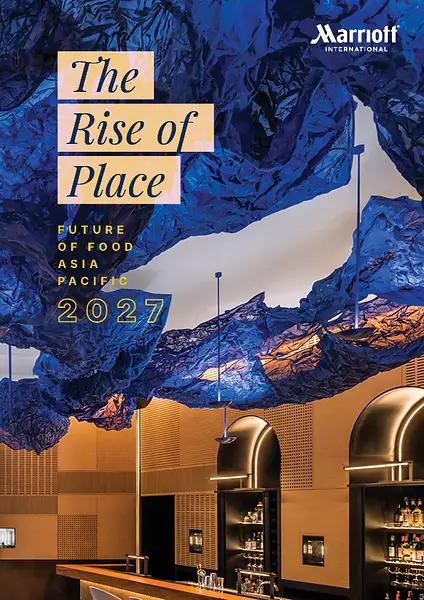
THE RISE OF PLACE: MARRIOTT INTERNATIONAL REVEALS ASIA PACIFIC'S FUTURE OF FOOD