China's futures market has accomplished its first-ever cross-border delivery on Friday, marking a major milestone in the opening-up of the country's derivatives-trading sector.
The landmark transaction was completed for the technically specified rubber (TSR) 20 futures on the Shanghai International Energy Exchange (INE), a subsidiary of the Shanghai Futures Exchange (SHFE).
The first batch of 600 tons of standard warehouse receipts for TSR 20 was generated by an overseas delivery warehouse and sold via delivery, with a transaction value of roughly 8.77 million yuan (about 1.30 million U.S. dollars).
Physical hand-over of the offshore goods is scheduled to take place at Laem Chabang Port in Thailand.
Under the cross-border delivery framework, trades are executed onshore in China, while physical commodities change hands overseas. Industry participants across the supply chain may take delivery and collect goods locally at producing regions. Compared with the previous model, which required cargo to be shipped to bonded warehouses within China for settlement, the new mechanism cuts logistics and transportation costs and greatly improves accessibility to futures delivery services.
The reform is also expected to encourage global market players to adopt China's futures pricing in international trade, bolstering the global recognition and influence of "China prices".
INE rolled out the cross-border delivery service for TSR 20 in July. Thai Hua Rubber has been approved as its first overseas TSR 20 delivery warehouse.

China completes first TSR20 futures cross-border delivery in Thailand
Chinese Foreign Minister Wang Yi on Friday called on China and Indonesia to strengthen all-round cooperation and pool greater development synergy to jointly tackle risks and challenges.
Wang, also a member of the Political Bureau of the Communist Party of China Central Committee, made the remarks while co-chairing the first Conference of China-Indonesia Comprehensive Strategic Dialogue Mechanism with Indonesian Foreign Minister Sugiono in Jakarta.
Noting that the current international situation is marked by growing turbulence and uncertainty, with unilateralism and hegemonic practices seriously impacting global security and development, Wang said it is timely for China and Indonesia, as major developing countries, to strengthen strategic communication and deepen strategic cooperation, which carries important and far-reaching significance beyond bilateral relations.
Wang said China has always placed Indonesia in an important position in its diplomacy, particularly its neighborhood diplomacy, and is ready to work with Indonesia to enhance mutual understanding and support.
Stressing that the conference marks an important milestone in bilateral relations, Sugiono said China's development has brought enormous opportunities to the world, particularly neighboring countries such as Indonesia.
He said Indonesia and China share closely intertwined interests and stressed the importance of strengthening coordination with China for mutual benefit as Indonesia advances its development strategies.
Sugiono added that Indonesia firmly adheres to the one-China policy and supports China's cause of reunification.
The two sides also agreed to uphold strategic autonomy and firmly support each other's core interests. They also decided to launch the formulation of the China-Indonesia Five-year Action Plan (2027-2031).
Both sides agreed that deepening cooperation in energy and mineral resources serves their common interests, and expressed readiness to jointly build a comprehensive, open and green partnership in energy and mineral resources.
Indonesia spoke highly of the contributions made by Chinese companies to local development, noting that the success of Chinese companies is also a success for Indonesia. It expressed readiness to provide Chinese companies with a fair, transparent and friendly business environment.
The two sides also pledged to expand cooperation in areas such as artificial intelligence and poverty reduction. They agreed to restart cooperation in fishing, accelerate maritime cooperation and push forward joint development.
They agreed to fully and effectively implement the Declaration on the Conduct of Parties in the South China Sea and work toward the early conclusion of the Code of Conduct in the South China Sea.
Both sides agreed to hold the second meeting of the dialogue mechanism in China next year.
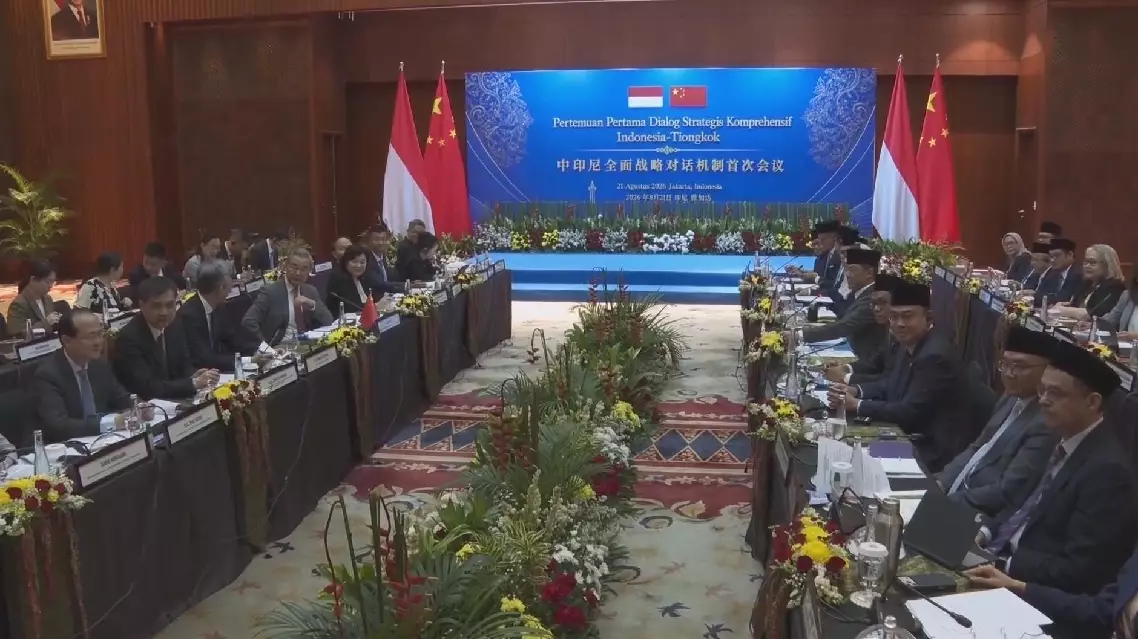
Chinese FM calls for stronger all-round cooperation with Indonesia to tackle risks, challenges