Skip to Content Facebook Feature Image

Pentagon dismisses Stars and Stripes leadership after editor, reporter oppose military interference

ENT

Pentagon dismisses Stars and Stripes leadership after editor, reporter oppose military interference
ENT

ENT

Pentagon dismisses Stars and Stripes leadership after editor, reporter oppose military interference

2026-08-22 07:21 Last Updated At:07:30

The Pentagon on Friday fired the editor-in-chief of Stars and Stripes and a top reporter for insubordination after they spoke publicly against any interference by the Defense Department in the military news outlet that has a long history of editorial independence. It was the latest move by an administration that has grown increasingly aggressive toward the news media.

The newspaper’s publisher, who announced his impending retirement days ago, was also dismissed.

Erik Slavin, editor-in-chief of the military newspaper that is partly funded by the Pentagon, told The Associated Press he was dismissed for insubordination after an interview he gave that objected to potential censorship by the U.S. military. He received a notice of separation, as did publisher Max Lederer — who had just announced his upcoming retirement — and Middle East reporter Lara Korte, Slavin said.

The moves come at a time when the Trump administration, in its second term, has been progressively combative toward the media — including sharply curtailing Pentagon access for the press corps that covers the Defense Department. Trump or other parts of the executive branch have also, in policy and in the courts, grappled with The Wall Street Journal,The Associated Press and The New York Times — in addition to using the FCC to target broadcast networks.

Slavin said he was being fired “for stating in a CBS interview that hypothetical censorship of news for service members would constitute a red line.” Korte participated in the same interview.

“I stand by the principle that Stars and Stripes must remain editorially independent, as required by law and by the department’s own policies,” Slavin said.

National Press Club President Mark Schoeff Jr. called the firing of Slavin “another brazen attempt by the Pentagon to dictate coverage of the military” and said it should be immediately reversed.

“Firing a newspaper editor after he publicly defended his newsroom’s editorial independence is deeply troubling, and it should concern every journalist and every member of the U.S. military who depends on independent reporting,” Schoeff said.

Neither Lederer nor Korte immediately responded to emailed requests for comment. Korte said on X: “Today, I was informed that the Department of Defense is firing me for insubordination after I told a CBS reporter that I work for Stars and Stripes — not the Pentagon, not the administration, and not any policy maker.”

Earlier this week, longtime publisher Lederer announced his retirement effective at the end of September. He made his announcement a few weeks after the Pentagon installed a new deputy publisher, an active duty service member, under him at the newspaper without his prior knowledge. Three Democratic senators on Thursday wrote to Defense Secretary Pete Hegseth, asking why the new deputy — Navy Capt. William Urban — had been installed.

The retirement of Lederer, who had been at Stars and Stripes for three decades and publisher since 2007, comes as Hegseth’s Pentagon has moved to exert editorial control and eliminate what it asserts are “woke distractions.”

“Stars and Stripes will be custom tailored to our warfighters,” Sean Parnell, Hegseth's spokesman, wrote in January on X. “It will focus on warfighting, weapons systems, fitness, lethality, survivability and ALL THINGS MILITARY. No more repurposed DC gossip columns; no more Associated Press reprints.”

In April, the Pentagon fired Jacqueline Smith, ombudsman for the newspaper, whose job had been to safeguard editorial independence.

Lederer, the second full-time civilian in the position, wrote in a staff memo this week that it had “become clear that my philosophy of leadership, and my understanding of the value and mission of Stars and Stripes, differ in fundamental ways from the direction the leadership of the Department of Defense has for the organization.”

In a letter posted on Stars and Stripes, Urban wrote of his plans and said: “I understand that I am now part of a team, committed to editorially independent journalism that best serves our most important customer, which is our service members, their families, and our greater military community.”

“I am a media junkie who has served as a communication professional engaged in being a spokesman for some of the hardest Public Affairs assignments in the Navy and Department of War for more than 20 years,” he wrote.

It was unclear whether Urban, currently titled “military deputy to the publisher,” would now become head publisher. “I can’t comment on what my role will be in the future,” he told the AP.

In a telephone interview, Urban said Stars and Stripes has “a strong team of professional journalists that are focused on the mission of providing our military service members and their families the best possible product. That mission is going to continue. All of us in leadership will continue to advocate for … the best possible journalism going forward.”

He said he had no formal journalism experience but cited his years in public affairs and communications. He said he would be focused on expanding digital journalism at the paper, because the service members to which it caters are often young and are “digital natives.”

“I think we need to get better on the digital side,” he said, “to make sure that we are reaching as many service members as we possibly can and having the impact that we should be having.”

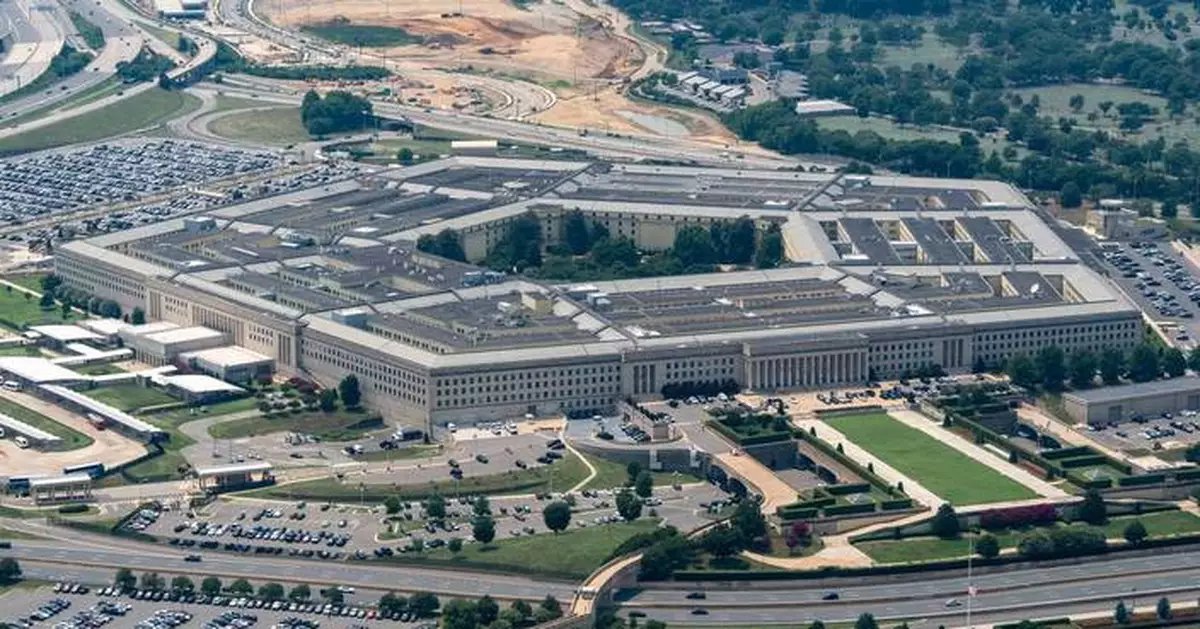
FILE - The Pentagon is seen from the air, July 15, 2026, in Washington. (AP Photo/Alex Brandon, File)

FILE - The Pentagon is seen from the air, July 15, 2026, in Washington. (AP Photo/Alex Brandon, File)
WASHINGTON (AP) — The Freedom 250 Grand Prix is largely about the visuals — the Capitol hovering behind Turn 1, the Washington Monument off in the distance.

Now, IndyCar drivers can finally evaluate the actual track.

“I didn’t know if it was going to be fun or not to drive. It’s a blast, super fun,” series points leader Alex Palou said after a morning practice session Saturday. “Very bumpy, huge bumps heading into Turn 2 and Turn 6. Massive bumps that are going to spice things up.”

The 1.7-mile street course in downtown Washington was an unknown commodity, set up for the first — and possibly the last — time for this event celebrating the country's 250th birthday. As these tracks go, it looks pretty simple with only seven turns, all but one to the left.

That doesn't mean the driving is smooth, though — even on the straightaway down Pennsylvania Avenue between Turns 1 and 2.

“We got quite a bit of bumps on the exit of Turn 1, quite a bit of bumps going into 2, the straightaway,” said Pato O'Ward, who won last month at Mid-Ohio. “I would say that’s taken over a little bit of what the characteristic of what this track is.”

Pennsylvania Avenue is repaved often because of its role in presidential inaugurations. Race chair Bud Denker spoke highly of the area's roads in the run-up to the event, but at high speed, the slightest bump can make a difference. Louis Foster went over one near the end of the Independence Avenue straightaway and ended up going nose-first into the wall — in the area Palou was talking about before Turn 6.

“Going to try to see if we can get a better balance in the corners, not focus so much on the bumps. They’re not going to disappear,” Palou said. “I think if you move a little bit on lanes, might be a little bit better, but it’s not going to completely go away from that.”

Palou said Turn 2 — a severe bend at the end of the Pennsylvania Avenue straightaway — presents a good passing opportunity. Same for Turn 5 — a 90-degree left from 7th Street onto Independence Avenue.

“I think there’s going to be a lot of action. I see that just having a wide track, it’s just going to allow us to have more passing than, for example, Detroit,” Palou said, referring to another downtown Indycar course. “It’s so narrow that even if you are so much faster, you can just block so much easier. Here, if you’re not going to have the pace, they’re going to overtake you.”

Palou had the top practice lap of 56.6145 seconds in the second session, then topped qualifying later in the day.

Although IndyCar owns the D.C. spotlight this weekend, NASCAR made its presence felt when four-time Cup champion Jeff Gordon swept Saturday's two-race IROC event in Washington. Kurt Busch was runner-up in both races.

“I was like a kid in a candy store,” Busch said. “It was like I was in a bowl of M&M's with all the colors and the banners. ‘Where’s my braking zone? I don't know — oh, that's a cool building.'”

The weather was mostly fine despite some threatening clouds. IndyCar drivers can expect humid conditions for Sunday's 147-lap, 250-mile race.

“It’s going to be physical,” O'Ward said. “Every challenge that a street course usually throws at you. It’s bumpy. You got a bunch of sweat inside of the helmet. You’re bouncing up and down in there. It gets pretty rough, gets pretty aggressive.”

See AP’s full auto racing coverage here

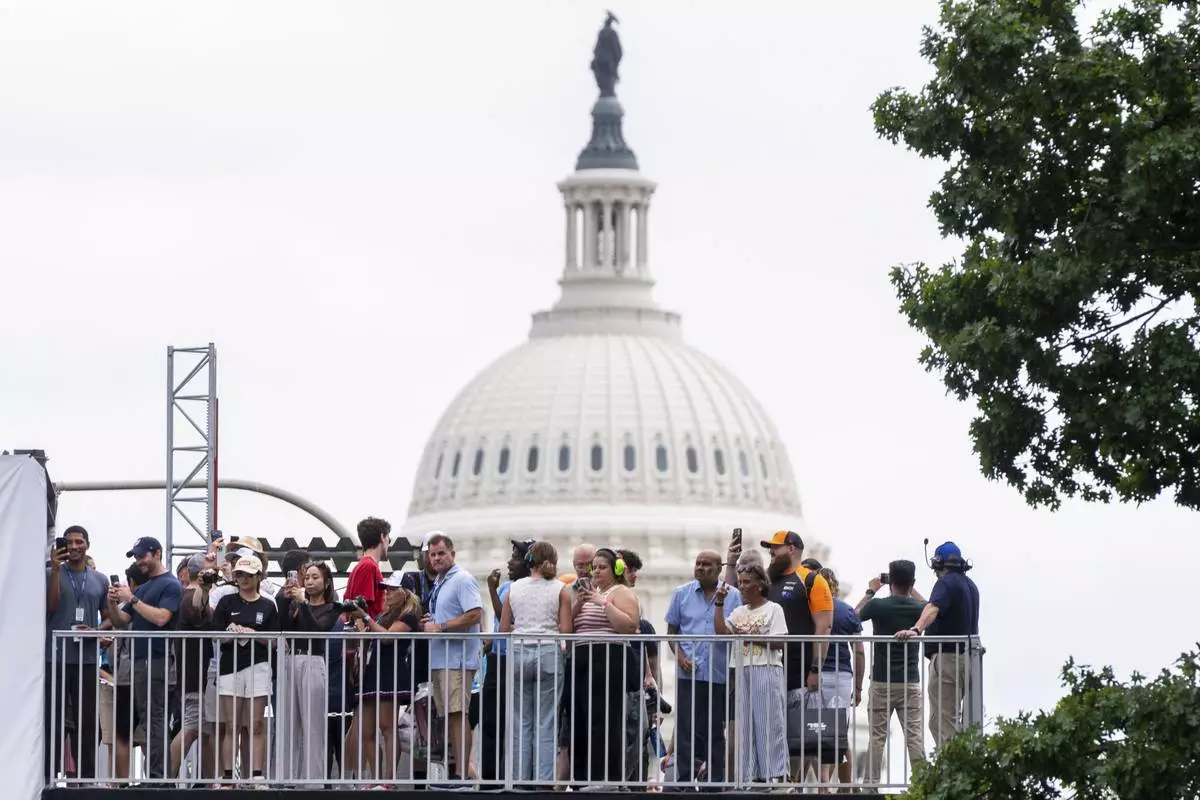
Spectators watch from an overpass near the U.S. Capitol as race car drivers take practice runs along Pennsylvania Avenue prior to Sunday's Freedom 250 Grand Prix auto race in Washington, Saturday, Aug. 22, 2026. (AP Photo/Manuel Balce Ceneta)

Spectators watch from an overpass near the U.S. Capitol as race car drivers take practice runs along Pennsylvania Avenue prior to Sunday's Freedom 250 Grand Prix auto race in Washington, Saturday, Aug. 22, 2026. (AP Photo/Manuel Balce Ceneta)

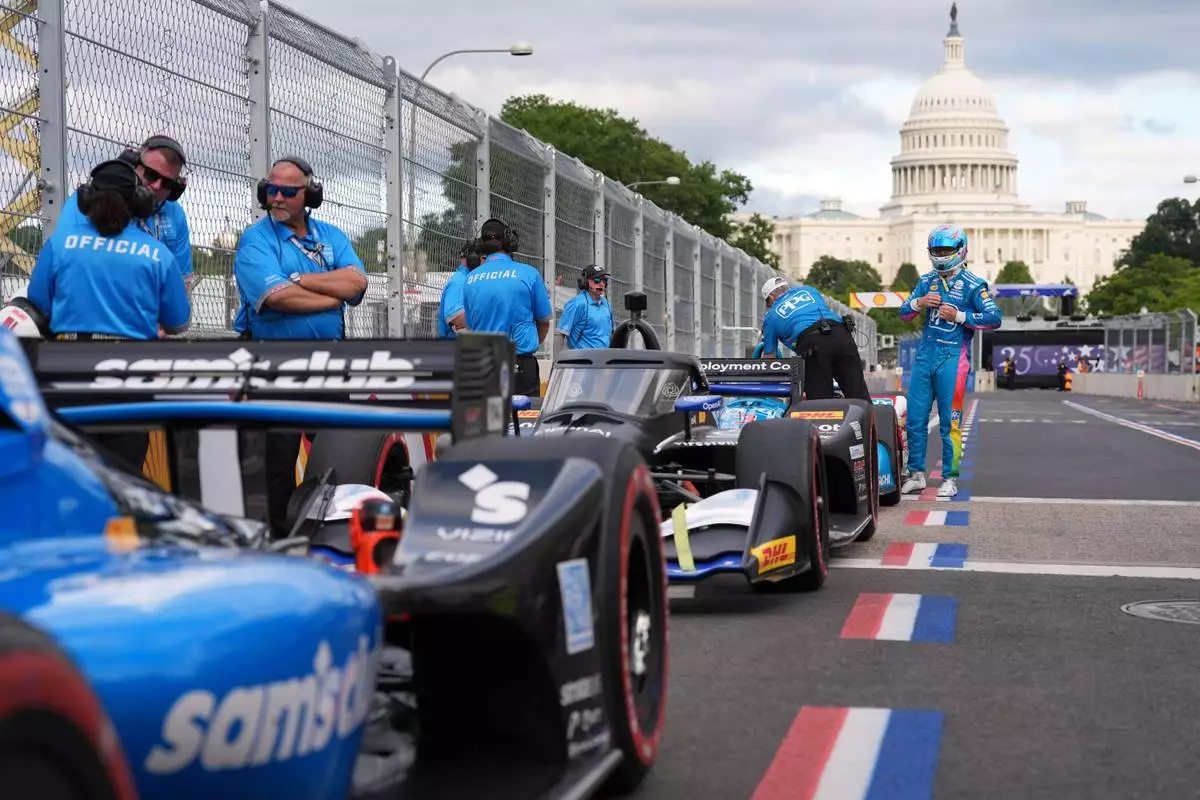
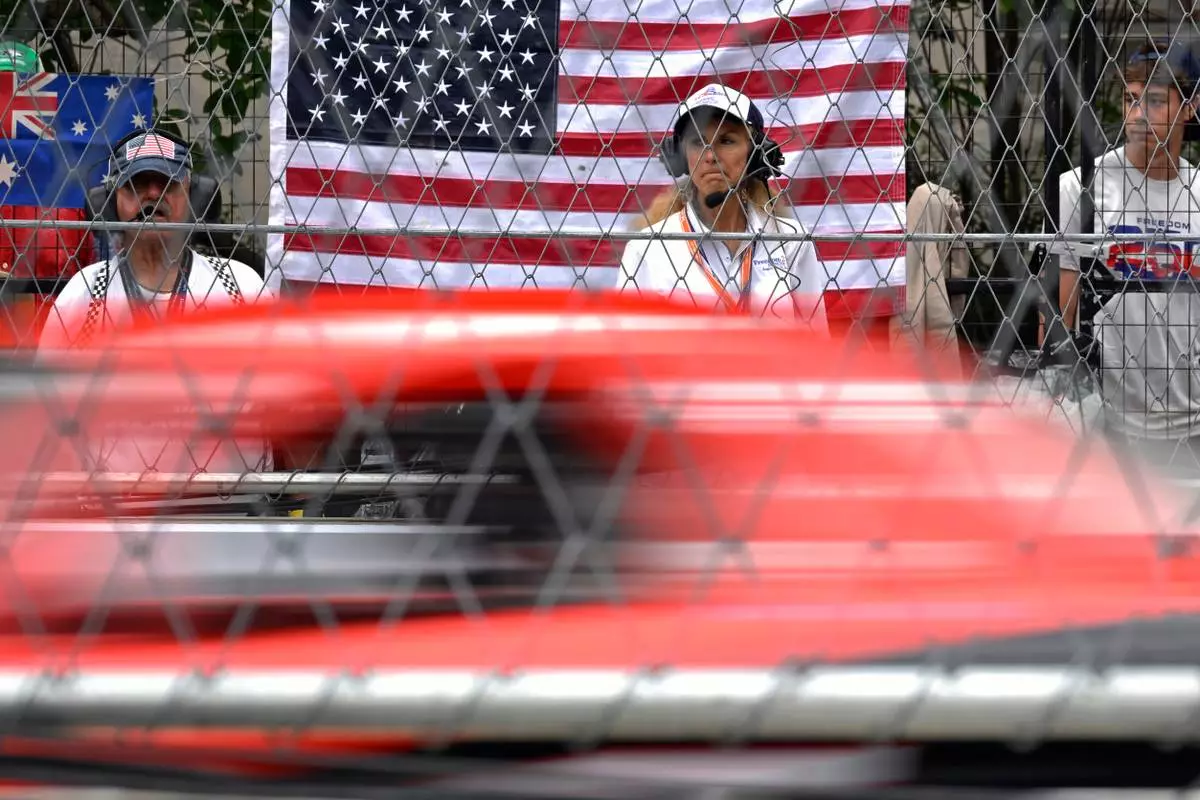
A race track official observes a car participating in a practice run for the IROC auto race, Saturday, Aug. 22, 2026, in Washington. (AP Photo/John McDonnell)

A race track official observes a car participating in a practice run for the IROC auto race, Saturday, Aug. 22, 2026, in Washington. (AP Photo/John McDonnell)

Race car diver Scott McLaughlin gets out of his car after a qualifying race prior to Sunday's Freedom 250 Grand Prix auto race in Washington, Saturday, Aug. 22, 2026.(AP Photo/Alex Brandon)

Race car diver Scott McLaughlin gets out of his car after a qualifying race prior to Sunday's Freedom 250 Grand Prix auto race in Washington, Saturday, Aug. 22, 2026.(AP Photo/Alex Brandon)

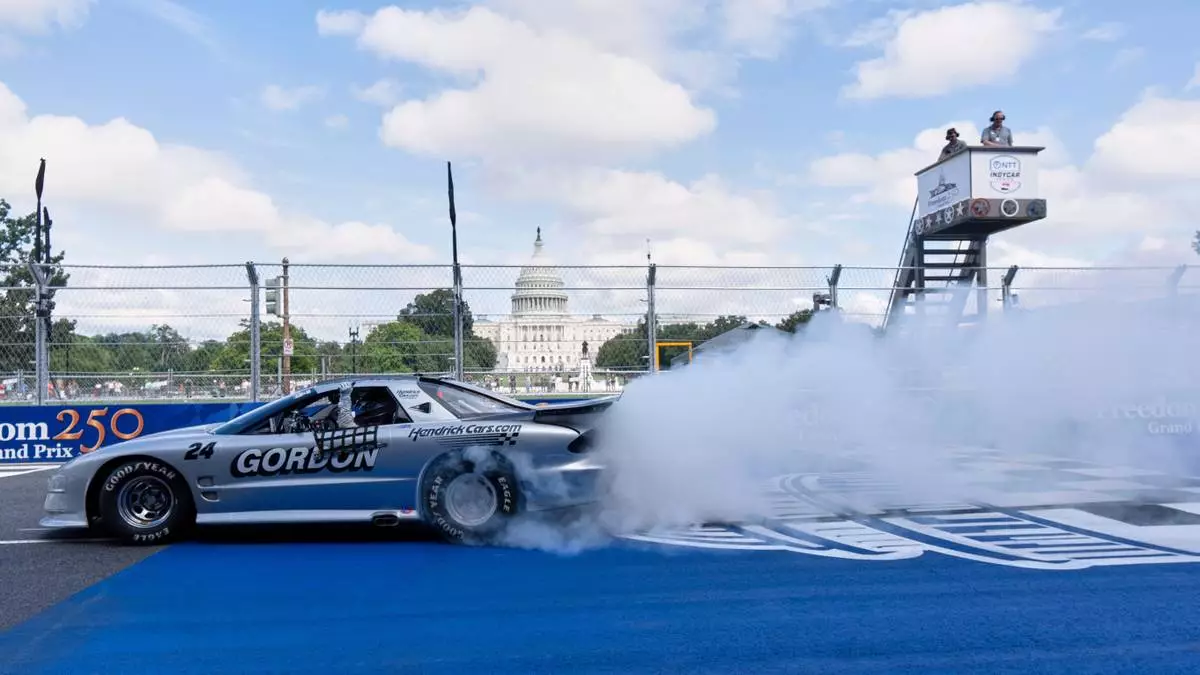
Jeff Gordon, driving an historic IROC Pontiac Firebird, performs a burnout after completing an IROC race, Saturday, Aug. 22, 2026, in Washington. (AP Photo/Manuel Balce Ceneta)

Jeff Gordon, driving an historic IROC Pontiac Firebird, performs a burnout after completing an IROC race, Saturday, Aug. 22, 2026, in Washington. (AP Photo/Manuel Balce Ceneta)

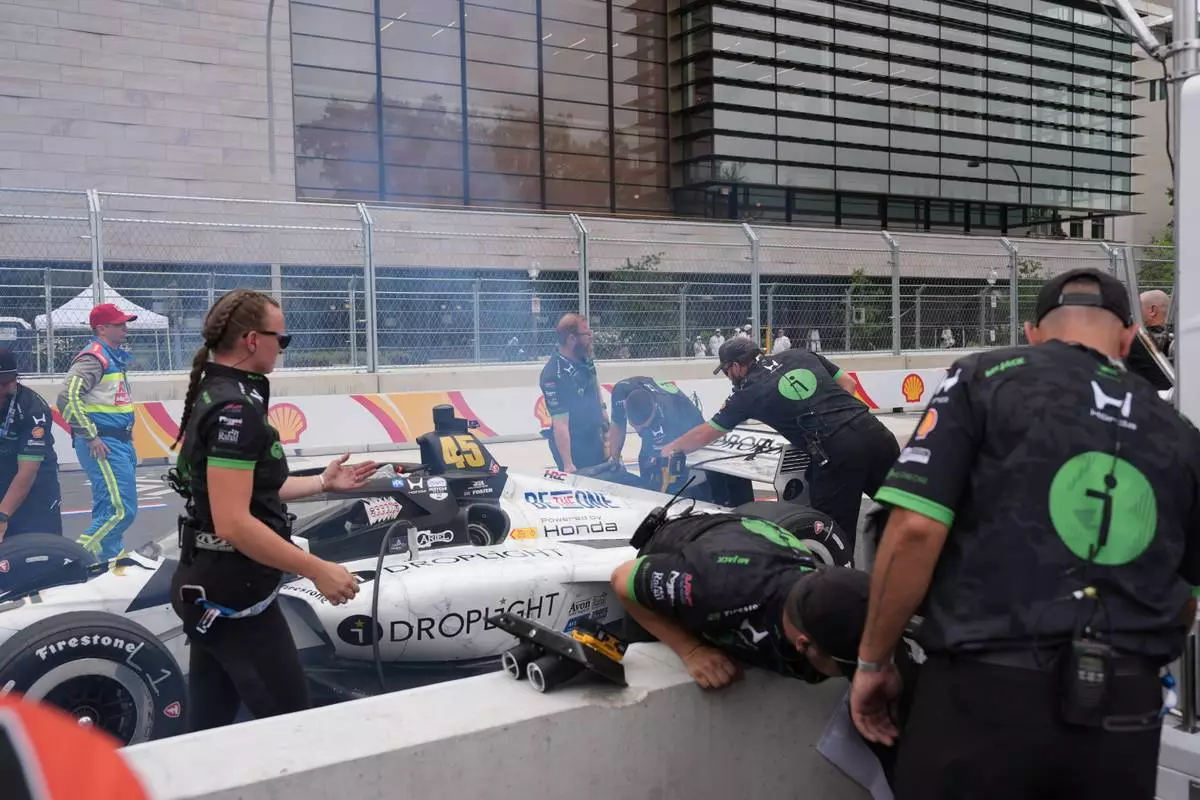
Race car driven by Louis Foster is seen as drivers take practice runs prior to Sunday's Freedom 250 Grand Prix auto race in Washington, Saturday, Aug. 22, 2026.(AP Photo/Alex Brandon)

Race car driven by Louis Foster is seen as drivers take practice runs prior to Sunday's Freedom 250 Grand Prix auto race in Washington, Saturday, Aug. 22, 2026.(AP Photo/Alex Brandon)

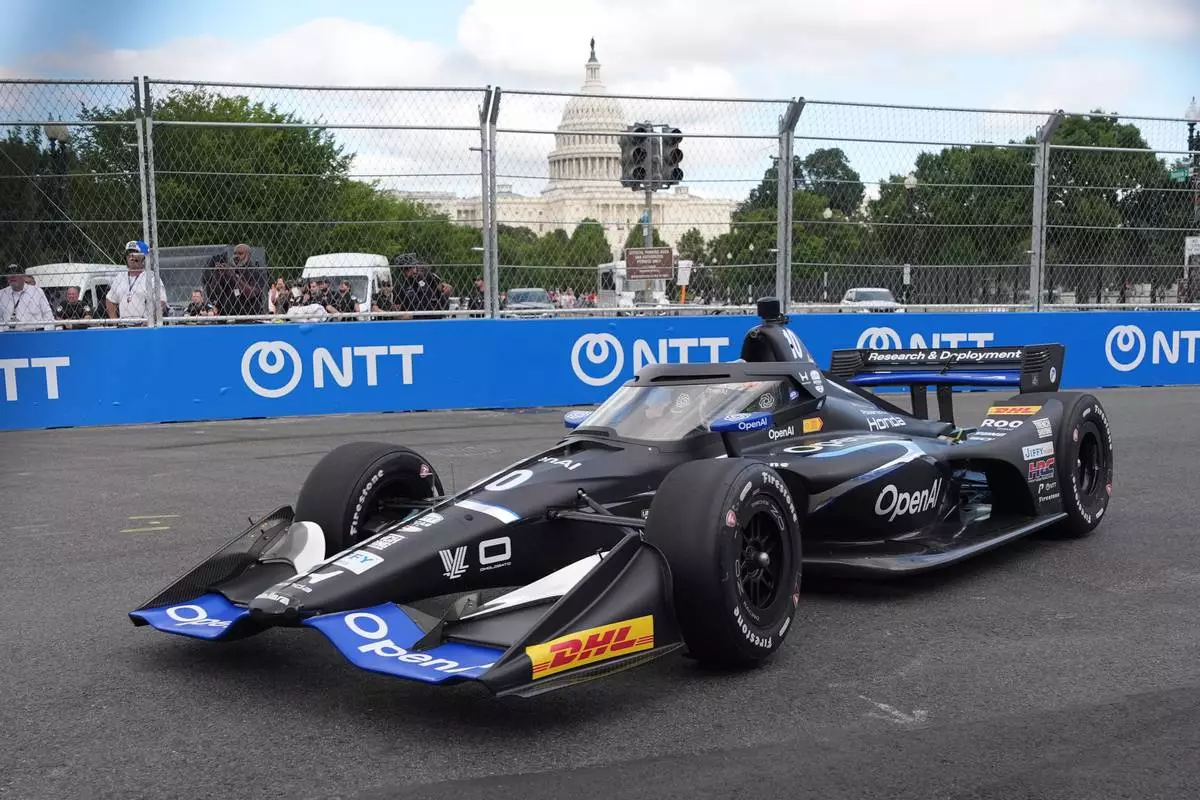
Race car diver Alex Palou, drives during a qualifying race prior to Sunday's Freedom 250 Grand Prix auto race in Washington, Saturday, Aug. 22, 2026.(AP Photo/Alex Brandon)

Race car diver Alex Palou, drives during a qualifying race prior to Sunday's Freedom 250 Grand Prix auto race in Washington, Saturday, Aug. 22, 2026.(AP Photo/Alex Brandon)

Recommended Articles