MONACO (AP) — Tadej Pogačar produced an explosive finish to win the first stage of the Spanish Vuelta by edging British rider Ethan Hayter by 0.09 seconds in the opening time trial on Saturday.
Pogačar, who’s bidding to become just the ninth rider to win all three Grand Tours, put himself in position from the offset by completing the highly technical 9.5-kilometer (5.9 mile) course through the streets of Monaco – where he resides – in 10 minutes, 57 seconds.
Click to Gallery
Spain's Ivan Romeo Abad rides during the first stage of the La Vuelta cycling race, a time trial with start and finish in Monaco, Saturday, Aug. 22, 2026. (AP Photo/Philippe Magoni)
Slovenia's Tadej Pogacar, wearing the overall leader's red jersey celebrates on the podium after winning the first stage of the La Vuelta cycling race, a time trial with start and finish in Monaco, Saturday, Aug. 22, 2026. (AP Photo/Philippe Magoni)
Slovenia's Tadej Pogacar rides to win the first stage of the La Vuelta cycling race, a time trial with start and finish in Monaco, Saturday, Aug. 22, 2026. (AP Photo/Philippe Magoni)
Slovenia's Tadej Pogacar rides to win the first stage of the La Vuelta cycling race, a time trial with start and finish in Monaco, Saturday, Aug. 22, 2026. (AP Photo/Philippe Magoni)
Slovenia's Tadej Pogacar rides to win the first stage of the La Vuelta cycling race, a time trial with start and finish in Monaco, Saturday, Aug. 22, 2026. (AP Photo/Philippe Magoni)
Hayter, who had gone earlier, must have thought he was going to win as he watched Pogačar on course to finish some seconds slower than he had. But the Slovenian accelerated as he approached the finish and just pipped Hayter to the win.
Hayter finished four seconds faster than compatriot Josh Tarling, who was racing just over a week after his younger brother Finlay Tarling was killed after being struck by a vehicle during the Volta a Portugal.
Pogačar is competing at the Vuelta for the first time since making his Grand Tour debut as a 20-year-old in the 2019 race. He won three stages and finished third at the time – his worst overall result in the three-week events.
This year is going much better.
Pogačar won the Tour de France for the third time straight time and fifth overall in July – equaling the record ¬– while he also won races at the Tour de Suisse and Tour de Romandie, and celebrated victories in one-day classics.
Pogačar won the Giro d’Italia in 2024 so the Vuelta is the only Grand Tour race he is yet to conquer. The only other men to have won all three are Eddy Merckx, Bernard Hinault, Jacques Anquetil, Alberto Contador, Chris Froome, Felice Gimondi, Vincenzo Nibali and Jonas Vingegaard.
Saturday's win was Pogačar's first in the opening stage of a Grand Tour, and it's also the first time he took the red jersey as the Vuelta leader. It's his 36th Grand Tour stage win altogether.
Pogačar’s main rival Vingegaard is not racing at the 81st edition of the Vuelta as he recovers from a broken collarbone sustained in a crash the day after he was woken at 2 a.m. for a doping test at the Tour de France.
Remco Evenepoel, who finished second behind Pogačar at the Tour, is also not competing. The Belgian rider has opted for rest and specific training for the Road World Championships in Montréal next month.
Monaco became the first city to host the start of all three Grand Tours. The Giro d’Italia started in the principality in 1966 and it staged the start of the Tour de France in 2009.
Much of the time trial route on Saturday covered the same course as the yearly Formula 1 Grand Prix.
The second stage will also start in Monaco before a 214.3-kilometer (133.1 mile) hilly trek through Provence to Manosque. It will be the longest stage of the race, which finishes in the southern Spanish city of Granada on Sept. 13.
See full AP coverage of European sports here

Spain's Ivan Romeo Abad rides during the first stage of the La Vuelta cycling race, a time trial with start and finish in Monaco, Saturday, Aug. 22, 2026. (AP Photo/Philippe Magoni)

Slovenia's Tadej Pogacar, wearing the overall leader's red jersey celebrates on the podium after winning the first stage of the La Vuelta cycling race, a time trial with start and finish in Monaco, Saturday, Aug. 22, 2026. (AP Photo/Philippe Magoni)

Slovenia's Tadej Pogacar rides to win the first stage of the La Vuelta cycling race, a time trial with start and finish in Monaco, Saturday, Aug. 22, 2026. (AP Photo/Philippe Magoni)

Slovenia's Tadej Pogacar rides to win the first stage of the La Vuelta cycling race, a time trial with start and finish in Monaco, Saturday, Aug. 22, 2026. (AP Photo/Philippe Magoni)

Slovenia's Tadej Pogacar rides to win the first stage of the La Vuelta cycling race, a time trial with start and finish in Monaco, Saturday, Aug. 22, 2026. (AP Photo/Philippe Magoni)
TORONTO (AP) — For decades, Canada built much of its prosperity on privileged access to the United States. Now, after the collapse of trade talks, one of the world’s closest and most durable alliances has been fundamentally altered, with both countries facing the risk of a full-scale trade war.
Prime Minister Mark Carney acknowledged the break after last-ditch negotiations failed Friday, saying Canada had recognized that “America has changed” and that the countries would “not return to our old relationship.”
The United States imposed 50% tariffs on about $20 billion worth of Canadian goods early Saturday. Carney said Canada would retaliate dollar for dollar beginning Sept. 8, targeting sectors including steel, dairy, appliances, agricultural equipment, pulp and paper and electronics.
Carney foreshadowed the shift at the World Economic Forum in Davos in January, declaring that the world was experiencing “a rupture, not a transition” and urging countries such as Canada to reduce their vulnerability to economic coercion by strengthening their economies at home and diversifying abroad.
He said in Ottawa on Saturday that warning had been borne out. He accused the U.S. of using “economic integration as a weapon” and said its “signature was written in pencil.”
“The collapse of the tariff talks points to the fact that the old Canada-U.S. relationship is over and, for many Canadians, it also confirms the perception that Canada can’t trust the Trump administration,” said Daniel Béland, a political science professor at McGill University in Montreal.
The pressure from Republican President Donald Trump has gone well beyond tariffs.
He has questioned Canada’s economic viability, repeatedly talked about making it the 51st U.S. state and used trade measures to encourage production to move from Canada to the United States. That has angered many Canadians and fueled a sense of betrayal in a country that had long regarded the U.S. as its closest ally.
Canadian travel to the U.S. remains sharply lower than before the dispute, with July return trips down nearly 29% by car and 27% by air from July 2024, Statistics Canada said.
The failed negotiations underscored how far the relationship had shifted. Canada had been prepared to accept some U.S. tariffs for market access and greater certainty — a break from decades of policy aimed at eliminating trade barriers.
For Canadians accustomed to preferential access under the 1989 Canada-U.S. Free Trade Agreement, NAFTA and its successor, even reduced tariffs would mark a retreat from the old relationship.
The collapse also puts Carney’s approach to Trump to the test.
The prime minister's “elbows up” posture — hockey shorthand for playing aggressively and refusing to be pushed around — has helped keep him popular at home. His decision to resist U.S. pressure could also resonate abroad with those impressed by his Davos call for countries to resist economic coercion and reduce dependence on great powers.
Provincial and conservative leaders broadly backed Carney. Saskatchewan Premier Scott Moe said “the old status quo is not possible,” while Ontario Premier Doug Ford praised Carney for rejecting what he called a bad deal for the auto, steel and manufacturing sectors.
Ford said Trump "is not to be trusted whatsoever.”
Former Alberta Premier Jason Kenney said Canada was “not cravenly surrendering in the face of constant economic and political aggression.”
Lana Payne, national president of Unifor, Canada’s largest private-sector union, accused Trump of trying to weaken Canada’s industrial base.
“What we have seen from the U.S. administration, or Donald Trump, is this consistent attempt to try and destroy the industrial economy of Canada with tariffs that have been strategically designed to attack us,” Payne said.
Nearly three-quarters of Canada’s goods exports go to the United States. The U.S. economy is roughly 10 times larger than Canada’s, limiting Ottawa’s ability to retaliate dollar for dollar without inflicting disproportionate damage at home.
Royal Bank of Canada economists estimate the tariffs directly affect about 0.4% of Canada’s GDP because they cover only about 5% of Canadian exports to the U.S. The damage could grow if retaliation broadens, more sectors are targeted or the dispute curbs investment and disrupts supply chains.
Carney himself acknowledged the cost of retaliation, saying the Canadian measures would “raise costs and reduce choice for Canadians.” He said his government would announce additional assistance for affected businesses and workers.
Béland said the countries were witnessing “the beginning of a full-scale trade war,” though he cautioned that the situation could change rapidly.
The dependence is not one-sided.
Carney said Canada supplies 99% of U.S. natural gas imports, 85% of its electricity imports and 60% of its crude oil imports. Trump has focused much of his pressure on autos, steel and aluminum, fueling resentment among Canadians who see the push as an effort to hollow out key industries.
Goldy Hyder, president and CEO of the Business Council of Canada, said businesses still view the U.S. as Canada’s most important trading partner but increasingly see the shift as lasting beyond Trump.
“There is a new trade and investment model, one that could well be kept in place by future U.S. administrations whether Democrat or Republican,” Hyder said.
The breakdown adds urgency to Carney’s push to diversify beyond the United States. He has traveled abroad seeking investment and new trade ties, aiming to attract $1 trillion Canadian (US$730 billion) by 2030 and double non-U.S. investment over the next decade. Canada has signed more than 20 trade and security agreements across five continents in the past year.
That made Washington’s effort to restrict Canada’s ability to negotiate trade agreements with other countries particularly significant.
In July, Ottawa and Alberta advanced plans for a new Pacific Coast oil pipeline to give Canadian crude greater access to Asian markets and reduce reliance on U.S. buyers.
The immediate question is how long the latest tariff confrontation will last.
Béland said the deeper change probably will, partly because U.S. protectionism is likely to remain influential under future administrations.
“The idea that things will return to ‘normal’ once Donald Trump leaves the White House is probably just wishful thinking,” Béland said. “It doesn’t mean the relationship might not improve in the future but that things will never be the same.”
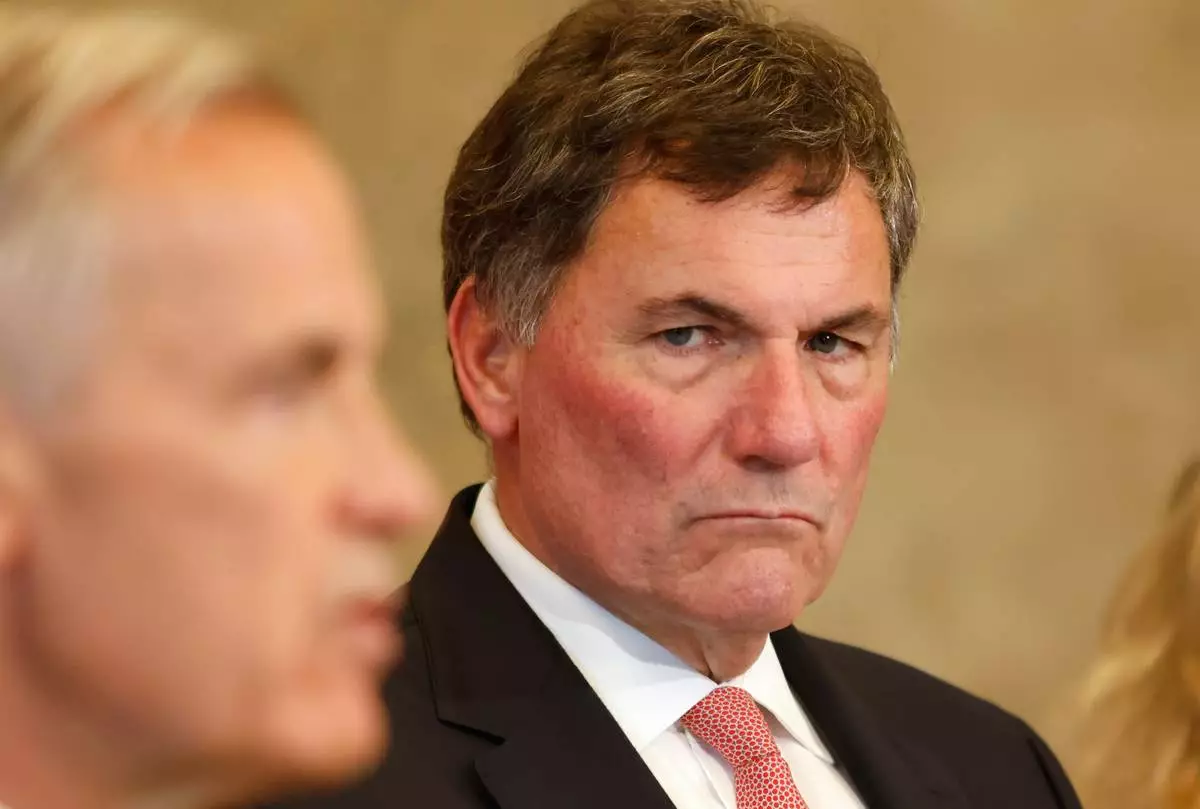
Canada-U.S. Trade Minister Dominic LeBlanc listens as Prime Minister Mark Carney speaks about Canada's response to new U.S. tariffs during a news conference on Parliament Hill in Ottawa on Saturday, Aug. 22, 2026. (Patrick Doyle/The Canadian Press via AP)
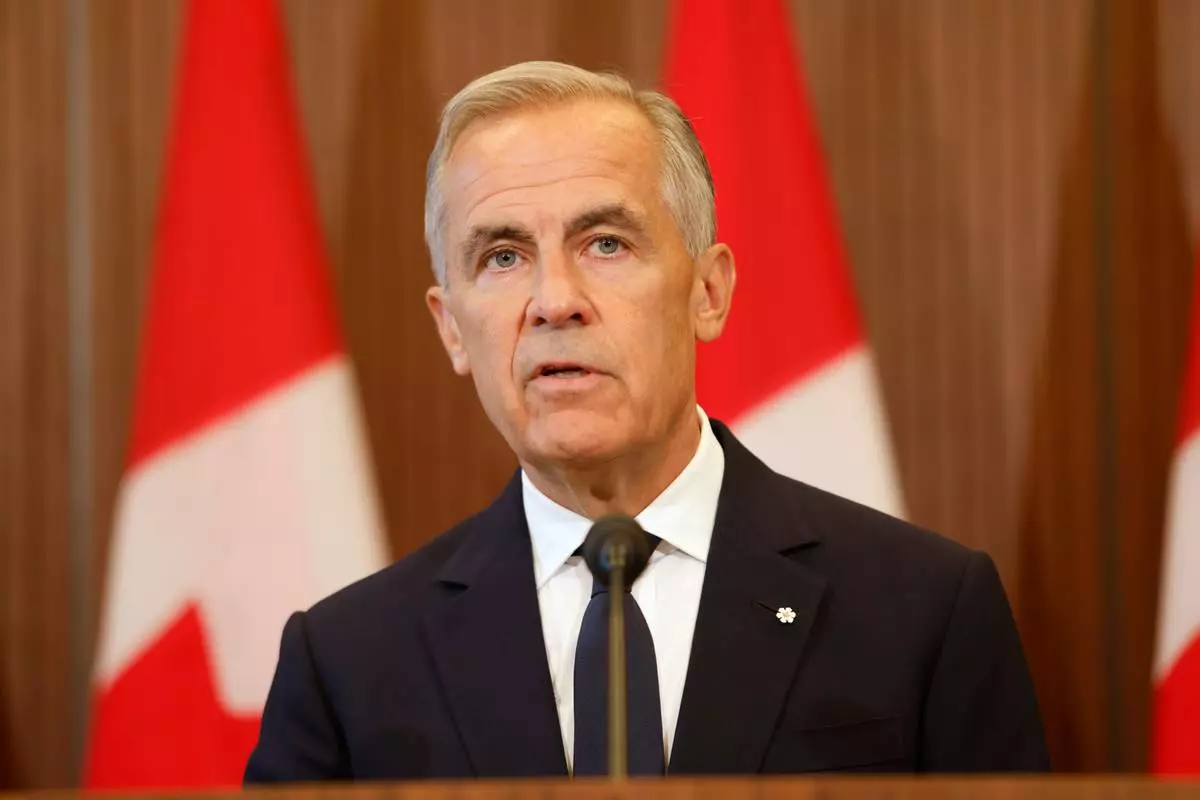
Prime Minister Mark Carney speaks about Canada's response to new U.S. tariffs during a news conference on Parliament Hill in Ottawa on Saturday, Aug. 22, 2026. (Patrick Doyle/The Canadian Press via AP)
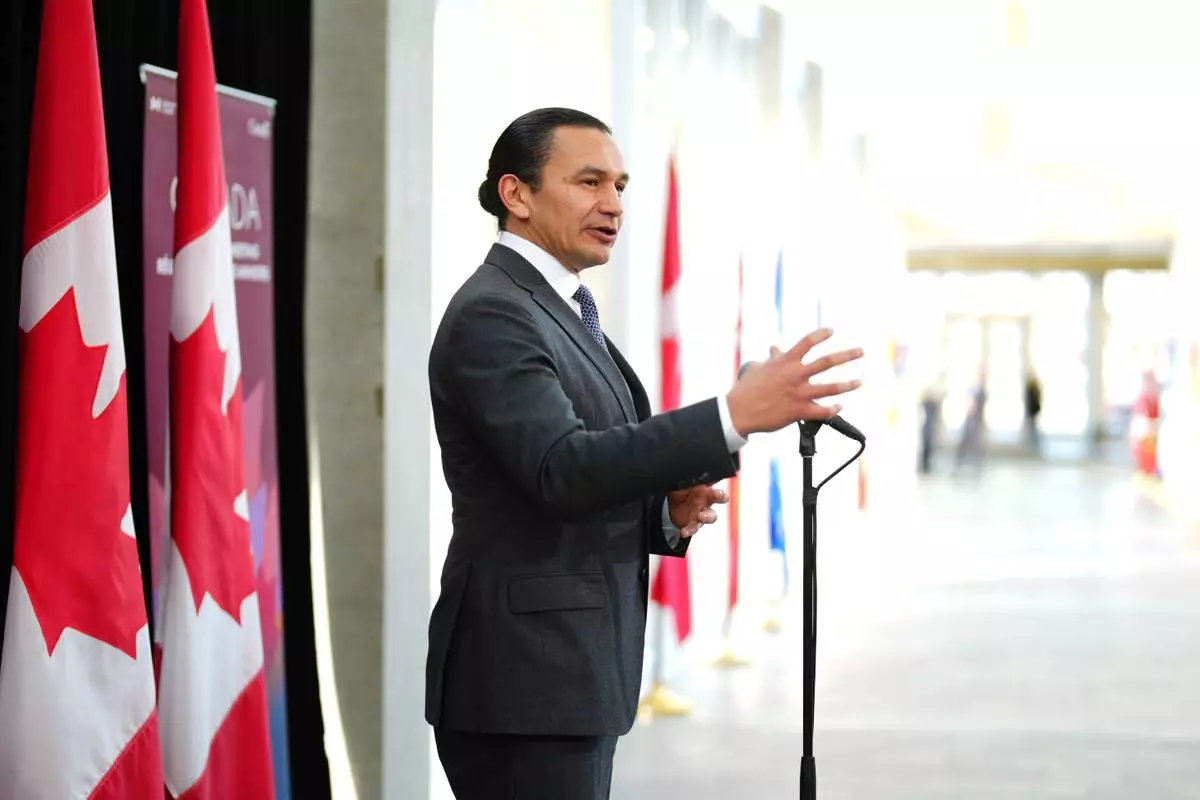
FILE - Manitoba Premier Wab Kinew talks to media as he arrives for a first ministers meeting in Ottawa on Jan.15, 2025. (Sean Kilpatrick/The Canadian Press via AP, File)
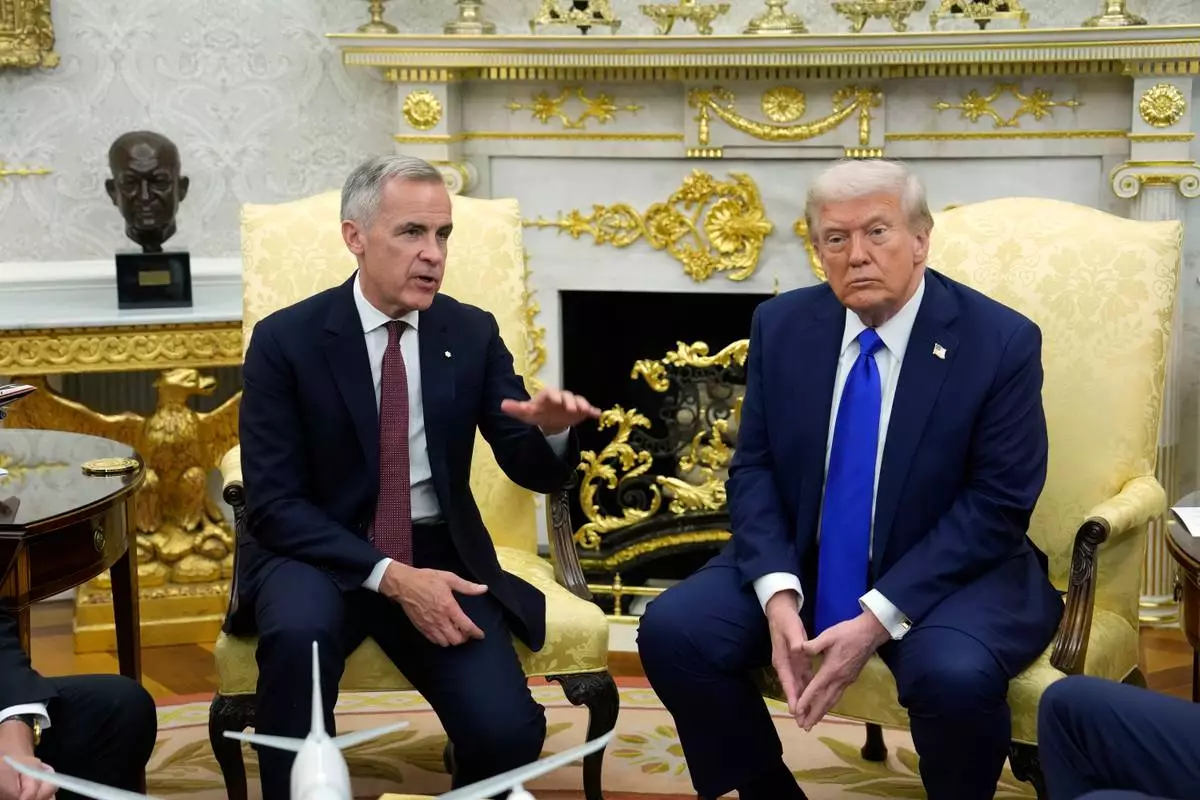
FILE - Canada Prime Minister Mark Carney and President Donald Trump hold a press conference at the White House in Washington, D.C., Oct. 7, 2025. (Adrian Wyld/The Canadian Press via AP, File)
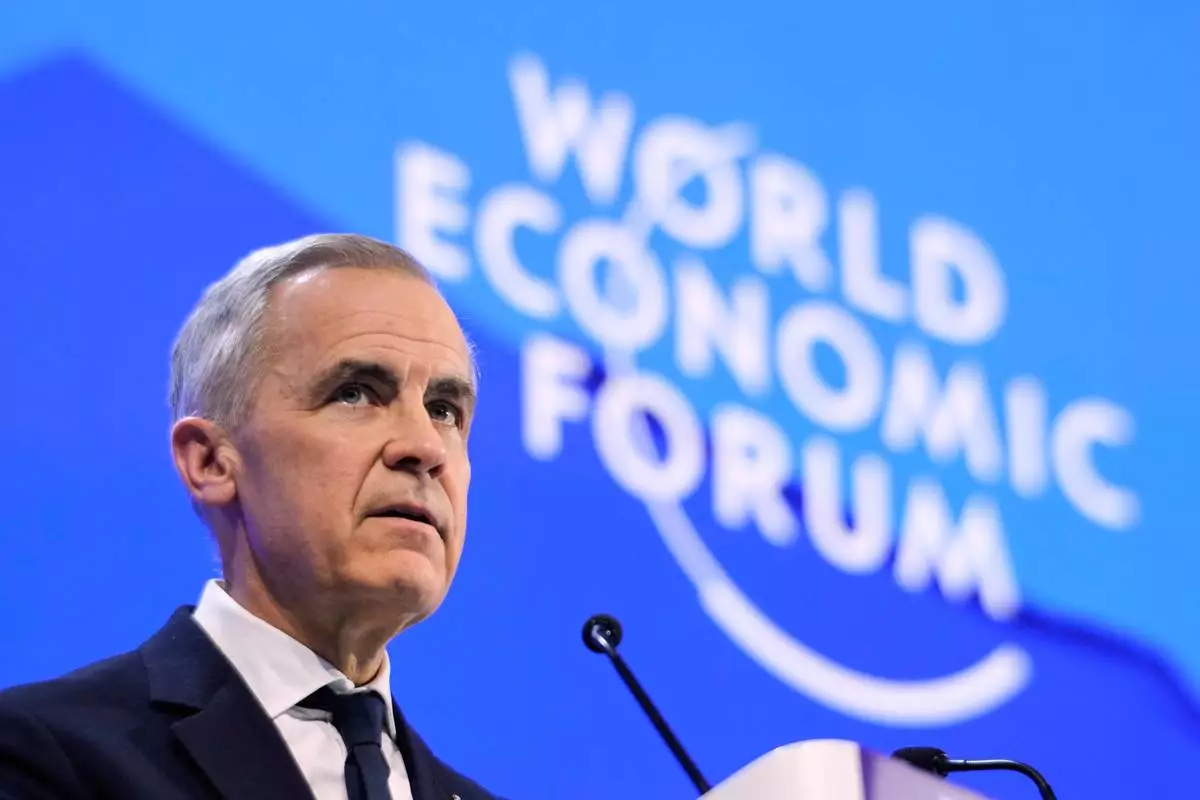
FILE - Canada's Prime Minister Mark Carney speaks during the Annual Meeting of the World Economic Forum in Davos, Switzerland, Jan. 20, 2026. (AP Photo/Markus Schreiber, File)
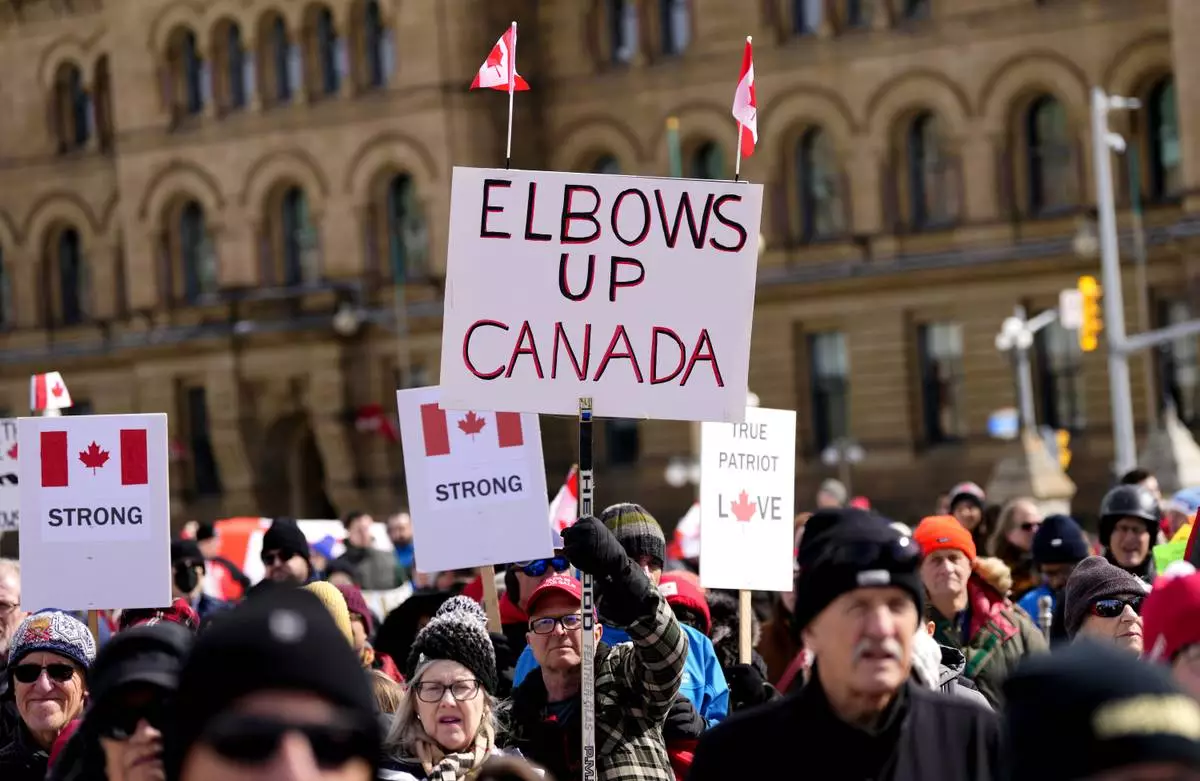
FILE - People rally in response to U.S. President Donald Trump's threats to Canadian sovereignty on Parliament Hill in Ottawa, March 9, 2025. (Justin Tang/The Canadian Press via AP File)