JOHANNESBURG (AP) — Coach Rassie Erasmus reassured South Africa supporters that recent history proved the test series against New Zealand can still be won after losing the opening salvo 33-16 on Saturday.
The All Blacks' biggest ever win at Ellis Park stripped double world champion South Africa of its No. 1 test ranking and ended the Springboks' 12-test win streak, their longest under Erasmus.
They have three more tests in their first full-scale series in 30 years and go to Cape Town next Saturday.
“We have been in many catastrophic situations in our lives,” Erasmus said.
He noted they lost the first test against the British and Irish Lions in 2021 and won that three-test series. He also noted losing their opening pool game to New Zealand at the 2019 Rugby World Cup and winning the trophy.
“There is a way out, and that's winning three matches on the trot,” Erasmus said. "Without doubt, it puts them in a very good position which they thoroughly deserve.
“We were thoroughly beaten by a team that is now No. 1 in the world — it'll be nice to go into the next game as the underdogs,” he quipped.
"We were dominant in the scrums but it doesn't help you if you're dominant in one or two parts of the game. The All Blacks were more dominant in most parts of the game.
“I'm not going to butter it up with that cliché and say we're going to learn from this and get better. We didn't need to learn from this; we knew what we had to do on the day — we didn’t do it.”
The Springboks failed to convert numerous chances in a dominant first half and turned with only a 13-12 lead. New Zealand was courageous and clinical and remarkably cantered home by five tries to one.
The key moment was near the hour mark when the Boks trailed 19-16 and had a scrum in front of the All Blacks' posts. Then they conceded a penalty on their own feed.
“Even if we had kicked over that scrum penalty and we won we still made a hell of a lot of errors,” Erasmus said. "But it wasn't a wake-up call. There were just so many things that we did wrong and that New Zealand did right — so I'm not going to say we learnt a lot of things from this match.
"There would have been a lot of things we'd have to put right even if we had scratched through this match with a one-point win.
“We didn't play well. There were a lot of things we didn't convert. New Zealand forced those on to us by being really intense and sharp.”
In regard to injuries, his main concerns were wingers Cheslin Kolbe and Kurt-Lee Arendse.
Arendse failed a head check after his mouthguard pinged in the first half. A mandatory stand-down for concussion made Arendse a doubt for the second test in Cape Town next weekend. Kolbe left in the second half with suspected cramp, Erasmus said.
Kolbe was perfect off the tee with four from four, and goalkicked ahead of Sacha Feinberg-Mngomezulu because, Erasmus said, he's “our most accurate kicker."
See AP’s full rugby coverage here

South Africa's players huddle following a Test rugby match between South Africa and New Zealand, in Johannesburg, South Africa, Saturday, Aug. 22, 2026. (AP Photo/Themba Hadebe)

South Africa's head coach Rassie Erasmus watches on as players warm up for a Test rugby match between South Africa and New Zealand, in Johannesburg, South Africa, Saturday, Aug. 22, 2026. (AP Photo/Themba Hadebe)
WASHINGTON (AP) — The United States and Canada, historic allies along an undefended border, fell deeper into a trade war Saturday marked by angry recriminations and new tariffs that are expected to raise prices for products in both countries.
Each side blamed the other for the collapse of negotiations in Washington late Friday, leading the U.S. to impose 50% tariffs on $20 billion worth of Canadian goods and Canada setting Sept. 8 as the start of its retaliatory penalties.
President Donald Trump’s import taxes will hit about 5% of what Canada ships to the United States every year, ranging from hockey sticks to tongue depressors. Prime Minister Carney said Ottawa would respond with targeted tariff protection for industries exposed to the new U.S. duties, including some steel products. He also mentioned the dairy, appliance, agricultural equipment, pulp and paper and electronics sectors.
No further talks were planned. Whatever the eventual outcome, a loss of trust seems one of the earliest casualties.
Carney accused Washington of using “economic integration as a weapon” and said “its signature was written in pencil.” Resorting to the language of battle, he said his country had been “attacked” by the new American tariffs. “You’re at war when you get attacked,” he said, adding that Canada had the reserves, resilience and plan to respond.
But to Trump's chief trade negotiator, Jamieson Greer, the U.S. was compelled to act after a year of retaliation by its longtime partner.
“We’ve said enough, and so we’ve taken countermeasures. Our interest is in protecting American workers and protecting American supply chains,” the U.S. trade representative told "Fox & Friends Weekend."
Carney said Canada had been willing to drop remaining retaliatory tariffs on steel, aluminum and autos if the U.S. substantially lowered its own, and to encourage provinces to restore U.S. alcohol sales. But he said Washington’s final demands went too far. “They asked too much and offered too little,” Carney said.
Greer said the Republican administration was offering to cut tariffs on steel, autos and lumber, “things that are sensitive for them. And they’ve always had the best deal, and they still would have an even better deal, but they didn’t want that."
As a result, he said, “We’re moving forward with measures that respond to Canadian retaliation.”
Carney said the U.S. added last-minute terms that would have reduced tariff relief for Canadian-made vehicles, restricted Canada’s ability to strike trade deals with other countries and weakened protections for language, culture and sovereignty.
He said such demands were “unacceptable.”
The breakdown in negotiations marked a sharp reversal from two days earlier, when officials from the two countries sounded as if they were headed toward a compromise.
Ontario Premier Doug Ford, who leads Canada’s most populous province, praised Carney for rejecting the deal, saying it would have hurt Ontario’s auto, steel and manufacturing sectors. Ford urged Canada to use “every tool in our toolbox” to fight the U.S. tariffs.
The moves also call into question the future of a North American trade agreement covering the United States, Canada and Mexico that is crucial to industry in all three countries.
Carney said the breakdown was “certainly not good news” for the review of that agreement and that the failed negotiations had given Canada “a new perspective” on what Washington wants from the broader economic relationship.
The political impact will likely be even bigger than the economic fallout. The countries sold each other $880 billion worth of goods and services last year.
The tariffs were initially supposed to kick in at 12:01 a.m. Wednesday. Trump extended the deadline for three days to allow talks to continue, but the countries could not reach an agreement in time.
The U.S. and Canada have wrangled for decades over trade, poking each other over sore spots such as Canadian softwood lumber imports and U.S. access to Canada’s protected dairy market.
Somehow, they still managed to remain friends, allies and trading partners. Canadian soldiers fought alongside Americans in Afghanistan after 9/11. The 5,525-mile U.S.-Canada border is undefended, and nearly 330,000 people and $2 billion worth of goods cross it every day; 800,000 Canadians live in the United States.
Trump’s approach to dealing with Canada marks an extraordinary departure from the traditionally cooperative relationship between the two countries. Trump has imposed tariffs on Canadian goods in a push to bring manufacturing back to the United States and made inflammatory comments about turning Canada into America’s 51st state.
Carney said Canada had recognized that “America has changed” and that the two countries would “not return to our old relationship.”
The Canadian public is fed up. A petition to expel U.S. Ambassador Pete Hoekstra, a Trump ally, has collected nearly 248,000 signatures since July 21. It accuses the former Republican congressman from Michigan of having “normalized’’ Trump’s talk of annexing Canada, among other things.
The two countries had good reasons to find a compromise.
Nearly 72% of Canada’s goods exports last year went to the United States. The Trump administration might be wary of imposing new tariffs — paid by U.S. importers who try to pass along the cost to consumers via higher prices — before the November midterm elections. American voters are already frustrated with the high cost of living.
“Both sides will be under immense pressure in the coming days to still find an off-ramp,” said Ryan Majerus, a partner at King & Spalding and a former U.S. trade official.
Joshua Bolten, CEO of the Business Roundtable, which represents leaders of major U.S. companies, warned the tariffs and retaliation risk “raising costs for American businesses and families” and disrupting vital supply chains, and urged both governments to resume negotiations.
Trump has made tariffs the centerpiece of his second-term economic agenda. Last year, he imposed double-digit import taxes on almost every country, justifying them by declaring the long-standing U.S. trade deficit a national emergency. The Supreme Court in February ruled that he had overstepped his authority. The justices struck down the trade penalties and set the stage for the federal government to pay refunds to importers.
So Trump has looked for other legal authority to justify tariffs.
After the Supreme Court struck down much of Trump’s earlier tariff program in February, the administration turned to other legal authorities. For Canada, Trump invoked Section 338 of the Tariff Act of 1930, a rarely used Depression-era provision allowing tariffs of up to 50% against countries deemed to discriminate against U.S. businesses.
The provision is part of the Smoot-Hawley tariff law, widely blamed by economists and historians for worsening the Great Depression by restricting global trade. Section 338 has never previously been used to impose tariffs.
The rift comes as the United States, Mexico and Canada are trying to renew a trade agreement that Trump negotiated in his first term and once praised as a triumph. The United States has begun formal talks with Mexico over revamping the US-Mexico-Canada Agreement, known as USMCA. But talks with Canada have not begun and escalating trade conflict casts doubt on whether they will.
__
Gillies reported from Toronto. Associated Press writer Michelle L. Price contributed to this report.
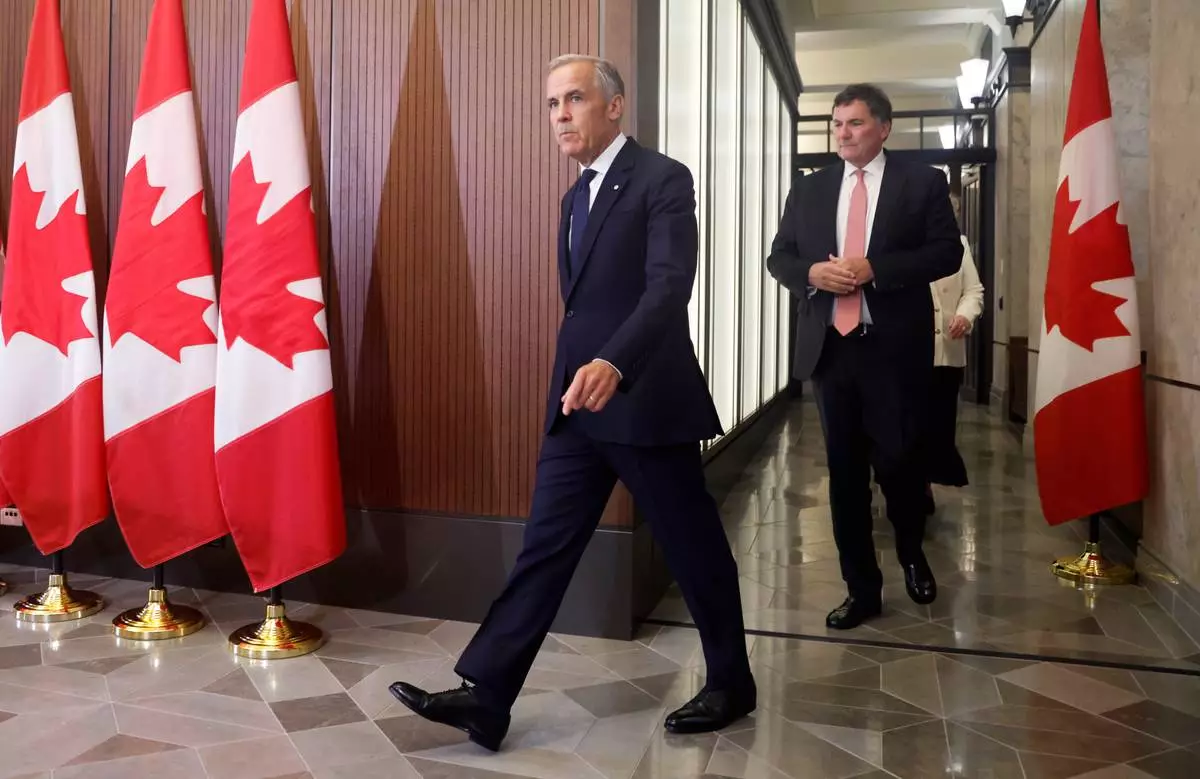
Prime Minister Mark Carney and Canada-U.S. Trade Minister Dominic LeBlanc arrive at a news conference about Canada's response to new U.S. tariffs on Parliament Hill in Ottawa on Saturday, Aug. 22, 2026. (Patrick Doyle/The Canadian Press via AP)
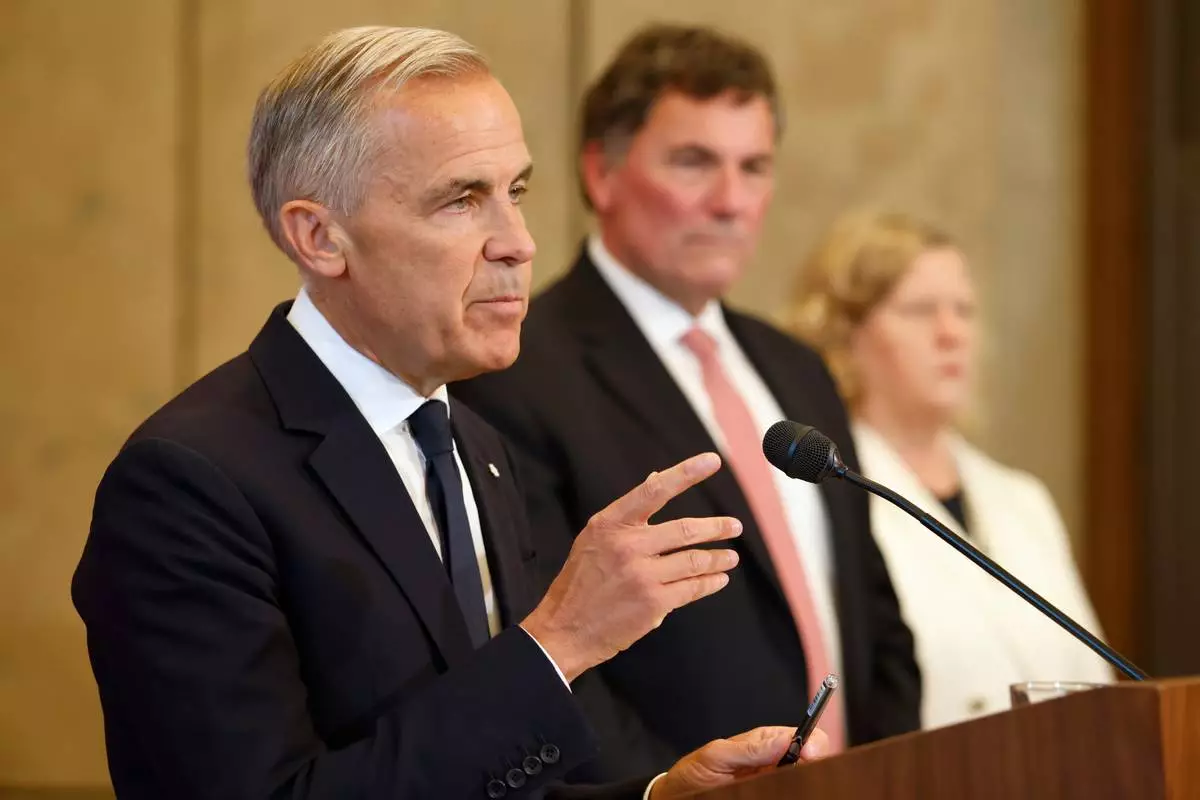
Canada-U.S. Trade Minister Dominic LeBlanc and chief trade negotiator Janice Charette listen as Prime Minister Mark Carney speaks about Canada's response to new U.S. tariffs during a news conference on Parliament Hill in Ottawa on Saturday, Aug. 22, 2026. (Patrick Doyle/The Canadian Press via AP)
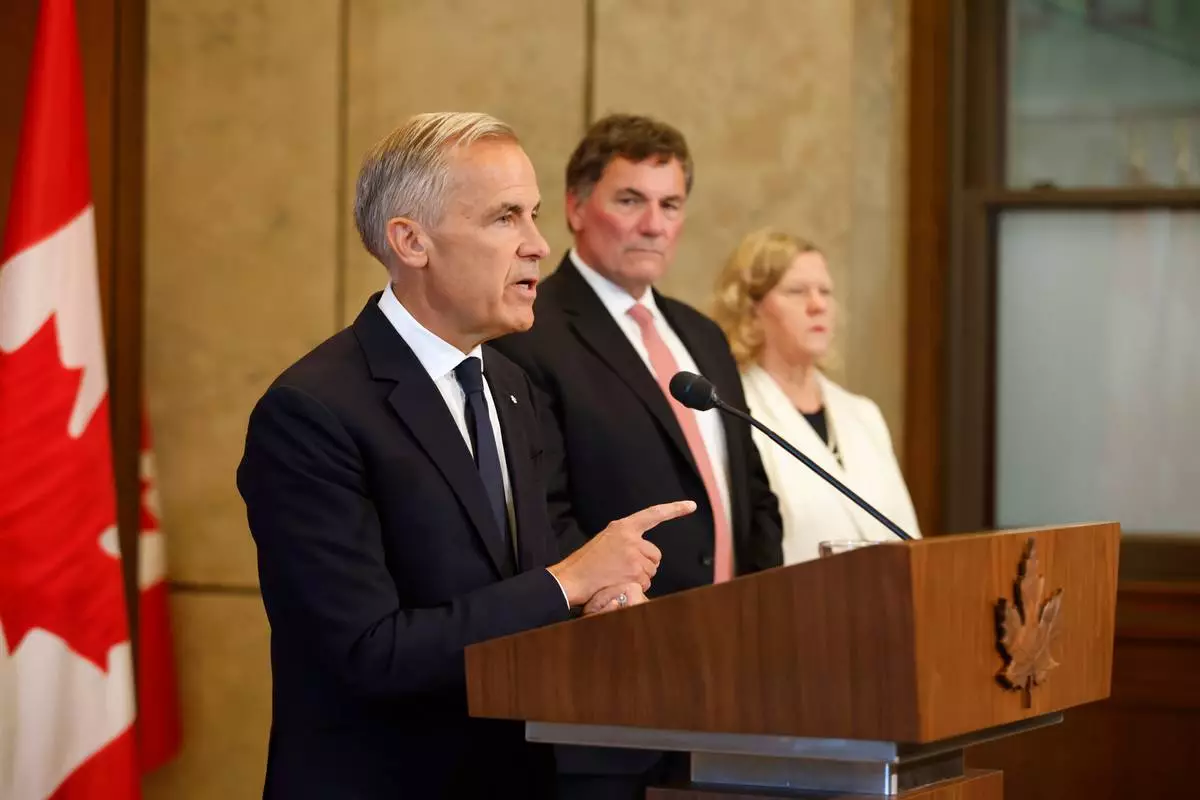
Canada-U.S. Trade Minister Dominic LeBlanc and chief trade negotiator Janice Charette listen as Prime Minister Mark Carney speaks about Canada's response to new U.S. tariffs during a news conference on Parliament Hill in Ottawa on Saturday, Aug. 22, 2026. (Patrick Doyle/The Canadian Press via AP)
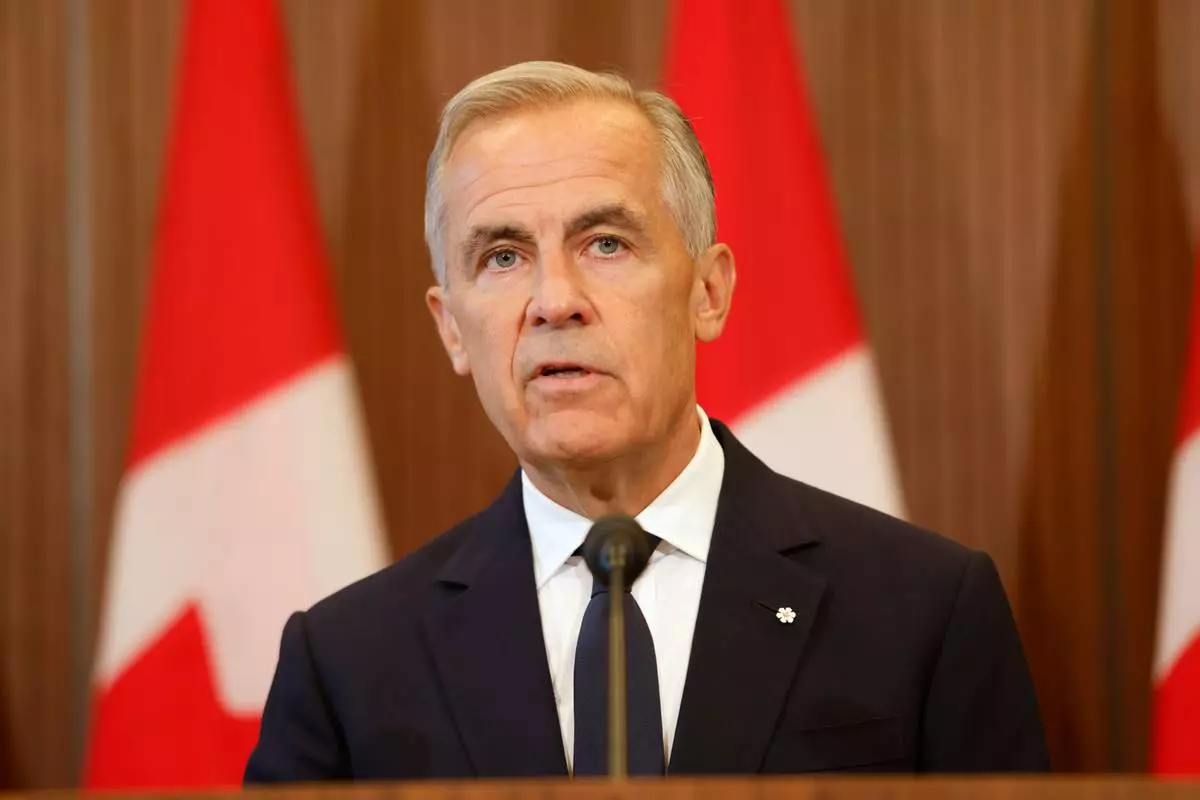
Prime Minister Mark Carney speaks about Canada's response to new U.S. tariffs during a news conference on Parliament Hill in Ottawa on Saturday, Aug. 22, 2026. (Patrick Doyle/The Canadian Press via AP)
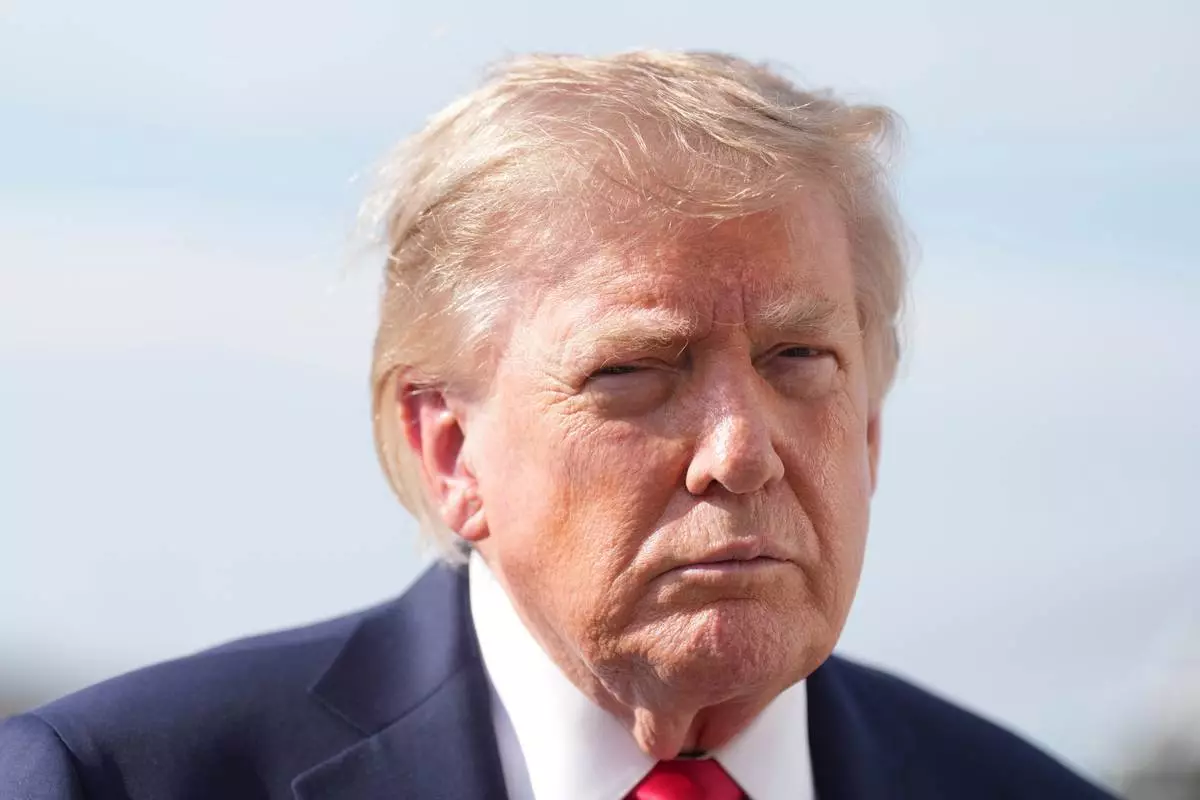
President Donald Trump speaks with reporters before boarding Air Force One, Friday, Aug. 21, 2026, at Joint Base Andrews, Md., en route to South Carolina. (AP Photo/Jacquelyn Martin)
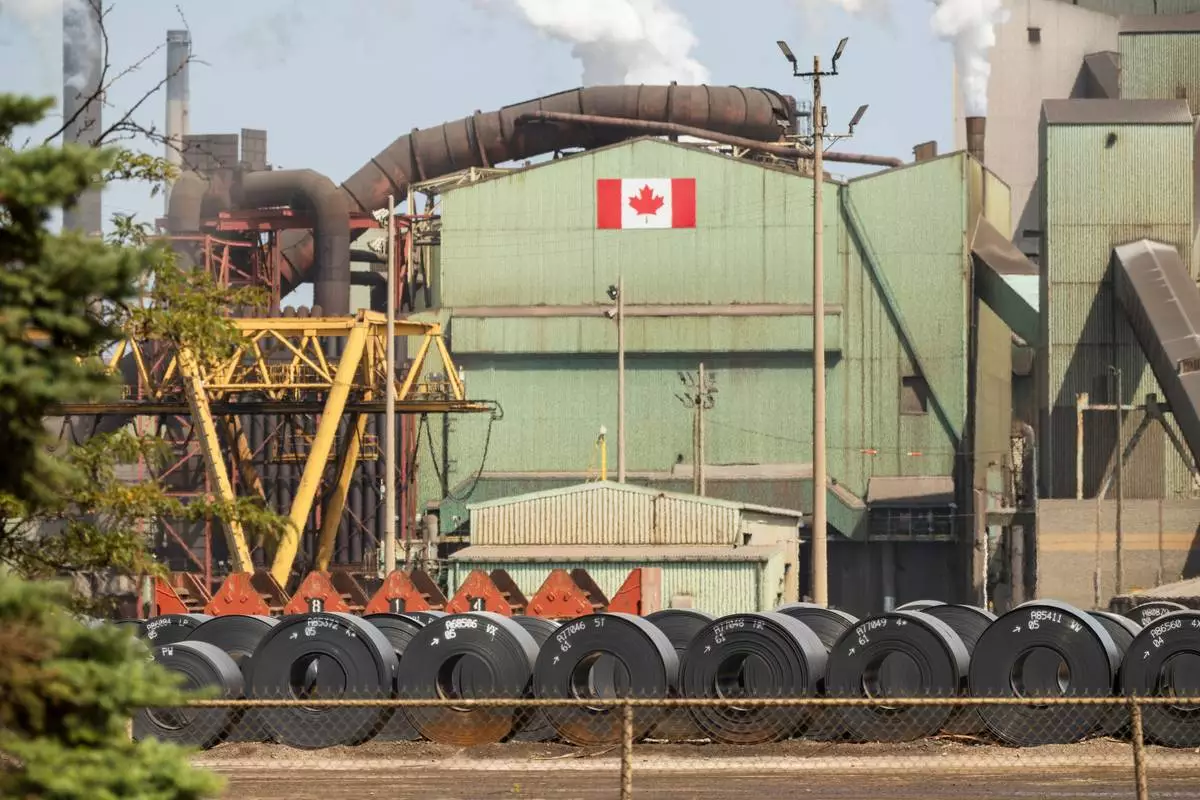
Rolled coils of steel sit in the yard at the ArcelorMittal Dofasco steel plant in Hamilton, Ont. on Thursday, Aug. 20, 2026. (Nick Iwanyshyn /The Canadian Press via AP)
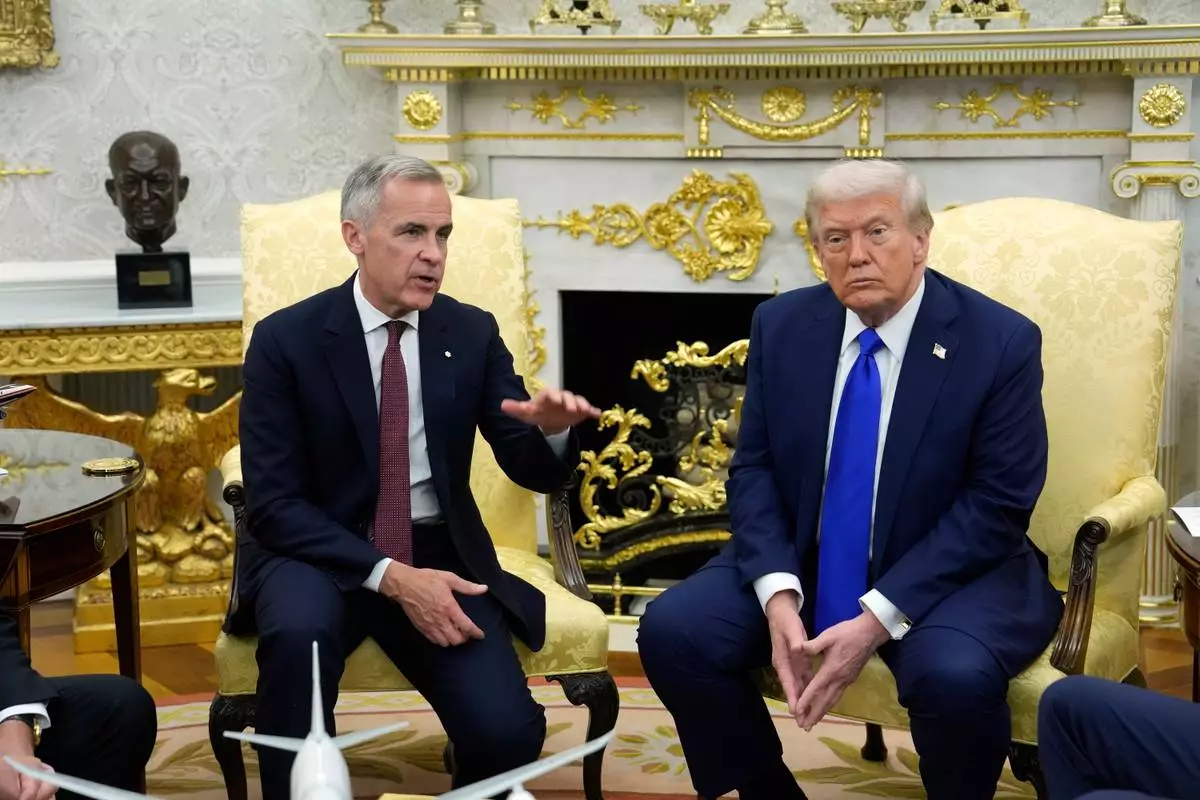
FILE - Canada Prime Minister Mark Carney and President Donald Trump hold a press conference at the White House in Washington, D.C., Oct. 7, 2025. (Adrian Wyld/The Canadian Press via AP, File)

Rolled coils of steel sit in the yard at the ArcelorMittal Dofasco steel plant in Hamilton, Ont. on Thursday, Aug. 20, 2026. (Nick Iwanyshyn /The Canadian Press via AP)
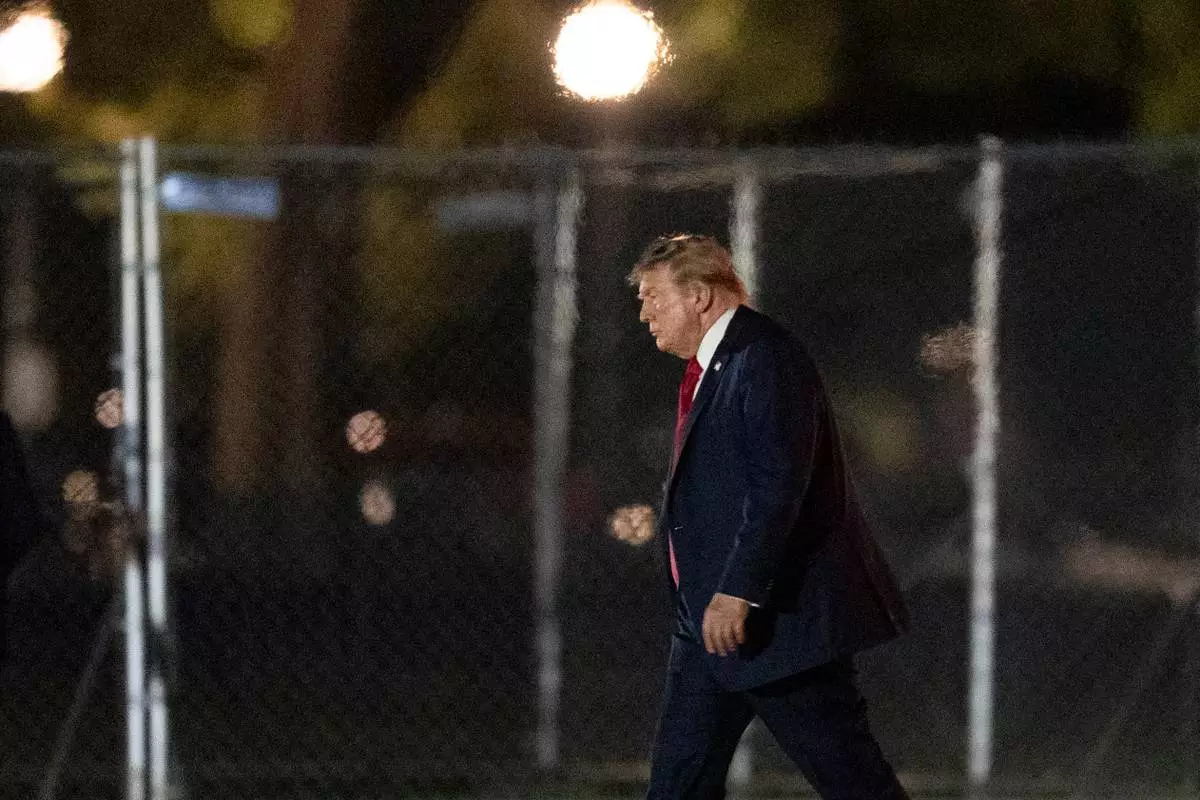
President Donald Trump walks on the Ellipse as he arrives on Marine One near the White House, Friday, Aug. 21, 2026, in Washington. (AP Photo/Manuel Balce Ceneta)