Typhoons Saudel, Narra and Gaenari, which have formed successively with strengthening power, have brought heavy rains to China's eastern and southern coastal regions, prompting the central authorities to activate an emergency response to the worst-hit areas on Sunday.
The back-to-back typhoons, the 18th, 19th and 20th of the season, are forecast to impact a large swathe of China over the coming days, according to the Central Meteorological Observatory (CMA).
The CMA continued to issue a blue alert for typhoons on Sunday, urging coastal regions to brace for prolonged wind and rain.
Currently, Typhoon Narra is still lashing south China's Guangxi Zhuang Autonomous Region, Guangdong Province, and Hainan Province with wind and rain.
Typhoon Gaenari is forecast to impact Fujian and Zhejiang Provinces on China's eastern coast as well as Guangdong with torrential rainfall over the next several days, while heavy downpours are also anticipated in parts of Heilongjiang, Jilin and Liaoning Provinces in China's northeast and the Inner Mongolia Autonomous Region in north China.
Typhoon Saudel is projected to enter the East China Sea around Wednesday, with subsequent impact expected across multiple provincial-level regions.
In response to Typhoon Narra's impact, the National Commission for Disaster Prevention, Reduction and Relief and the Ministry of Emergency Management, together with the National Food and Strategic Reserves Administration, dispatched 20,000 central disaster relief supplies to Guangxi on Sunday.
China has a four-tier color-coded weather warning system, with red representing the most severe, followed by orange, yellow and blue.

Triple typhoons bring torrential rains to south, east China, triggering disaster response
U.S. stocks closed mixed on Monday as a sharp sell-off in semiconductor equities dragged down the technology sector, while investors digested new U.S. economic sanctions announced against Iran and fresh trade tariff warnings targeting Canada.
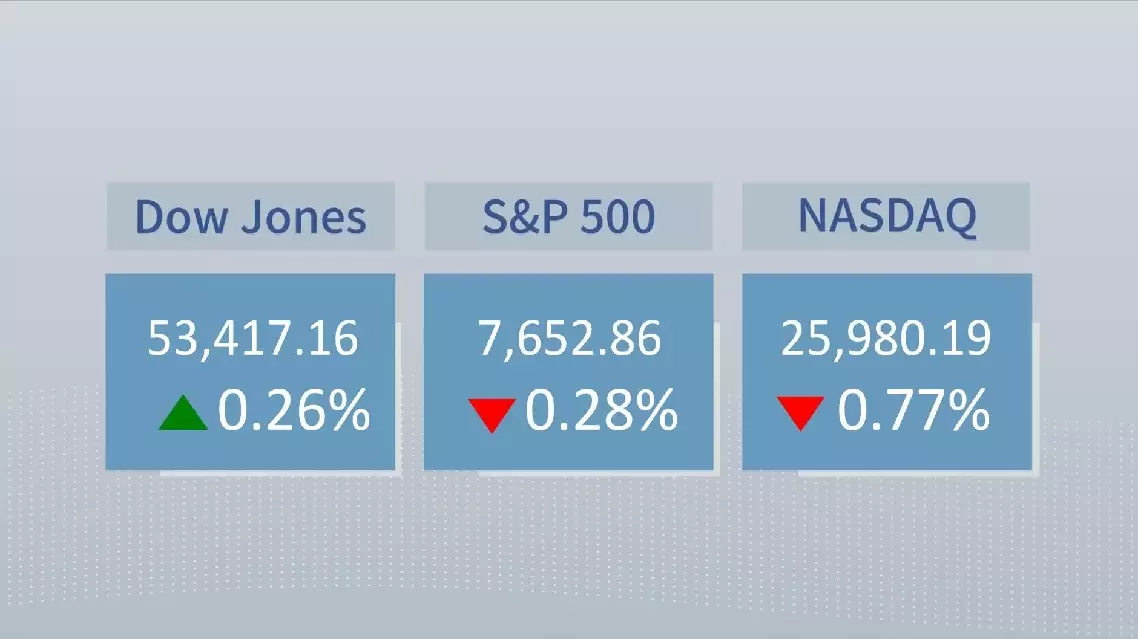
The Dow Jones Industrial Average rose 140.15 points, or 0.26 percent, to 53,417.16. The S and P 500 sank 21.51 points, or 0.28 percent, to 7,652.86. The Nasdaq Composite Index shed 200.264 points, or 0.77 percent, to 25,980.19.
Eight of the 11 primary S and P 500 sectors ended in the green, with consumer staples and financials leading the gainers by going up 1.76 percent and 1.24 percent, respectively. Meanwhile, technology and energy led the laggards by losing 1.59 percent and 0.76 percent, respectively.
The tech sector's pullback stemmed from broad weakness across chipmakers. Memory and semiconductor shares came under heavy pressure following weekend reports that graphics processor leader Nvidia plans to implement price hikes across select AI server configurations. SanDisk, Western Digital, SK Hynix, Micron Technology and Seagate Technology all finished lower.
Geopolitical developments dominated macroeconomic headlines as U.S. Treasury Secretary Scott Bessent on Monday threatened Iran with "an economic D-Day," announcing a wave of new sanctions aimed at further isolating the country.
On the trade front, U.S. President Donald Trump escalated trade frictions with Canada, announcing intentions to raise tariffs on Canadian cars, automotive parts and steel to 50 percent effective Jan. 1, 2027. The announcement weighed on domestic automotive equities, pulling shares of General Motors and Ford lower.
In corporate earnings disclosures, U.S.-listed shares of Chinese e-commerce firm PDD and electric vehicle maker XPeng declined 1.48 percent and 8.53 percent, respectively, following their latest quarterly financial reports.
Market attention is now converging on two critical catalysts later this week: Nvidia's highly anticipated second-quarter earnings release on Wednesday, expected to serve as a vital referendum on the ongoing AI investment cycle, and Federal Reserve Chair Kevin Warsh's scheduled address at the central bank's annual Jackson Hole Economic Policy Symposium.
U.S. stocks close mixed as chip stocks sink