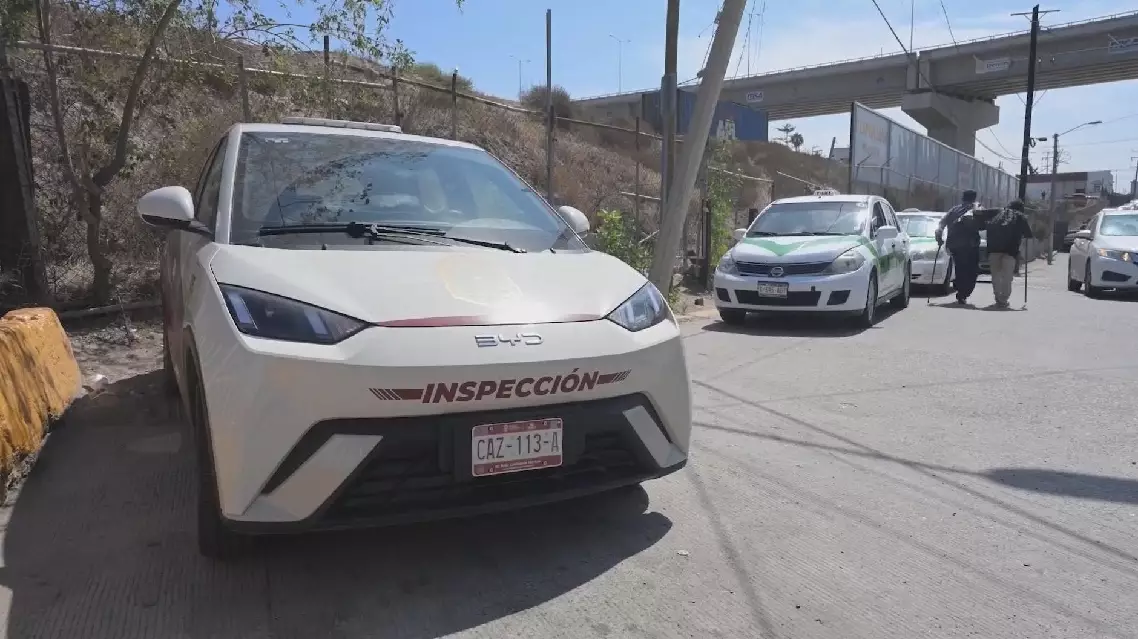
Chinese-made electric vehicles (EVs) are enjoying a sales boom in Tijuana, a Mexican border city with the United States, even as the same cars remain remarkably scarce in the neighboring U.S. state of California.
The trend has caused long lines to form at EV charging stations, as Tijuana's infrastructure is still catching up to the sudden spike in EV use.
"Charging can be a bit of a struggle, there are two chargers and about six cars waiting already," said Cesar Salazar, an EV user.
The surge in EV sales in Mexico has been brisk. Industrial data shows that a total of over 95,000 electrified vehicles were sold during the first half of 2026, marking a 44 percent rise from the same period in 2025, with Chinese manufacturers accounting for a large proportion of total sales.
On the Mexican side, Chinese-made electric cars are everywhere, accounting for roughly seven in ten EV sales nationwide. Across the border in California, by contrast, they remain a rare sight, effectively barred by the 100 percent U.S. import tariff.
That means buyers in Tijuana have access to newer, cheaper electric cars unavailable to their American neighbors.
Antonio Lopez works at one of this border city's three BYD dealerships. He said a large proportion of his customers come from north of the border.
"To buy a car here you must be a Mexican citizen or legal resident, and many Americans with dual-nationality come here, buy their car, register it in Mexico, and use it to cross the border," said Lopez.
Pablo Acevedo, who holds Mexican and American dual citizenship, crossed the border for that very reason.
"They should have these agencies over there. Gas is very expensive right now, and electric cars in the U.S. cost nearly double," Acevedo said.
For Uber drivers in Tijuana like Sergio Mata, the purchase of his first electric car has boosted his own earnings.
"I had a gasoline car which would cost 50 dollars to cover the same distance that this one does on a 10 dollar charge," said Mata.
While drivers celebrate the savings, the country as a whole is embracing the shift to electric vehicles as part of its broader shift towards green mobility. Under its National Initiative for the Electrification of Collective Public Transportation (INETPC), Mexico aims to electrify public transit systems nationwide.
Chinese EV market booms south of US border in Mexico
As China marks the 90th anniversary of the victory of the Long March, a roughly 12,500-kilometer military odyssey, German writer Christian Y. Schmidt shared his and fellow author Volker Haering's extraordinary cycling journey retracing the the historic route with local audiences in Germany.
The Long March (1934-1936) was a military maneuver by the Chinese Workers' and Peasants' Red Army that later became a defining episode in modern Chinese history, symbolizing endurance and perseverance as troops crossed some of the country's harshest terrain to establish a new revolutionary base. Some marched as far as 12,500 kilometers, enduring hunger, thirst and cold.
Schmidt and his friend, fellow writer Haering spent 138 days between 2023 and 2024, cycling nearly 7,000 kilometers along the historic route of the Chinese Red Army, starting from Ruijin County in east China's Jiangxi Province and heading northwest.
Their experiences have been compiled into a book titled "Der lange Fahrrad-Marsch: 7.000 Kilometer durch das Reich der Mitte".
Last week, Schmidt shared extraordinary journey with audiences at the Confucius Institute at Dusseldorf, drawing engagement from local attendees seeking fresh perspectives on Chinese modern history.
"I think we can take away an inspiration from this: As long as you keep moving forward, never give up, and always keep your eyes fixed on your goal, you will surely be able to keep going. And if you encounter difficulties along the way, you just have to find ways to overcome them," said Schmidt.
The presentation prompted reflections on endurance and modern development among the German audience.
"Mao Zedong once said, 'Nothing is impossible in the world if you dare to scale the heights.' I think this is precisely the spirit demonstrated during the Long March. Who could have imagined that after enduring such hardship, victory could still be achieved in the end? I think that is the lesson we can draw from it. In a sense, the memory of the Long March seems deeply etched into the genes of future generations," said Kneppel, an attendee.
"China's development is indeed nothing short of a miracle. China has achieved astonishing leaps in technological development. Driven by the government, China displays tremendous vitality, focus, and purposeful effort. The Chinese government unites people from all over the country to march toward the exact same goal, and I have witnessed this with my own eyes," said Maria, another attendee.
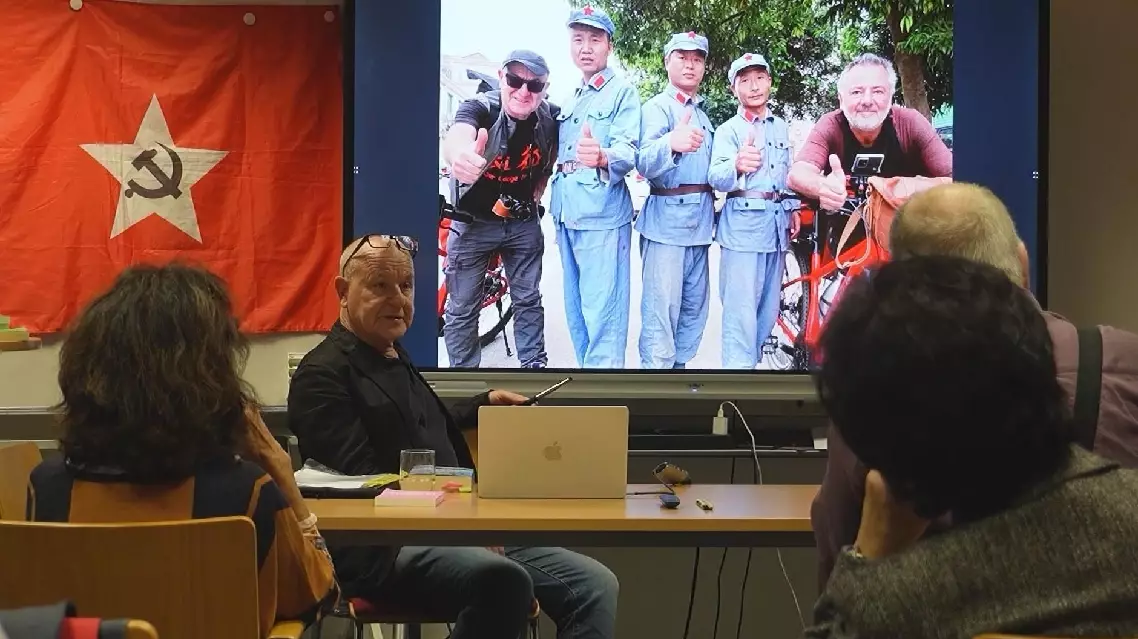
German writer shares 7,000 km Long March cycling journey with audiences