CAMPBELL, Calif.--(BUSINESS WIRE)--Aug 24, 2026--
Light Links, the optical wireless communication company behind Wi-OW™, announced it has closed $6 million in pre-seed funding to scale production and expand deployments across industrial automation and defense. The round was led by Outlander, with participation from Anorak, Output Capital, Mana, Crosscourt, and other well-known dual-use and defense-tech VCs whose portfolios include Anduril and SpaceX.
This press release features multimedia. View the full release here: https://www.businesswire.com/news/home/20260824893425/en/
Light Links’ Wi-OW replaces radio with invisible infrared light. Rather than competing for crowded radio spectrum, Wi-OW transmits data as diffused laser light that reflects off walls and ceilings, so it works even when the direct path is blocked. The light stays inside the room, so no outside device can interfere, and each device gets a guaranteed slot to transmit.
The system can be implemented without significant operational changes; it is built on the same mass-produced components already deployed throughout global fiber networks, plugs in like a dongle, and uses standard Ethernet. Light Links reports throughput up to 25 Gbps symmetrical and microsecond-scale round-trip times.
“Wireless networks are no longer keeping pace with what we’re asking them to do,” said Firouz Vafadari, founder and CEO of Light Links. “Whether we’re depending on a network to communicate across a fleet of robots in a warehouse or to keep a drone on mission for national defense, that network is still built on devices politely taking turns, colliding, and retrying. Light, on the other hand, gives us wireless that performs like a wired connection.”
What This Means for Industrial Automation
Wi-Fi and private 5G were designed for best-effort traffic, not for physical AI, modern robotics and autonomous vehicles that need an answer in milliseconds.
In these applications, each node works like part of a body connected to a larger nervous system. Each node may sit meters or kilometers apart, but they must reach the central brain and react almost instantly. Without microsecond latency, physical AI and robotics cannot scale.
Light Links has validated Wi-OW with a Fortune 50 company, where the technology is now replacing Wi-Fi in live operations.
What This Means for Defense
In defense applications, radio transmissions can reveal location, making transmission in contested environments a risk in itself, while adversaries routinely employ jamming and spoofing. RF emissions are also subject to strict HERO (Hazards of Electromagnetic Radiation to Ordnance) requirements in sensitive environments, including aircraft carrier flight decks such as those aboard the USS Gerald R. Ford (CVN-78), where ordnance and electromagnetic systems operate in close proximity.
Wi-OW carries data on light instead of radio, so there is no radio signal for an adversary to detect or jam. That makes it inherently low probability of intercept and low probability of detection. Light Links is also developing optical identification of friend or foe for drone platforms.
“Wireless communication has been living inside the limits of radio frequency for decades,” said Jordan Kretchmer, Senior Partner at Outlander VC. “Light Links diffuses light across a space the way a router diffuses RF signals. The difference is that everything inside that space gets fiber-optic speed without ever touching a cable. Firouz and his team understand that for mission-critical secure applications, the future of communications is wireless at the speed of light. This is exactly the type of category-defining advancement Outlander lives to back.”
About Light Links
Light Links, Inc. is a Silicon Valley optical wireless communication company behind Wi-OW™, a diffused laser network that delivers fiber-like speed, microsecond latency, and RF-free operation for industrial automation, robotics, defense, and secure enterprise environments. Founded in 2024 and headquartered in Campbell, California, Light Links is backed by numerous reputable U.S.-based defense-tech and dual-use institutional investors. Learn more at www.lightlinks.co.

The Light Links Team with Daniel Furtado (third from left), Mayor of Campbell.
TEHRAN, Iran (AP) — Iran’s currency hit a record low Monday as Washington prepared to announce new sanctions it said would put more pressure on an economy already battered by previous sanctions and a U.S. naval blockade.
The rial dropped to 2.02 million to the U.S. dollar as trading opened on currency markets. Iran’s official Central Bank rate stood at around 1.5 million rial to the dollar, but the market rate is what most Iranians pay.
The currency had already been under pressure before the U.S. and Israel attacked Iran on Feb. 28, as Iran faced double-digit inflation and negative growth. The rial has repeatedly hit new lows as nearly six months of war have taken an even greater toll.
Iranians find daily staples increasingly unaffordable. Since the war began, rice is up some 60% and beef prices are more than 150% higher. The International Monetary Fund forecasts that gross domestic product will contract more than 5%.
Still, economic pressure has not yet translated into political pressure. Iran retains a key strategic advantage: Its attacks and threats on ships in the Strait of Hormuz have brought traffic in the vital waterway to a near halt, damaging the world economy and heaping pressure on U.S. President Donald Trump ahead of congressional elections.
The war, as a result, has devolved into a fight over who controls the strait, through which a fifth of the world’s traded oil transited before the conflict. Iran is now refusing to fully reopen it unless it can charge ships.
Iran and Oman, which is on the opposite side of the strait, are reportedly in the final stages of agreeing on a plan for joint management of the waterway. Oman’s foreign minister is set to visit Iran on Tuesday.
In an attempt to break the impasse, Trump's administration promised even stronger sanctions would be announced Monday, including secondary sanctions on countries that continue to do business with Iran.
Ahead of the announcement, Trump posted on social media that “IRAN IS COMPLETELY COLLAPSING!!!”
“President Trump decimated Iran’s economy to a point where the rial has never been weaker and inflation has rarely been higher,” U.S. Treasury Secretary Scott Bessent wrote Sunday in an opinion piece in the Financial Times. “The regime’s final refuge now lies in the self-deception of fearful nations that still believe accommodating aggression can secure a durable peace.”
Already last week, the United Arab Emirates announced that it was suspending all trade with Iran. The UAE has long been one of Iran’s largest trading partners and its biggest source of imports.
Iranian Foreign Ministry spokesperson Esmail Baghaei told reporters in Tehran on Monday that “any escalation of this situation will undoubtedly bring about consequences."
“Our hands are not tied,” he added.
Pakistan, which played a key role in brokering a 60-day ceasefire in June, sent a high-level delegation to Iran on Monday to encourage the U.S. and Iran to return to negotiations, two senior officials said. The officials spoke on condition of anonymity because they were not authorized to speak to the media on the record.
The military confirmed only Field Marshal Asim Munir’s visit, saying it was aimed at deescalating tensions in the region.
Trump spoke with Munir ahead of the army chief’s visit to Iran, according to a person familiar with the discussion. The person spoke on condition of anonymity to confirm a private conversation. Reuters, citing Pakistani sources, first reported the call.
Munir met Iranian Interior Minister Eskandar Momeni in Tehran, according to the two senior officials. Munir was accompanied by Pakistani Interior Minister Mohsin Naqvi and other officials. Munir was expected to remain in Iran overnight and meet the Iranian president and other senior officials before returning to Pakistan.
His previous visit to Tehran in May helped pave the way for a memorandum of understanding signed by the U.S. and Iran in June.
In downtown Tehran, 73-year-old Sadegh Mahmoudi did not hold out hope for a resolution. He joined a line of about a dozen people to purchase U.S. dollars with his remaining savings to hedge against further declines.
“There is no hope for a deal and peace,” he said.
Rising reported from Dubai, United Arab Emirates. Associated Press writers Seung Min Kim in Washington and Munir Ahmed in Islamabad contributed.
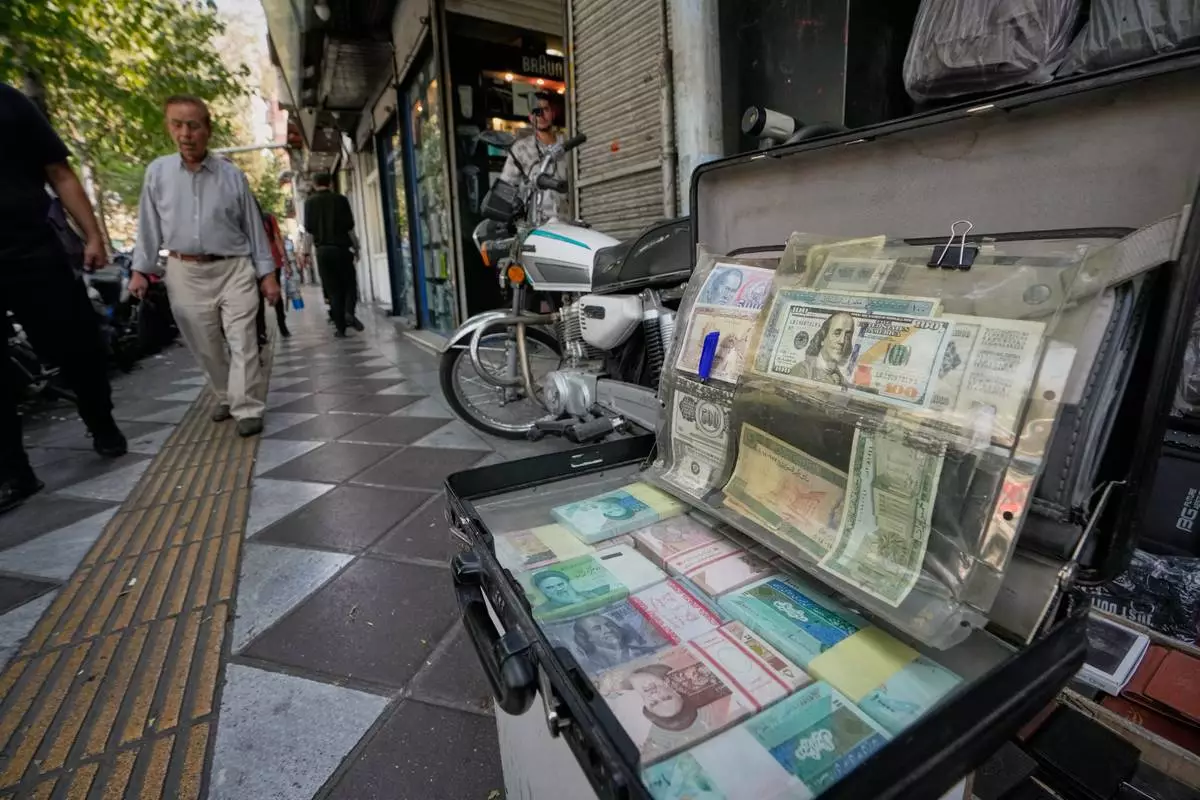
Pedestrians walk past a sidewalk display of Iranian currency and vintage banknotes at Ferdowsi Square, a hub for foreign currency trading in downtown Tehran, Iran, Monday, Aug. 24, 2026. (AP Photo/Vahid Salemi)
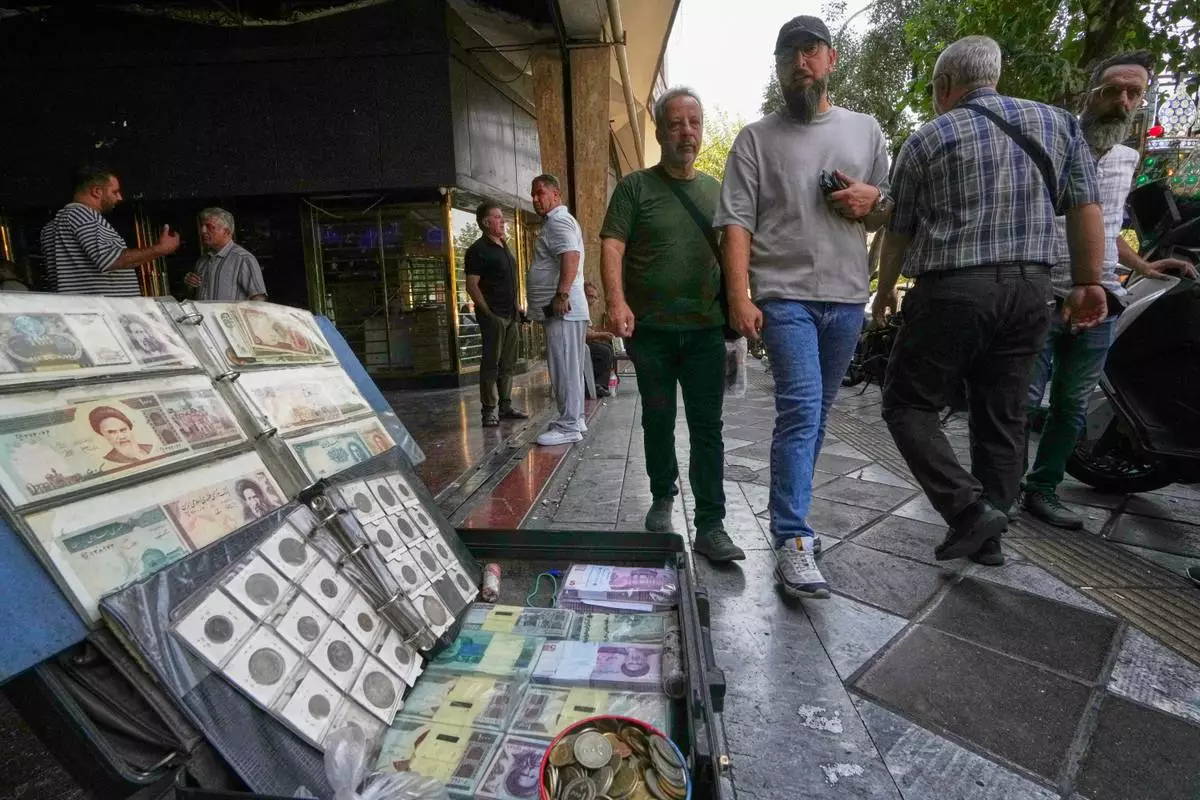
Pedestrians walk past a sidewalk display of Iranian currency and vintage banknotes and coins near Ferdowsi Square, a hub for currency trading in downtown Tehran, Iran, Monday, Aug. 24, 2026. (AP Photo/Vahid Salemi)
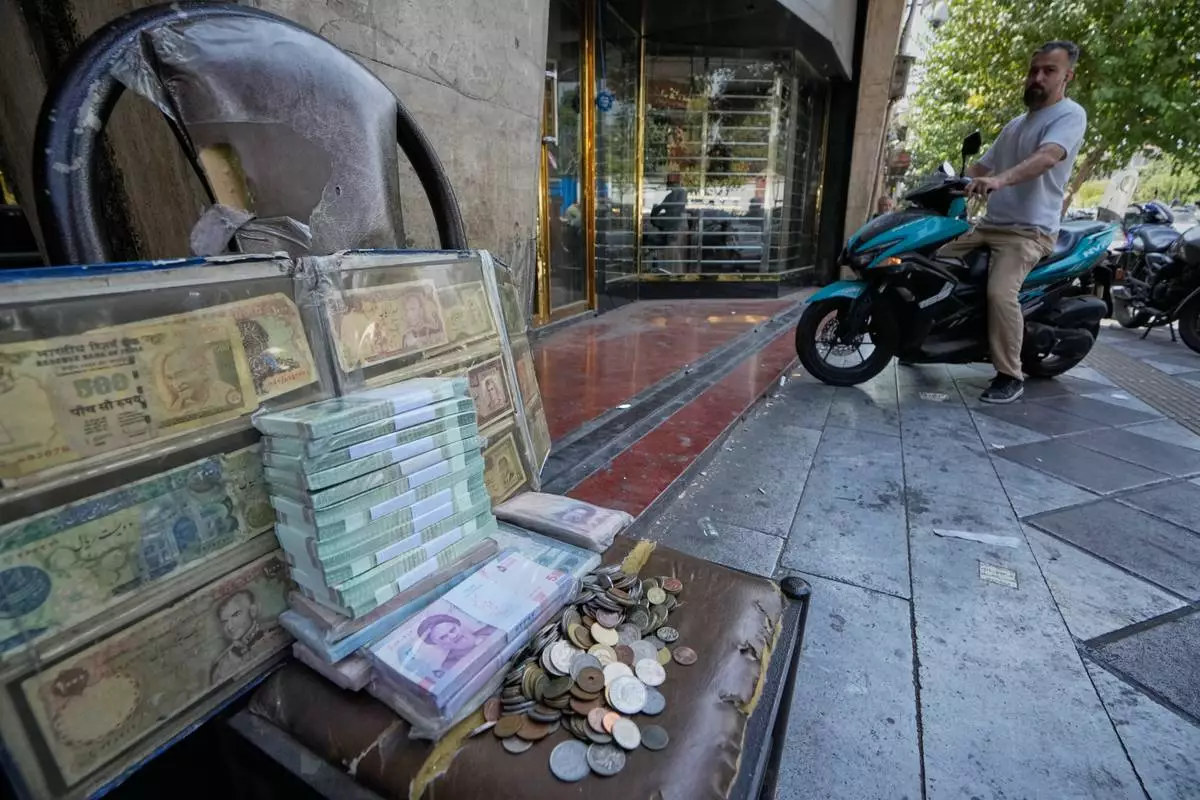
A man parks his motorcycle beside a sidewalk display of current and pre-revolutionary Iranian banknotes near Ferdowsi Square, a hub for foreign currency trading in downtown Tehran, Iran, Monday, Aug. 24, 2026. (AP Photo/Vahid Salemi)
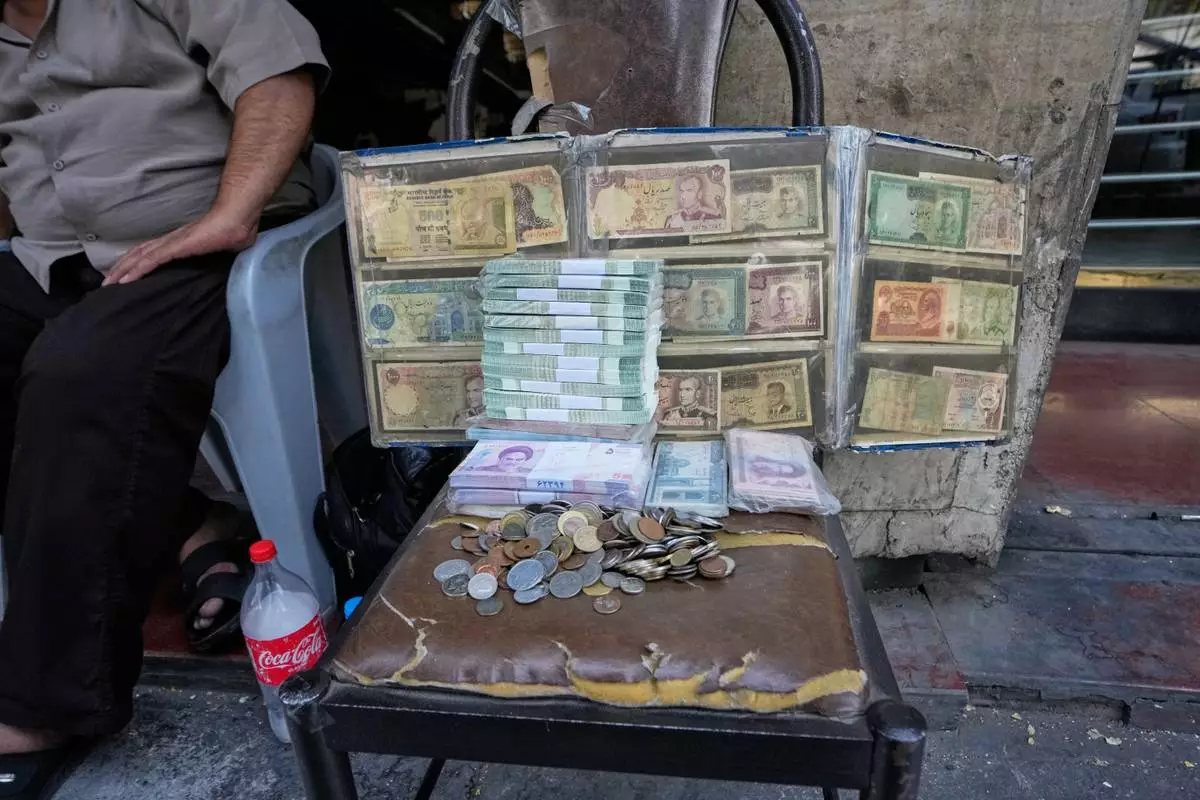
Current and pre-revolution Iranian banknotes are displayed by a street money exchanger at Ferdowsi square, a hub for foreign currency trading in downtown Tehran, Iran, Monday, Aug. 24, 2026. (AP Photo/Vahid Salemi)
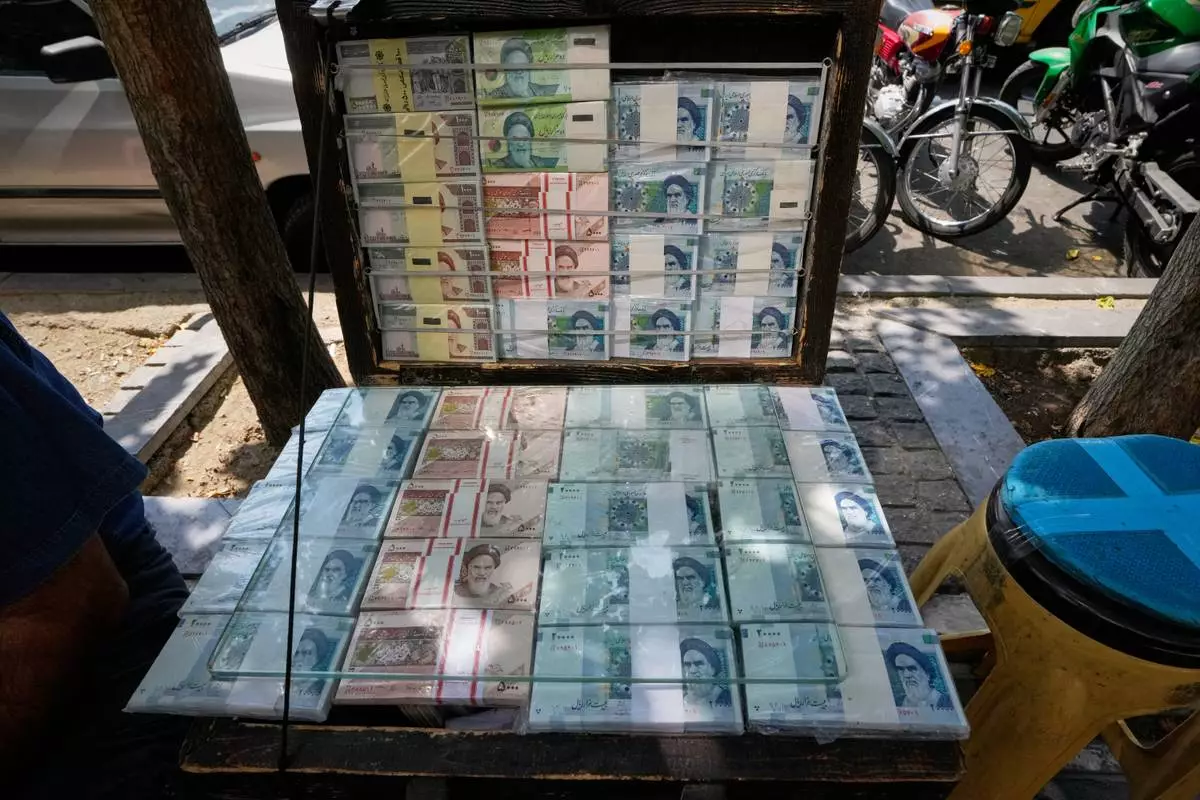
Iranian banknotes are displayed by a street money exchanger at Ferdowsi square, Tehran's go-to venue for foreign currency exchange, in downtown Tehran, Iran, Monday, Aug. 24, 2026. AP Photo/Vahid Salemi)
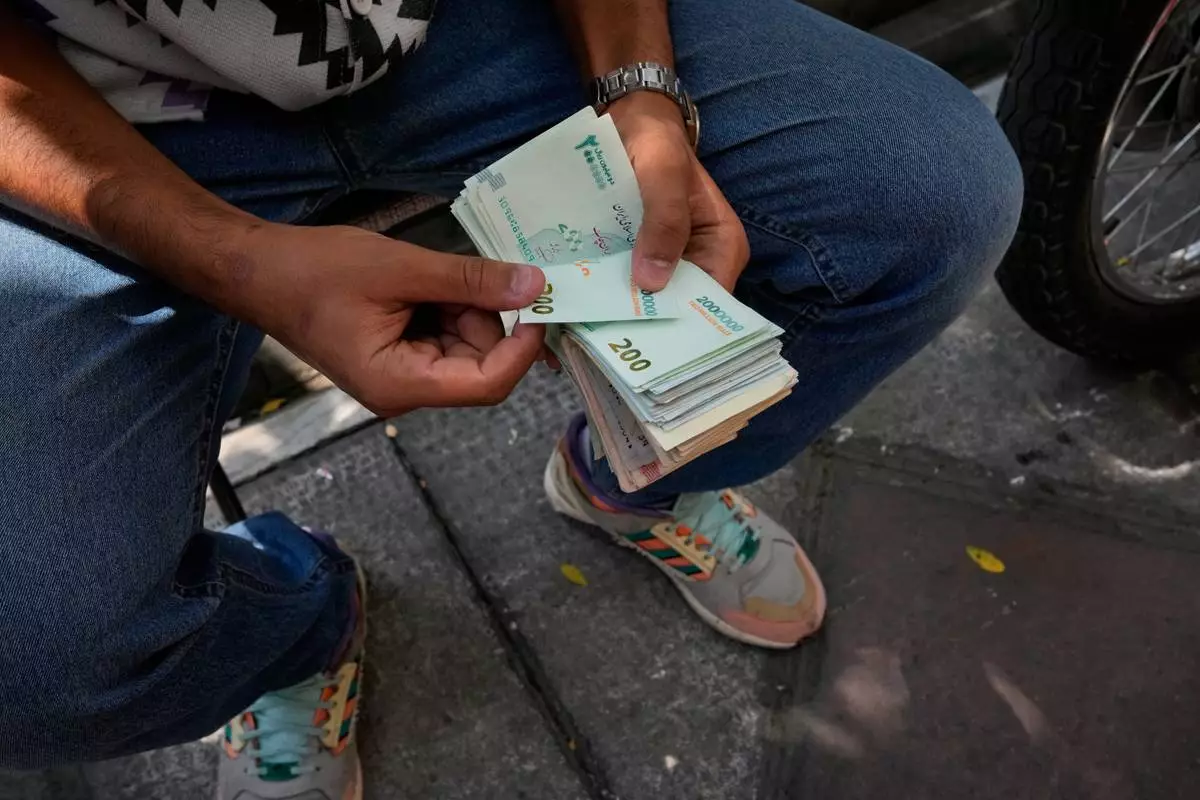
A money exchanger counts Iranian banknotes at Ferdowsi square, Tehran's go-to venue for foreign currency exchange, in downtown Tehran, Iran, Monday, Aug. 24, 2026. AP Photo/Vahid Salemi)
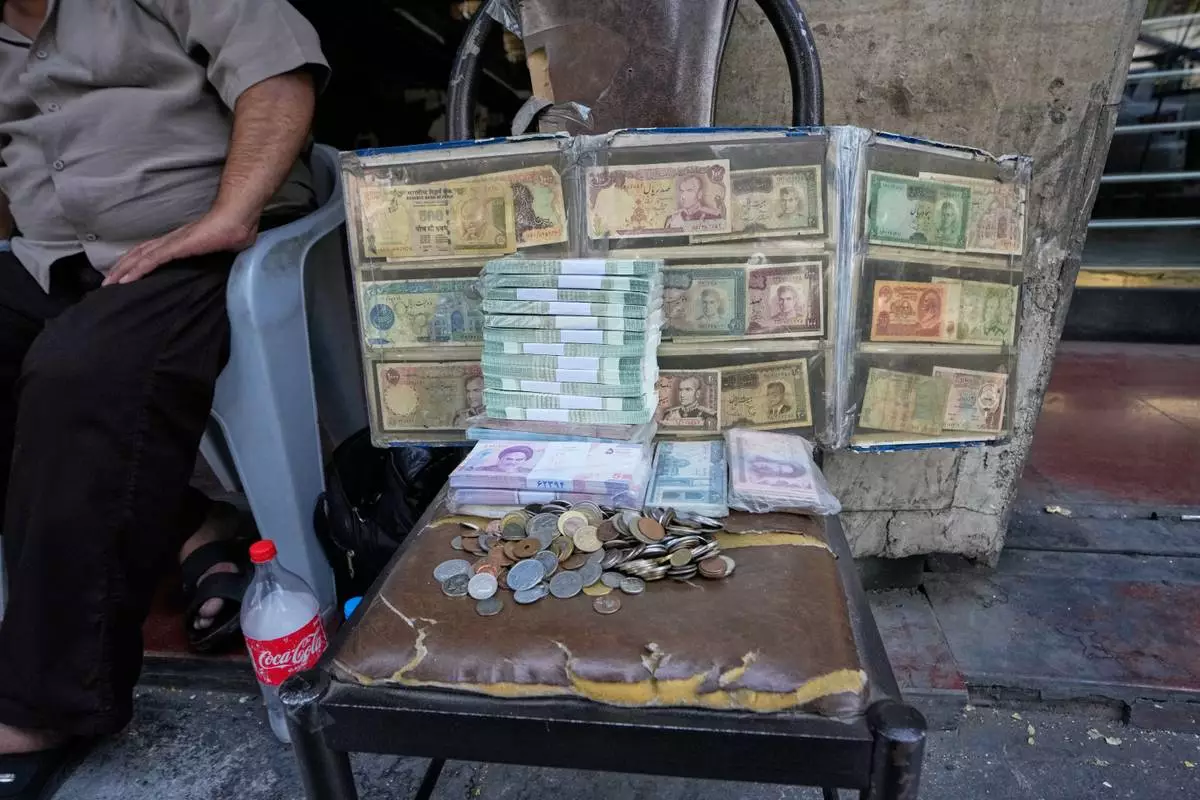
Current and pre-revolution Iranian banknotes are displayed by a street money exchanger at Ferdowsi square, Tehran's go-to venue for foreign currency exchange, in downtown Tehran, Iran, Monday, Aug. 24, 2026. AP Photo/Vahid Salemi)
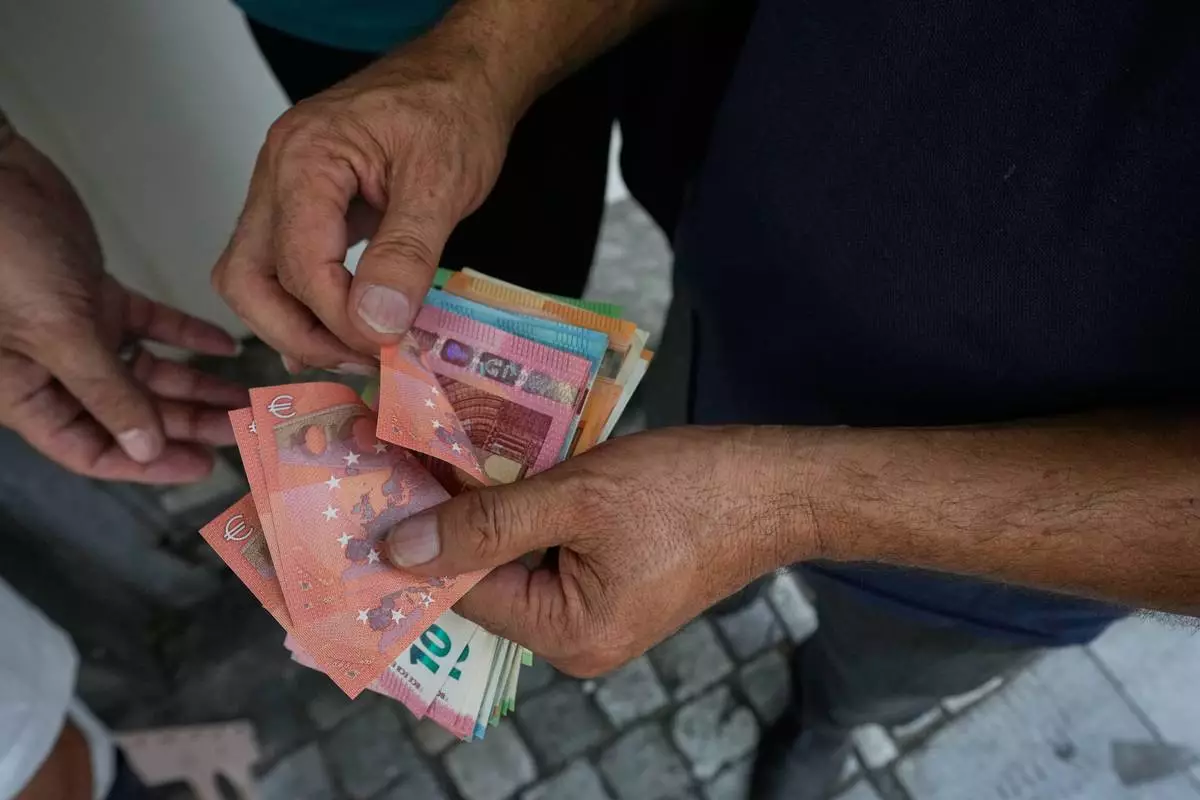
A money exchanger counts Euro bank notes at Ferdowsi square, Tehran's go-to venue for foreign currency exchange, in downtown Tehran, Iran, Monday, Aug. 24, 2026. AP Photo/Vahid Salemi)