At the ongoing 2nd World Humanoid Robot Games in Beijing, Chinese robots showcased exceptional force control in the nail-hammering challenge, underscoring their immense potential for real-world industrial applications.
At the competition venue, robots stands at a workstation holding a hammer in their right hand and a nail in their left. The task requires the machine to place the nail vertically on a corkboard and hammer it into a designated target point.
According to the competition rules, a successful strike requires the nail to be fully driven into the board, with no protruding head and no obvious bending. The final score is determined by the number of valid nails hammered within a five-minute window.
The main difficulty of the task lies in the robot's ability to precisely position the nail and maintain a perfectly vertical strike.
"The initial strike to secure the nail is crucial. The robot must first fix the nail into the corkboard before it can wield the hammer in its right hand for subsequent strikes. This is a major technical hurdle. During the competition, we see many nails driven in at an angle. Under our rules, angled nails won't be counted into the final score, which truly tests the robot's force control capabilities," said Wang Shilong, a referee of the games.
The rapid robotic advancements on display have left audiences deeply impressed.
"Watching the competitions this afternoon, I can feel how rapidly robot technology is developing. Their forms and movements are already incredibly close to those of humans. It's quite interesting to watch, and it makes you feel that robots could be highly effective in taking over dangerous jobs in the future," said Zhao Chen, a spectator.
Running from Saturday to Wednesday, the games have attracted 666 teams and 2,056 robots from 16 countries and regions across six continents, with team participation quadrupling from the inaugural edition last year.
The event features 51 competition items divided into two main categories: competitive matches and scenario-based challenges.
The competitive category includes athletics, football, gymnastics, weightlifting, martial arts, street dance, and tug of war, while the scenario-based category is set in real-world environments, namely factories, hotels, homes, emergency response sites, hospitals, and retail spaces.
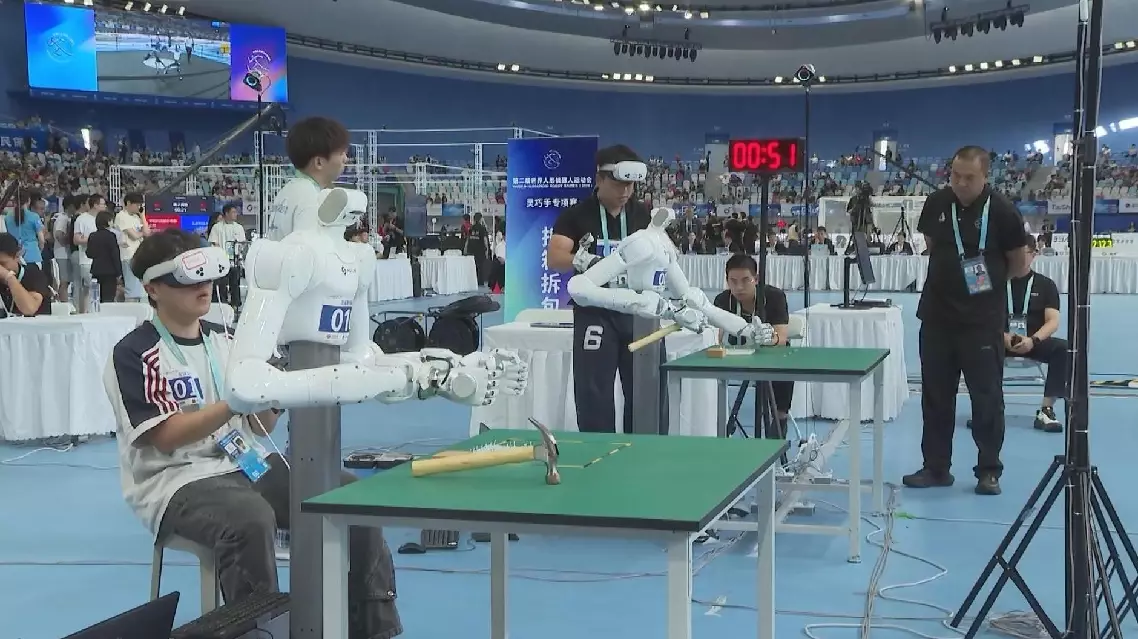
Robots compete to hammer nails with precision at humanoid robot games in Beijing