Service expansion of The Chinese Medicine Hospital of Hong Kong includes launch of 24-hour inpatient services from mid-December
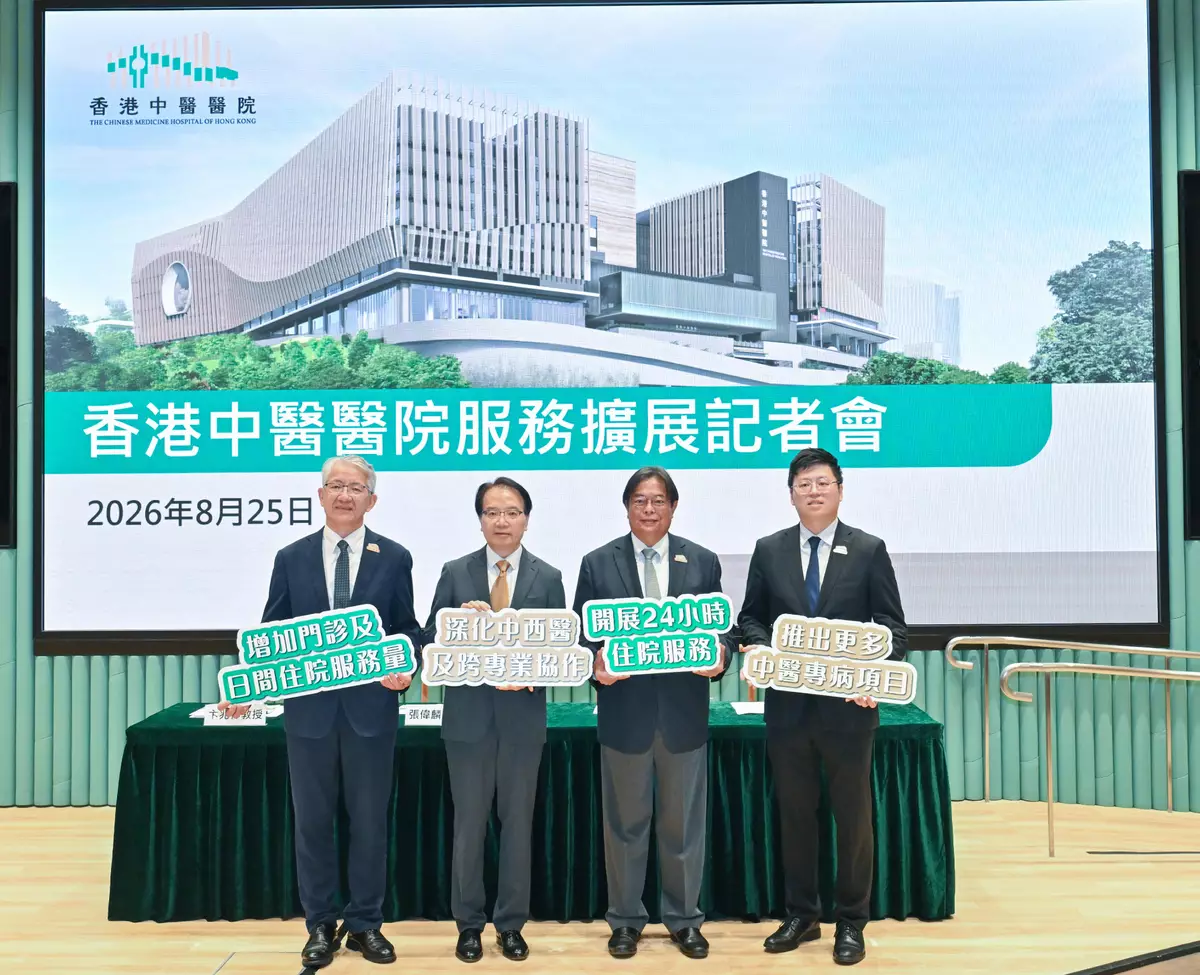
The Health Bureau (HHB) and the Operator of The Chinese Medicine Hospital of Hong Kong (CMHHK) announced today (August 25) the service expansion plan of CMHHK, including the launch of 24-hour inpatient services on December 11, and the introduction of 10 additional special disease programmes by year end. The extension of coverage under the Voluntary Health Insurance Scheme to inpatient services of CMHHK will also start next year.
The Secretary for Health, Professor Lo Chung-mau, said, "As the local flagship Chinese medicine institution, CMHHK has made good progress in various areas including healthcare services, training and education, research, collaboration, and creating health values, since its service commencement last year. Members of the public generally have positive feedback on the environment and professional services of the hospital. In just over eight months since commencing operation, the hospital has already increased the quota for government-subsidised outpatient services four times to meet keen public demand. The provision of 24-hour inpatient services commencing in mid-December will further advance Hong Kong's Chinese medicine services from primary healthcare to secondary and tertiary healthcare services, marking a significant breakthrough in the development of Chinese medicine."
Launch of 24-hour inpatient services
CMHHK will roll out its 24-hour inpatient services in phases starting from December 11, covering both government-subsidised and market-oriented services. In the first phase, the hospital will provide 93 inpatient beds, 20 beds under the Clinical Trial and Research Centre, and two high dependency beds. It is expected that by the end of 2030, the hospital will provide a total of 400 beds.
In addition, the hospital will expand its outpatient and day-inpatient services progressively as planned. The annual outpatient service volume of the hospital is expected to rise from 140 000 attendances in the first year to over 260 000 in the second year of operation while day-patient services will increase from 25 beds to 35 beds. The hospital will also strengthen its radiological diagnostic services (including computed tomography, magnetic resonance imaging and ultrasound) and pathology laboratory services.
Expansion of special disease programmes
Adhering to the principle of "pursuing speciality in specialised Chinese medicine services and exceling in special disease programmes", CMHHK will fully launch six specialised Chinese medicine services and 12 special disease programmes in its first year of operation. Following the introduction of the Post-stroke Care Programme and the Low Back Pain Care Programme in July, CMHHK will launch 10 additional special disease programmes in September and November (see Annex 1). Other special disease programmes will also be rolled out progressively as planned. By leveraging the strengths of Chinese medicine and the complementary advantages of Chinese and Western medicine, the multidisciplinary team of the hospital will provide patients with highly effective treatment to enhance clinical outcomes.
Fee arrangements
CMHHK will continue to provide both government-subsidised and market-oriented services, and will adopt existing charging principles and approaches applicable to outpatient and day-patient services, ensuring continuity and consistency in the fee arrangements. The fee levels have been set after taking full account of factors such as market prices, public affordability and service costs, with a view to ensuring members of the public can access the services at reasonable and affordable prices.
The hospital will continue to adopt fee models including package charges, simplified itemised charges and combined charges on 24-hour inpatient services to enhance fee transparency, enabling members of the public to better manage their estimated hospitalisation expenses. This approach also encourages them to select services according to their actual needs and make optimal use of resources. Under the market-oriented service arrangement, package charges on special disease programmes will be introduced for both 24-hour and day-patient services to offer the public a choice.
Details of the fees for relevant services are set out in Annexes 2 and 3.
Fee waiver arrangements
A medical fee waiver mechanism is in place in CMHHK to ensure that patients with financial difficulties are able to access its services.
Voluntary Health Insurance Scheme
Regarding health insurance, the Voluntary Health Insurance Scheme (VHIS) will cover inpatient services provided by CMHHK. Insurance companies will launch Certified Plans (Chinese Medicine), with a view to providing an additional insurance option for members of the public who have already taken out Western medicine-based inpatient coverage. There are two types of Certified Plans (Chinese Medicine):
(1) Standard Plan (Chinese Medicine): setting out the minimum compliance requirements for Certified Plans (Chinese medicine), with inpatient coverage limited to CMHHK only; and
(2) Flexi Plan (Chinese Medicine): allowing insurance companies greater flexibility in product design to offer additional protection on top of the minimum compliance requirements, such as higher benefit limits and/or broader benefit coverage (e.g. extending coverage to other hospitals), to cater for the needs of different consumers.
All insurance companies participating in the VHIS are required to make available at least one Standard Plan (Chinese Medicine) for consumers' choice, with a target to roll out the relevant products in phases starting from March 2027. In addition, insurance companies may progressively launch Flexi Plans (Chinese Medicine) in accordance with their business considerations and development directions. Insurance companies can choose to offer Certified Plans (Chinese Medicine) to consumers as riders (i.e. attached to Certified Plan Policies) or as standalone products. The HHB will maintain close liaison with insurance companies and, upon receipt of the relevant product information, vet the applications to confirm their eligibility for certification, so that Certified Plans (Chinese Medicine) can be launched in the market in an orderly manner.
Members of the public may visit the hospital's website (www.cmhhk.org.hk) for latest updates on service developments and relevant charging arrangements of CMHHK.
Service expansion of The Chinese Medicine Hospital of Hong Kong includes launch of 24-hour inpatient services from mid-December Source: HKSAR Government Press Releases