TEL AVIV, Israel--(BUSINESS WIRE)--Aug 25, 2026--
Addionics, a pioneer in advanced battery architecture, today announces a new Battery Architecture for Low-Temperature Performance, a ground-breaking smart battery architecture designed to increase battery operations and charging capabilities at low temperatures. The new technology enhances the performance of electric vehicles, trucks, defense drones, and space and electric aviation in cold weather, where traditional lithium-ion batteries decline. Some of the benefits of the new architecture include extended mission capabilities, increased usability range, faster charging, and overall enhanced performance in low temperatures.
This press release features multimedia. View the full release here: https://www.businesswire.com/news/home/20260825564699/en/
With this new technology, Addionics is addressing the pain point of the market. With enhanced battery performance, the door is now open for companies to expand to new markets, applications, and widen their activity in places and sectors that were once not possible. Traditional batteries that decline at low temperatures create costly and complex limitations. Batteries at low temperatures in electric vehicles provide less usable energy, while the vehicle consumes more energy for cabin heating, battery heating, and thermal preparation before charging. As a result, in severe winters an electric vehicle can lose up to an estimated 40% of its range. Electric semi trucks require tremendous power from the battery since a loaded truck carries substantial weight and drives at a consistently high speed on the highway; reduced power from cold weather could demand reducing the payload or avoiding routes in the winter. Additionally, freezing conditions can shorten defense drones' mission time, reduce operational radius, and limit the power available for launch and maneuvering. For space missions, keeping batteries at the right temperature in cold conditions requires heater energy, thermal hardware, and additional stored energy. Reducing the battery’s heating requirement can create benefits across the complete spacecraft power system, including the battery, solar array, and launch mass.
Addionics Smart 3D Porous Current Collectors change the internal transport architecture of the battery. The porous structure allows electrolyte and lithium ions to move through the current collector plane, creating additional access pathways throughout the electrode. This reduces effective transport distances, improves active-material accessibility, and distributes electrochemical activity across a larger volume. By improving how ions, electrons, and electrochemical reactions are moving inside the cell, the technology enables batteries to retain more of their intended performance when temperatures decrease.
“By transforming the architecture of the battery cell, Addionics is removing some of the largest limitations that electrified systems have faced,” says Dr. Moshiel Biton, CEO and Founder of Addionics. “Batteries need to perform optimally in all locations and temperatures so that the products they power can be relied upon consistently. Addionics is at the forefront of making the once unachievable possible. We are enabling the always-on world to operate - all of the time, anywhere, even in the cold.”
Addionics continues to redefine battery performance through advanced architecture. The company collaborates with leading global companies across robotics and physical AI- related applications, including defense, space, automotive, energy storage, and next-generation industrial applications.
For more information about the Battery Architecture for Low-Temperature Performance, please visit here.
About Addionics
Addionics is redefining battery performance through advanced smart metal architecture. The company’s proprietary Smart 3D Porous Current Collectors replace conventional flat metal foils with an engineered three-dimensional structure that transforms how batteries manage current, heat, and mechanical stress from within the cell. Compatible with existing and emerging battery chemistries and manufacturing processes, Addionics’ technology enables higher energy density, faster charging, greater power capability, longer lifetime, improved safety, and more efficient manufacturing. As the world transitions to an AI-driven, always-on future, Addionics is building the battery architecture designed to power the next generation of autonomous systems, robotics, EVs, defense and aerospace.

Addionics Battery Architecture for Low-Temperature Performance
AUSTIN, Texas--(BUSINESS WIRE)--Aug 25, 2026--
Infravision, the company transforming how power grids are built and maintained with drone-enabled technology, today announced the appointment of veteran transmission construction leader Paul Gillespie as Director, Transmission Solutions. Gillespie will support the global deployment of drone and robotic systems across overhead transmission construction.
This press release features multimedia. View the full release here: https://www.businesswire.com/news/home/20260825193501/en/
At Infravision, Gillespie will lead the U.S. 765 kV transmission construction program. He will also oversee transmission solution development, customer engagement, constructability reviews, deployment planning, technology implementation, customer success, and workforce training programs supporting technology adoption for utilities and EPC contractors across global markets. As Director, Transmission Solutions, Gillespie will serve in a critical leadership role, guiding a global team of more than 150 people, with military veterans playing key roles across engineering, avionics, field operations, and project management.
“We are scaling fast, and the question now is how quickly we can put proven drone-enabled construction systems into the hands of the crews building tomorrow's power grid,” said Matt Jones, Chief Commercial Officer of Infravision. “Paul has led those teams. He's spent decades helping customers adopt new construction methods and solve some of the industry's toughest delivery challenges. That's exactly the experience our customers need as they integrate new approaches into their operations.”
“Innovation delivers its greatest value when it's grounded in practical construction experience,” said Gillespie. “What drew me to Infravision is that this system is already deployed on real projects, with real crews, delivering real results. In my role, I'll be focused on extending my market leading experience to scale how the technology fits the actual construction happening in the field.”
Gillespie brings more than 30 years of the highest levels of international experience delivering complex transmission projects from 132 kV through 765 kV. Prior to joining Infravision, he served as Construction Manager at Cormorant Utility Services (PowerTel) in Ontario, Canada, where he spent over five years leading transmission line construction and planning and executing major transmission infrastructure projects for utilities, renewable energy developers, and industrial clients.
During his tenure, Gillespie played a critical role in the successful delivery of high-profile transmission projects, renewable energy interconnections (including 500 kV, 230 kV, and 115 kV line projects), and major grid modernization initiatives. His responsibilities extended beyond construction management to include constructability reviews, execution strategy, project planning, stakeholder engagement, workforce development, and operational excellence.
Gillespie began his career as a transmission linesman and progressed through supervisory and senior construction management roles, leading multidisciplinary teams of more than 100 personnel across construction, EPC, and ECI project delivery models. His work has spanned Canada, the United Kingdom, Europe, Australia, and India, including support for planning, constructability, deployment strategy, customer engagement, and training for India's expanding 765 kV network, one of the largest extra-high-voltage transmission programs in the world.
In the United States, transmission construction is entering a period of unprecedented growth. To meet the demands of both large-load and public-service needs, high-capacity lines are necessary. At the highest levels of 765 kV, most of the U.S. infrastructure was built in the 1960s and 1970s. There have been no meaningful 765 kV projects completed in the United States in the last 25 years. This has created a critical resource gap in the skills, knowledge, and expertise necessary to meet this demand. As of 2026, over 9,000 miles of new U.S. 765 kV construction projects have been announced or proposed for completion over the next 10 years. Gillespie’s extensive international experience constructing 765 kV transmission lines – combined with his exceptional experience with drones and aerial robotics, as well as modern construction methods – makes him uniquely qualified to help address this critical resource gap.
Gillespie will join a distinguished executive team that has expanded significantly since the company's $91 million Series B led by GIC, which included the appointment of Frank Tybor as Chief Technology Officer – a veteran aerospace and mechanical engineer who helped design and commission SpaceX's launch and recovery infrastructure, including the autonomous Droneships and Crew Dragon recovery systems.
About Infravision
Infravision is transforming how the world builds and maintains power grids. Its proprietary drone-enabled system helps utilities, contractors, and developers expand transmission and distribution infrastructure faster, safer, and at significantly lower cost, with far less environmental and community impact. Infravision has installed more than 2,000 miles of line across four countries for utilities including Powerlink, Transgrid, and PG&E. In 2026, Infravision was named one of Fast Company's Most Innovative Companies. For more information, visit infravisioninc.com.
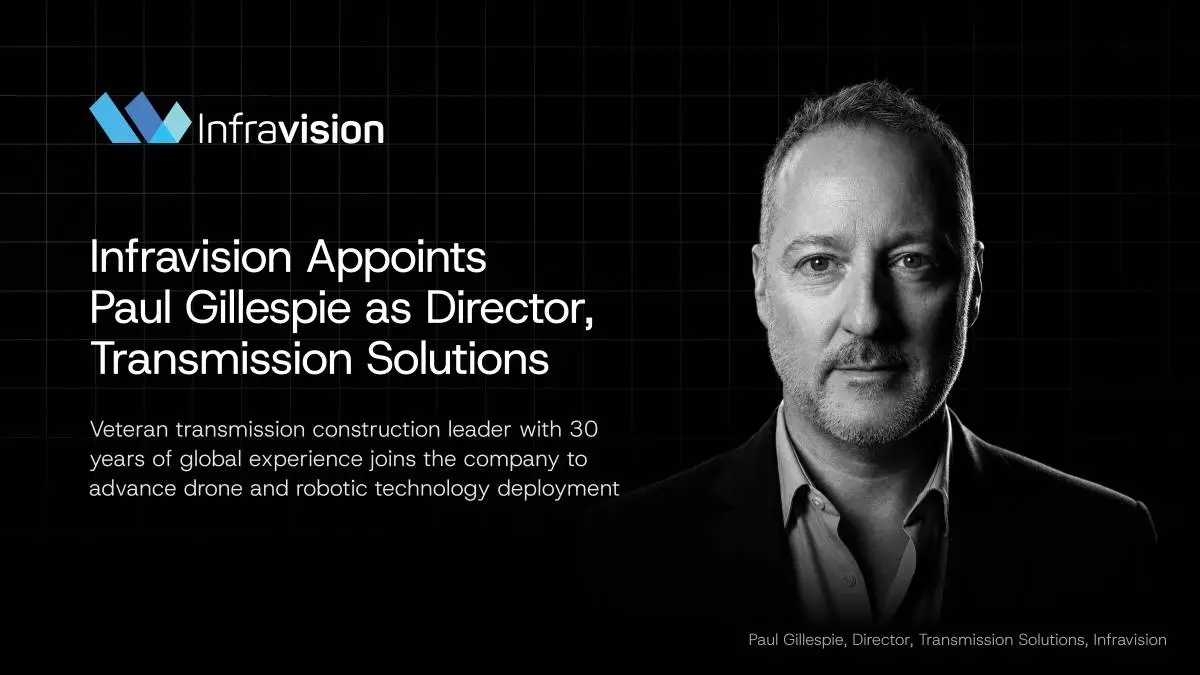
Infravision Announces the Appointment of Paul Gillespie as Director, Transmission Solutions