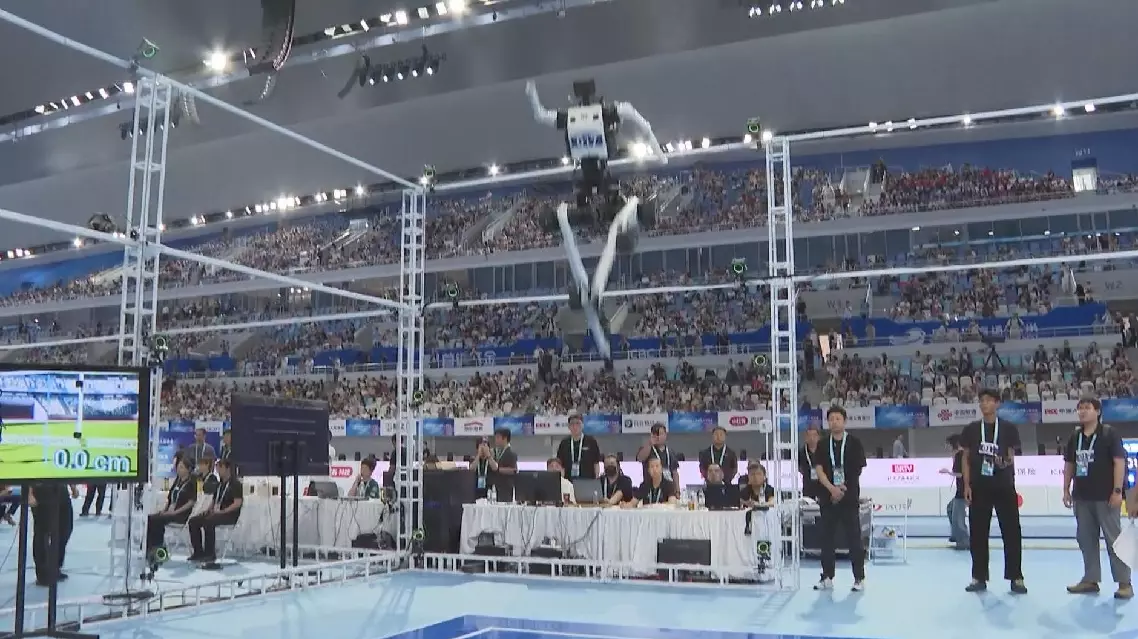
The standing high jump final of the 2nd World Humanoid Robot Games concluded Tuesday at Beijing's National Speed Skating Oval, widely known as the "Ice Ribbon", pushing the limits of robotic mobility and paving the way for broader real-world use cases.
The final event set stringent benchmarks for the overall motion performance of competing machines.
Every stage of a jump, from stationary two-foot takeoff to mid-air posture control and steady landing, demands robust power output from leg systems, precise balance regulation and effective shock absorption, posing high requirements for both mechanical hardware and control algorithms.
Under official rules, each robot was given 10 minutes to complete three attempts, with the highest valid score taken as the final result.
A valid jump must be executed within a 3×3-meter competition zone, with the robot taking off from a standing position and landing smoothly inside the area.
Scores were calculated based on the vertical height between the lowest point of the robot's body and the ground at the jump's apex, while acrobatic flips are banned.
Professional cameras installed around the arena captured real-time data to ensure accurate and fair judging.
Nearly 20 robots qualified for the final showdown. After intense rounds of competition, Team Tianzhuo from the Beijing Humanoid Robot Innovation Center took the top spot with a 3.4-meter leap.
Participating researchers said the event raises the technical bar for algorithms governing lower-limb force and balance, and serves as a key catalyst to expand humanoid robots' application boundaries in real-world scenarios.
"Looking ahead, we aim to develop applications for high-risk rescue operations and heavy cargo handling, assisting humans in saving time and effort," said Wang Jiajun, a motion control algorithm expert at Beijing Humanoid Robot Innovation Center.
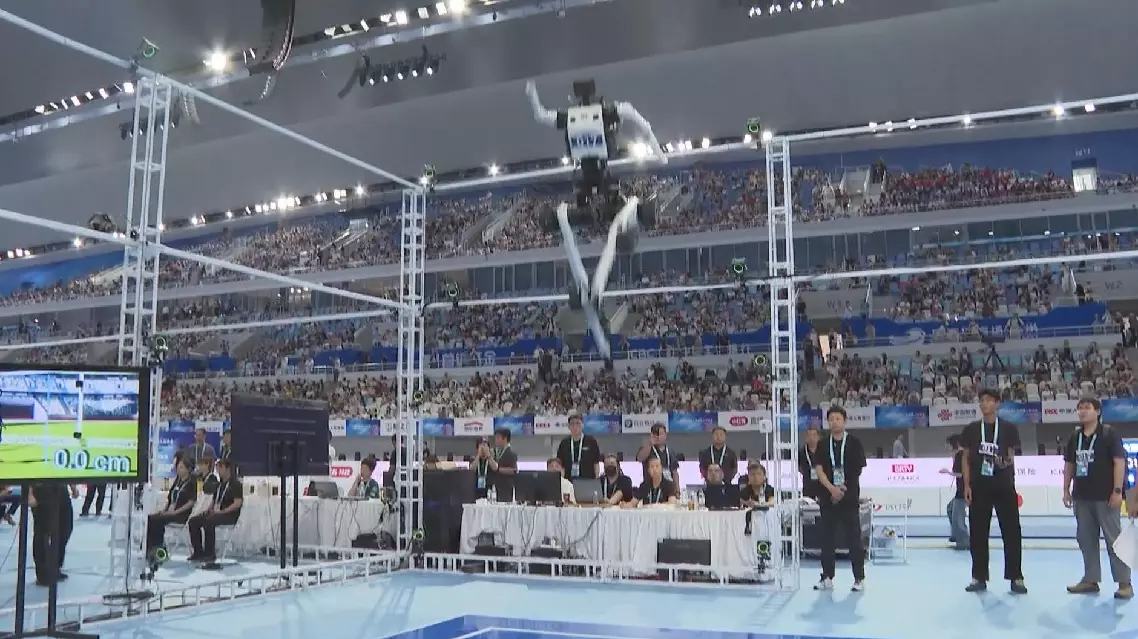
Standing high jump at World Humanoid Robot Games expands robotic application frontiers
Standing high jump at World Humanoid Robot Games expands robotic application frontiers